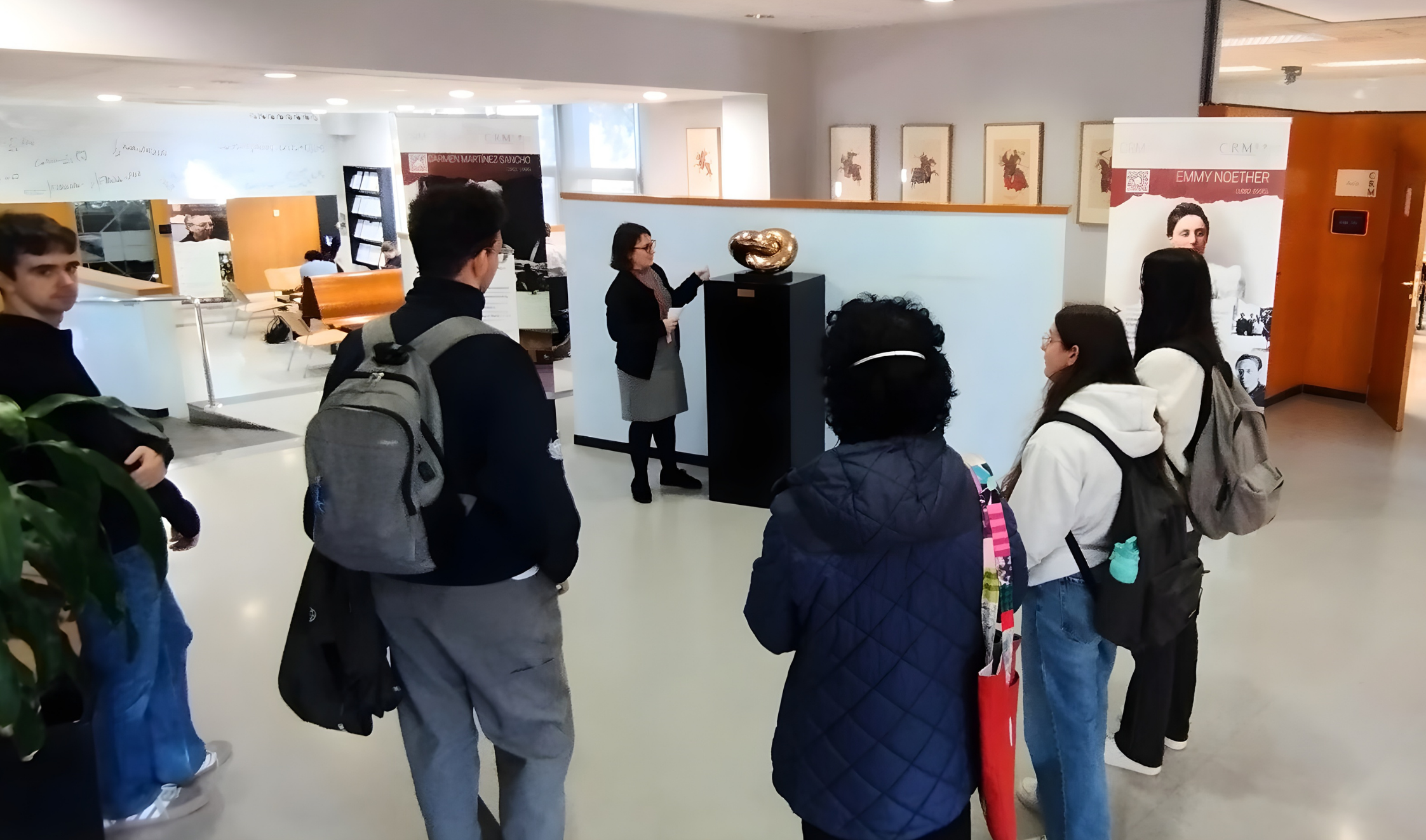
The Centre de Recerca Matemàtica hosted the
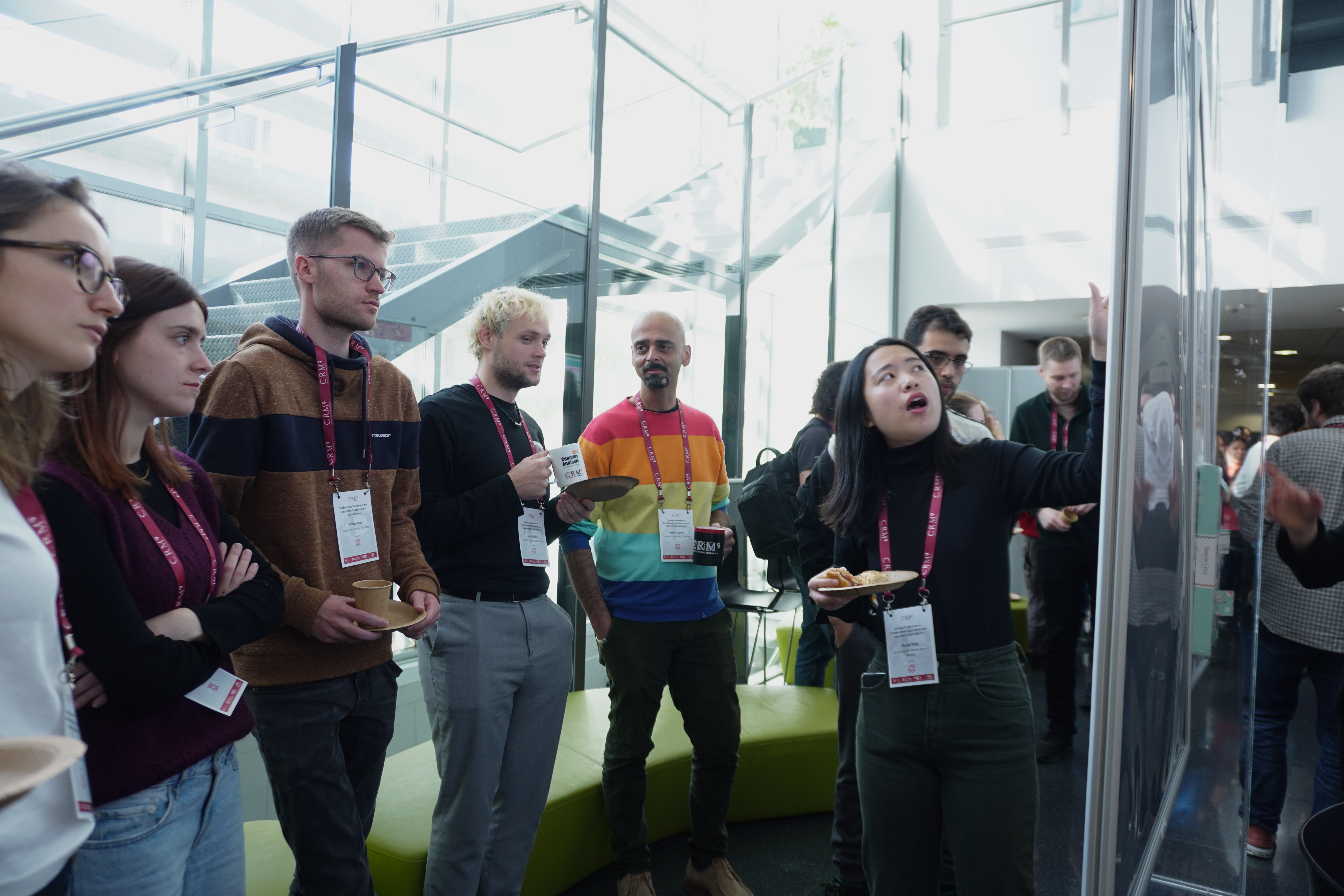
Mathematical Foundations of Machine Learning: PDEs, Probability, and Dynamics workshop from January 7-9, 2026, bringing together over 100 participants to address fundamental questions about the mathematical principles underlying modern artificial intelligence. Organised by
Joan Bruna (Courant Institute, NYU),
Xavier Ros-Oton (UB-ICREA-CRM), and
Domènec Ruiz-Balet (UB), the workshop aimed to bridge the growing gap between machine learning’s empirical successes and its theoretical understanding.
The workshop featured presentations from leading researchers addressing core theoretical questions through diverse mathematical perspectives. Stéphane Mallat, (Collège de France & ENS), recipient of the 2025 CNRS Gold Medal, presented Moment Guided Diffusion for Maximum Entropy Generation, connecting classical maximum entropy methods with contemporary sampling techniques. “The topic is at the interface of older statistical techniques and much more recent techniques about learning how to sample probability distributions with these machine learning techniques,” he explained. “Understanding the bridge between these older techniques and what is being done now defines mathematical environments in which are easier to understand the properties of these newer algorithms.”
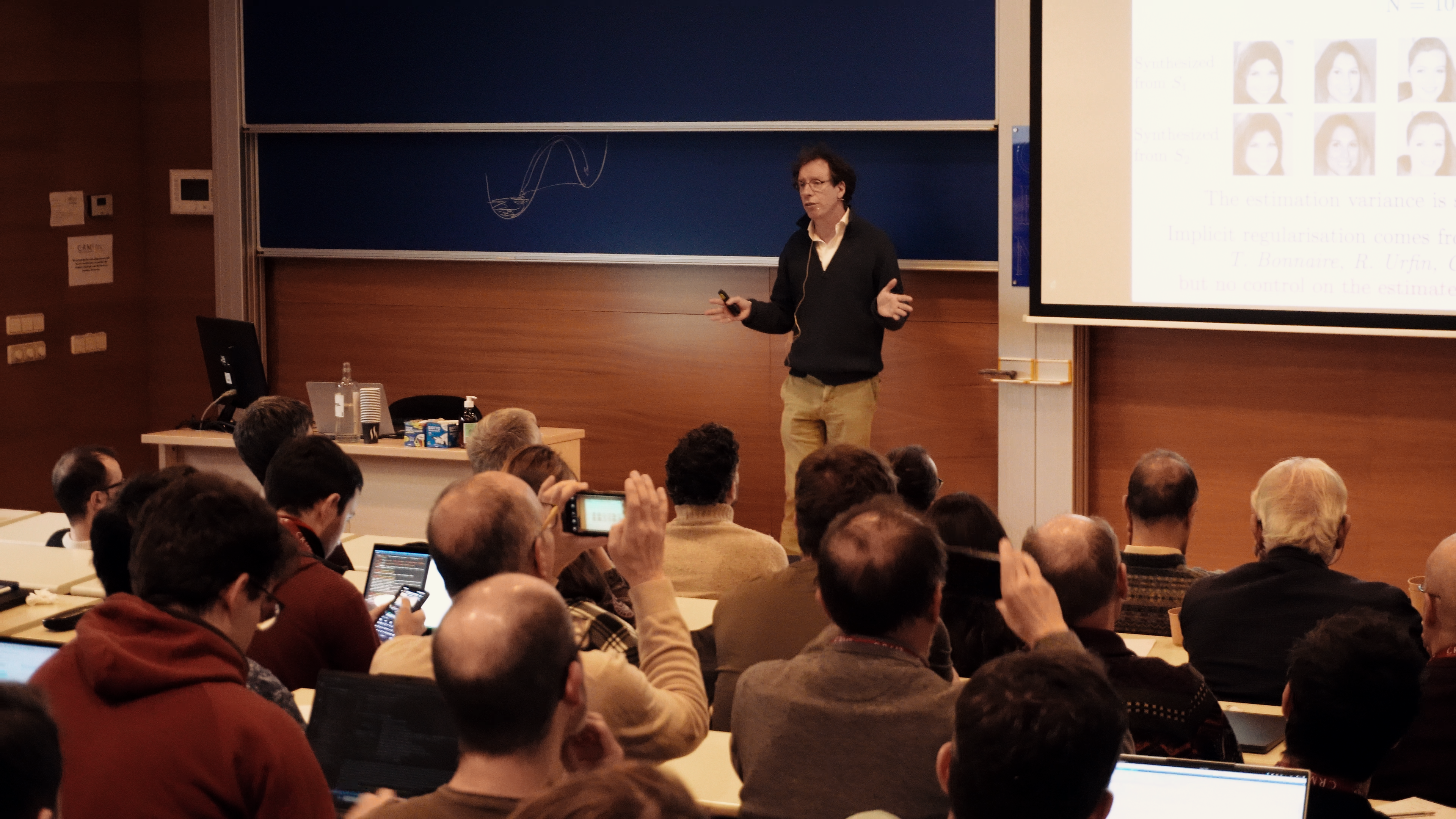
His work addresses the curse of dimensionality, how neural networks learn probability distributions despite exponentially exploding parameter spaces. “If you think of deep neural networks, what they are doing is learning probability distributions. Now, you cannot learn probability distribution when you have a very large number of parameters because the set of possibilities is exploding,” Mallat noted. Understanding how neural networks overcome this challenge represents “a very beautiful fundamental problem that touches all ranges of knowledge, which we are now trying to tackle from a math point of view.”
Aside from efficiency, mathematical understanding offers interpretability. “When you apply them to physics to predict the weather, somewhere they can understand the underlying structure of the physics,” Mallat explained. “What kind of information do they extract? How can we understand that mathematically?”
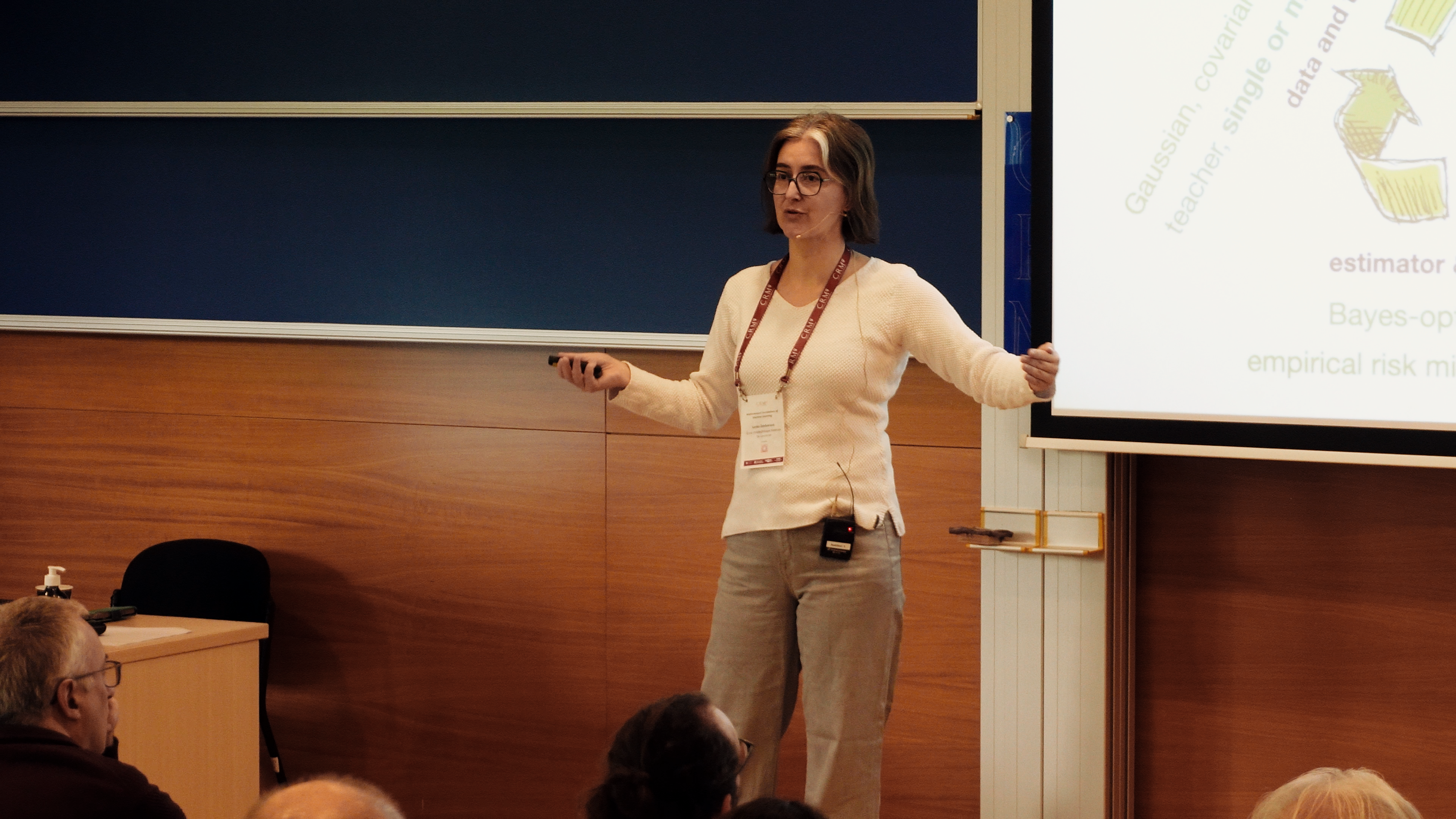
Lenka Zdeborová (EPFL) spoke on Generalization in Attention-Based Models, applying methods from statistical physics to understand attention mechanisms. Her research demonstrates that attention need not be harder to understand mathematically than feedforward networks. “We in essence conceptualise away some of the difficulty and bring it to a set of models that can be solved using very similar tools,” she explained.
The workshop brought together invited speakers working across different mathematical approaches to machine learning theory. Gabriel Peyré (CNRS & ENS) presented Diffusion Flows and Optimal Transport in Machine Learning, examining how optimal transport methods apply to flow matching, Wasserstein gradient flows, and token probability evolution in transformers. Eric Vanden-Eijnden (Courant Institute, NYU) spoke on Beyond Diffusions with Stochastic Interpolants, introducing a framework that unifies flow-based and diffusion-based generative models. Gergely Neu (UPF) discussed optimal transport distances for Markov chains, demonstrating equivalence between bisimulation metrics and optimal transport distances.
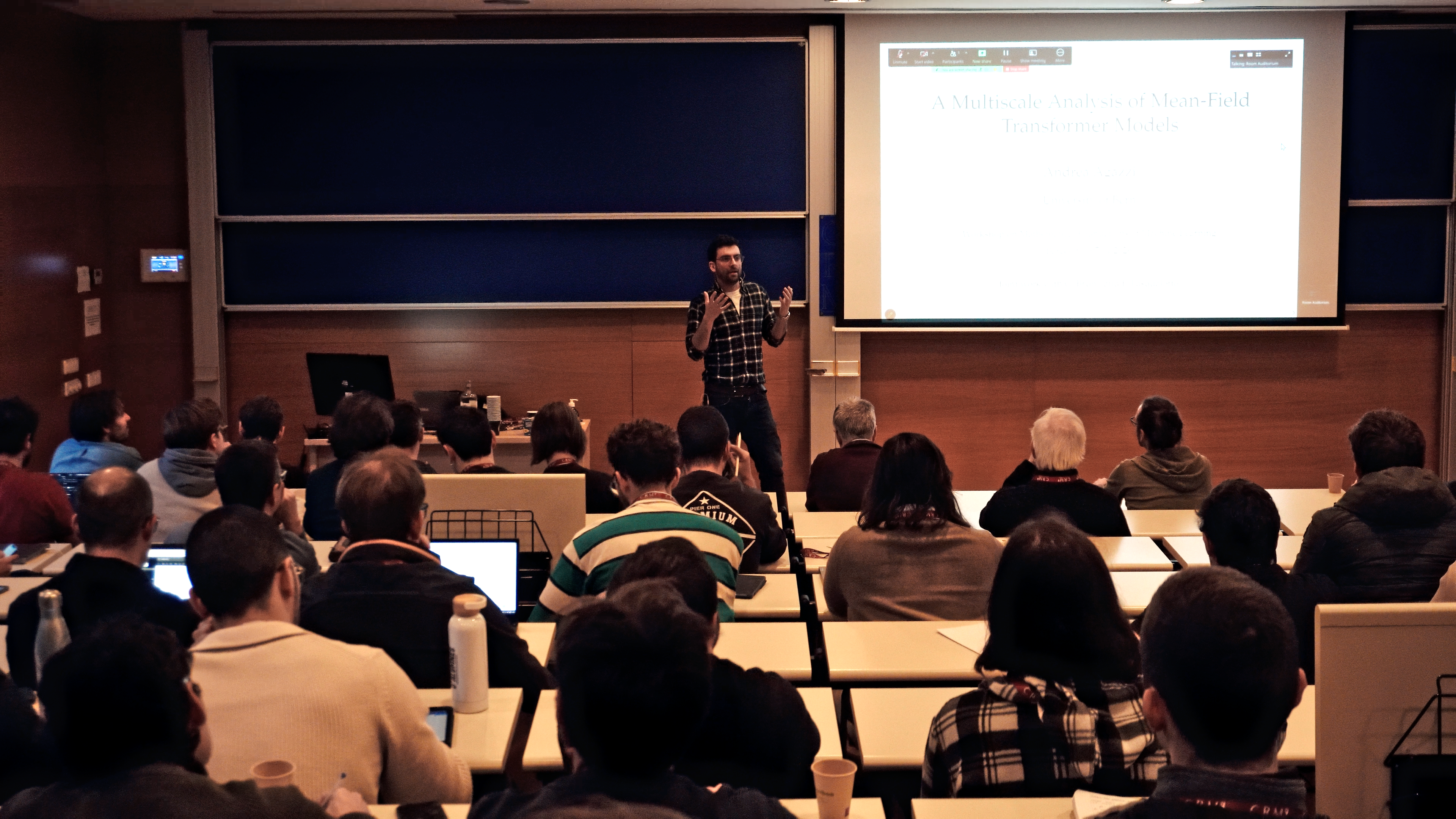
Eulàlia Nualart (UPF-BSE) addressed the convergence of continuous-time stochastic gradient descent, while Borjan Geshkovski (INRIA) presented work on transformers as interacting particle systems. Andrea Agazzi (University of Bern) spoke on mean-field analysis of transformer models, and Jaume de Dios Pont (ETH Zurich) presented bounds for log-concave sampling. Roberto Rubio (UAB) contributed a pure mathematician’s perspective. The program also included Xavier Fernàndez-Real (EPFL), Gábor Lugosi (ICREA-UPF), and Maria Prat (Brown).
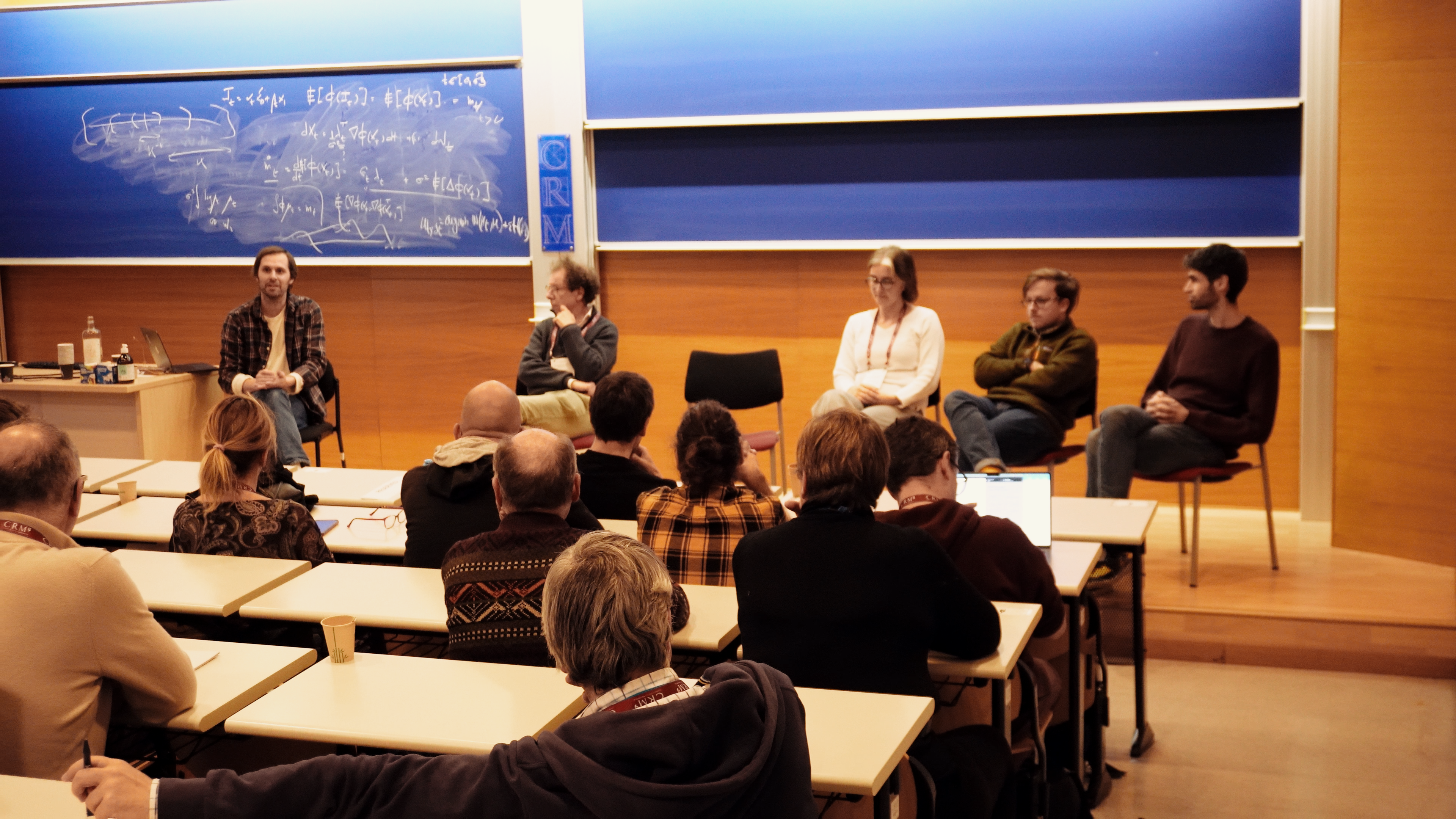
Beyond the technical presentations, the workshop featured a round table and debate session where participants engaged in open discussion about the current state of research at the intersection of mathematics and machine learning, examining both progress made and challenges ahead in developing rigorous theoretical foundations for AI systems.
The Challenge
“Mathematics is very much behind,” explained Stéphane Mallat in an interview during the workshop. “Most of these results are engineering results. Very impressive, very spectacular, but we don’t really understand the underlying mathematics.” This gap carries practical consequences. “These algorithms take a lot of energy to optimise. It requires a lot of data,” Mallat noted. “Understanding of math is about potentially improving them.”
Lenka Zdeborová drew a historical parallel. “If we compare the steam engine in the 18th century to the AI revolution today, back then, also the trains were running, the companies were running, but we were not really understanding the scientific principles,” she observed. “It’s only half a century later that with Carnot and his work, we found what the boundaries of efficiency are.” The analogy extends directly to artificial intelligence. “AI today uses a lot of data, a lot of electricity to train it. And you could think that one cannot do better, but we don’t know scientifically,” Zdeborová continued. “If we can do better, this would save a lot of resources, and the understanding would lead to that.”
“We are really now entering a phase where theoretical progress through theoretical understanding is going to be a major driver for future progress.”
— Joan Bruna, NYU Courant Institute
Joan Bruna, who served on the workshop’s scientific committee, characterised the current moment as transformative. “AI has completely transformed from a very small discipline in the corner of computer science. Now it’s really a central part of society,” he said. “I think that AI is definitely ready to bring new problems, new interesting mathematical questions that we need to study.” This integration follows historical precedent. “Physics brought PDEs. We also have problems in engineering that brought harmonic analysis,” Bruna noted. Mallat reinforced this with deeper historical context: “In the history of math, most branches of mathematics have been evolving from applied problems. If you think 4,000 years ago, the appearance of geometry from the Egyptians, that was for measuring the surface of the fields.”
“Dynamics is really at the heart of machine learning,” Bruna explained. “We see it appearing in many, many different areas. Training neural networks involves some dynamical process of gradient descent. We also see dynamics as features progress across layers. We now also see dynamics when we do generative modeling with diffusion models and flow matching.” Barcelona’s expertise in PDEs, dynamical systems, and probability made it a natural venue. “What we hope is that maybe in the future we can also bring other areas of mathematics together,” Bruna added.
Open Questions: Old and New
Beyond bringing new methodological tools, interdisciplinary work offers intellectual freedom. “As a social species, we tend to be influenced by the biases of our community,” Zdeborová reflected. “When we go and see how different communities are asking the same questions, they do it very differently. That forces us to rethink all those biases and, in a sense, free ourselves from them. And really go towards the core of the scientific questioning without the biases created by the community.”For Mallat, it represents the bridge-building that has characterised his career: “What I like the most is to be in between, going from the applications, but trying to understand the essence of the math that is behind.”
The workshop emphasised optimism about theoretical mathematics shaping AI’s trajectory, with many students and young researchers among the participants. “We are really now entering a phase where theoretical progress through theoretical understanding is going to be a major driver for future progress,” Bruna added. For those considering entering the field, he offered direct encouragement: “Mathematics has a very important role to play. Do not hesitate to reach out to people on the applied side; there are always interesting questions that can be brought together by connecting mathematics with the practical aspects of the problem.”
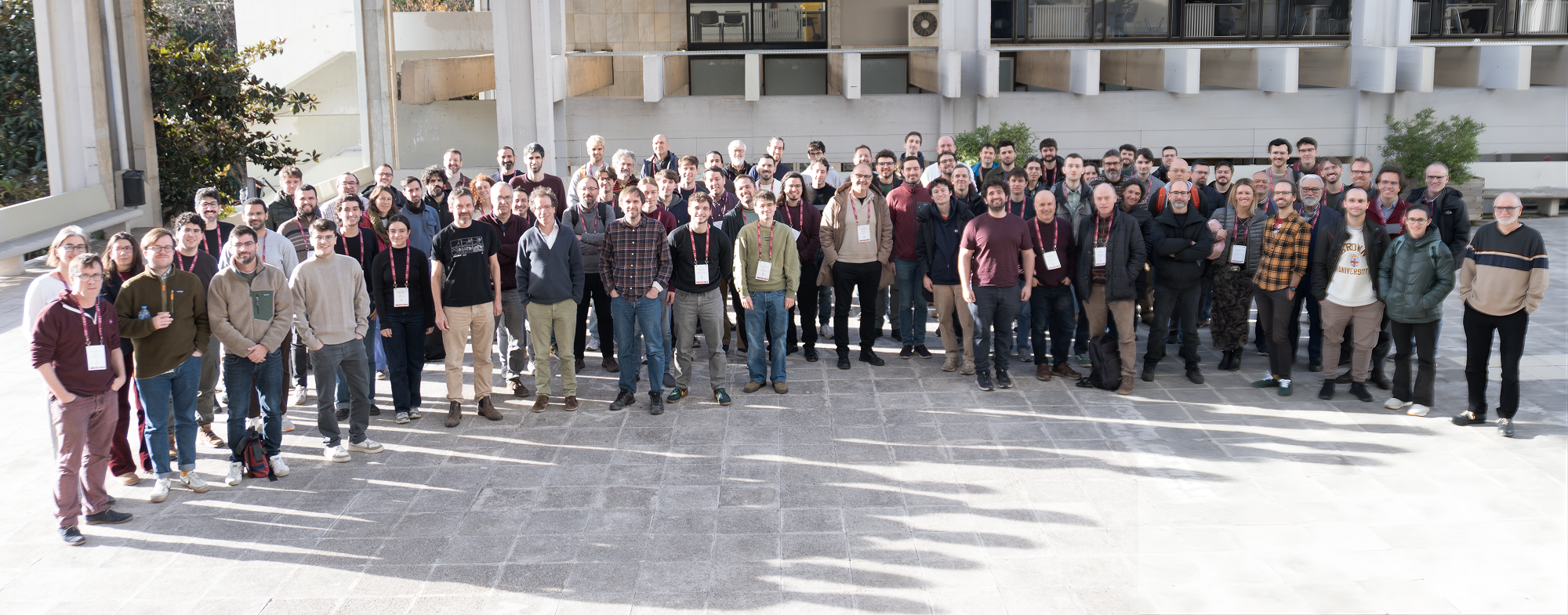
With over 100 participants engaging across disciplinary boundaries, the workshop established a foundation for continued work at the intersection of rigorous mathematical theory and contemporary AI challenges, demonstrating Barcelona’s strengths while creating opportunities for collaboration between researchers working on mathematical foundations and practical machine learning systems.
Recordings of all workshop talks are available on the CRM YouTube channel, along with a video featuring interviews with Stéphane Mallat, Lenka Zdeborová, and Joan Bruna discussing the workshop’s key themes.