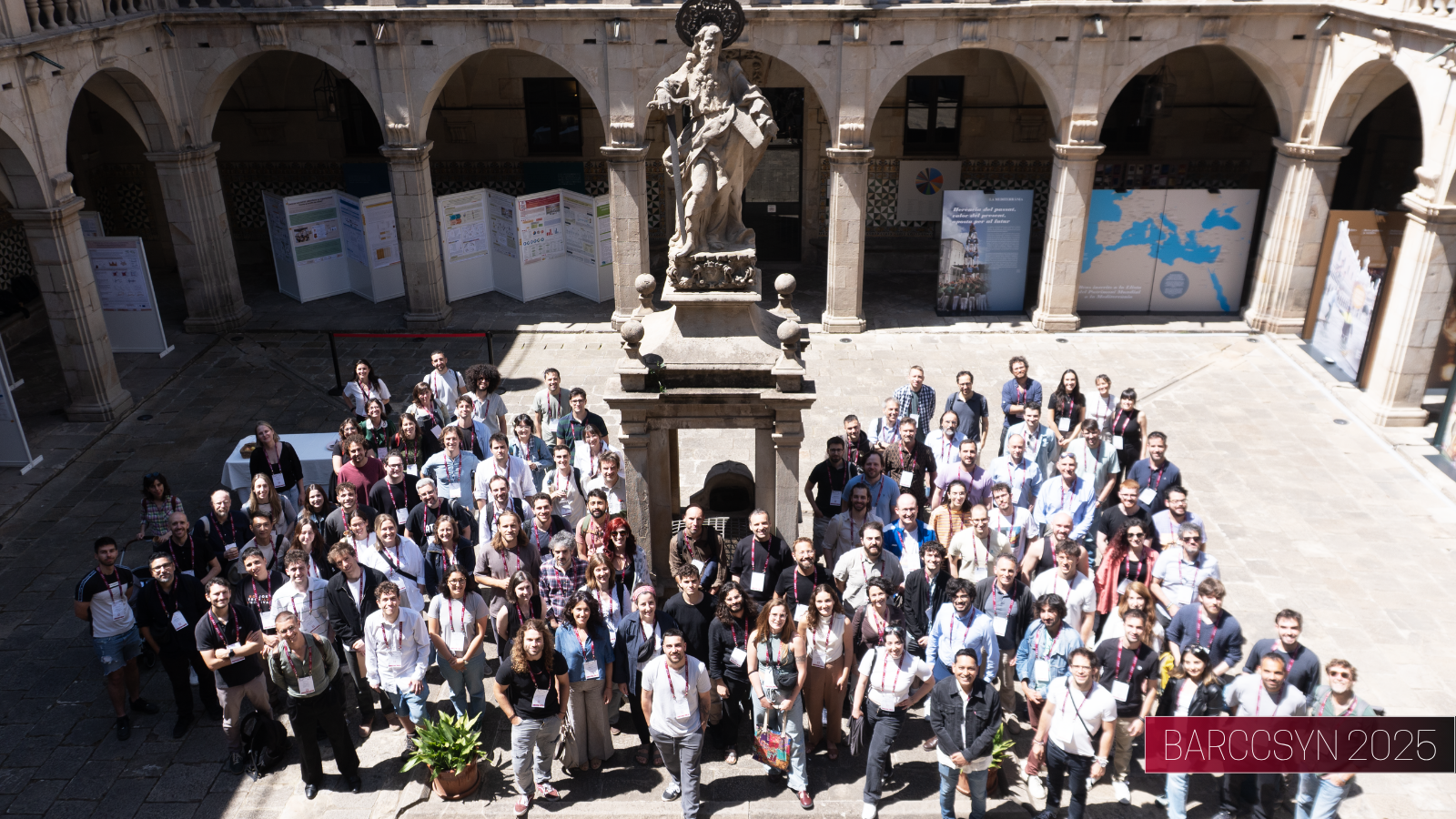
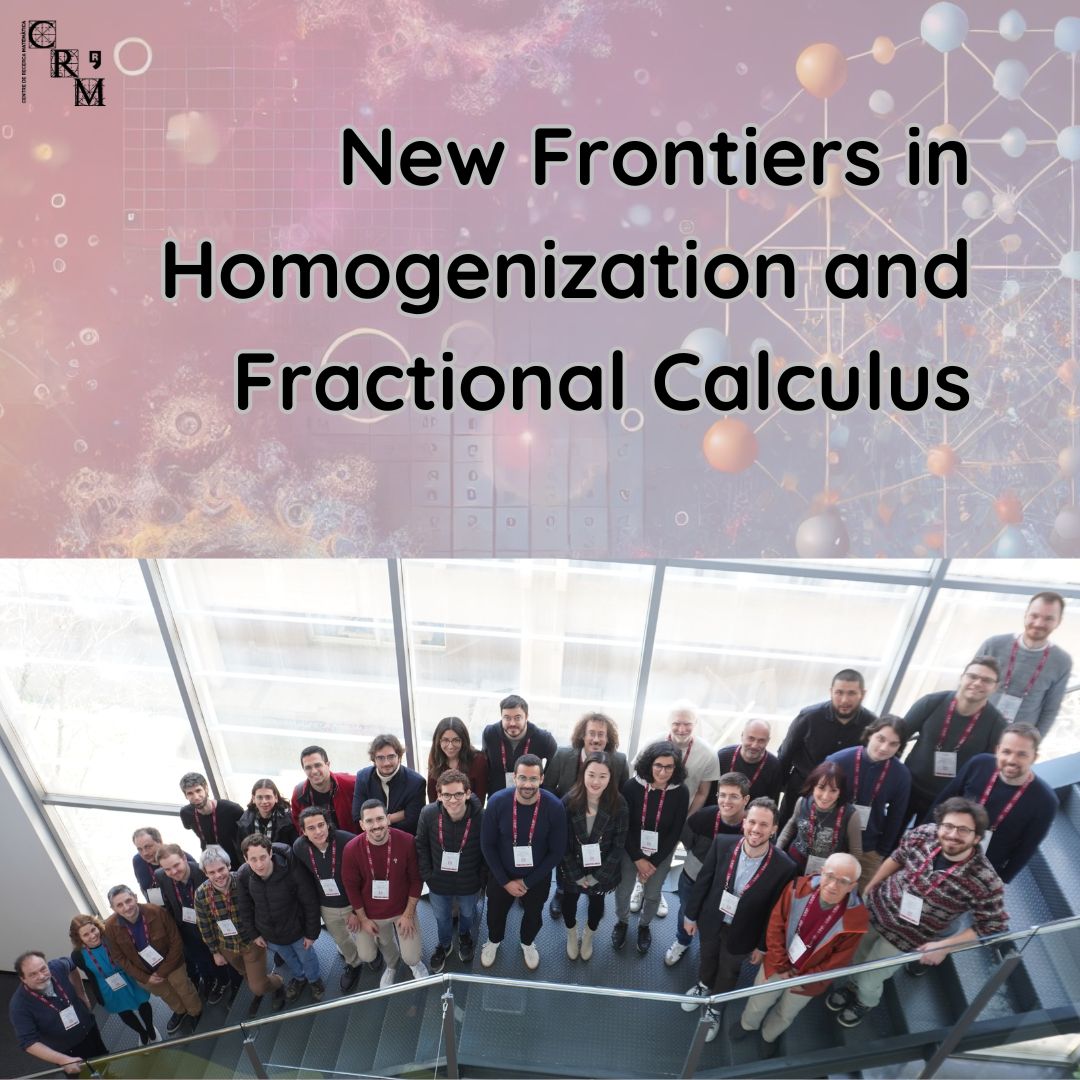
From May 26 to May 30, 2025, the Centre de Recerca Matemàtica (CRM) in Bellaterra welcomed more than 80 participants from institutions around the world for the Advanced Course on Modern Aspects of Fourier Analysis. The activity, held at the CRM Auditorium, was one of the central components of the broader Intensive Research Programme (IRP) on Modern Trends in Fourier Analysis, which runs throughout May and June 2025.
Designed as an in-depth training opportunity for doctoral students and early-career researchers, the advanced course combined high-level lectures with interactive sessions, poster presentations, and problem discussions. Over the five-day event, attendees engaged with cutting-edge developments in harmonic analysis, partial differential equations, discrete geometry, and number theory, with a special focus on the many faces of Fourier analysis.
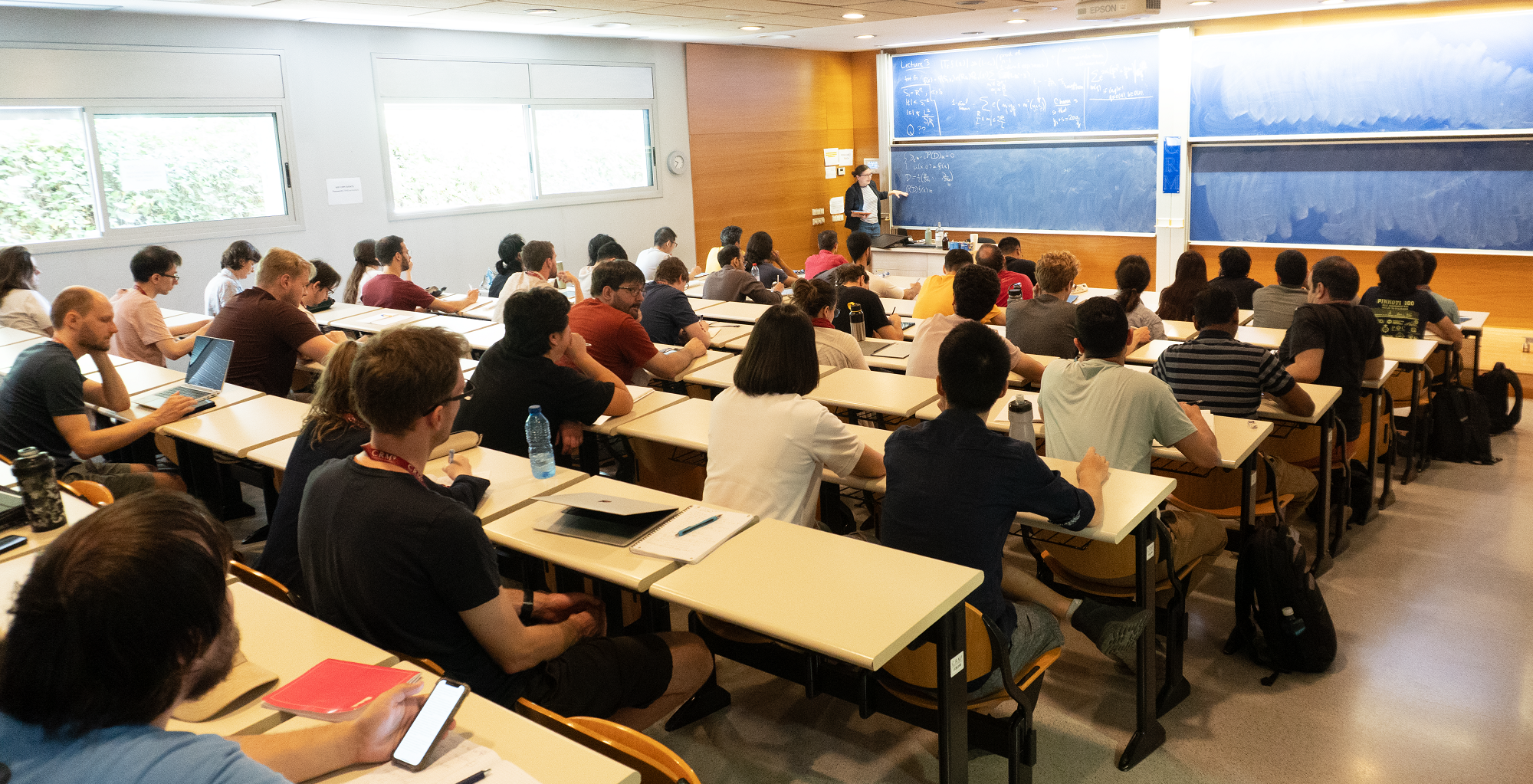
The program featured four advanced courses, each consisting of three 50-minute lectures delivered by internationally recognised experts. Felipe Gonçalves (IMPA, Brazil) led the course Measures with pure point support and spectrum. His lectures explored the surprising and elegant appearance of summation formulas for the Fourier transform across various fields of mathematics, including number theory, discrete geometry, harmonic analysis, and modular forms. Gonçalves presented examples of measures exhibiting pure point support and spectrum, discussed their connections to almost periodicity, and introduced several open conjectures inspired by these structures.
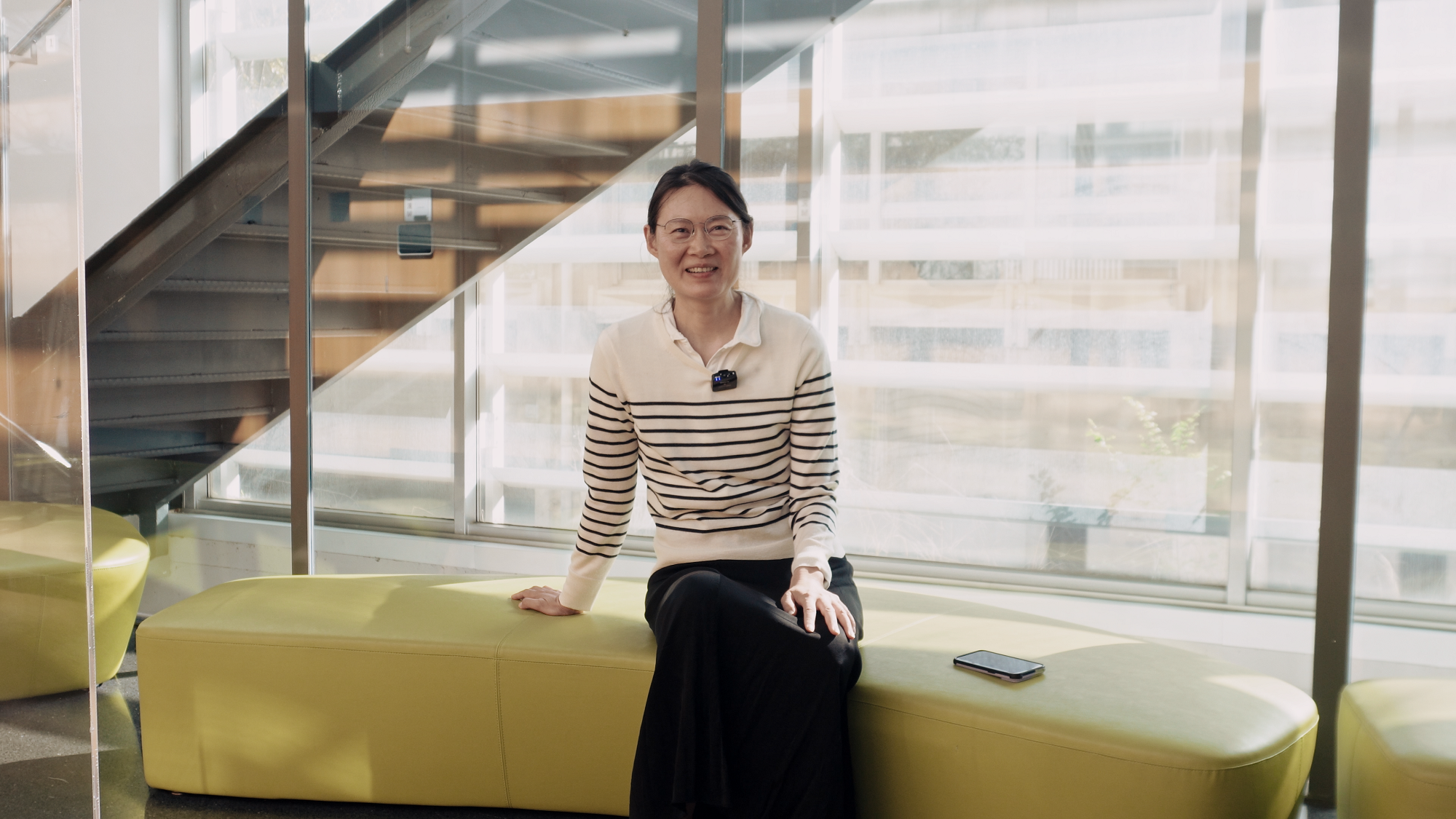
Lillian Pierce (Duke University, United States) presented Counterexamples to pointwise convergence questions in dispersive PDE’s, focusing on a long-standing question originally posed by Lennart Carleson in 1980 regarding the Schrödinger equation. Pierce revisited Bourgain’s groundbreaking counterexample, illustrating how it challenged prevailing expectations, and demonstrated how Gauss sums played a central role. She further outlined general techniques to construct broader classes of counterexamples, shedding light on subtle aspects of pointwise convergence.
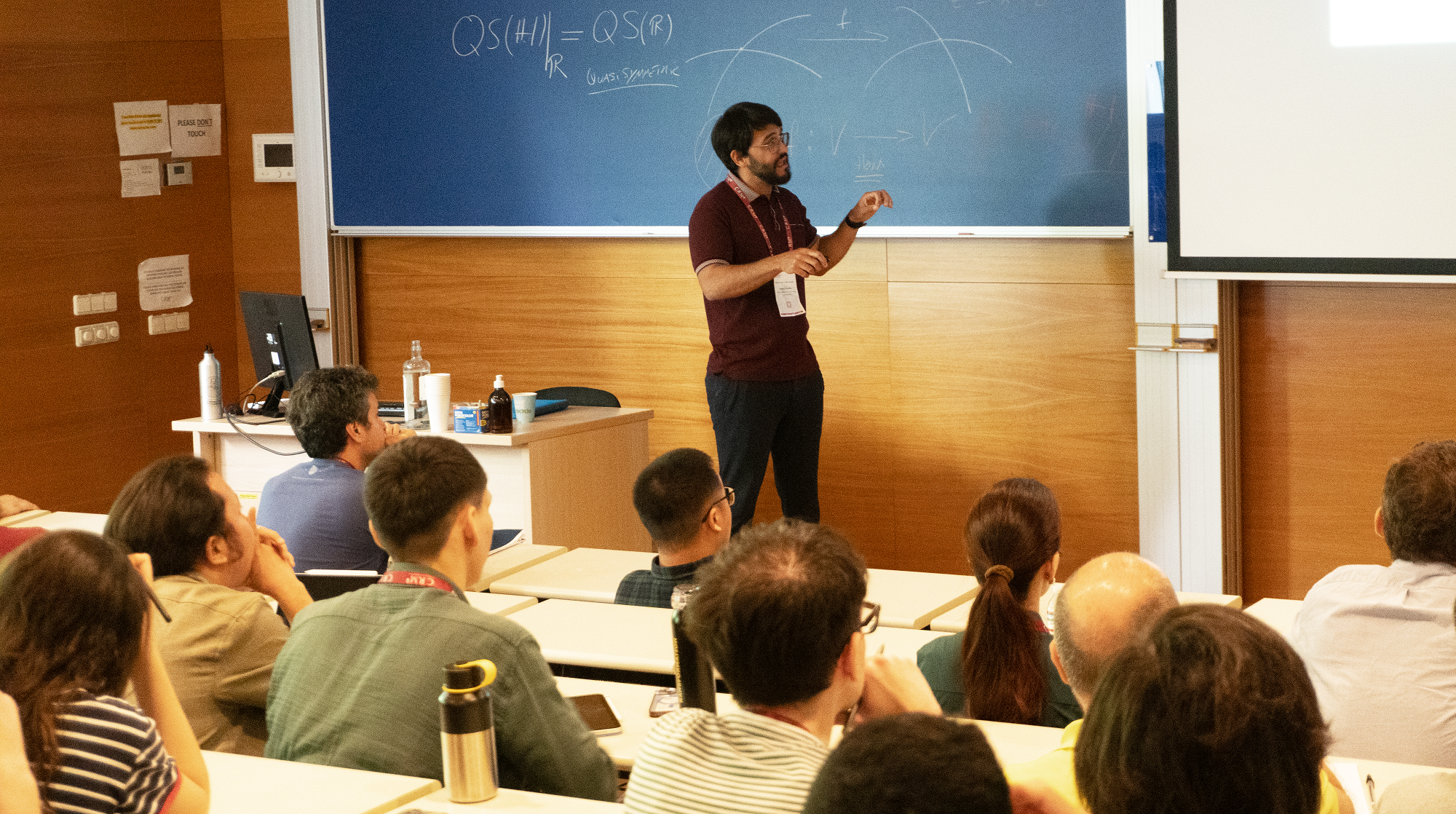
Danylo Radchenko (University of Lille, France) delivered the course Summation formulas, modular forms, and applications, offering a comprehensive tour of classical and modern summation formulas, beginning with the Poisson summation formula. His lectures connected these formulas to modular forms, Dirichlet series, time-frequency analysis, crystallography, coding theory, and number theory, emphasising the wide-ranging applications and mathematical depth of these tools.
Ruixiang Zhang (UC Berkeley, United States) taught Some tools in Fourier Restriction, Kakeya and Weighted Restriction, focusing on three closely related topics at the frontier of harmonic analysis. Zhang provided an introduction to the central questions and recent advances in these areas, while also highlighting connections with fields such as geometric measure theory and dispersive PDEs. He presented several modern techniques that have proved effective in tackling some of the field’s most challenging open problems.
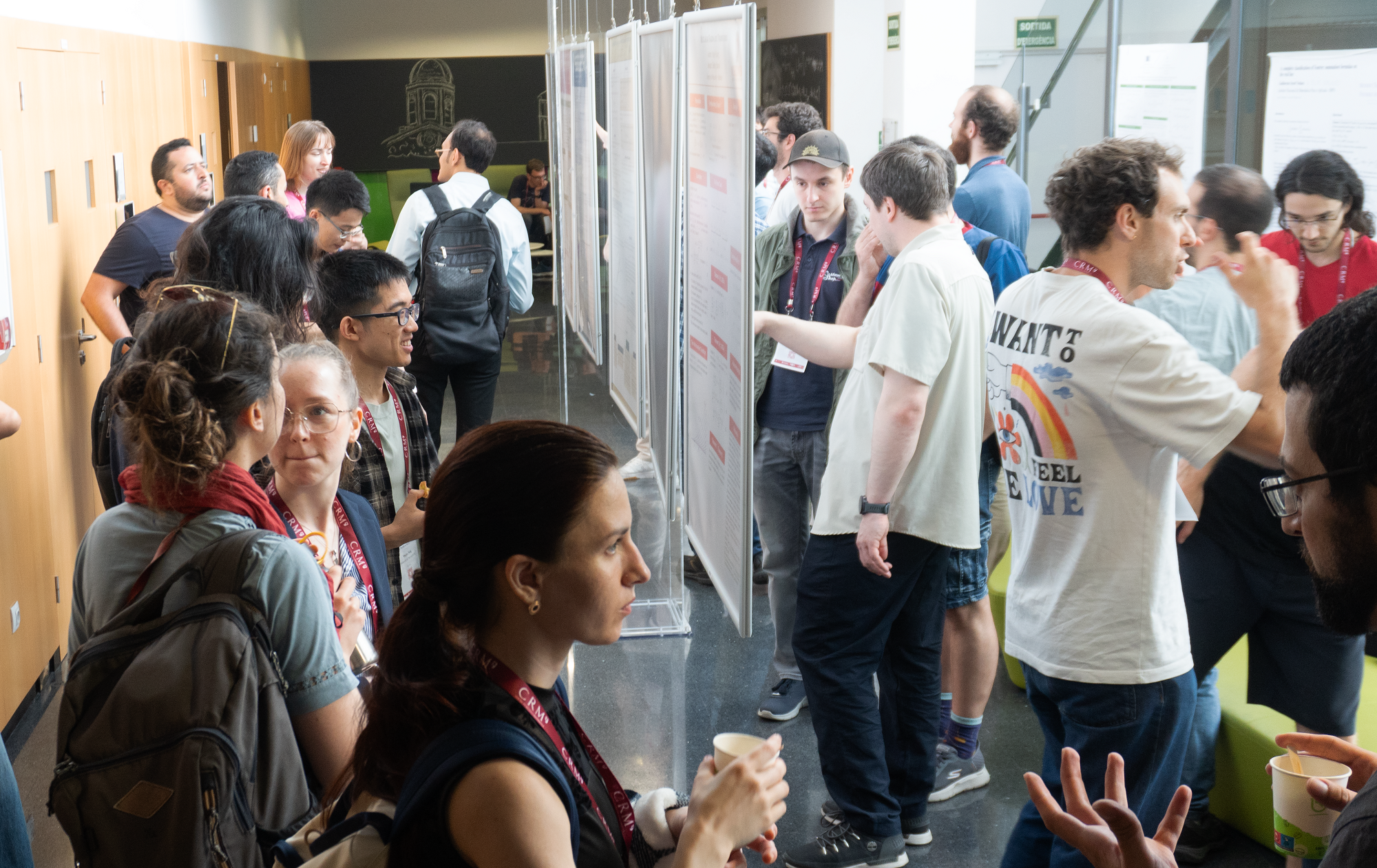
In addition to the main lectures, the course featured afternoon sessions for discussions, poster presentations, and an open problem session, providing an interactive environment for participants to exchange ideas and explore collaborations. The poster session gathered contributions from many of the young researchers attending, offering a wide snapshot of current work in Fourier analysis and its applications.
The scientific and organising committee for the activity included Dmitriy Bilyk (University of Minnesota), Emanuel Carneiro (ICTP), Diogo Oliveira e Silva (Instituto Superior Técnico), Betsy Stovall (University of Wisconsin–Madison), and Sergey Tikhonov (ICREA, Centre de Recerca Matemàtica). The local organizing team included Carlo Bellavita (Universitat de Barcelona), Óscar Domínguez (CUNEF), Egor Kosov (CRM), and Sergey Tikhonov.
The Advanced Course is an integral part of the ongoing IRP, which continues at the CRM with seminars, research sessions, and the upcoming Conference on Modern Trends in Fourier Analysis (June 2–6, 2025). Through this initiative, the CRM continues to serve as an international hub for research in harmonic analysis and its many interconnections across mathematics.