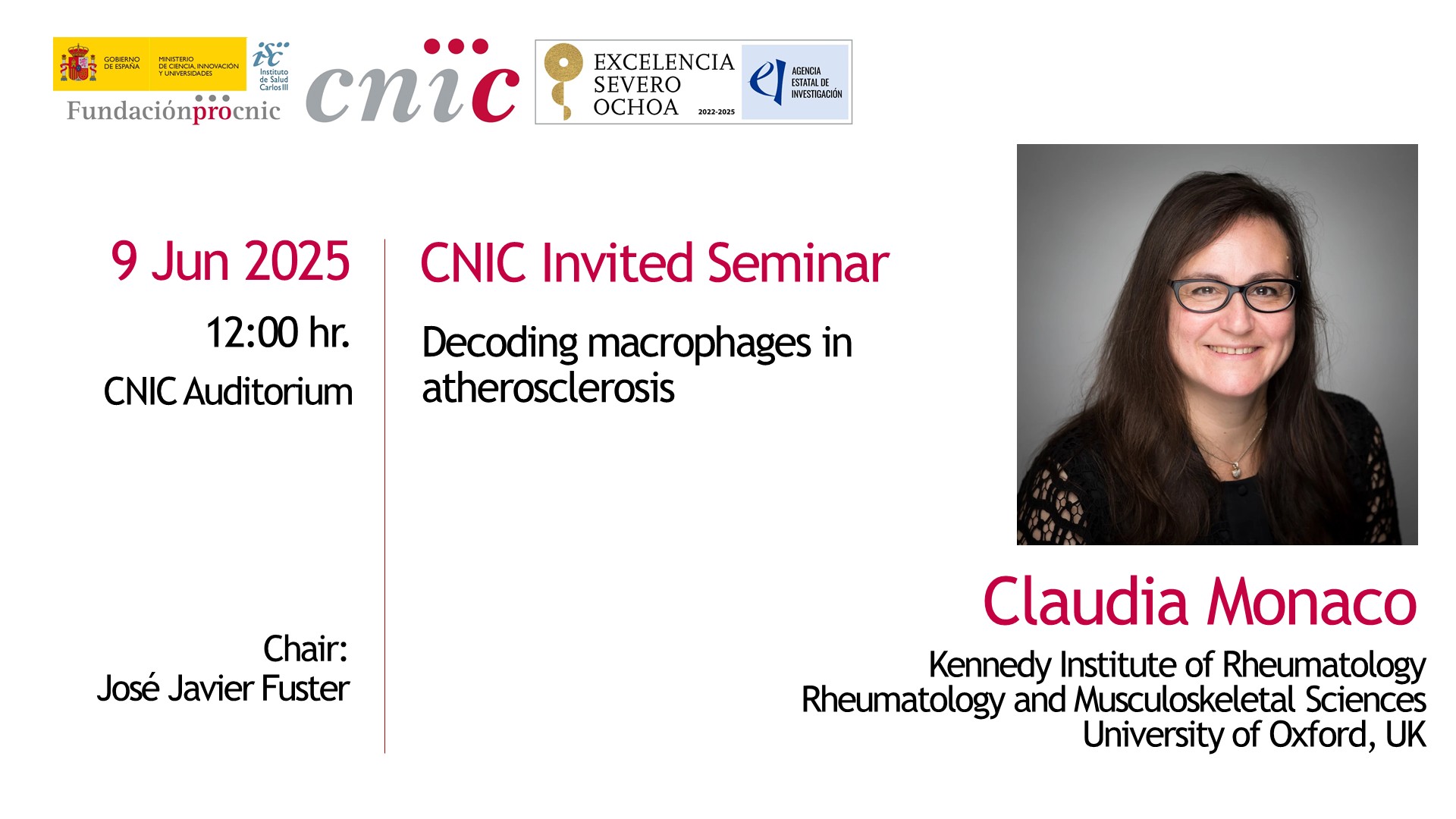
Claudia Monacoo trained as a cardiologist and PhD with Professor Attilio Maseri at the Catholic University of Rome, Italy, before moving to the Kennedy Institute of Rheumatology, Imperial College London to work with Professor Marc Feldmann. She moved to the University of Oxford in 2011, where she became Professor of Cardiovascular Inflammation. Her group was the first to establish innovative experimental methodology for the isolation, culture and targeting of live cells from human atheroma lesions. Her work allowed the elegant characterization of the inflammatory and synthetic properties of human atherosclerosis, establishing toll-like receptors as important activators of innate immunity in atherosclerosis. The Cardiovascular Inflammation Team is now focused on interpreting the functional diversity of immune cells in atherosclerosis with single cell biology techniques and devise strategies for their selective targeting.
- What is the role of macrophages in the development of atherosclerosis, and how has our understanding of their function evolved?
We are focused, in particular, on macrophages and what their function is in atherosclerosis. I think it’s quite interesting, because different types of macrophages have different functions in the development of atherosclerosis. Before, we thought that all macrophages were bad—that all macrophages and the whole immune system were actually promoting atherosclerosis. But now we know the picture is much more complex than that.
It’s very related to what macrophages are, where they’re seeded, and how they establish themselves in specific niches. There are some macrophages, like the lipid-associated macrophages, that definitely promote disease. But there are others—vascular macrophages that are already present within the vessel wall—that actually act like guardians of the artery and are protective.
I think it’s very important—this direction we’re going in, toward more targeted therapies. The idea is not to block all macrophages, because some are actually your friends. You need to look after them, especially the ones in the artery, while others are really pushing things toward a dangerous, disease-promoting path. This duality is really important, especially from a therapeutic perspective. That’s why we’re so fixated on understanding this better.
- And how can you tell the difference between the “good” macrophages and the ones you want to block? What kind of techniques do you use?
We use single-cell biology a lot. We’re not yet in the clinical space, but we’ve identified good markers. If those markers prove reliable, it would be easy to translate this into new tools to look at different macrophages in vivo. There’s also the potential to tailor imaging—not just therapeutics, but also how we visualize these macrophages.
The key idea we want to get across is that there isn’t just “one” macrophage type. We always said that macrophages are very pleiotropic—that they can take on different phenotypes—but that didn’t always seem to matter because we thought they all eventually just changed into each other. But actually, that’s not quite true.
There is some dynamic flexibility, yes, but it’s quite reproducible which path they take. They really adapt specifically to their environment. For example, in the adventitia, they adopt a very specific phenotype, and in the intima, a different one. And these phenotypes remain pretty stable during atherosclerosis, and also in health and disease. They’re not just switching randomly between states, they’re adapting in a niche-specific way, just like cells in any other organ. That’s important because it means we can start visualizing and treating patients differently more precisely.
- You mentioned you’re still in the experimental phase and not yet in clinical trials. How far is immunotherapy for cardiovascular disease?
I think there have been some early trials, and there are more and more now that are targeting inflammation in atherosclerosis. It’s really a booming field. We waited a long time to get here. The field was slow to move in this direction because so much focus was on lowering cholesterol, which is of course important—but inflammation wasn’t really explored until recently.
Studies like the CANTOS trial and others have started targeting cytokines, and I think we are going in the right direction. But progress is still very slow. One big reason is the lack of imaging tools. Imaging is only now reaching the level where we can maybe use it instead of relying on hard cardiovascular outcomes in trials.
If you look at cancer, for example, you can track things much faster, look at the size of the tumor, and see how the patient is responding. Same for diseases like rheumatoid arthritis, where you can scan the joints or use PET imaging. Those imaging methods have been around for decades, and they’ve made it possible to run smaller trials that are either based on imaging or give you very clear, early outcomes.
But with cardiovascular disease, we still have to look at how patients are doing over 5, 10 years. That’s a big challenge. These trials are very expensive, especially because biologic drugs cost so much. So pharmaceutical companies need to make a huge financial commitment. The more we can improve imaging, the more we’ll be able to run meaningful trials that evaluate new biologics or targeted agents, like nanotechnology-based ones.
I think evolution isn’t just about immunology, it’s also about how we study this in the real world. Other fields can run smaller trials to understand how things work and then move on to larger outcome trials. But here, with trials like the CANTOS trial—which involved over 10,000 patients and a very expensive biologic—that kind of scale is almost unheard of in other diseases like rheumatoid arthritis.
So yes, the challenges are really at the clinical stage—how we bring all this incredible knowledge about the immune system into cardiovascular medicine. The real barrier is economic.
- You’re a cardiologist—you worked in Rome for many years, and then you moved to Oxford. You trained as a cardiologist, and then you also shifted into doing experiments and research. How do you combine these two areas?
Well, combining clinical duties and research is one of the biggest challenges you can attempt to do. I think if you’re doing clinical research—like outcomes-based research or imaging studies—then it’s easier to combine with clinical work. But if you’re developing science at the molecular level, it’s much harder to do both. At least I couldn’t manage it as well as I would have liked.
There’s a big divide between what we think we know and what we actually know. We have this concept of how atherosclerosis develops, how the immune system contributes—but in reality, we don’t really understand the specific mechanisms at play. I felt that, to bridge this gap, I had to go back to the basics. That meant not only using experimental models but also working with human samples. I saw a huge opportunity in single-cell biology has been a big opportunity—for all of us—to understand human immunology at a very detailed level. Because if we only look at mice, then the gap between mouse and human, and then from preclinical to clinical stages, is massive.
For example, we really need access to human vascular tissue. But as cardiologists, we’ve moved so much toward percutaneous approaches to the coronary arteries, so we don’t actually remove them anymore. That’s why I work a lot with vascular surgeons. They still operate in a way that allows us to obtain human tissue—but that might not last. Even vascular surgery is moving more and more toward stenting, which means we’ll eventually lose the ability to get that tissue. We have this narrow window of opportunity where we can still work with tissue from patients, and I felt I had to take it. I’m very vocal about this having a short window before vascular surgery becomes entirely percutaneous,
- It seems like improvements in clinical treatment are making things harder for basic science in a way.
Exactly. It’s advancing, but at the same time, it means that now we have this critical window. I always say vascular surgeons do research, collect tissue, because we need to analyze what the cells are really doing. Just relying on blood studies, on systemic inflammation, doesn’t tell us much about what’s happening in the atherosclerotic artery. The immune cells inside the artery are very different in their programming compared to circulating cells in the blood.
Most cells come from the blood—but there are also some embryonic macrophages that form inside the artery and never circulate. And even the ones that come from the blood and stay in the artery for 10 years, they acquire very specialized instructions. You can take monocytes from blood and run as many blood tests as you want—but that doesn’t tell you what’s actually happening inside the artery.
They behave differently, they look different, they’ve changed their shape and function completely. This creates a gap in what we can understand—it seems like we’re missing something in these studies . We can’t see all the different effects a drug might have if we only look at peripheral blood. I think the real answers are also in the vascular tissue, in the atherosclerotic plaque itself. We need to go as close to the source as possible—to find real targets, and to see the real effects of drugs on atherosclerotic tissue.
Because a lot of clinical trials have targeted systemic inflammation. But that’s not the same as inflammation within the plaque. The drivers of plaque inflammation may be different.
We know systemic inflammation is a risk factor, yes, but what you see in the blood isn’t necessarily what’s happening in the plaque. We often assume it is—because it’s convenient. But in cardiovascular disease, especially cardiology, we never actually look at the plaque. We look at the lumen. Intravascular ultrasound (IVUS) is the only way to get a glimpse of the arterial wall. Experimentally, we might look at blood from the heart in very complex ways—but we’re still mainly looking at circulating markers. We’re not really studying the tissue itself.
- As a cardiologist with experience of treating patients, do you think your clinical background influences the kinds of research questions you ask?
Yes. And there are two things that help me a lot, I think. And that’s why I never stop clinics, even though they told me several times to stop clinics. I think I… I don’t like to stop the clinics because I enjoy that interaction.
I think, being a scientist, your rewards are very long-term. If you’re a doctor, the rewards are quite immediate, because the patient is happier, yes—you can give the treatment. So, I think it gives me a lot of motivation to serve the patient. But at the same time, I think research is also a good way to serve patients.
Because as a clinician I’ve learned a lot from basic scientists. They’re much better at developing techniques at the bench, and so I have great respect for my scientific colleagues. But sometimes, as a clinician, you can see what really matters. And it makes you particularly attached to a specific disease, you know? Basic scientists are sometimes across fields. This study gives me the determination and the drive to really try and solve atherosclerosis.