Author Archive

Maria de Maeztu Postdoctoral position in Quantum Resources for Science and Technology

Maria de Maeztu Postdoctoral position in Quantum Resources for Science and Technology secretaria Tue, 22/07/2025 – 09:23
Deadline

The Institute of Cosmos Sciences of the University of Barcelona (ICCUB) invites applications for a Postdoctoral position in Quantum Resources for Science and Technology, as part of its current call for two postdoctoral positions and one ICCUB Postdoctoral Fellowship, offered under the framework of its Unit of Excellence Maria de Maeztu

These positions are part of a dynamic and interdisciplinary research environment at one of Europe’s leading centers in cosmology, astrophysics, and particle physics. The Institute of Cosmos Sciences (ICCUB) at the University of Barcelona, established in 2006, focuses on cosmology, astrophysics, particle physics, quantum physics, and nuclear physics. With over 70 scientists, 20 engineers, and 90 postdoctoral researchers and PhD students (35% international), ICCUB collaborates internationally on projects like Gaia, LHCb, Virgo, MAGIC, CTA, and DESI. It also has an Advanced Technology Unit supporting experimental research requiring cutting-edge technology. 

Description of the postdoctoral position


The candidate is expected to contribute substantially to the ICCUB-Maria de Maeztu Challenge: Exploiting quantum resources for science and technology

The rapidly unfolding second quantum revolution hinges on harnessing quantum entanglement and superposition to advance our understanding of nature at a fundamental level and to develop novel technologies. Key facets include quantum communication, computation, hardware, sensing, and imaging, with potential extensive applications across scientific and technological domains.

These developments are poised to have an unprecedented impact on communication security and on our computational capacity, driving global efforts in this field. Quantum hardware represents the current frontier, involving development of entangled-source qubits, quantum memories, quantum networks and sensors.

We take on this challenge with a strong multidisciplinary drive, a newly established quantum communications laboratory, and quantum computation and simulation. The latter includes basic science contributions to quantum simulation, and the development of algorithms to advance our understanding of many-body quantum systems with quantum computers.

Requirements:

Applicants must hold a PhD in Physics, Astrophysics, or a closely related field by the start date of the contract, approximately in October 2026. We are looking for motivated researchers with a strong track record and a collaborative spirit.

Employment Terms:

  • Duration: 3 years
  • Start Date: Preferably by Fall 2026 (flexibility possible for parental or special circumstances)
  • Salary
    • Maria de Maeztu Postdoctoral Positions: Approx. 36.360€/year (gross), including full social security and public healthcare coverage for the researcher, spouse or registered partner and children
    • ICCUB Postdoctoral Fellowship: Approx. 42.900€/year (gross), including full social security and public healthcare coverage for the researcher, spouse or registered partner and children
  • Research Support
    • Fellowship: €8,000/year for travel and training
    • Postdoctoral Positions: €5,000/year for travel and training
  • Access to ICCUB’s advanced computational infrastructure, training programs, and career development resources


Equal Employment Opportunity Statement

ICCUB offers and promotes a diverse and inclusive environment and welcomes applicants regardless of age, disability, gender, nationality, race, religion or sexual orientation (for additional information please see the Diversity, Equity and Inclusion Commission. Job seekers in need of a reasonable accommodation to complete the application process should call or email secretaria@icc.ub.edu with their request.

Application Process:

To apply, please complete the application form and provide contact details for three referees. After submission, you will receive instructions to upload the following documents:

  • Curriculum Vitae
  • Cover Letter 
  • Research statement (max 4pp) outlining research experience, interests, research plan and how the candidate’s profiles and research plan would fit with the scientific profile of the position(s)
  • Publication List
  • Three Reference Letters (referees will be contacted directly)

Reference letters must be sent directly by the referees through the on-line application system (the system will contact these scientists you named, asking them to submit their letters of reference after a few working days). 

Note: Applicants should select their preferred job offer.

Note: Your application will only be considered complete once at least two reference letters have been received.

For questions regarding the application process, please contact Esther Pallarès at secretaria@icc.ub.edu.

Deadline

Application deadline: 31 October, 2025
Review of applications will begin immediately after the deadline and will continue until all positions are filled.

Funding:

These positions are financed by the State Agency for Research of the Spanish Ministry of Science, Innovation and Universities through the “Unit of Excellence María de Maeztu 04/2019-03/2031” awarded to the Institute of Cosmos Sciences, grant CEX2024-001451-M funded by MICIU/AEI/10.13039/501100011033.

The Unit of Excellence Maria de Maeztu recognition has been awarded by the Spanish Government in 2025 for the third time to the ICCUB, as a center with a highly competitive strategic research programmes in the frontiers of knowledge.

Logos acknowledgements

Go to Source

Maria de Maeztu Postdoctoral position on Gravitational Waves Astronomy

Maria de Maeztu Postdoctoral position on Gravitational Waves Astronomy secretaria Tue, 22/07/2025 – 09:20
Deadline

The Institute of Cosmos Sciences of the University of Barcelona (ICCUB) invites applications for a 3-year Postdoctoral position in gravitational wave astronomy, as part of its current call for two postdoctoral positions and one ICCUB Postdoctoral Fellowship, offered under the framework of its Unit of Excellence Maria de Maeztu

The successful candidate will lead projects spanning both theoretical and data analysis aspects of gravitational wave science. Research topics may include, but not be limited to parameter estimation, gravitational lensing, numerical relativity simulations, detector characterization, mock data generation, neutron star asteroseismology, magnetohydrodynamic modeling of neutron stars and multimessenger signals, stellar/BH dynamics, tests of general relativity, relations to high energy and nuclear physics and connections to holography. The ICCUB is a member of the LVK Collaboration, the Einstein Telescope Collaboration and is contributing to the LISA mission on theoretical models, computing and instrumentation activities. We are also part of the Spanish RedONGRA network (Red Nacional en Ondas Gravitacionales), which fosters national collaboration in gravitational wave research. In addition, we are actively participating in surveys (ESA-Gaia, Weave, SDSS-IV) and EM follow-up missions at various wavelengths (BlackGEM, MAGIC and LSST), which allow scientists at the ICCUB (https://icc.ub.edu/research/gravitational-waves) to build an end-to-end understanding of all steps leading to GW sources. Prior research experience in gravitational wave data analysis is preferred, but not strictly required. Experience with large-scale computation, Bayesian methods, and/or machine learning/AI is considered a plus. 

These positions are part of a dynamic and interdisciplinary research environment at one of Europe’s leading centers in cosmology, astrophysics, and particle physics. The Institute of Cosmos Sciences (ICCUB) at the University of Barcelona, established in 2006, focuses on cosmology, astrophysics, particle physics, quantum physics, and nuclear physics. With over 70 scientists, 20 engineers, and 90 postdoctoral researchers and PhD students (35% international), ICCUB collaborates internationally on projects like Gaia, LHCb, Virgo, MAGIC, CTA, and DESI. It also has an Advanced Technology Unit supporting experimental research requiring cutting-edge technology. 

Requirements:

Applicants must hold a PhD in Physics, Astrophysics, or a closely related field by the start date of the contract, approximately in October 2026. We are looking for motivated researchers with a strong track record and a collaborative spirit.

Employment Terms:

  • Duration: 3 years
  • Start Date: Preferably by Fall 2026 (flexibility possible for parental or special circumstances)
  • Salary
    • Maria de Maeztu Postdoctoral Positions: Approx. 36.360€/year (gross), including full social security and public healthcare coverage for the researcher, spouse or registered partner and children
    • ICCUB Postdoctoral Fellowship: Approx. 42.900€/year (gross), including full social security and public healthcare coverage for the researcher, spouse or registered partner and children
  • Research Support
    • Fellowship: €8,000/year for travel and training
    • Postdoctoral Positions: €5,000/year for travel and training
  • Access to ICCUB’s advanced computational infrastructure, training programs, and career development resources


Equal Employment Opportunity Statement

ICCUB offers and promotes a diverse and inclusive environment and welcomes applicants regardless of age, disability, gender, nationality, race, religion or sexual orientation (for additional information please see the Diversity, Equity and Inclusion Commission. Job seekers in need of a reasonable accommodation to complete the application process should call or email secretaria@icc.ub.edu with their request.

Application Process:

To apply, please complete the application form and provide contact details for three referees. After submission, you will receive instructions to upload the following documents:

  • Curriculum Vitae
  • Cover Letter 
  • Research statement (max 4pp) outlining research experience, interests, research plan and how the candidate’s profiles and research plan would fit with the scientific profile of the position(s)
  • Publication List
  • Three Reference Letters (referees will be contacted directly)

Reference letters must be sent directly by the referees through the on-line application system (the system will contact these scientists you named, asking them to submit their letters of reference after a few working days). 

Note: Applicants should select their preferred job offer.

Note: Your application will only be considered complete once at least two reference letters have been received.

For questions regarding the application process, please contact Esther Pallarès at secretaria@icc.ub.edu.

Deadline

Application deadline: November 30th, 2025
Review of applications will begin immediately after the deadline and will continue until all positions are filled.

Funding:

These positions are financed by the State Agency for Research of the Spanish Ministry of Science, Innovation and Universities through the “Unit of Excellence María de Maeztu 04/2019-03/2031” awarded to the Institute of Cosmos Sciences, grant CEX2024-001451-M funded by MICIU/AEI/10.13039/501100011033.

The Unit of Excellence Maria de Maeztu recognition has been awarded by the Spanish Government in 2025 for the third time to the ICCUB, as a center with a highly competitive strategic research programmes in the frontiers of knowledge.

Logos acknowledgement Maria de Maeztu

Go to Source

Gravitational waves from inflation in LISA: reconstruction pipeline and physics interpretation

Gravitational waves from inflation in LISA: reconstruction pipeline and physics interpretation

Braglia M.; Calcagni G.; Franciolini G.; Fumagalli J.; Nardini G.; Peloso M.; Pieroni M.; Renaux-Petel S.; Ricciardone A.; Tasinato G.; Vaskonen V.
Journal of Cosmology and Astroparticle Physics, Vol. 2024, Num. 032 (2024)
Article

Go to Source

Multi-component dark matter from Minimal Flavor Violation

Multi-component dark matter from Minimal Flavor Violation

Mescia F.; Okawa S.; Wu K.
Journal of High Energy Physics, Vol. 2024, Num. 114 (2024)
Article

Go to Source

Consistent theories for the DESI dark energy fit

Consistent theories for the DESI dark energy fit

Notari A.; Redi M.; Tesi A.
Journal of Cosmology and Astroparticle Physics, Vol. 2024, Num. 025 (2024)
Article

Go to Source

Shell-model study of Si 28: Coexistence of oblate, prolate, and superdeformed shapes

Shell-model study of Si 28: Coexistence of oblate, prolate, and superdeformed shapes

Frycz D.; Menéndez J.; Rios A.; Bally B.; Rodríguez T.R.; Romero A.M.
Physical Review C, Vol. 110, Num. 054326 (2024)
Article

Go to Source

Measurement of (Formula presented), (Formula presented), and (Formula presented) Decay Parameters Using (Formula presented) Decays

Measurement of (Formula presented), (Formula presented), and (Formula presented) Decay Parameters Using (Formula presented) Decays

Dekkers S.; Egede U.; Fujii Y.; Hadavizadeh T.; Henderson R.D.L.; Lane J.J.; Liu F.L.; Monk M.; Song R.; Walton E.J.; Ward J.A.; Bediaga I.B.; Camargo Magalhaes P.; Cruz Torres M.; De Freitas Carneiro Da Graca U.; De Miranda J.M.; dos Reis A.C.; Falcao L.N.; Gomes A.; Massafferri A.; Santoro L.; Sundfeld D.; Torres Machado D.; Amato S.; De Paula L.; Ferreira Rodrigues F.; Gandelman M.; Hicheur A.; Lopes J.H.; Nasteva I.; Nogarolli P.; Otalora Goicochea J.M.; Polycarpo E.; Rangel M.S.; Souza De P
Physical Review Letters, Vol. 133, Num. 261804 (2024)
Article

Go to Source

A speed limit on tachyon fields from cosmological and fine-structure data

A speed limit on tachyon fields from cosmological and fine-structure data

Dias J.D.F.; Schöneberg N.; Vacher L.; Martins C.J.A.P.; Vinzl S.
Journal of Cosmology and Astroparticle Physics, Vol. 2024, Num. 030 (2024)
Article

Go to Source

Maria de Maeztu-ICCUB Postdoctoral positions and Fellowship

Maria de Maeztu-ICCUB Postdoctoral positions and Fellowship secretaria Tue, 22/07/2025 – 09:10
Deadline

The Institute of Cosmos Sciences of the University of Barcelona (ICCUB) invites applications for two postdoctoral positions and one ICCUB Postdoctoral Fellowship, offered under the framework of its Unit of Excellence Maria de Maeztu. All positions are funded for up to  3 years.

The three scientific profiles are as follows:

These positions are part of a dynamic and interdisciplinary research environment at one of Europe’s leading centers in cosmology, astrophysics, and particle physics. The Institute of Cosmos Sciences (ICCUB) at the University of Barcelona, established in 2006, focuses on cosmology, astrophysics, particle physics, quantum physics, and nuclear physics. With over 70 scientists, 20 engineers, and 90 postdoctoral researchers and PhD students (35% international), ICCUB collaborates internationally on projects like Gaia, LHCb, Virgo, MAGIC, CTA, and DESI. It also has an Advanced Technology Unit supporting experimental research requiring cutting-edge technology. 

Requirements:

Applicants must hold a PhD in Physics, Astrophysics, or a closely related field by the start date of the contract, approximately in October 2026. We are looking for motivated researchers with a strong track record and a collaborative spirit.

Employment Terms:

  • Duration: 3 years
  • Start Date: Preferably by Fall 2026 (flexibility possible for parental or special circumstances)
  • Salary
    • Maria de Maeztu Postdoctoral Positions: Approx. 36.360€/year (gross), including full social security and public healthcare coverage for the researcher, spouse or registered partner and children
    • ICCUB Postdoctoral Fellowship: Approx. 42.900€/year (gross), including full social security and public healthcare coverage for the researcher, spouse or registered partner and children
  • Research Support
    • Fellowship: €8,000/year for travel and training
    • Postdoctoral Positions: €5,000/year for travel and training
  • Access to ICCUB’s advanced computational infrastructure, training programs, and career development resources


Equal Employment Opportunity Statement

ICCUB offers and promotes a diverse and inclusive environment and welcomes applicants regardless of age, disability, gender, nationality, race, religion or sexual orientation (for additional information please see the Diversity, Equity and Inclusion Commission. Job seekers in need of a reasonable accommodation to complete the application process should call or email secretaria@icc.ub.edu with their request.

Application Process:

To apply, please complete the application form and provide contact details for three referees. After submission, you will receive instructions to upload the following documents:

  • Curriculum Vitae
  • Cover Letter
  • Research statement (max 4 pp) outlining research experience, interests, research plan and how the candidate’s profiles and research plan  would fit with the scientific profile of the position(s)
  • Publication List
  • The contact of three Reference Letter writers (referees will be contacted directly)

Reference letters must be sent directly by the referees through the on-line application system (the system will contact these scientists you named, asking them to submit their letters of reference after a few working days). Applications will only be considered once at least two reference letters have been received.

Note: Applicants should select their preferred job offer.

Note: For questions regarding the application process, please contact Esther Pallarès at secretaria@icc.ub.edu.

Deadline

Application deadline: November 30th, 2025
Review of applications will begin immediately after the deadline and will continue until all positions are filled.

Selection process:

The selection process consists of two phases: merit-based evaluation and an interview.

1. Merit-Based Evaluation

The Selection Committee will verify and assess the merits documented by the applicants. The maximum score for this phase is 80 points, distributed across the following categories:

Curriculum Vitae — Maximum: 30 points

The following aspects will be assessed:

  • Scientific and technical contributions in the relevant research field.
  • Quality and impact of publications, particularly those where the applicant is the lead author.
  • Participation in research projects, collaborations, and scientific dissemination activities.
  • Teaching experience, supervision of academic work and mentoring (e.g., theses, dissertations).

Alignment with the María de Maeztu Challenge — Maximum: 30 points

The following aspects will be assessed:

  • A research statement that is ambitious, innovative, and clearly aligned with the objectives of the María de Maeztu Challenge.
  • Potential for high-impact contributions within the proposed research line.
  • Strategic use of relevant infrastructures and resources.

Reference Letters — Maximum: 20 points

The following aspects will be assessed:

  • Strength and relevance of the recommendations.
  • Evidence of the applicant’s research capabilities, independence, and potential for future contributions.

2. Interview: maximum 20 points

Applicants who score at least 50 points in the merit-based evaluation will be invited to an interview. The interview will be conducted in English and may take place online via a video conferencing platform.

Format and Content

  • A presentation by the candidate: The presentation will last up to 20 minutes.
  • Applicants will present their professional profile, focusing on how it aligns with the position and the María de Maeztu Challenge.
  • They will also outline their vision for future scientific development and how they plan to contribute to the research environment.

Following the presentation, the Selection Committee may ask questions related to:

  • The applicant’s research background and achievements.
  • The proposed research statement.
  • Any other relevant aspects of the application.

Scoring Criteria — Maximum: 20 points

  • Up to 10 points for the alignment of the applicant’s profile with the objectives of the position.
  • Up to 10 points for the clarity, feasibility, and impact of the applicant’s future research vision.

A minimum of 10 points is required to pass the interview phase.

Funding:

These positions are financed by the State Agency for Research of the Spanish Ministry of Science, Innovation and Universities through the “Unit of Excellence María de Maeztu 04/2019-03/2031” awarded to the Institute of Cosmos Sciences, grant CEX2024-001451-M funded by MICIU/AEI/10.13039/501100011033.

The Unit of Excellence Maria de Maeztu recognition has been awarded by the Spanish Government in 2025 for the third time to the ICCUB, as a center with a highly competitive strategic research programmes in the frontiers of knowledge.

Logo acknowledgement Maria de Maeztu


Go to Source

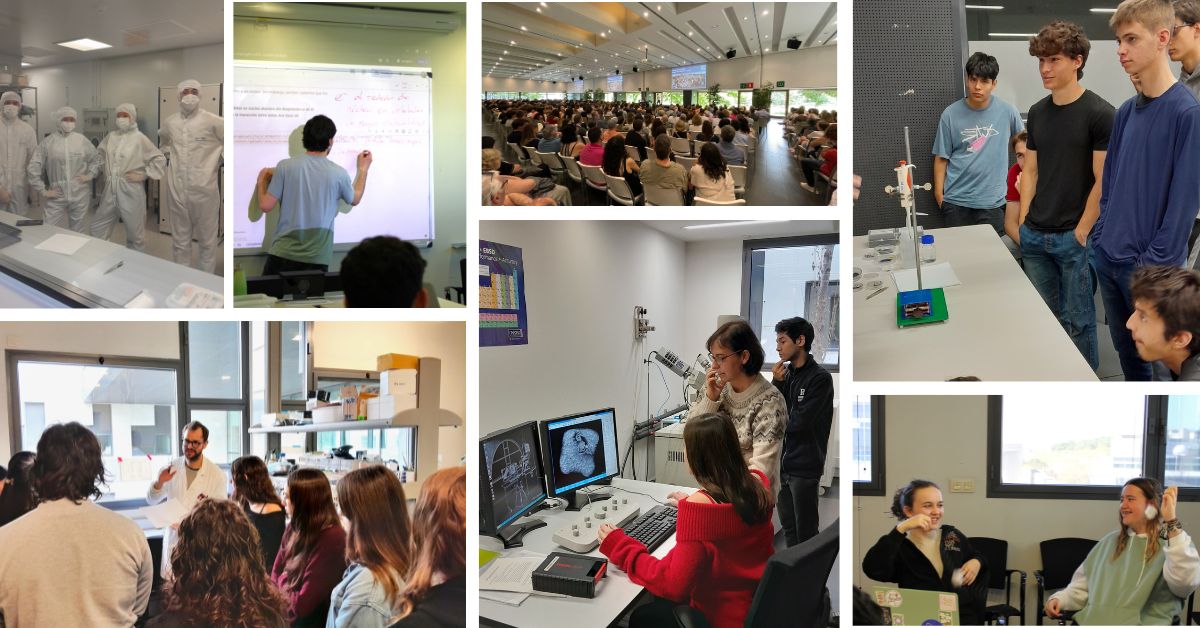
Bojos per la Física 2025: A Journey into Physics and Nanotechnology for Curious Young Minds

ICN2 took part once again in the “Bojos per la Física” (Crazy about Physics) programme, bringing cutting-edge nanotechnology and research closer to high school students.

Go to Source

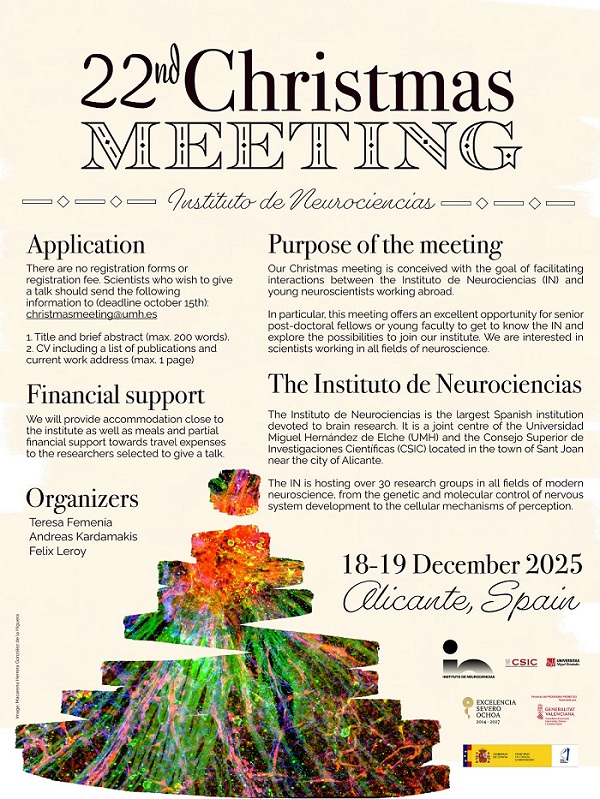
22nd Christmas Meeting, 18-19 dec 2025

La entrada 22nd Christmas Meeting, 18-19 dec 2025 se publicó primero en Instituto de Neurociencias de Alicante.

Go to Source

The Government of Catalonia visits the ICIQ to find out more about its projects for the future

The ICIQ has received a visit from representatives of the Government of Catalonia with the aim of sharing the current status and progress of the strategic projects promoted by the centre in the field of decarbonisation and industrial innovation.

On the one hand, the ICIQ held its first institutional meeting with Lucía López, territorial delegate of the Government of Catalonia in Tarragona. During the meeting, the director of the centre, Prof. Emilio Palomares, and the manager and administrative director, Dr. Imma Escofet, presented the details of the industrial decarbonisation project led by the centre, co-financed by the FEDER Programme of Catalonia 2021-2027, and which has the support of the main industrial sectors in the country, such as the cement, steel and waste incineration sectors, as well as the knowledge agents, Eurecat and URV.

This project involves the construction of four mobile test units designed to test innovative CO₂ capture and reuse technologies, a strategic commitment to move towards a more sustainable and environmentally friendly industry.

The meeting also served to explore ways of institutional collaboration in order to promote the future Industrial Innovation Centre planned for La Canonja. The ICIQ stressed the importance of encouraging initiatives that promote innovation, technology transfer and the creation of new economic and scientific opportunities in the region. It considers it essential to forge solid alliances with local stakeholders to strengthen the innovation ecosystem and contribute to a real impact on the productive fabric and the sustainable transformation of the chemical industry.

On the other hand, the centre has also received the visit of representatives of the Department of Business and Labor and the Association of Chemical Companies of Tarragona (AEQT).

La entrada The Government of Catalonia visits the ICIQ to find out more about its projects for the future se publicó primero en ICIQ.

Go to Source

Sidebar