Coulomb confinement in the Hamiltonian limit
Dawid S.M.; Smith W.A.; Rodas A.; Perry R.J.; Fernández-Ramírez C.; Swanson E.S.; Szczepaniak A.P.
Physical Review D, Vol. 110, Num. 094509 (2024)
Article

By completing a project to implement a FAIR scientific data management system, the institute has transformed its data infrastructure, enabling the automated integration and standardised publication of experimental datasets alongside traditional scientific outputs.

A recent work from the ‘Synthetic biology of plant signalling circuits’ group from the CBGP co-led with Sapienza University of Rome, reveals that the plant cell wall is much more than a passive support structure. The findings, published in Science Advances, show how mechanical signals originating from the cell wall play a crucial role in regulating cell division and maintaining organized root development.

Los trabajadores y trabajadoras del Centro Nacional de Investigaciones Oncológicas (CNIO) cultivan células, manejan pipetas, escriben algoritmos, analizan proteínas, genes, mutaciones, ribosomas, ritmos circadianos, anticuerpos… para conocer mejor, prevenir y tratar el cáncer. Y, además, cuando llega la Navidad crean decorados que colonizan pasillos, laboratorios y hasta la cafetería.
Este diciembre ha ocurrido algo especial. Sucede que el CNIO alberga grandes amantes de la música, que han organizado espontáneamente un fantástico Concierto de Año Nuevo. Unidos en cuatro grupos (R’n’B-seq, The Western Blotters, Pop Strings Group y B Carios), convirtieron en ritmo los mejores deseos para unas muy Felices Fiestas navideñas, e insuflaron la mejor energía para recibir el 2026. He aquí algunas muestras:
La entrada Belenes, árboles y talento musical para crear Navidad en el CNIO se publicó primero en CNIO.
The workshop, held in the ICN2 Seminar Room, brought together 16 participants, including PhD students, postdoctoral researchers, and communication and Open Science specialists.
From ICTA-UAB, we wish you Happy Holidays and a Happy New Year 2026.
Thank you for sharing with us, throughout this year, your ideas, experiences, collaboration and commitment, all of which continue to inspire our work.
We look forward to continuing this journey together, growing and strengthening Brave Science For A Changing World, and facing together with hope, enthusiasm and care the major societal challenges arising from environmental issues.
Once again, the Institute for Neurosciences (IN), a joint center of the Spanish National Research Council (CSIC) and the Miguel Hernández University (UMH) of Elche, served as a meeting point for young researchers from around the world during the twenty-second edition of its Christmas Meeting. The event took place on December 18 and 19 at the Santiago Ramón y Cajal building on the Sant Joan d’Alacant campus, offering neuroscientists working abroad an opportunity to connect with IN staff and explore its facilities.
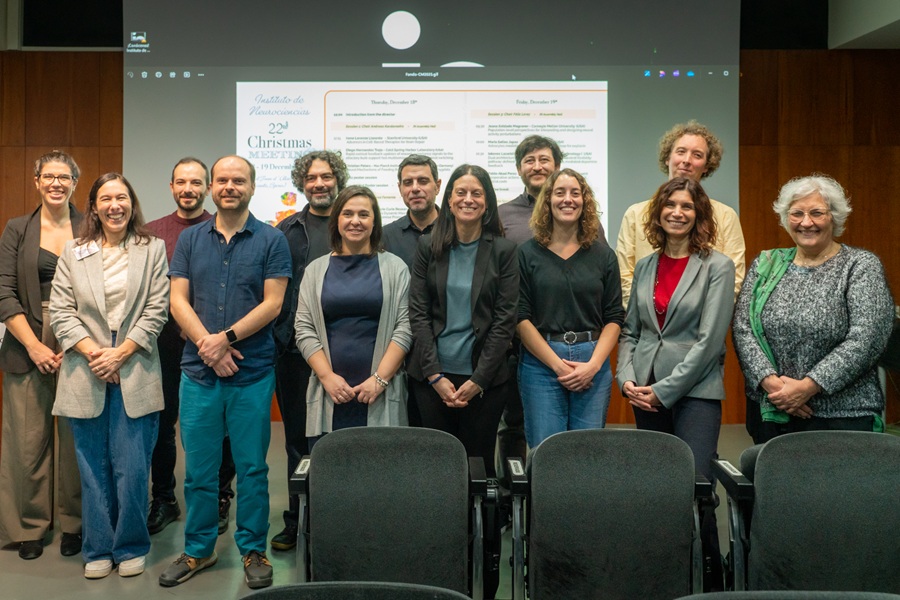
Speakers and organizers of the 22nd edition of the Christmas Meeting at the Institute for Neurosciences CSIC-UMH.
The purpose of the meeting is to inspire promising young scientists working in various fields of neuroscience who may be interested in joining the IN in the future by providing direct interaction with its research staff. In this regard, Juana Gallar, IN director, highlights that “this event has become a cornerstone of our institute’s traditions. This 22nd edition continues that legacy, serving as a showcase for cutting-edge neurobiology in an in-person format, as there is no substitute for the intellectual synergy fostered by this type of meeting”.
Gallar also emphasizes that the Christmas Meeting “is much more than a scientific conference: it is a space where we succeed in bringing together the rigor of research with the warmth of our community.” In this vein, the Director notes that this year’s programme has reflected the quality and diversity of the field, with a focus ranging from the study of complex systems and human behaviour to the most basic molecular mechanisms that underlie them, and she adds: “It is a source of great pride that, alongside the excellence of the science carried out elsewhere in the world, we have been able to witness the exceptionally high level of the research conducted here at the IN by our doctoral researchers in training, who represent the present and future of our centre.”
Throughout the two-day event, participants presented their current research through a series of talks and poster sessions. In this way, IN researchers and PhD students were able to share the latest findings in the field, as well as experiences and common ground.
In addition, researcher Panayiota Poirazi, Director of Research at the Institute of Molecular Biology and Biotechnology, a centre of the Foundation for Research and Technology Hellas located in Heraklion (Greece), delivered today’s keynote lecture. In her talk, entitled ‘Learning with dendrites in brains and machines’, she addressed the role of dendrites in learning processes in both the brain and artificial systems, highlighting how these mechanisms can inspire new models of computation and machine learning.
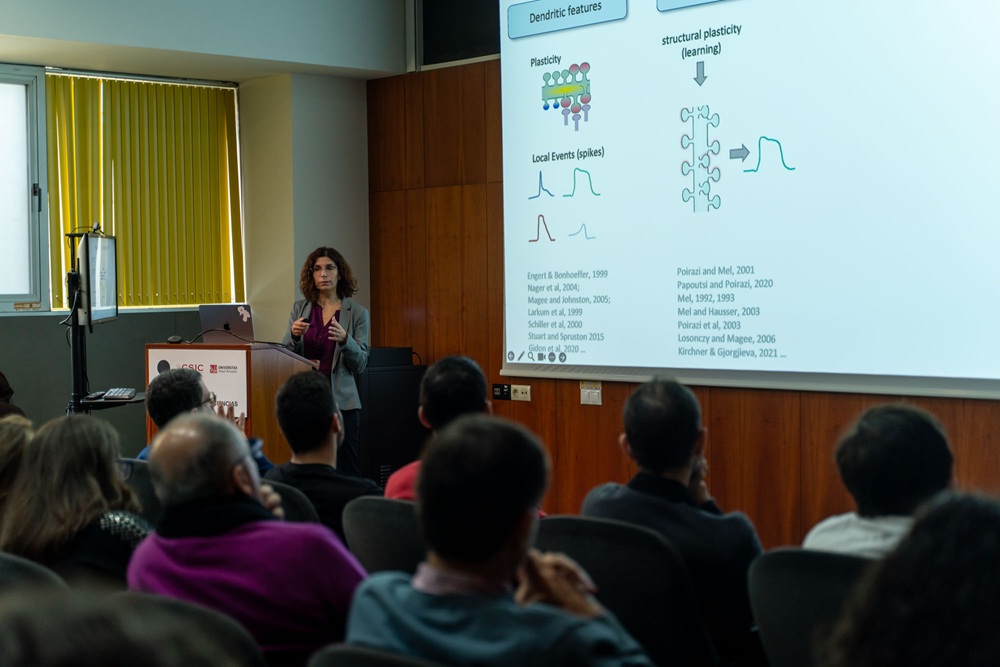
Researcher Panayiota Poirazi during the keynote lecture.
At the end of the meeting, the awards were presented. The prize for the best talk went to Iakovos Lazaridis, a researcher from the Massachusetts Institute of Technology (USA), for a presentation on how different dopamine regulation mechanisms allow the brain to flexibly adapt behavior. Meanwhile, the award for the best poster was given to Martina Riva, a researcher at the Development, Wiring and Function of Cerebellar Circuits laboratory at the IN. In addition, taking advantage of the celebration of this event, the prizes for the fifth edition of the #SciencePhoto_IN scientific photography contest were also presented.
The meeting ended with a festive toast to celebrate the holidays and wish attendees a happy new year, closing an eventful gathering for all those who traveled to San Joan d’Alacant to learn about the Institute for Neurosciences and the research carried out at this centre.
The organization of this year’s Christmas Meeting was led by IN researchers Teresa Femenía, Andreas Kardamakis, and Félix Leroy. The event was made possible thanks to the support of the IN’s Severo Ochoa Excellence Program, the Spanish State Research Agency – Ministry of Science, Innovation and Universities, and companies Leica Microsystems, QUIMA S.L., ZEISS, and Izasa Scientific.
For more information, consult the complete program in the attached document.
Source: Institute for Neurosciences CSIC-UMH (in.comunicacion@umh.es)
La entrada The Institute for Neurosciences CSIC-UMH holds its XXII Christmas Meeting se publicó primero en Instituto de Neurociencias de Alicante.