Parametrized quasinormal mode framework for modified Teukolsky equations
Cano P.A.; Capuano L.; Franchini N.; Maenaut S.; Völkel S.H.
Physical Review D, Vol. 110, Num. 104007 (2024)
Article

A new health policy paper published in The Lancet Regional Health – Europe calls for decisive action to transform how Europe monitors noncommunicable diseases (NCDs). Developed collectively by the Joint Action on Cardiovascular Diseases and Diabetes (JACARDI), the Joint Action Prevent Non-Communicable Diseases (JA PreventNCD), and the WHO Regional Office for Europe (WHO/Europe), the document sets out five priority actions to strengthen health surveillance systems across the region, an essential step in curbing the growing burden of NCDs and mental health and ensuring more effective and equitable health care.
The publication, entitled “Strengthening noncommunicable disease surveillance systems in Europe through a collaborative, multi-stakeholder approach: a key priority for advancing evidence-based policymaking,” comes at a critical time following the Fourth United Nations High-Level Meeting on NCDs and Mental Health.
“Europe has a unique opportunity and responsibility to recommit to evidence-based health governance, with sustained investment in resilient NCD surveillance systems,” explain the authors of the publication.
Dr. Bueno: “Data is not just numbers; it is the basis for designing policies that reduce inequalities and improve the health of the entire population”
Dr. Héctor Bueno, one of the authors of the document and leader of the JACARDI working group on data availability and quality, emphasizes the importance of coordinating and strengthening health information systems in order to achieve continuous, systematic, and standardized monitoring that will ensure more effective and equitable policies. “To advance the fight against NCDs, we need information systems that are robust, inclusive, and sustainable. Data are not just numbers; they are the basis for designing policies that reduce inequalities and improve the health of the entire population”.
The coordinator of the Cardiovascular Research Area at the Instituto de Investigación i+12 and head of the Multidisciplinary Translational Cardiovascular Research Group at i+12 at the Hospital Universitario 12 de Octubrein Madrid, and leader of a research group at the Spanish National Center for Cardiovascular Research (CNIC), insists that “it is time to invest in robust and collaborative surveillance systems so that healthcare decisions are based on real evidence and have a lasting impact on people’s health.”
The publication highlights five critical areas where action is needed to make monitoring systems stronger, fairer, and more effective. It calls for collecting data that is truly inclusive and disaggregated, so that inequalities become visible and can be addressed. It stresses the importance of solid governance, clear legal frameworks, and long-term investment to ensure that progress is sustained.
Monitoring, the authors argue, should also be embedded in real-time policymaking, so that information directly shapes decisions and drives accountability. Civil society, communities, people with lived experience, and marginalized groups should have a meaningful voice in this process, making sure that data reflects people’s lived realities. And finally, the paper points to the need for stronger collaboration across sectors, greater sharing of knowledge, and more capacity building to secure lasting impact.
80% of NCDs can be prevented through effective public health policies and early detection strategies
“Tackling NCDs is one of five priorities of WHO/Europe’s Second European Programme of Work, co-created with 53 Member States and shaped through broad public consultations, including with health professionals, people living with NCDs and civil society. Effective action on NCDs hinges on good data. Europe can lead by example and showcase collaborative and inclusive approaches together with key stakeholders, including EU Joint Actions”, said Dr. Gundo Weiler, Director of the Division of Prevention and Health Promotion at WHO Regional Office for Europe.
An estimated 80% of NCDs are considered preventable through effective public health policies and early detection strategies. These figures underscore the urgent need for a paradigm shift from a model centred on diagnostics and treatment to one rooted in prevention, health promotion, and evidence-based screening.
Despite great efforts in international commitments, progress at the national level has been inconsistent. Monitoring systems remain fragmented, overly reliant on short-term projects, or challenged by limited governance and insufficient investment. This has created a critical gap between ambitious global targets and their translation into actionable national policies.
The policy paper identifies persistent data gaps, structural weaknesses, and opportunities for innovation. It emphasizes that monitoring is not just about collecting data, it is about ensuring that information is used in real time to drive policy reform, accountability, and equity.
Lessons from Europe
The authors underline that too often, NCD monitoring efforts have been ad hoc, reliant on external funding or driven by individual champions. This has led to uneven coverage, lack of comparability between countries, and persistent blind spots when it comes to the health of groups living in vulnerable situations, such as migrants, minorities, and people with disabilities.
Without data that is disaggregated and reflects disparities, inequalities remain invisible and policies risk reinforcing exclusion. The authors argue that equity must be at the center of all future monitoring efforts.
Dra. Armocida: “We should begin to view data not only as numbers, but as reflections of lives and human rights”
“It is a moral and ethical imperative to advocate for and generate more inclusive data. Data should be systematically disaggregated by age, sex, gender, geography, socioeconomic status, disability, ethnic and migration background to reveal territorial disparities and enable place-based interventions”, unfolds Dr. Benedetta Armocida, from the Department of Cardiovascular, Endocrine-metabolic Diseases and Aging at Istituto Superiore di Sanità-ISS, Rome (Italy) and Coordinator of JACARDI.
“We should begin to view data not merely as numbers, but as reflections of human lives and rights: each data point tells a story, and data becomes truly powerful when it shifts narratives, amplifies the voices of those too often overlooked, and holds systems accountable. Data must be observed critically and translated into policies that strengthen health systems. Without inclusive monitoring, structural inequities remain concealed, and the most vulnerable remain invisible—one data point, one life, one missed opportunity at a time”, adds Dr Armocida.
At the same time, the authors highlight successful innovations and good practices emerging from European Joint Actions, such as JACARDI and JA PreventNCD, demonstrating that progress is possible when commitments are matched by clear governance, adequate investment, and cross-sector collaboration.
“Across Europe we already see solutions that work. Joint Actions like JA PreventNCD and JACARDI help countries align methods, share tools and learn faster from each other. That is how we improve comparability between countries and make monitoring more useful for prevention and health promotion, including by showing more clearly where inequalities persist,” says Professor Knut-Inge Klepp, from the Norwegian Institute of Public Health, Oslo and Scientific Coordinator of JA PreventNCD.
“But we have to treat monitoring as core infrastructure, not an extra task. It needs stable funding, clear governance and the ability to produce data that is timely and inclusive. If monitoring depends on short-term projects or individual champions, it will remain uneven. If it is institutionalized, it can guide priorities, strengthen accountability and help sustain progress over time,” adds Klepp.
Europe has both a responsibility and an opportunity to lead the way in building stronger, more inclusive health information systems that can serve as a global benchmark. Doing so will be critical not only to reducing premature mortality from NCDs by one-third by 2030, but also to ensuring health equity and resilience in the face of future challenges. “Because what gets measured gets prioritised. What gets disaggregated gets addressed. And what gets institutionalised can be sustained”, conclude the authors.
Benedetta Armocida, Hanna Tolonen, Ivo Rakovac, Beatrice Formenti, Jill Farrington, Allison Ekberg, Hector Bueno, Giovanni Capelli, Silvia Francisci, Morten S. Frydensberg, Ane Fullaondo, Linda Granlund, Yhasmine Hamu Azcarate, Torben F. Hansen, Emil Høstrup, Tomi Mäki-Opas, Luigi Palmieri, Markku Peltonen, Valentina Possenti, Marco Silano, Gundo Weiler, Kremlin Wickramasinghe, Edwin Wouters, Knut-Inge Klepp, Graziano Onder, Gauden Galea, Strengthening non-communicable diseases monitoring systems in Europe through a multistakeholder collaborative approach: a key priority for advancing data-driven policymaking, The Lancet Regional Health – Europe, Volume 61, 2026, 101553, ISSN 2666-7762, https://doi.org/10.1016/j.lanepe.2025.101553
Abstract: TBA
La entrada IMDEA Energía celebra la 14ª edición del workshop de jóvenes investigadores se publicó primero en IMDEA ENERGÍA.
Biopharmaceutical company Oniria Therapeutics, Vall d’Hebron Institute of Oncology (VHIO) and Institut Català d’Investigació Química (ICIQ) will work together on the regulatory preclinical phase for ONR-001 and develop the drug up to its first clinical trial in patients.
ONR-001 is an innovative therapy from Oniria Therapeutics designed for malignant tumors that do not respond to current treatments.
Biopharmaceutical company Oniria Therapeutics, Vall d’Hebron Institute of Oncology (VHIO) and Institut Català d’Investigació Química (ICIQ) have joined forces to advance development of ONR-001, a new drug to treat colorectal cancer (CRC), and prepare it for clinical trials. ONR-001 is an innovative therapy developed by Oniria Therapeutics targeting aggressive solid and hematologic tumors that don’t respond to current treatments.
For this purpose, a public-private consortium has been established that will receive €1,772,651 in funding from the Spanish Ministry of Science, Innovation and Universities and the European Union, through the CPP 2024 program. These funds will be used to carry out the whole regulatory preclinical phase with ONR-001, which includes conducting more experiments to demonstrate its efficacy in colorectal cancer, developing the Chemistry, Manufacturing and Controls (CMC) strategy and executing the regulatory preclinical studies needed to demonstrate its safety.
What sets ONR-001 apart from other therapies is that it hyperactivates the TET2 enzyme to a level that is lethal to persistent tumor cells, acting as an Achilles’ heel that, in preclinical studies, has been shown to significantly inhibit the progression of colon cancer, metastatic melanoma and acute myeloid leukemia. TET2 is a tumor suppressor gene that, when hyperactivated, leaves a mark in the DNA of tumor cells, forcing them to alter their function. Unable to adapt, the malignant cells die. This strategy, based on controlled activation of a protective gene, is a completely new approach to cancer treatment.
Colorectal cancer, one of the leading causes of cancer mortality
With approximately 1.9 million new cases and 900,000 deaths each year, colorectal cancer is the third most commonly diagnosed cancer in the world and one of the leading causes of cancer-related mortality, according to the World Health Organization (WHO). In Spain, it is even more significant, as the most frequent type of malignant tumor: 41,167 new cases were diagnosed in 2024 alone, according to the Spanish Association Against Cancer.
“Tumor resistance and recurrence, often caused by cancer cells that survive initial therapies, are two of the greatest obstacles in treating colorectal cancer. With ONR-001, we are pursuing a targeted strategy to help overcome these challenges and improve long-term patient outcomes,” explains Dr. Hector G. Palmer, chief scientific officer and co-founder of Oniria Therapeutics, and head of the VHIO Stem Cells and Cancer Group.
“Collaborations like this are essential to facilitate the exchange of knowledge between research centers, in our case in chemical research applied to health, and the biomedical industry, helping accelerate innovative therapies that can benefit millions of patients,” notes Dr. Fernando Bravo, Knowledge and Technology Transfer (KTT) manager at ICIQ.
“The whole Oniria Therapeutics team is excited to see that this project will allow us to take ONR-001 to Phase I clinical trials in 2027 and that we are moving forward according to the business plan to make it an effective new therapy for various tumors that are resistant to current treatments,” concludes Esther Riambau, CEO and co-founder of Oniria Therapeutics.
At the same time, the biopharmaceutical company is also working to bring ONR-001 to the clinical phase for patients with metastatic melanoma and other indications where evidence of efficacy has already been obtained.
In 2024, Oniria Therapeutics was named one of the 10 most disruptive companies by the Government of Catalonia (ACCIÓ) and received the Catalan Society of Biology Award for its outstanding work to overcome cancer persistence.

Project CPP2024-011292 funded by MICIU/AEI/10.13039/501100011033/FEDER, EU.
About Oniria Therapeutics
Oniria Therapeutics is a biopharmaceutical company in the preclinical phase that is developing innovative precision drugs to eliminate persistent tumor cells, which are responsible for patients progressing into the fatal phases of cancer. The company was established in 2021 as a spinoff of the Vall d’Hebron Institute of Oncology (VHIO), University of Barcelona (UB) and Catalan Institution for Research and Advanced Studies (ICREA) by Dr. Héctor G. Palmer, Esther Riambau, Dr. Isabel Puig, Dr. Josep Tabernero, Dr. Xavier Barril and Dr. Carles Galdeano. Oniria headquarters is in the Cellex Center on the Vall d’Hebron Hospital campus in Barcelona. It has received support from investors (Botín Foundation and Banco Sabadell BStartup), business angels and organizations in the health and biomedicine sector (Spanish Association Against Cancer and the ”La Caixa” Foundation). More information: www.oniriatherapeutics.com
About VHIO
The Vall d’Hebron Institute of Oncology (VHIO), created in 2006 and integrated into the Vall d’Hebron Campus, is a benchmark center in personalized medicine in oncology. Our goal is to carry out research to improve the prevention, early diagnosis and treatment of cancer thanks to a pioneering model of translational research that consists of transforming the latest discoveries in the lab into early phase clinical trials and, therefore, into new, more effective treatments that improve quality of life for cancer patients. VHIO is a member of the CERCA system and an accredited Severo Ochoa Center of Excellence. None of the VHIO activities would be possible without the support of our patrons —Government of Catalonia, Cellex Foundation, FERO Foundation, ”la Caixa” Foundation, BBVA Foundation and CRIS Cancer Foundation— and donations from all the associations, entities and individuals who contribute generously so that we can advance in cancer research. More information: https://vhio.net
La entrada Oniria Therapeutics, VHIO and ICIQ awarded over €1.7 million from Spanish Ministry of Science and Innovation to advance drug targeting resistant colon cancer se publicó primero en ICIQ.

The congress, co-organised by ICN2, featured strong participation from the institute’s researchers and offered a broad programme focused on the latest advances in nanotechnology and biomedicine.

Heart attacks that occur at night are less severe than those that strike during the day. A new study from the Centro Nacional de Investigaciones Cardiovasculares (CNIC) explains why. Published in the Journal of Experimental Medicine, the study led by Dr. Andrés Hidalgo’s group at the CNIC shows that neutrophils—a type of white blood cell—have an internal clock that regulates their aggressiveness throughout the day and determines the extent of damage they cause to the heart after a heart attack.
The researchers also developed a pharmacological strategy in experimental models to block the molecular clock in neutrophils, keeping them in a “nighttime” state and thereby reducing their harmful potential during a heart attack.
The immune system protects the body against microorganisms that cause infection. Because humans are diurnal—active during the day and asleep at night—the likelihood of exposure to pathogens is higher during the day. The immune system therefore adjusts its activity peaks to this circadian rhythm.
However, this same defensive response can become harmful. It is well known that in stressful situations such as myocardial infarction, the immune system can cause severe collateral damage to tissues.
Decades of research have shown that almost half of the cardiac damage after a heart attack is caused by neutrophils. Interestingly, this type of inflammatory damage fluctuates naturally throughout the day, suggesting the existence of circadian mechanisms that limit neutrophil activity and protect the body.
In collaboration with the Multidisciplinary Translational Cardiovascular Research Group at the CNIC, led by Dr. Héctor Bueno, the researchers examined data from thousands of patients at Hospital 12 de Octubre. The analysis confirmed that lower neutrophil activity at night results in less severe heart attacks during this period. The team then developed a pharmacological strategy in experimental models to block the molecular clock in neutrophils, reducing their harmful potential during infarction.
“The compound mimics a factor that the body produces mainly at night,” explains Dr. Hidalgo. “In a way, this factor ‘tricks’ neutrophils into thinking it’s nighttime, reducing their toxic activity.”
Study first author Dr. Alejandra Aroca-Crevillén highlights that the observed protection stems from a change in cellular behavior: “At night, neutrophils migrate to the damaged area while sparing healthy tissue. During the day, they lose this directionality and cause more damage to surrounding tissue.”
This study is one of the first to harness the circadian rhythms of the immune system to modulate inflammation without compromising infection defense. “We were surprised to find,” adds Dr. Aroca-Crevillén, “that blocking the neutrophil circadian clock not only protects the heart, but also improves responses to certain microbes and even reduces embolisms associated with sickle cell anemia.”
The findings reveal a neutrophil circadian ‘checkpoint’ that protects against excessive inflammation and can be therapeutically activated to protect the body.
The authors conclude that the results open the door to new therapies based on chronobiology (the branch of biology that studies how living organisms structure their physiological processes in time), with the potential to protect the heart and other organs from inflammatory damage without weakening the body’s natural defenses.
The study was supported by funding from Fundación La Caixa; the US National Institutes of Health (NIH); the Spanish Ministry of Science, Innovation, and Universities (MICIU); the China Scholarship Council; ANR PRC; Fondation pour la Recherche Médicale (FRM); the Leducq Transatlantic Network of Excellence on circadian effects in stroke; the Spanish Society of Cardiology; and support from AstraZeneca, Boehringer Ingelheim, and Janssen.

Los estrógenos, la principal hormona sexual femenina aunque con funciones también en hombres, intervienen en un sinfín de procesos -por eso cambia tanto el cuerpo en la menopausia-. Esto es así porque los estrógenos regulan a cientos de genes. Un estudio liderado por el Centro Nacional de Investigaciones Oncológicas (CNIO) desvela ahora cómo lo hacen, profundizando hasta el núcleo de la célula: hallan que la acción de los estrógenos depende de una propiedad física del ADN, su capacidad para retorcerse o súperenrollarse.
“Hemos descubierto que la forma en que se enrolla y desenrolla la molécula de ADN, su topología, es clave para que las células respondan a los estrógenos”, explica el investigador del CNIO Felipe Cortés, co-autor principal del estudio, que se publica en Science Advances.
“Cuando llegan los estrógenos, unas enzimas llamadas topoisomerasas regulan el enrollamiento del ADN, y con ello controlan la activación de los genes necesarios para que la célula responda a las hormonas”, dice Cortés, jefe del grupo de Topología y Roturas de ADN del CNIO.
Son procesos que ocurren en minutos. Dentro de nuestras células, en el núcleo, la molécula de ADN está continuamente cambiando de configuración, retorciéndose y desplegándose más o menos, y eso contribuye a que los genes puedan ser activados o no.
También son autores del trabajo que ahora se publica en Science Advances José Terrón Bautista (primer autor), ahora investigador postdoctoral en el Helmholtz Zentrum de Munich (Alemania); y Gonzalo Millán-Zambrano (co-autor principal) del Centro Andaluz de Biología Molecular y Medicina Regenerativa-CABIMER (Universidad de Sevilla-CSIC-Universidad Pablo de Olavide).
Cómo activar el gen adecuado en el momento adecuado
La información genética codificada en el ADN de cada uno de nosotros -nuestro genoma- está formada por una secuencia de piezas químicas diferentes (representadas normalmente como letras: A, T, C, G). Dicha secuencia de ADN es igual en todas las células de un organismo, pero cada tipo de célula lee partes distintas de la molécula de ADN -los genes- en momentos distintos, y por eso hay tejidos y órganos diferentes.
En otras palabras, cada célula controla cuidadosamente qué genes lee – ‘activa’ o ‘expresa’- en cada momento. La pregunta de cómo lo hace es absolutamente clave en biología, y en ella se inscribe el estudio recién publicado.
Uno de los principales cambios de paradigma en esta área deriva del hallazgo, en años recientes, de que la información en el genoma está codificada en tres dimensiones. Es decir: la forma 3D del genoma influye en qué genes se expresan en qué momento.
La tercera dimensión del genoma
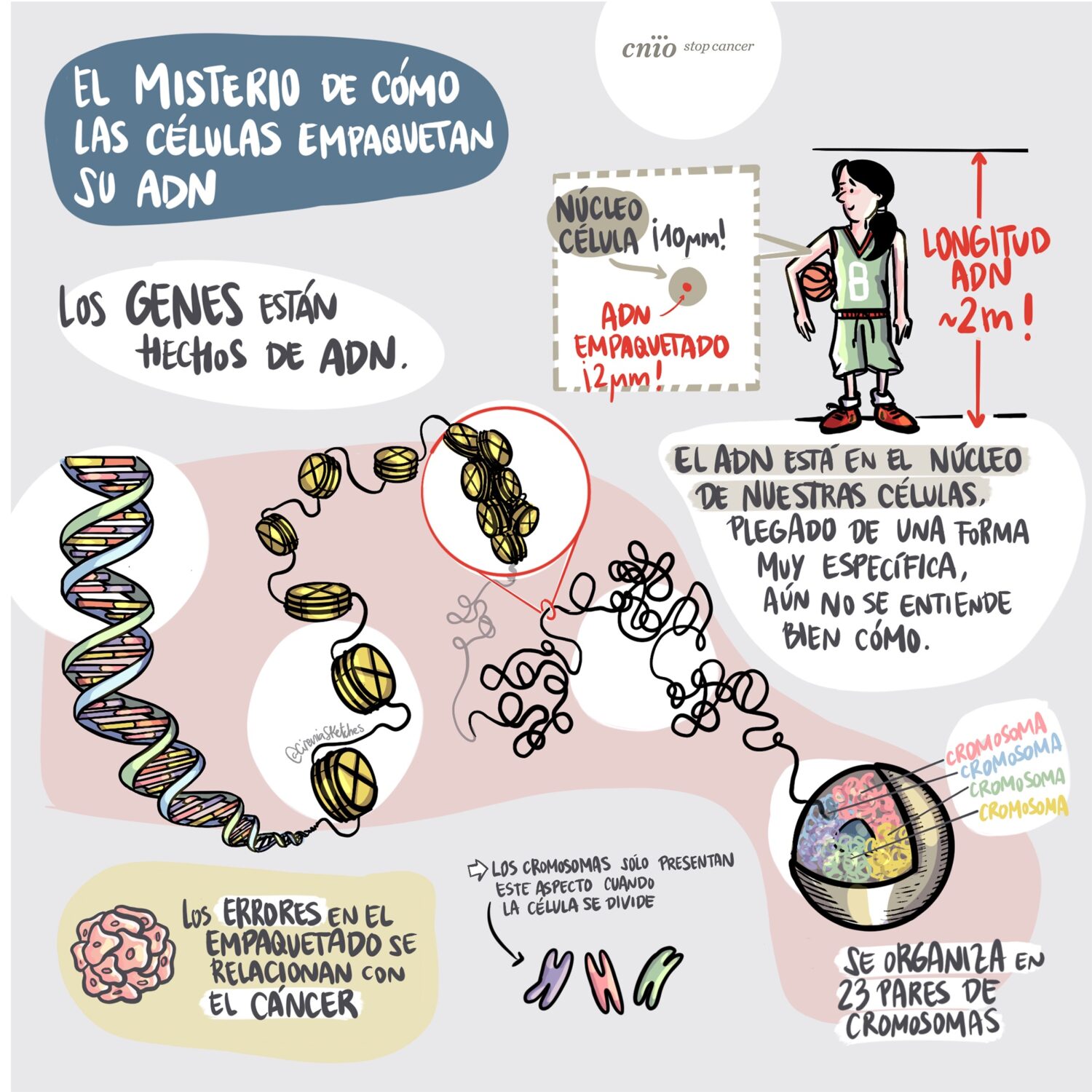
El núcleo de la célula, que mide milésimas de milímetro de diámetro, alberga el ADN, que desenrollado mide dos metros -en el caso humano-. El ADN está por tanto densamente plegado, pero no como un amasijo cualquiera de cables sino con un orden muy estricto. Esto hace posible que regiones de ADN linealmente alejadas entren en contacto, y es esa proximidad física la que activa y desactiva genes. Que el ADN esté bien plegado es tan importante que si hay fallos aparecen enfermedades, entre ellas el cáncer.
Entender este proceso es un área de investigación que avanza rápido. “El plegamiento del ADN determina cómo la célula lee e interpreta la información del genoma. Empezamos a entender cómo esta organización tridimensional influye en la actividad de los genes”, señala Cortés.
Estrógenos, activación de genes y ‘superenrollamiento’ del ADN
Los estrógenos actúan como señales químicas que modifican la expresión de cientos de genes, relacionados con reproducción, metabolismo, crecimiento celular, diferenciación y supervivencia.
El nuevo estudio en Science Advances muestra que esta función de los estrógenos depende directamente de cambios físicos en el plegamiento del ADN, cambios mediados por las enzimas topoisomerasas.
“Hallamos que, en presencia de estrógenos, las topoisomerasas modifican el enrollamiento del ADN, y así controlan la activación de los genes diana”, explica Cortes.
Específicamente, las topoisomerasas modifican el superenrollamiento del ADN, el fenómeno por el cual la molécula se retuerce sobre sí misma como cuando un cable de los antiguos teléfonos, tras un cierto número de giros, se superenrolla espontáneamente para aliviar la tensión física de la torsión.
Enzimas que regulan el superenrollamiento para regular expresión de genes
“Los cambios en el superenrollamiento inducidos por las toposiomerasas afectan a la organización tridimensional del genoma y por tanto a cómo se tocan entre sí distintas regiones reguladoras; estos contactos son esenciales para activar los genes de respuesta a estrógenos”, señala el investigador del CNIO.
En resumen, “demostramos que la forma en que se retuerce el ADN es una capa de regulación de la expresión génica que había pasado inadvertida. Hasta ahora se pensaba que las topoisomerasas simplemente eliminaban tensiones del ADN; nuestro trabajo muestra que, al menos en la respuesta a estrógenos, ocurre lo contrario: la célula genera y modula activamente esas tensiones para favorecer contactos que estimulan la activación de los genes”.
Relación con cáncer de mama
El estudio tiene relación, aunque no inmediata, con el tratamiento del cáncer. Muchos cánceres de mama necesitan los estrógenos para crecer, y los tratamientos habituales actúan bloqueando esa señal hormonal. Además, los inhibidores de topoisomerasas, que afectan directamente a la topología del ADN, también se emplean en el tratamiento de diversos tumores, en ocasiones en combinación con terapias hormonales.
“Nuestros resultados muestran que la forma en la que el ADN se enrolla influye directamente en cómo las células responden a los estrógenos. Esto sugiere que la señalización hormonal y las topoisomerasas, tradicionalmente consideradas dianas terapéuticas independientes, están en realidad funcionalmente conectadas, lo que podría ayudar a explicar mecanismos de resistencia y contribuir al diseño de terapias más personalizadas y eficaces”, indica Cortés.
Este estudio ha sido realizado con financiación de:
La entrada La acción de los estrógenos, la principal hormona sexual femenina, depende de cómo se ‘súperenrolla’ el ADN se publicó primero en CNIO.
