Axion Clouds around Neutron Stars
Noordhuis D.; Prabhu A.; Weniger C.; Witte S.J.
Physical Review X, Vol. 14, Num. 041015 (2024)
Article

Advances in cancer treatment mean that more people than ever are surviving the disease. However, some of the most effective anticancer drugs—a class of medicines called anthracyclines—can cause serious damage to the heart. In some patients, this cardiac damage appears months or even years after treatment and has a major impact on quality of life.
Protecting the heart without compromising the effectiveness of chemotherapy is a major challenge in the field of cardio-oncology. Now, a team at the Centro Nacional de Investigaciones Cardiovasculares (CNIC), led by Dr. Borja Ibáñez, provides new evidence that this can be achieved.
The study, published in Basic Research in Cardiology, demonstrates in an experimental model that the heart can be protected during anthracycline treatment using a simple, non-pharmacological technique known as remote ischemic conditioning (RIC), without reducing chemotherapy’s antitumor effectiveness.
RIC consists of controlled, brief interruptions of blood flow to a limb, usually achieved by applying a pressure cuff similar to those used to measure blood pressure. This stimulus activates protective mechanisms in the body that help the heart better withstand subsequent stressors, such as the damage caused by certain cancer treatments.
In the study, the researchers used anthracycline-treated, tumor-bearing mice to model the clinical situation in cancer patients. The results show that animals receiving RIC maintained better cardiac function during treatment. Importantly, this cardioprotective effect was not associated with increased tumor growth or reduced antitumor efficacy of chemotherapy.
The study’s first author, Anabel Díaz Guerra, a CNIC predoctoral researcher funded by the Spanish Association Against Cancer (AECC), explains: “Showing that the heart can be protected without compromising cancer treatment is essential to developing safer therapies.”
These results align with the translational vision of the group led by Dr. Borja Ibáñez—CNIC Scientific Director, cardiologist at Fundación Jiménez Díaz, and principal investigator in the CIBERCV network—which is currently coordinating the European clinical trial RESILIENCE. The trial is evaluating whether RIC can protect the hearts of cancer patients treated with anthracyclines and reduce long-term cardiovascular complications.
Senior CNIC investigator Dr. Laura Cádiz, co-supervisor of Díaz Guerra’s thesis, notes that the findings “reinforce the idea that simple, non-invasive strategies can play a key role in cardiovascular protection for cancer patients and open new avenues to improve their quality of life during and after treatment.
La entrada IMDEA Energía en Transfiere 2026: impulsando la innovación y la transferencia de conocimiento se publicó primero en IMDEA ENERGÍA.
The 13th LISA Cosmology Working Group Workshop will take place in Barcelona on June 1-5, 2026.
The workshop’s objective is to convene the LISA Cosmology Working Group community to examine recent advancements in cosmology pertinent to LISA. Its purpose is to kickstart collaborative projects and tackle unresolved issues in LISA cosmology.
Abstract: The wealth of data from the Euclid space telescope represents a major resource not only for cosmological studies but also for ultracool dwarf (UCD) science. Its Quick Data Release, covering 63 deg², has already revealed more than 5,000 UCD candidates. Over 10% of these have been spectroscopically confirmed, and more than half have available spectra showing characteristic UCD features. The sample spans spectral types from late M to late T. The first major data release (DR1), scheduled for October 2026, will cover an area 30 times larger, marking the transition of substellar science into the era of big data and enabling the establishment of robust photometric and spectroscopic standards. I will present the current UCD catalogue from the Q1 data release and future prospects with the Euclid data.
The Institute of Chemical Research of Catalonia (ICIQ) is pleased to announce the appointment of Dr. Luis Escobar as Junior Group Leader through ICIQ’s Advanced Tenure Track Programme. In this role, he will establish an innovative research programme centred on hybrid supramolecular systems with biomedical relevance.
The new research group will focus on the design and development of hybrid supramolecular systems that integrate biological scaffolds, such as nucleic acids and peptides, with synthetic host-guest complexes based on macrocyclic receptors. By combining precise molecular design with the programmability of biological scaffolds, his team aims to generate hybrid oligomers and supramolecular nanostructures. These systems will be explored for their long-term potential in health-oriented applications, while advancing the fundamental principles of molecular recognition and self-assembly in complex environments.
Dr Escobar’s recruitment has been made possible thanks to the Severo Ochoa Excellence Grant CEX2024-001469-S, funded by MICIU/AEI/10.13039/501100011033, which supports strategic talent incorporation at ICIQ.
A trajectory shaped by excellence and international experience
Originally from Albacete, Dr. Escobar completed his PhD in Organic Chemistry and Supramolecular Chemistry at ICIQ and the Universitat Rovira i Virgili (URV), including a research stay at the University of Texas at Austin, supported by an FPU Fellowship. He subsequently held postdoctoral positions at the Ludwig Maximilian University (LMU) of Munich, funded by a Humboldt Fellowship, and at the University of Cambridge, where he gained expertise in Chemical Biology, Prebiotic Chemistry, and Polymer Science.
In 2024, he was awarded a Junior Leader Fellowship from the “la Caixa” Foundation and a Ramón y Cajal Fellowship from the Spanish Government, enabling him to return to ICIQ and launch his independent research career. His work has been published in leading journals such as Nature, PNAS, and Chemical Reviews, and he has received several distinctions, including the Extraordinary PhD Award from URV, the Postdoctoral Research Award from the Spanish Royal Society of Chemistry (RSEQ), and recognition as an Emerging Talent in Systems Chemistry.
“I am deeply honoured and genuinely excited to take on the role of Junior Group Leader at ICIQ. This appointment represents a significant milestone in my academic journey and a unique opportunity to consolidate and expand my independent research program within an environment that fosters excellence, creativity, and scientific rigor. ICIQ’s commitment to multidisciplinary collaboration and international impact resonates strongly with my ambition to develop innovative hybrid systems that bridge synthetic and biological chemistry. I look forward to building a dynamic research team, contributing actively to the institute’s scientific community, and helping to shape the next generation of research at the chemistry-biology interface,” states Dr. Escobar.
With this incorporation, ICIQ reinforces its commitment to nurturing emerging scientific talent and advancing frontier research in Organic Chemistry, Supramolecular Chemistry, and Chemical Biology.

La entrada Dr. Luis Escobar appointed as Junior Group Leader at ICIQ se publicó primero en ICIQ.

The NANORADIOMED project, a collaboration involving ICN2, UAB, the ICO-Germans Trias i Pujol Research Institute (IGTP), and CARINSA Group, aims to prevent and treat some of the most common side effects associated with radiotherapy. Its technology is based on the controlled release of active ingredients through microcapsules integrated into clothing, with the goal of improving patients’ quality of life.

Reunido el patronato en su sesión extraordinaria del 27 de febrero de 2026 ha quedado informado de la renuncia del gerente del CNIO, así como de un escrito firmado por 27 jefes de grupos de investigación del Centro relativo a la gestión del mismo.
El patronato, por decisión propia, celebrará una nueva reunión a la mayor brevedad posible para analizar la situación actual y el futuro del Centro.
La entrada Comunicado del Patronato del CNIO se publicó primero en CNIO.
Efforts to advance towards a more sustainable world focus heavily on a limited set of actions and actors while overlooking key strategies and sectors needed to address the climate crisis and biodiversity loss, according to a new study published today in Nature Sustainability. Conducted by the ICTA-UAB, and based on the analysis of 4 million scholarly documents, the study reveals major blind spots in global sustainable research and highlights the urgent need for a more inclusive and coordinated approach to address the environmental crisis.
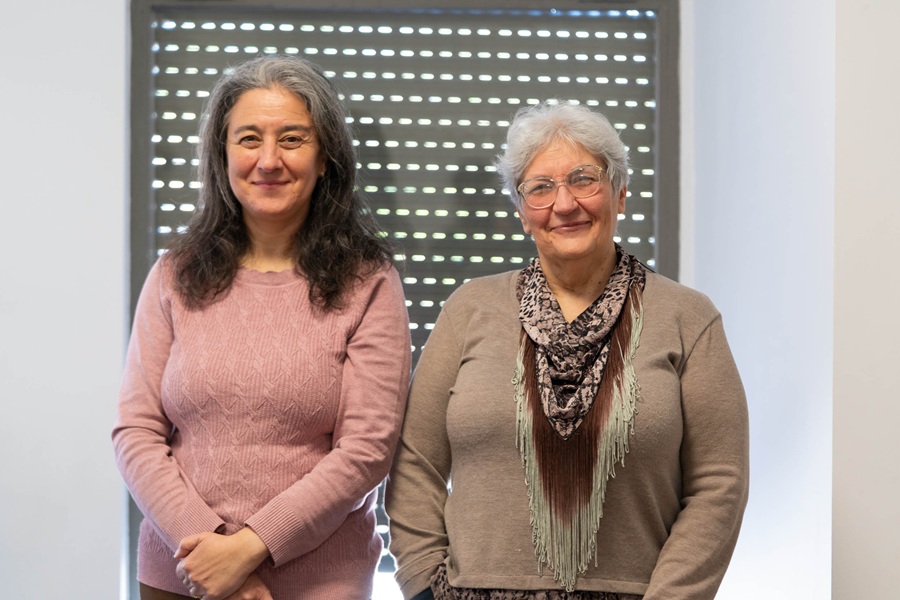
Photo: Researchers Mª Carmen Acosta and Juana Gallar, who lead the Ocular Neurobiology laboratory at IN UMH-CSIC
Congenital aniridia is a rare disease caused, in most cases, by mutations in the PAX6 gene, which is essential for the development of ocular structures. Although the most visible feature is the total or partial absence of the iris, its effects go far beyond this, as those affected often experience focusing problems, photophobia, and various complications that may worsen over time. Now, a clinical study led by the Ocular Neurobiology Group at the Institute for Neurosciences (IN), a joint center of Miguel Hernández University of Elche (UMH) and the Spanish National Research Council (CSIC), and published in the journal  Link YouTube: https://youtu.be/uM8NerQd7tY
Until now, previous studies have shown that nerve density in the corneas of adult patients with aniridia is reduced. However, no one had analyzed whether these nerves were fully functional: “We knew there were fewer nerves, but we still needed to understand whether the remaining ones were working properly and what consequences this had for the eye”, explains Professor Mª Carmen Acosta, who led the study. To carry out this research, the team evaluated a group of patients with aniridia, including both children and adults, and compared them with individuals without the ocular condition.
Since aniridia is a rare disease, assembling a clinical cohort that included different age groups posed a significant challenge. The study was made possible thanks to collaboration with ophthalmologist Nora Szentmáry, a specialist at Semmelweis University (Hungary), whose research background and clinical expertise in aniridia make her an international reference in this field. Her unit facilitated patient recruitment and evaluation, a key factor in enabling the analysis of how nerve function evolves from childhood to adulthood.
The researchers measured corneal sensitivity to very mild mechanical stimuli applied through controlled air pulses, as well as sensitivity to cold. They also analyzed tear production under basal conditions and after activating the lacrimal reflex through CO₂ microstimulation using the i-Onion device, developed from a patent held by the research group itself.
The results showed a clear pattern: in childhood, corneal sensitivity is very similar to that of healthy individuals. However, in adulthood, a significant decrease appears, and patients require stronger stimuli to perceive contact, showing difficulty distinguishing stimulus intensity. “The most relevant finding is that the deterioration is not static, but progressive. Children still retain a function quite close to normal, but in adults, we observe a clear loss of sensitivity”, Acosta notes.
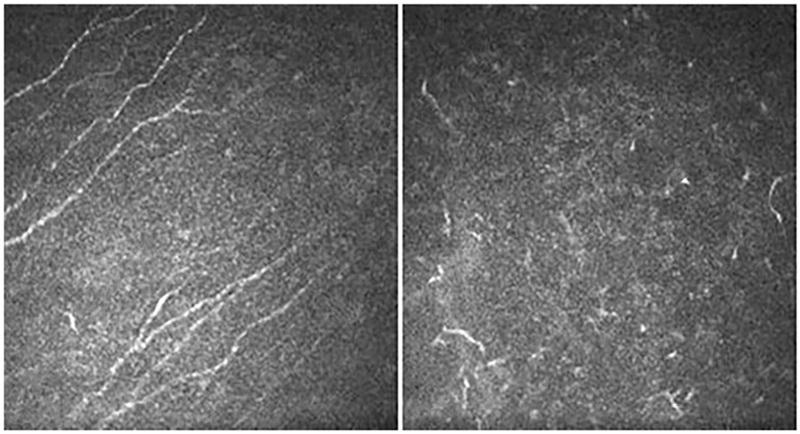
Current Eye Research, 2024. doi: 10.1080/02713683.2024.2320779
Cornea of a healthy eye (left) and of a patient with aniridia (right), showing changes in the tissue’s defensive cells that reflect corneal alteration. Source: Csorba et al., Current Eye Research, 2024.
The study also reveals alterations in the tear response. Although basal tear production is comparable to that of people without aniridia, the ability to increase secretion in response to a protective stimulus is reduced, limiting one of the eye’s main defense mechanisms. “Sensory information not only allows us to detect contact or cold. It is what activates protective mechanisms such as blinking and tear production. If the nerve signal weakens, the eye’s defense system also weakens”, explains Professor Juana Gallar, head of the Ocular Neurobiology Group.
The cornea loses its ability to regenerate
Another relevant aspect of the study is that the team focused on the trophic function of sensory nerves. Beyond their role in the perception of sensations, these nerves actively contribute to maintaining and regenerating tissue. When innervation decreases or deteriorates, the cornea loses its ability to repair itself, which promotes the appearance of small lesions, loss of transparency, and persistent pain. “Nerves are essential for keeping the cornea healthy. If their function becomes altered over time, the tissue no longer regenerates properly, and complications arise that affect both vision and quality of life”, adds Gallar.
This work is part of a broader project in which the team studies aniridia, both in patients and experimental models. In the next phase, the researchers will further analyze nerve function in a mouse model carrying a mutation in the PAX6 gene, which will allow them to study in greater detail the cellular mechanisms involved in the progressive degeneration of corneal innervation. Understanding these processes at a basic level is essential for designing more precise therapeutic strategies in the future to help slow deterioration and improve patients’ quality of life.
This research was possible thanks to funding from the Spanish State Research Agency – Spanish Ministry of Science, Innovation and Universities, the European Regional Development Fund (ERDF/European Union) “A Way of Making Europe”, and the Generalitat Valenciana. It also received support from the Dr. Rolf M. Schwiete Foundation, the Hungarian Academy of Sciences, and the National Research, Development and Innovation Office of Hungary.
Age Impairs Corneal Sensitivity and Reflex Tearing in Congenital Aniridia. Acosta MC, Náray A, Csidey M, Maka E, Nagy ZZ, Jávorszky E, Zobor D, Tory K, Cortón M, Kovács I, Gallar J & Szentmáry N. Cornea (2026)
Source: Institute for Neurosciences UMH-CSIC (in.comunicacion@umh.es)
La entrada A clinical study led by the Institute for Neurosciences reveals that aniridia causes a progressive loss of corneal sensitivity se publicó primero en Instituto de Neurociencias de Alicante.

