Author Archive

Francisco X. Real: «Es el momento menos amargo de la historia del cáncer de páncreas»

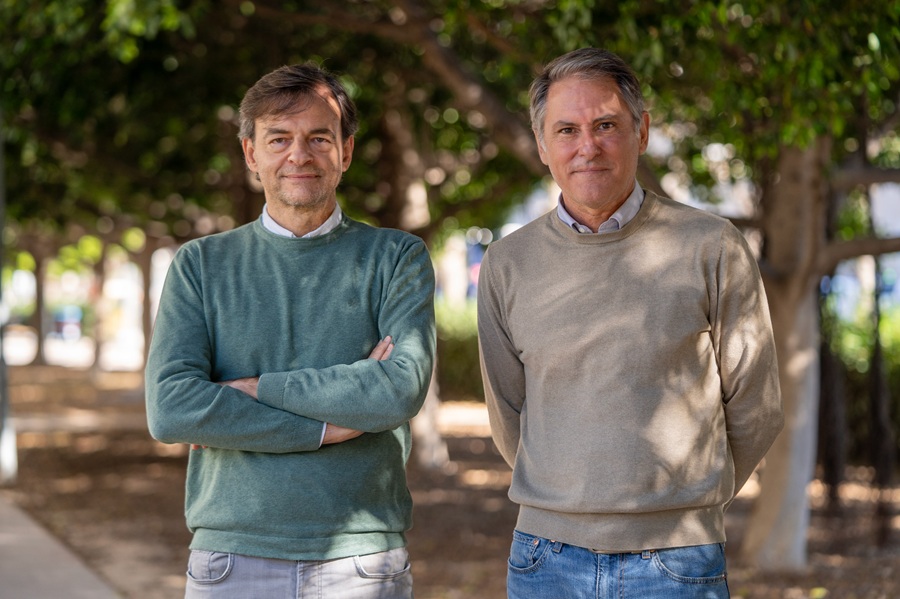
Francisco X. Real, investigador del Centro Nacional de Investigaciones Oncológicas (CNIO). / Christian Esposito. CNIO

Francisco X. Real dirige el Grupo de Carcinogénesis Epitelial del Centro Nacional de Investigaciones Oncológicas (CNIO) y preside ALIPANC, la Alianza de Investigación en Cáncer de Páncreas en España. La última investigación del grupo de Real ha permitido hallar el mecanismo por el que una variante genética aumenta el riesgo de cáncer de páncreas. Es un paso hacia un objetivo ambicioso, la prevención de un tumor que demasiado a menudo se diagnostica cuando ya no es operable, porque se ha diseminado a otros órganos.

Para Real, hay que avanzar en paralelo en la investigación para identificar población con más riesgo, en diagnóstico precoz y en tratamiento.  Con ese abordaje, “el impacto de aquí a 10 años será importante”, asegura. 

¿Está aumentando el cáncer de páncreas en jóvenes? Si es así, ¿por qué?

Podría estar aumentando en menores de 55 años, aunque los datos no son concluyentes y por tanto debemos ser cautos. Pero sin duda hay que prestar atención al problema, porque es una enfermedad agresiva y son muchos años de vida perdidos.

En él tratamiento del cáncer de páncreas se ha avanzado menos que en otros tumores. ¿Empieza esto a cambiar?

Lo más importante es que se están ensayando ya los primeros fármacos que se dirigen específicamente contra el principal oncogén implicado en cáncer de páncreas, que es KRAS. Es el primer avance en casi 40 años en lo que se refiere al tratamiento, y va a cambiar las perspectivas terapéuticas de los pacientes. No estoy hablando de curación, pero por fin vamos a tener fármacos más específicos que la quimioterapia. Así que podemos decir que es el momento menos amargo de la historia del cáncer de páncreas.

Los datos comunicados informalmente por las compañías apuntan a que estos nuevos fármacos doblan la esperanza de vida. Pero, aun así, se trata de meses…

Es que aún no tenemos curación para el cáncer de páncreas. Ese es el primer punto. Lo que tenemos son fármacos nuevos más activos que la quimioterapia de la que disponíamos hasta ahora, fármacos que están todavía en fase de experimentación. Es decir, para que estén disponibles para todos los pacientes aún falta completar los ensayos clínicos. También deben aprobarlos las agencias reguladoras estadounidense y europea, y las administraciones nacionales. Pero nunca hemos tenido fármacos tan buenos, así que es una situación de esperanza.

¿Cuál es la situación actual de los pacientes de cáncer de páncreas?

Hay un 20% de pacientes que pueden ser intervenidos quirúrgicamente para curar la enfermedad. Pero el 80% restante es diagnosticado ya con enfermedad inoperable y con frecuencia metastásica [el cáncer se ha extendido a otros órganos. Durante los últimos 50 años el único tratamiento para estos pacientes ha sido la quimioterapia, que no es muy efectiva contra el cáncer de páncreas.

“Un reto es identificar a la población con más riesgo
para diagnosticar precozmente o incluso prevenir”

¿Cómo se está avanzando en diagnóstico precoz?

El progreso es lento, pero es seguro. Como en el campo terapéutico, hay desafíos importantes. Por ejemplo en cáncer de páncreas la biopsia líquida es más compleja y menos efectiva que en otros cánceres, sin que sepamos por qué. El reto previo, desde luego, es identificar a la población con riesgo alto, para intervenir con diagnóstico temprano o incluso con un tratamiento quimio-preventivo.r

¿Cómo se acota a la población de riesgo, las personas que deben vigilarse más?

Un grupo son los pacientes con una historia de cáncer de páncreas familiar, que son entre un 5% y un 10% [del total de los casos de cáncer de páncreas]. También los pacientes en que se diagnostica diabetes, y quienes tienen pancreatitis crónica. Y los fumadores; el tabaco no aumenta mucho el riesgo de cáncer de páncreas, pero influye. 

¿Hay un hábito que se asocie específicamente al riesgo de desarrollar cáncer de páncreas?

No, en páncreas no hay un factor de riesgo único fundamental, como es el tabaco en cáncer de pulmón. Lo que hay son muchos factores que se vuelven importantes en conjunto, al interaccionar entre ellos.

En cuanto a la quimio-prevención, ¿hay, o habrá, algún fármaco que prevenga el cáncer de páncreas en grupos de riesgo?

Esto me interesa particularmente, lo estamos trabajando en nuestro laboratorio. Es un área en que los modelos animales que reproducen el cáncer de páncreas en humanos están siendo de gran ayuda. Queremos estudiar si fármacos ya aprobados, que sabemos que tienen poca toxicidad, podrían prevenir el cáncer en grupos específicos.

“Cada vez hay más grupos de investigación
interesados en cáncer de páncreas»

¿Hay que priorizar la investigación en tratamiento, diagnóstico precoz o prevención?

Lo importante es avanzar en todas estas áreas. Si identificamos los sujetos de alto riesgo, mejoramos en diagnóstico precoz, detectamos a los pacientes que van a tener enfermedad metastática y avanzamos en el tratamiento en torno a la cirugía, el impacto será importante, estoy seguro. No lo veremos mañana, pero sí de aquí a 10 años.

Como presidente de ALIPANC, la Alianza de Investigación sobre Cáncer de Páncreas en España, ¿percibe un aumento de la investigación precisamente por la llegada de los nuevos tratamientos en ensayo?

ALIPANC se puso en marcha antes de la pandemia y en pocos años ha creado una red de investigadores clínicos y traslacionales en cáncer de páncreas en España. Somos unos 60 grupos y estamos creciendo, porque efectivamente hay nuevos grupos interesados. Trabajamos para acercar los descubrimientos básicos a los ensayos clínicos, y a la mejora del manejo de los pacientes. Los últimos que hemos incorporado trabajan en inmunoterapia del cáncer de páncreas.

Su grupo, y otros en el CNIO, también participan en los grandes proyectos internacionales de investigación en cáncer de páncreas.

Sí, nuestra red internacional de colaboraciones es tupida. En Europa, sobre todo, tenemos importantes colaboraciones en Francia y en Alemania, particularmente. Los grupos de Nuria Malats y Héctor Peinado participan en proyectos relacionados con el uso de biopsia líquida, por ejemplo.

¿Qué está suponiendo la inteligencia artificial para la investigación en cáncer de páncreas?

No es distinto que en otros tumores, lo que pasa es que cuando vas muy rezagado cualquier avance tiene un impacto alto. En este sentido nosotros tenemos mucho que avanzar. Pero, desde el punto de vista conceptual, es igual que en otros tumores, y es completamente cierto que la IA va a revolucionar la forma en que trabajamos: desde el diseño de nuevos tratamientos, hasta cómo hacemos los experimentos.

La entrada Francisco X. Real: «Es el momento menos amargo de la historia del cáncer de páncreas» se publicó primero en CNIO.

Go to Source

Celebration of the Year Maria Assumpció Català at UB Physics

Image
Celebration of the Year Maria Assumpció Català at UB Physics
Other activity

Celebration of the Year Maria Assumpció Català at UB Physics

Date
Place
Espai Hemeroteca, CRAI Biblioteca Física i Química UB


As part of the centenary of the birth of Maria Assumpció Català i Poch (Barcelona, 1925 – 2009), the University of Barcelona inaugurates three exhibitions that highlight her career as a pioneering mathematician and astronomer, as well as her scientific and educational legacy.


Exhibitions:


Program Highlights:

  • Institutional Welcome
    By:

    • Vice-Rector for Culture and Heritage, Dr. Agustí Alcoberro
    • Dean of the Faculty of Physics, Dr. Eugeni Graugés
    • Director of the Department of Quantum Physics and Astrophysics, Dr. Montserrat Guilleumas
    • President of the Catalan Institute for Women, Sònia Guerra López
  • Presentation of the Virtual Exhibition
    By: Dolores Pulido

  • Presentation of the Personal Collection of M. Assumpció Català Poch
    By: Jordi Tremosa, Maria Moreno, Estela Gombau

  • Presentation of Historical Astronomy Instruments
    By: Joan Manel Hernández, Trini Cadefau Surroca

  • Guided Tour
    To the CRAI exhibitions and the showcase of historical instruments.

Free admission.
We invite you to discover the life and work of a key figure in the history of science in Catalonia.

Go to Source

Advancing Toward Long-Term Stable Graphene Neural Implants

In a new study, ICN2 researchers have presented graphene-based brain interfaces that are more robust and durable, thanks to a hybrid coating of organic and inorganic materials. This represents an important step toward developing a new generation of neural interfaces designed for long-term clinical use.

Go to Source

ICIQ PhD students complete the third edition of the Severo Ochoa PhD Training Programme SHARP

The third edition of ICIQ’s Severo Ochoa PhD Training Programme (SHARP) has successfully concluded after two intensive weeks filled with training sessions designed to strengthen the scientific, technical, and professional development of ICIQ PhD students. 

SHARP is a multiannual training initiative aimed at providing ICIQ doctoral researchers with complementary skills that go beyond traditional BSc or MSc curricula. The programme covers scientific and transversal aspects of chemistry, preparing participants for successful careers both within and beyond academia. 

“Our goal is to provide a well-rounded training experience that empowers our PhD students to grow as scientists and professionals,” explains the ICIQ Academic Committee. “SHARP offers them tools to communicate effectively, innovate responsibly, and connect their research to broader societal needs.” 


The programme is structured around four progressive stages, each aligned with the students’ PhD trajectory: 

> First Year – Introduction to research and technical skills: Focused on building a solid foundation for a successful PhD, this stage includes scientific and technical modules, team building, programming for chemists, and open science. 

> Second Year– Communication skills: This stage focuses on developing soft skills crucial for effective communication. Sessions covered technical writing and presentations, scientific ethics, public engagement, and data visualization.. 

> Third Year – Innovation and technology transfer: The third-year module explores how research ideas can move beyond the lab. Students learned about knowledge and technology transfer (KTT), intellectual property (IP), and the process of creating a spin-off. 

> Fourth Year – Career development: This session centers on career development, featuring courses on CV adaptation and how to approach job interviews. 

Expertise from inside and outside ICIQ 

As in previous editions, the programme benefited from the contribution of experts from both ICIQ and external institutions. 

Among this year’s invited lecturers were Vlad Martin (ALBA Synchrotron), Alejandro Diéguez (Johnson & Johnson), Wenceslao Lumeras (Lilly), Isabel Marco (Pons IP), Juan José Saenz (Agata) and Guillermo Marín (BSC-CNS) who shared their perspectives on research infrastructures, industrial R&D, intellectual property, communication skills and data visualization.  

This third edition gathered 71 PhD students from different cohorts, 37 men and 34 women, who took part in the two-week programme. For first-year participants, SHARP offered a window into the broader scientific landscape and a chance to connect with peers across disciplines. 

“The SHARP programme was a great and truly valuable experience for me,” says Farzaneh Hosseini, first-year PhD student in the group of Prof. Carles Bo. “I found the computational section, particularly the Machine Learning and Python sessions presented by Moises, Diego, Javier, and Santiago, extremely useful and an excellent starting point for my PhD journey. “ 

For third-year students, the programme also provided continuity and reflection. Having participated since the first edition, they could appreciate how their skills evolved alongside the growing scope of SHARP. 

“Participating in the three SHARP editions has given me a clear sense of progression: first learning the basics, then improving how I communicate science, and now thinking about innovation and my future career,” says Laia Marin, third-year PhD student in the group of Prof. Palomares. “It’s a programme that grows with you, and I’m grateful for the continuity and support it provides. “All ICIQ PhD students are encouraged to participate actively in SHARP. Attendance is certified with a diploma, and evaluation is carried out by mutual agreement between the student, their PI, or the lecturer. 


The programme ensures balance across ICIQ’s key research areas — catalysis, sustainability, health, and energy — and aligns with the institute’s Severo Ochoa Excellence accreditation (CEX2024-001469-S), funded by MICIU/AEI (10.13039/501100011033). 


La entrada ICIQ PhD students complete the third edition of the Severo Ochoa PhD Training Programme SHARP se publicó primero en ICIQ.

Go to Source

Research professor Santiago Canals collaborates on a congressional report on minors and social media

A large part of adolescent socialization occurs in digital environments, where social media influences how minors communicate, build their identity, and learn, but also poses risks to their mental health and rights. To address this reality, the Congress of Deputies’ Office of Science and Technology has presented the report Menores y redes sociales (Minors and Social Media), a document featuring the collaboration of experts such as Santiago Canals, a research professor at the Institute for Neurosciences, a joint center of the Spanish National Research Council (CSIC) and the Miguel Hernández University (UMH) of Elche; and Daniel Lloret, a professor of Social Psychology at UMH.

Photo: Santiago Canals, Daniel Lloret

The report highlights that adolescence is a particularly vulnerable period to the effects of social media, due to the social, hormonal, neurocognitive, and emotional changes characteristic of this stage. Younger adolescents (10–15 years) show greater vulnerability, and negative effects are more frequent in girls, partly due to a more image-centric use and different forms of digital violence. It also reminds us that platforms are designed to generate economic profit, which is why they seek to maximize attention and usage time. As such, their design favors “problematic use” patterns that affect between 3% and 8% of minors in Spain.

Digital risks are grouped into content, contacts, conduct, and consumption, in addition to other cross-cutting issues that affect health, privacy, or security. Usage time, especially over two hours daily, may be related to negative effects, but experts warn that how social media is used and in what context are determining factors. The report emphasizes that social media also distorts sleep, self-image, and the way adolescents’ social and sexual identities develop.

At the same time, the scientific community agrees that social media also offers opportunities for social, intellectual, and civic development. They facilitate self-expression, learning, participation, and identity exploration, though they can simultaneously satisfy and frustrate the same needs, such as reinforcing autonomy while also generating dependence.

The objective of this report is to design public interventions for the protection of the health, well-being, and rights of the younger population based on scientific evidence. It gathers data from nearly 400 studies and consults 21 experts on the subject.

In addition to compiling the most current scientific evidence, the experts propose a set of measures to reduce risks and maximize the benefits of the digital environment. One key would be to legislate for “safe design by default.” That is, platforms should guarantee and transparently demonstrate that their products are safe and that access to harmful content or services is limited with effective age verification systems.

They also recommend an integrated protection approach for minors that simultaneously involves the fields of health, education, family, and social welfare. Finally, they consider international collaboration and algorithm transparency to be key for effective supervision and the protection of children in global digital environments.

Santiago Canals is a CSIC Research Professor at the Institute for Neurosciences (CSIC-UMH), where he directs the Plasticity of Brain Networks laboratory, a group dedicated to investigating how brain connections reorganize in response to learning experiences, environmental changes, or pathological processes. His academic career combines neurobiology, brain imaging techniques, and the study of neural circuits to understand memory and addiction.

In addition to his scientific contribution to the Congressional report on minors and social media, Canals has co-edited the book Juego de apuestas y publicidad. Salud, impacto social y prevención (Gambling and Advertising. Health, Social Impact, and Prevention) with Daniel Lloret, published by the CSIC in its Politeya collection. The work analyzes, from a multidisciplinary perspective covering neuroscience, psychology, public health, and law, how gambling advertising influences behavior, with a special focus on youth, adolescents, and gender differences.

Report Access: https://oficinac.es/es/informes-c/redes-sociales-y-menores

Source: UMH Communication Service (comunicacion@umh.es) / Institute for Neurosciences CSIC-UMH (in.comunicacion@umh.es)

La entrada Research professor Santiago Canals collaborates on a congressional report on minors and social media se publicó primero en Instituto de Neurociencias de Alicante.

Go to Source

Science under the control of major publishers: profit over knowledge

The current publishing system is harmful to science. A new analysis involving ICTA-UAB, Spain, shows that in scientific publishing, commercial interests put profit ahead of advancing knowledge and academic integrity.

Go to Source

A new characterization of the holographic entropy cone

Image
A new characterization of the holographic entropy cone
Seminar

A new characterization of the holographic entropy cone

Date
Place
Pere Pascual V5.07 Room

Abstract: Entanglement entropies computed using the holographic Ryu-Takayanagi formula are known to obey an infinite set of linear inequalities, which define the so-called RT entropy cone. The general structure of this cone, or equivalently the set of all valid inequalities, is unknown. It is also unknown whether those same inequalities are also obeyed by entropies computed using the covariant Hubeny-Rangamani-Takayanagi formula, although significant evidence has accumulated that they are. Using Markov states, we develop a test of this conjecture in a heretofore unexplored regime. The test reduces to checking that a given inequality obeys a certain majorization property, which is easy to evaluate. We prove that RT inequalities pass this test, providing strong new evidence that the HRT and RT cone coincide. Furthermore, we initiate the study of the relations between majorization and RT inequalities; thereby offering a new characterization of the holographic entropy cone.

Go to Source

The Institute of Astrophysics of Andalusia presents ‘Soninautas’, an intergalactic journey guided by sound

Soninautas is a pioneering virtual reality initiative that uses sonification techniques to guide the user in a virtual spatial environment. The video game, available for free on the Meta Store, combines popular science and immersive technology.

Go to Source

Ancient and colonial legacies still shaping the Amazon’s forests

Human influence across centuries continues to define biodiversity and carbon storage in the world’s largest rainforest, according to a new collaborative and international study involving ICTA-UAB researcher Umberto Lombardo.

Go to Source

সাফল্যের জন্য অভিনন্দন, Dr. Ranu!

Koushik Ranu, a PhD student who is under Prof. Antoni Llobet and Dr. Carlos García Bellido supervision has successfully defended his PhD thesis entitled “A Journey to Molecular Electro(Photo-)anodes for Water Oxidation” publicly on Tuesday, November 18.

The members of the evaluation committee were Dr. Mª Victoria Jiménez Rupérez (Universidad de Zaragoza), Dr. Marta Estrader Bofarull (Universitat de Barcelona) and Dr. Nicolas Le Poul (Université de Bretagne Occidentale).

Koushik Ranu is from West Bengal, India. He earned his M.Sc. in Chemical Sciences from the Indian Association for the Cultivation of Science (IACS), Kolkata, and his B.Sc. in Chemistry from Krishnath College under Kalyani University. Beyond science, he enjoys sketching, painting, yoga-meditation, and playing guitar.

During his PhD at ICIQ, he received several external grants: the ICIQ International PhD Fellowship (PhD 2020-32 ALL), the FI AGAUR Fellowship from the Government of Catalunya (2022 FI_B 00459), and the ICIQ Severo Ochoa International Mobility Fellowship 2024.

Why did you become a scientist?

Honestly, my interest in science started with my love for painting and colors. I was always amazed when mixing two colors created an entirely new one. Later, when I learned the scientific reason behind it and how our eyes perceive light and blend colors instead of separating the pigments, I became even more curious. During school, I often took part in science exhibitions, and I loved seeing how mixing two chemicals could change their color, just like in painting. That’s when I realized that every observation around us has a scientific explanation. This curiosity made me want to understand the world through logic and evidence. Over time, my interest naturally grew toward chemistry, where I could explore these changes more deeply and use that knowledge to solve real-world problems.

What is your thesis about?

My doctoral thesis is mainly focused on the development of the solid-state molecular-based Hybrid anodes for Water Oxidation. Water Oxidation is one of the most challenging reactions to generate sustainable green hydrogen via Artificial Photosynthesis. Here, I have explored various anchoring strategies to immobilize Ru and Cu based Molecular Water Oxidation Catalysts (Mol-WOCs) on conductive metal oxide, graphitic surfaces or semiconductor to build hybrid molecular materials which could be integrated into technical devices for the generation of solar fuel.

What triggered your interest for the subject of your thesis?

Most of the world’s energy still comes from burning fossil fuels which is main driver of climate change. In order to tackle this, we need to switch to alternative energy source. Artificial photosynthesis offers a promising solution by using sunlight to split water and produce hydrogen. My passion for contributing to this sustainable energy technology inspired me to pursue doctoral research in redox catalysis for Artificial Photosynthesis.

What applications can your thesis have in the future?

Well, in my thesis, I explored the development of molecular-based hybrid materials for water oxidation. By studying surface-complex interactions and different anchoring strategies to immobilize molecular catalysts on various substrates, I aimed to bridge the gap between homogeneous and heterogeneous catalysis. This fundamental understanding lays the groundwork for designing hybrid molecular electrodes that can be integrated into devices to produce green hydrogen from sunlight.

What advice do you have for someone who’s starting their PhD now?

Be patient, not everything will run smoothly. You will face problems, specially when something does not go as you expected, that’s the challenging time. Just believe that it’s a part of this journey, and you will figure it out. Always ask for help whenever you need.

Who/What has been your biggest influence/motivation?

I’d say Richard Feynman has been one of the biggest inspirations in my scientific career. His curiosity, clarity of thought, and unique way of understanding and explaining science have deeply influenced me and continue to motivate me today.

Where are you going next? What will you do there?

I will move to CEA, Grenoble, France for my post-doctoral study under Prof. Vincent Artero and Dr. Laurent Severy. There, I will be working on CO2 capture and reduction to produce fuel- the reduction side of Artificial Photosynthesis.

If you were a piece of lab equipment, what would you be?

I would like to be a glassy carbon (GC) electrode, a small but essential piece of lab equipment to study electrochemical processes. Over the past four years, I’ve spent countless hours working with it, witnessed lots of beautiful phenomena taking place on top of this tiny little surface, which became the heart of my thesis.

Tell us something about you that people might not know… 

Apart from Science and Art, I have been engaged in writing a book on Life’s philosophy and connecting Spirituality to understand the world better. Hopefully, I will be able to publish it at some point.


La entrada সাফল্যের জন্য অভিনন্দন, Dr. Ranu! se publicó primero en ICIQ.

Go to Source

Perspectives on thermodynamics of non-stationary horizons

Image
Perspectives on thermodynamics of non-stationary horizons
Seminar

Perspectives on thermodynamics of non-stationary horizons

Date
Place
Pere Pascual V5.07 Room

Abstract: In this talk, I introduce two complementary approaches to study the thermodynamics of horizons perturbatively away from stationarity in arbitrary diffeomorphism-invariant theories of gravity with non-minimal matter couplings. (1) Light-ray focusing: on the dynamical horizon, we prove a generalised focusing theorem encoding horizon thermodynamics: under positive null energy flux, light rays converge when their expansion is measured by the Wall entropy density rather than the area element. Wall entropy extends Bekenstein–Hawking and Wald entropies and satisfies the first and second laws. With higher-spin fields, the theorem and laws persist subject to a “higher-spin focusing condition”, proposed as a consistency constraint. (2) Symmetry: near-stationary horizons possess a perturbatively broken boost symmetry whose improved Noether charge defines the Hollands–Wald–Zhang dynamical entropy, which offers another dynamical generalisation of Wald entropy. We extend this from pure gravity to general theories with arbitrary bosonic matter couplings, analyse horizon temperature variations, and treat charged black objects—strings, rings, and branes, etc.—with p-form charges in one framework, deriving the associated first and second laws. Finally, the two approaches unify: the event-horizon dynamical entropy equals the Wall entropy of the generalised apparent horizon.

Go to Source

Far-from-Equilibrium Inflation

Image
Far-from-Equilibrium Inflation
Seminar

Far-from-Equilibrium Inflation

Date
Place
DAM 7.24 Seminar Room

Abstract: In this informal internal seminar I will report on our ongoing work on isometry-invariant states of non-conformal, strongly coupled matter in de Sitter space using a class of bottom-up holographic models. We find that these models admit multiple de Sitter–symmetric states at a fixed Hubble expansion rate. We observe that, for certain choices of model parameters, such multiple states exist even at arbitrarily small curvatures, with a finite energy density gap between them. This minimum curvature depends exponentially on the model parameters. While gravity is treated as nondynamical in our analysis, the presence of multiple low-curvature states leads to  self-consistent de Sitter solutions of the Friedmann equation governing the cosmology of a universe filled with this matter.
Finally, we argue that these solutions act as natural attractors for the late-time evolution of deeply overcooled matter, which supports thermal inflation while near equilibrium and evolves toward the attractor solutions as it becomes far from equilibrium.

Go to Source

Sidebar