Author Archive

Gender Bias in the Perception of Masturbation

Sesgos de género en la percepción de la masturbación
Masturbation is a common and natural practice, yet it has not always been perceived in the same way. Beyond its private nature, our thoughts regarding it are deeply influenced by social and gender norms. A man masturbating is not judged the same as a woman doing so, and these differences in perception reveal a great deal about the values that continue to shape our sexuality.
Seguir leyendo

Go to Source

Circulation Research: The body’s internal clock influences stroke severity and response to treatment

A study led by scientists at the Centro Nacional de Investigaciones Carlos III (CNIC) demonstrates that stroke severity depends on the time of day the event occurs. The research shows that neutrophils—the most abundant immune cells and first responders after stroke—are regulated by the body’s internal biological clock. This circadian regulation influences cerebral perfusion, tissue injury, and patient recovery.

Ischemic stroke is a leading cause of death and disability worldwide. Despite advances in acute treatment, patient outcomes vary widely, suggesting the involvement of biological mechanisms that remain poorly understood. This study identifies one such mechanism: the circadian regulation of the immune response.

”These circadian changes directly influence collateral circulation, cerebral perfusion, and the extent of damage after blood flow is interrupted through immunothrombosis-related processes,” explains Dra. María Ángeles Moro, principal investigator and head of the Neurovascular Pathophysiology Laboratory at the CNIC.

“Our results show that stroke is not a biologically uniform event,” adds Dr. Moro. “The state of the immune system at the moment the stroke occurs can lead to major differences in severity and recovery.”

Using mouse models and clinical data from more than 500 patients, the study shows that at specific times of day neutrophils adopt a more pro-inflammatory profile and release higher levels of web-like structures known as neutrophil extracellular traps (NETs). Although NETs play a role in immune defense, excessive NET formation can obstruct the cerebral microcirculation, promote immunothrombosis, and worsen tissue injury.

“When neutrophils release more NETs, blood flow through small vessels is compromised and brain damage is greater,” explains Sandra Vázquez Reyes, a CNIC researcher currently at Massachusetts General Hospital / Harvard Medical School.

By contrast, at other phases of the circadian cycle, neutrophils exhibit less damaging behavior, allowing better perfusion and limiting stroke progression. “This helps explain why patients with similar clinical profiles can experience very different outcomes,” says Alicia García Culebras, a researcher at the Complutense University of Madrid.

“These findings reinforce the clinical relevance of circadian immun regulation in stroke,” adds Patricia Calleja, neurologist at the Stroke Unit of Hospital 12 de Octubre.

The authors conclude that incorporating both the time of day and the circadian regulation of the immune system into treatment decisions could improve the effectiveness of future therapies. In addition, blood biomarkers linked to immunothrombosis may help support personalized medicine approaches based on individual patient characteristics and on the biological moment at which a stroke occurs.

This study was funded by the Spanish Ministry of Science, Innovation and Universities (MICIU) and the Spanish State Research Agency (AEI), with co funding from the European Regional Development Fund (ERDF/EU). Additional support came from the Leducq Trans-Atlantic Network of Excellence on Circadian Effects in Stroke; the “la Caixa” Foundation (HR17_00527); and the Carlos III Health Institute (ISCIII), with ERDF/EU co funding.

The researchers also acknowledge the use of the ICTS Distributed Biomedical Imaging Network (ReDIB), supported by MICIU through BioImaC.
Go to Source

Fernando Peláez, galardonado con el XIII Premio Nacional de Biotecnología

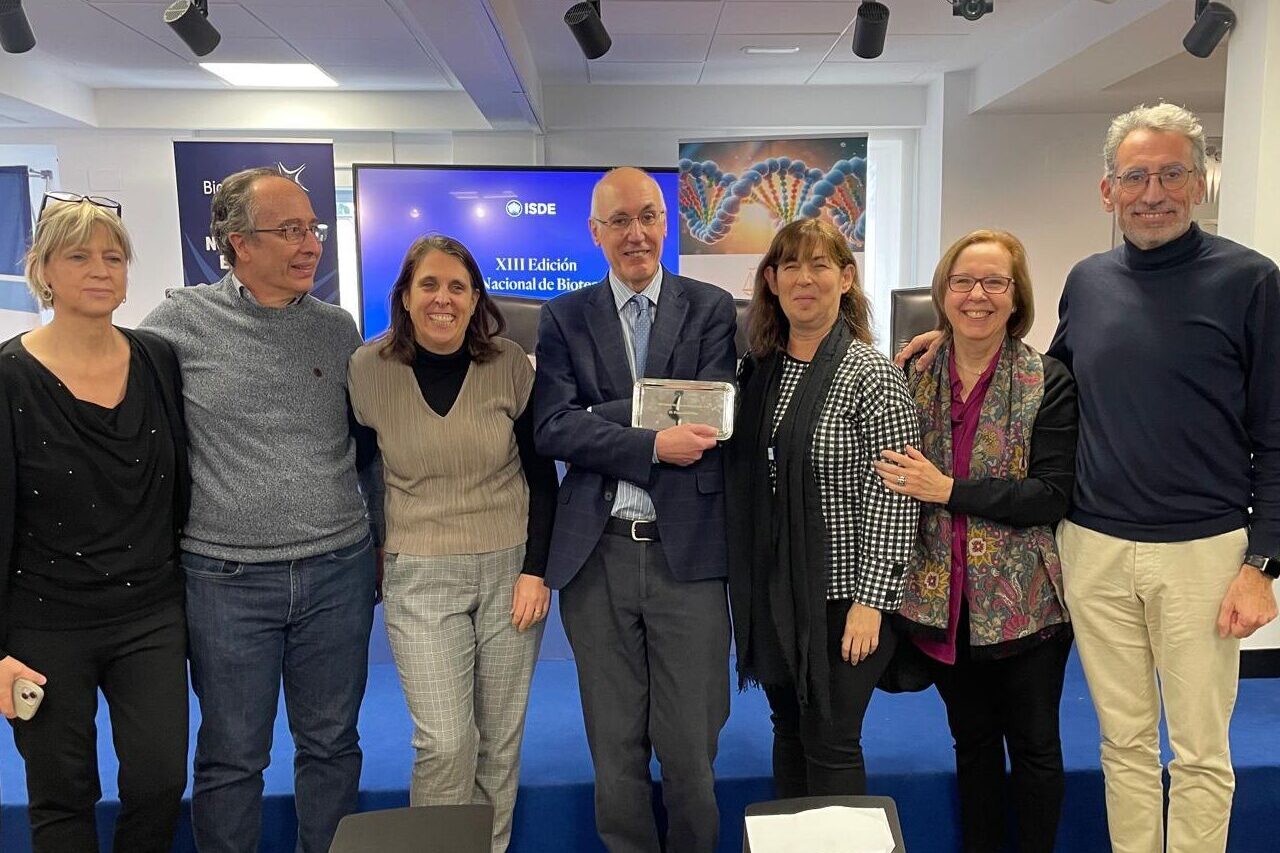
Fernando Peláez, director científico interino del CNIO, de pie en el centro, en el acto de entrega del XIII Premio Nacional de Biotecnología. /CNIO

El director científico en funciones del CNIO, Fernando Peláez, ha sido galardonado con el XIII Premio Nacional de Biotecnología, «un reconocimiento a quienes convierten ciencia en impacto real —desde el laboratorio hasta el mercado— con rigor, ética y visión de país», señala la Sociedad Española de Biotecnología (SEBiot).

El premio lo organiza la consultora en biotecnología y derecho Alpha Bioteclegal, con el apoyo de las empresas biotecnológicas Gold Standard Diagnostics, ISDE, Biofrontera Group, Condalab y BIOVEGEN. El jurado ha reconocido «los méritos de la trayectoria científica de Fernándo Peláez, que ha combinado tanto el trabajo en la industria como en centros de investigación de excelencia».

El premiado con compañeros del CNIO. Desde la izda.: Giovanna Roncador, Eduardo Caleiras, Isabel Blanco, Fernando Peláez, Francisca Mulero, Sagrario Ortega y Jorge Martínez Torrecuadrada. /CNIO

El jurado en esta edicion estuvo presidido por Martín Hernández-Palacios, director de Relaciones Institucionales del Alpha Bioteclegal, y formado por una veintena de personas expertas de instituciones de investigación y empresas biotecnológicas.

Fernando Peláez es expresidente de la Sociedad Española de Biotecnología. Entre 1999 y 2008 fue director del Centro de Investigación Básica de España (CIBE) de la empresa farmacéutica Merck, Sharp & Dohme (MSD), donde dirigió un equipo de más de 70 personas y jugó un papel clave en los proyectos de descubrimiento de fármacos en MSD a nivel internacional.

En 2008, se incorporó al Centro Nacional de Investigaciones Oncológicas (CNIO), como Director del Programa de Biotecnología, asumiendo la supervisión y coordinación de un departamento compuesto por nueve unidades de apoyo a la investigación cubriendo múltiples disciplinas científico-técnicas (Genómica, Proteómica, Histopatología, Anticuerpos Monoclonales, Animalario, Edición Génica en Ratón, Citometría de Flujo, Microscopía Confocal e Imagen Molecular). Ha sido también responsable administrativo del Animalario del CNIO, presidente del Comité Científico del Biobanco de la entidad y Jefe de Gabinete de la Dirección del CNIO. En enero de 2025 asumió la dirección científica en funciones del CNIO.

Fernando Peláez es miembro del Comité de Coordinación de la Plataforma Tecnológica Española de Medicamentos Innovadores (PTEMI) de Farmaindustria desde 2010, y entre 2021 y 2022 fue Coordinador de la Presidencia de la alianza SOMMa de centros Severo Ochoa y unidades María de Maeztu.

La entrada Fernando Peláez, galardonado con el XIII Premio Nacional de Biotecnología se publicó primero en CNIO.

Go to Source

‘In Search of New Earths’, an exhibition by the IAA-CSIC about the ESA’s PLATO mission, arrives at the MUNCYT

The Institute of Astrophysics of Andalusia (IAA-CSIC) is promoting this exhibition project, which combines informational panels, scale models, three-dimensional models, and real engineering pieces to bring the objectives of the PLATO mission closer to the public. The exhibition begins its tour at the National Museum of Science and Technology of Madrid (MUNCYT) in Alcobendas, where it will be on display until April 2026, and will then travel to other science museums throughout the country.

Go to Source

Assessing the robustness of the Galactic rotation curve inferred from the Jeans equations using Gaia DR3 and cosmological simulations

Assessing the robustness of the Galactic rotation curve inferred from the Jeans equations using Gaia DR3 and cosmological simulations

Koop O.; Antoja T.; Helmi A.; Callingham T.M.; Laporte C.F.P.
Astronomy and Astrophysics, Vol. 692, Num. A50 (2024)
Article

Go to Source

[X/Fe] Marks the Spot: Mapping Chemical Azimuthal Variations in the Galactic Disk with APOGEE

[X/Fe] Marks the Spot: Mapping Chemical Azimuthal Variations in the Galactic Disk with APOGEE

Hackshaw Z.; Hawkins K.; Filion C.; Horta D.; Laporte C.F.P.; Carr C.; Price-Whelan A.M.
Astrophysical Journal, Vol. 977, Num. 143 (2024)
Article

Go to Source

Euclid: High-precision imaging astrometry and photometry from Early Release Observations I. Internal kinematics of NGC 6397 by combining Euclid and Gaia data

Euclid: High-precision imaging astrometry and photometry from Early Release Observations I. Internal kinematics of NGC 6397 by combining Euclid and Gaia data

Libralato M.; Bedin L.R.; Griggio M.; Massari D.; Anderson J.; Cuillandre J.-C.; Ferguson A.M.N.; Lançon A.; Larsen S.S.; Schirmer M.; Annibali F.; Balbinot E.; Dalessandro E.; Erkal D.; Kuzma P.B.; Saifollahi T.; Verdoes Kleijn G.; Kümmel M.; Nakajima R.; Correnti M.; Battaglia G.; Altieri B.; Amara A.; Andreon S.; Baccigalupi C.; Baldi M.; Balestra A.; Bardelli S.; Basset A.; Battaglia P.; Bonino D.; Branchini E.; Brescia M.; Brinchmann J.; Caillat A.; Camera S.; Capobianco V.; Carbone C.; Car
Astronomy and Astrophysics, Vol. 692, Num. A96 (2024)
Article

Go to Source

Measurement of (Formula presented), (Formula presented), and (Formula presented) Decay Parameters Using (Formula presented) Decays

Measurement of (Formula presented), (Formula presented), and (Formula presented) Decay Parameters Using (Formula presented) Decays

Dekkers S.; Egede U.; Fujii Y.; Hadavizadeh T.; Henderson R.D.L.; Lane J.J.; Liu F.L.; Monk M.; Song R.; Walton E.J.; Ward J.A.; Bediaga I.B.; Camargo Magalhaes P.; Cruz Torres M.; De Freitas Carneiro Da Graca U.; De Miranda J.M.; dos Reis A.C.; Falcao L.N.; Gomes A.; Massafferri A.; Santoro L.; Sundfeld D.; Torres Machado D.; Amato S.; De Paula L.; Ferreira Rodrigues F.; Gandelman M.; Hicheur A.; Lopes J.H.; Nasteva I.; Nogarolli P.; Otalora Goicochea J.M.; Polycarpo E.; Rangel M.S.; Souza De P
Physical Review Letters, Vol. 133, Num. 261804 (2024)
Article

Go to Source

Kasner eons in Lovelock black holes

Kasner eons in Lovelock black holes

Bueno P.; Cano P.A.; Hennigar R.A.; Li M.-D.
Physical Review D, Vol. 110, Num. 124015 (2024)
Article

Go to Source

A new method of reconstructing images of gamma-ray telescopes applied to the LST-1 of CTAO

A new method of reconstructing images of gamma-ray telescopes applied to the LST-1 of CTAO

Abe K.; Abe S.; Abhishek A.; Acero F.; Aguasca-Cabot A.; Agudo I.; Alispach C.; Crespo N.A.; Ambrosino D.; Antonelli L.A.; Aramo C.; Arbet-Engels A.; Arcaro C.; Asano K.; Aubert P.; Baktash A.; Balbo M.; Bamba A.; Larriva A.B.; Barres de Almeida U.; Barrio J.A.; Jiménez L.B.; Batkovic I.; Baxter J.; González J.B.; Bernardini E.; Medrano J.B.; Berti A.; Bezshyiko I.; Bhattacharjee P.; Bigongiari C.; Bissaldi E.; Blanch O.; Bonnoli G.; Bordas P.; Borkowski G.; Brunelli G.; Bulgarelli A.; Burelli I
Astronomy and Astrophysics, Vol. 691, Num. A328 (2024)
Article

Go to Source

New constraints on gauged U1Lμ−Lτ models via Z − Z′ mixing

New constraints on gauged U1Lμ−Lτ models via Z − Z′ mixing

Asai K.; Miyao C.; Okawa S.; Tsumura K.
Journal of High Energy Physics, Vol. 2024, Num. 18 (2024)
Article

Go to Source

Neutrino mass bounds from DESI 2024 are relaxed by Planck PR4 and cosmological supernovae

Neutrino mass bounds from DESI 2024 are relaxed by Planck PR4 and cosmological supernovae

Allali I.J.; Notari A.
Journal of Cosmology and Astroparticle Physics, Vol. 2024, Num. 020 (2024)
Article

Go to Source

Sidebar