Un nuevo estudio liderado por investigadoras/es de la Universidad SWPS (Poznań, Polonia) y del CIMCYC (Universidad de Granada) analizó el papel de la regulación emocional y la atención en la tendencia a procrastinar. Los resultados sugieren que las personas que procrastinan con frecuencia podrían tener dificultades para controlar su atención durante la realización de tareas y mantener la concentración durante períodos prolongados
Seguir leyendo
A new study led by researchers from SWPS University (Poznań, Poland) and CIMCYC (University of Granada) offers new insights into the role of emotion regulation and attention in a tendency to procrastinate. The findings suggest that participants who frequently procrastinate might have difficulty controlling their attention during task completion and maintaining focus over longer periods of time.
Seguir leyendo
El premio Nobel de Fisiología o Medicina de este año acaba de ser concedido a quienes descubrieron cómo las defensas del organismo evitan atacar al propio cuerpo. El hallazgo de Shimon Sakaguchi, Mary Brunkow y Fred Ramsdell “fue decisivo para comprender por qué no todos desarrollamos enfermedades autoinmunes graves”, dice el Comité Nobel, y ha hecho avanzar los tratamientos para el cáncer y las enfermedades autoinmunes, entre otras áreas.
Pero es improbable que este descubrimiento hubiera impulsado tantos campos de no ser por otro desarrollo algo posterior, con sello español. En 2005 Giovanna Roncador y su equipo en el Centro Nacional de Investigaciones Oncológicas (CNIO) desarrollaron los anticuerpos que permiten identificar en muestras de tejido y suspensiones celulares a las células responsables del mecanismo descrito por Sakaguchi, Brunkow y Ramsdell.
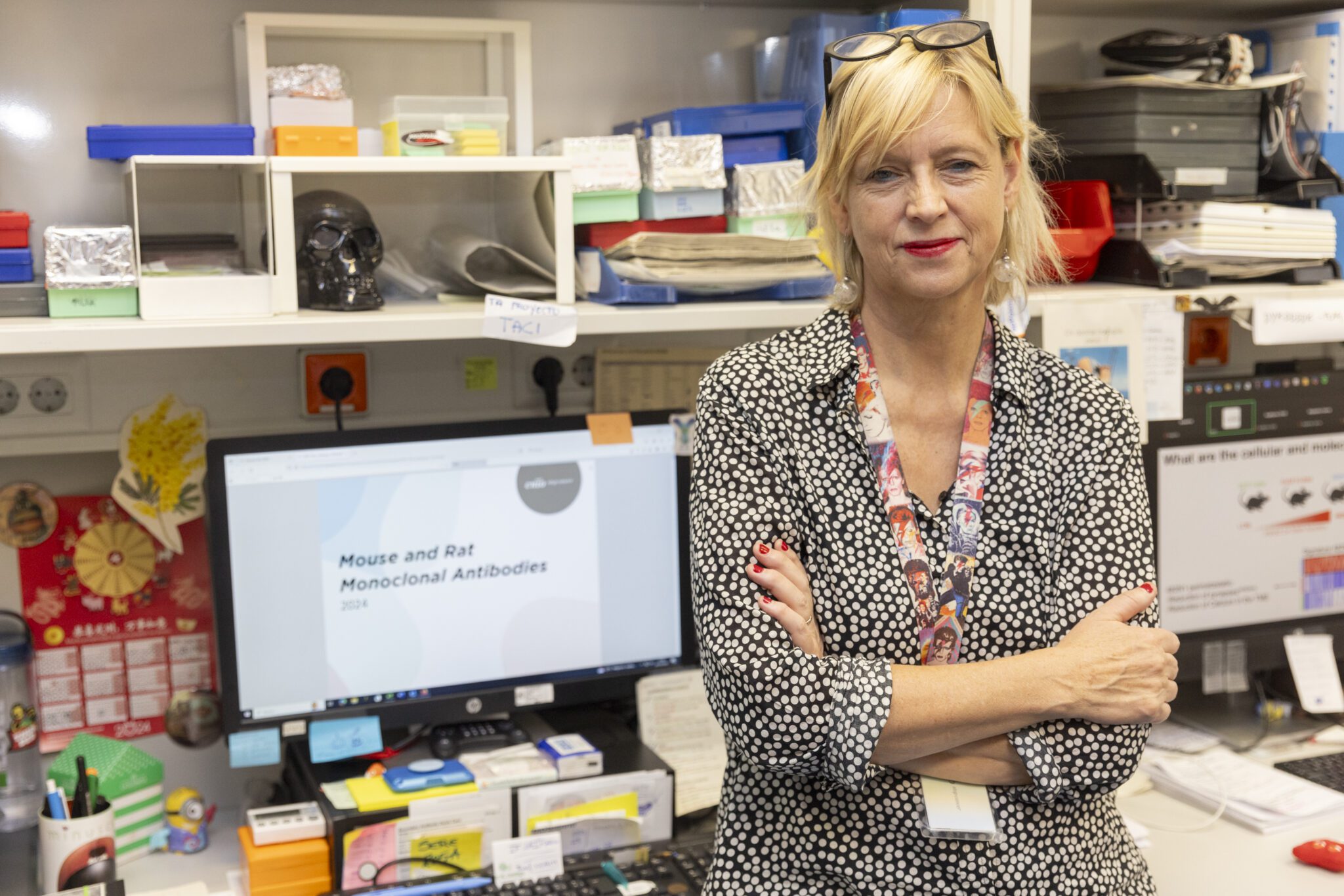
La Unidad de Anticuerpos Monoclonales del CNIO. /CNIO
Una de las licencias que más riqueza generaen todo el sistema de ciencia español
Sin estos anticuerpos, desarrollados en el CNIO en colaboración con Alison Banham, de la Universidad de Oxford, y presentados en la revista Journal of Immunology, hubiera sido mucho más difícil estudiar las células del sistema inmunitario cuya descripción se premia ahora, los linfocitos T reguladores.
No en vano estos anticuerpos se han convertido en las últimas dos décadas en uno de los productos biotecnológicos más demandados por la comunidad investigadora y farmacéutica mundial. La comercialización de su licencia genera ingresos para el CNIO de alrededor de un millón de euros anuales desde 2021; en total, más de 8.5 millones desde su creación. Es la licencia más productiva del CNIO, y una de las más productivas del sistema español de I+D+1.
La noticia del Nobel alegró ayer a Roncador, por lo que implica de reconocimiento, también, al valor de su propio trabajo: “Nuestros anticuerpos permitieron por primera vez aislar y estudiar los linfocitos T reguladores [del sistema inmunitario] tanto en muestras tisulares como en suspensiones celulares”, explica.
“Desde su publicación estos anticuerpos se han convertido en una herramienta de referencia mundial, ampliamente utilizada en el ámbito de la investigación básica y biomédica, y en el diagnóstico clínico”, añade.
La proteína que identifica a las células reguladorasdel sistema inmunitario
Se trata de anticuerpos monoclonales diseñados para engancharse químicamente a la proteína FOXP3, que es la proteína que identifica las células del sistema inmunitario linfocitos T reguladores. Estos linfocitos son los que monitorizan otras células defensivas y regulan su respuesta, para garantizar que el sistema inmunitario tolere los propios tejidos -esto es lo que que descubrieron a principios de los 2000 Sakaguchi, Brunkow y Ramsdell, desde ayer ganadores del Nobel-.
Como explica Roncador, “las células T reguladoras se distinguen del resto de los linfocitos por la expresión de la proteína FOXP3, considerada el marcador más específico de este tipo celular. La detección de FOXP3 requiere herramientas que permitan visualizar su presencia en células o tejidos, y los anticuerpos monoclonales constituyen el método más preciso y extendido para este propósito”.
Banderas que alertan al sistema inmunitario
Los anticuerpos son pequeñas proteínas que genera el sistema inmunitario para etiquetar invasores; gracias a su forma, muy específica, se enganchan a proteínas enemigas de manera muy precisa y actúan como banderas, alertando así a otras células del sistema inmunitario, que entran en acción. En los años setenta se desarrolló una técnica para crear en el laboratorio anticuerpos a medida, contra las proteínas deseadas: los anticuerpos monoclonales.
“Los anticuerpos monoclonales no son algo novedoso, la técnica para generarlos es de 1975, pero desde entonces han proporcionado una herramienta fundamental para conocer las funciones de determinadas proteínas, y también en el desarrollo de la inmunoterapia contra el cáncer”, explica Roncador, que es fundadora y actual presidenta de EuroMAbNet, la red europea que reúne a los máximos referentes en el campo de los anticuerpos monoclonales.
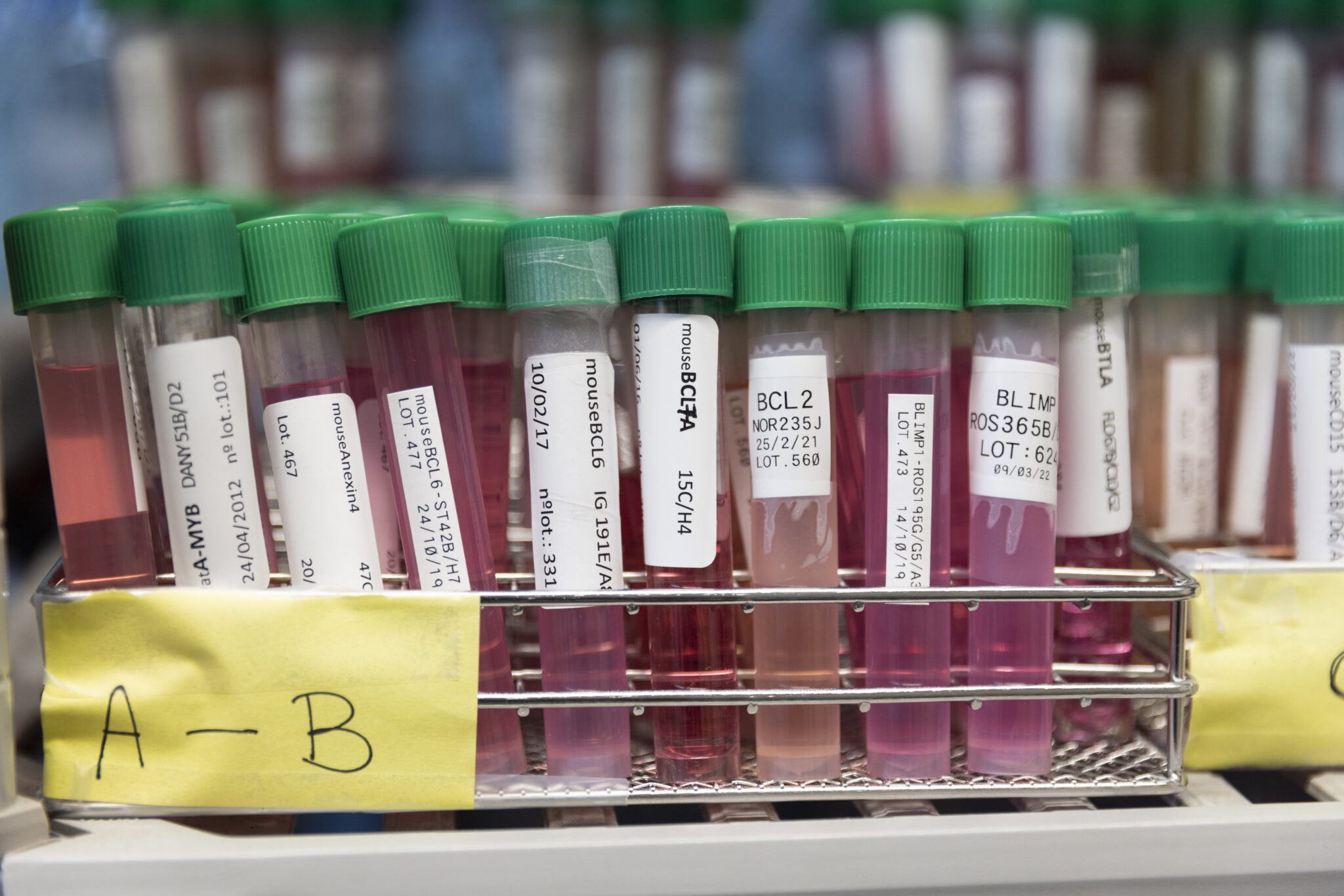
Anticuerpos monoclonales producidos en el CNIO. /Laura M. Lombardía. CNIO
13 millones de euros en 20 años
La Unidad de Anticuerpos Monoclonales del CNIO, que ella dirige, diseña, genera y licencia anticuerpos novedosos con alto impacto en la investigación y el diagnóstico del cáncer. En los últimos 25 años ha generado unos 150 anticuerpos monoclonales, perfectamente publicitados en un catálogoa disposición de la comunidad biomédica mundial. Sus licencias han generado al CNIO en las últimas dos décadas casi 13 millones de euros.
“Nuestros anticuerpos contribuyen al diagnóstico preciso del cáncer, y al desarrollo de terapias dirigidas que mejoran el tratamiento y los resultados de los pacientes”, dice Roncador.
Por ejemplo los anticuerpos contra FOXP3, la proteína en las células reguladoras del sistema inmunitario, tienen numerosas aplicaciones en investigación y en la clínica. FOXP3 es un reconocido biomarcador y factor pronóstico en tejidos tumorales de mama y colon. También se usan anticuerpos FOXP3 para definir biomarcadores en enfermedades autoinmunes, como lupus o artritis reumatoide, y en patologías alérgicas.
Sara Maestre, researcher at ICTA-UAB, has co-authored a new report for the European Commission titled “Co-creating nature-based solutions with commonly excluded stakeholders: Insights from practice and research.”
The Council of Ministers has approved the Royal Decree that will regulate the commission responsible for coordinating the actions during the solar eclipses of August 12, 2026, August 2, 2027 and January 26, 2028. The so -called ‘Iberian trio’ of Eclipses, visible almost exclusively from Spain, is a logistics and security challenge, in addition to an opportunity for research and scientific dissemination.
Gamification refers to the practice of incorporating game design elements and principles into non-game environments, like education. This is the case of the SUPERVAL game, developed by a team from the Institute of Chemical Research of Catalonia (ICIQ), coordinators of the European research project SUPERVAL. They present an educational card game to help secondary school students understand the carbon and nitrogen cycles in an interactive way. Players learn how these cycles function, how human activities can disrupt them, and how ecosystems can be restored.
“Communicating cycles like carbon and nitrogen is not straightforward—they are complex, invisible processes. The card game helps us translate those abstract concepts into actions that people can see, manipulate and understand. It’s a way to bring rigorous science closer to society,” said Marta Llorens Fons, ICIQ’s Scientific Communication Officer and co-creator of the game.
The SUPERVAL game was first presented during the European Researchers’ Night 2025 in Tarragona, an event that drew nearly 5,000 visitors. Over two days, children and adults continuously filled the play tables, confirming that the activity can engage audiences of all ages.
From Researchers’ Night to Schools
While the game was launched at the European Researchers’ Night, its main purpose is as an educational outreach activity for schools. Sessions, designed for students aged 14–16, include a short introduction to the carbon and nitrogen cycles, active card gameplay to assimilate the concepts, a video presenting SUPERVAL’s research actions and a final activity connecting theory to everyday products (such as those derived from ammonia or formate). Each interested school receives a kit with material which remains there for long-term use.
“Schools are at the heart of this initiative. But our commitment goes beyond the classroom: through activities like the European Researchers’ Night and other similar upcoming events, we aim to reach both younger generations and the wider public. Outreach is essential if we want people to understand not only what SUPERVAL researches, but also why it matters,” said Arnau Jordà Queral, ICIQ’s Project Communication Officer and SUPERVAL’s card game co-creator.
SUPERVAL will be contacting schools in Spain, Italy, the Netherlands, Denmark, and Germany to distribute the card game activity and teaching materials. At the same time, schools interested in taking part are welcome to reach out to the SUPERVAL team to request participation.
How the game works
The card deck represents the elements, processes, and impacts of the carbon and nitrogen cycles. Players work to build balanced cycles while facing “challenge cards” that introduce climate change consequences or human activities such as acid rain, intensive industry, or ozone layer depletion. To win, one player must complete all the processes of one cycle and apply strategies that restore ecological balance, such as playing a green industry card or promoting reforestation, mirroring real environmental challenges. The competitivity of the game naturally increases players’ motivation and fosters deeper engagement.
The concept of the game is based on research from SUPERVAL’s research objectives, which aims at developing sustainable technologies to transform nitrogen- and carbon-based pollutants into valuable products, contributing to climate change mitigation.
Funded by the European Union (101162513-ERN-ApuliaMED).
Funded by the European Union under grant agreement No. 101115456.
The ICN2 and CSIC spin-off has been selected for its innovative CO₂ mineralisation technology, which transforms industrial emissions of this gas into valuable carbonated products.
A project led by the Donostia International Physics Center (DIPC) that seeks to develop superconducting materials for future quantum computers has been awarded a €250,000-grant by the BBVA Foundation’s Fundamentos Programme.
Resolving the PREX-CREX puzzle in nuclear density functional theory
Date
Place
Pere Pascual V5.07 Room and via Zoom
Abstract: The simultaneous description of the recent Lead Radius Experiment II (PREX2) and Calcium Radius Experiment (CREX) parity-violating electron-scattering data poses a big challenge for nuclear energy density functional theory, which is referred to as the RREX2-CREX puzzle. While in the non-relativistic Skyrme-like energy density functional, it has been shown that a strong isovector spin-orbit interaction can reconcile the tension, I will present how this puzzle can be resolved within relativistic density functional theory using density-dependent point-coupling functionals with tensor couplings.
Data-driven diagnosis of the Milky Way disk dynamics
Date
Place
“Aula Magna Enric Casassas”, Physics Faculty
Abstract: Let’s start with a thought experiment: Imagine an ideal river in which we can measure with perfect precision both the position and the velocity of every water particle. If this river is unperturbed, these particles move together, with their velocity vectors pointing to the same direction. Now place a rock somewhere upstream: as particles encounter the obstacle, their paths are deflected, and downstream the once–uniform velocity distribution bears a characteristic distortion that encodes the rock’s size, shape, and location.
In galactic dynamics, the water becomes the stars and the rock can be anything from the Galactic bar to a passing dwarf galaxy. Thanks to the Gaia mission and other surveys, we now have an amazing six-dimensional map of stellar positions and velocities in the Solar Neighbourhood. By measuring local deviations from an equilibrium velocity distribution, we aim to infer the unseen mass distribution of the Milky Way and reconstruct its past encounters with other galaxies.
Tribunal:
President: Dr. Amina Helmi
Secretary: Dr. Francesca Figueras Siñol
Vocal: Dr. Jason Hunt
Suplents:
Dr. Friedrich Anders
Dr. Daisuke Kawata
Directors: Dr. Maria Teresa Antoja Castelltort and Dr. Pau Ramos Ramírez

.png?h=7cc5cb94&itok=7VpNwbPT "procrastinación, la regulación emocional y la atención")