Gravity Is Not a Fundamental Force: Renormalization Group Flow Induced Gravity
Date
Place
Online, via Zoom
Abstract: We revisit the holographic renormalization group (RG) setting in which a 4-dimensional (4d) quantum field theory at a finite cutoff corresponds to/is described by the Einstein gravity on a part of AdS5 space, cutoff at a finite radius. This holographic setting has interesting and important implications for the 4d field theory: Deformation of the field theory by a certain combination involving the square of its energy-momentum tensor can be alternatively viewed as formulating the field theory on a background with a dynamical metric. Explicitly, starting with a non-gravitating 4d field theory in the UV, flowing to the IR, quantum effects that we compute using the classical 5d Einstein gravity theory, induce an effective 4d Einstein gravity theory. In other words, we show that gravity is not a fundamental force and is an effective description of quantum effects in the IR limit.
The local Milky Way unveiled by its OB stars and associations
Date
Place
DAM 7.24 Seminar Room and via Zoom
Abstract: From star formation to stellar multiplicity, O- and B-type stars constitute vital tools across many areas of astronomy. Being short-lived, they remain close to their birth environment, and can therefore serve as tracers of the position and motion of their birthplaces, such as the Galactic spiral arms. Furthermore, they effectively act as both creators and destructors of stellar systems, and therefore life. Through their feedback processes, they enrich the interstellar medium in new chemical elements subsequently used to form new stars and planets, but their powerful core-collapse supernova explosions are able to deplete the atmosphere of Earth-like planets in their vicinity, thereby engendering cataclysmic events. They also constitute the brightest members of OB associations, which are young, low-density and gravitationally unbound stellar groups. As a transition between star-forming regions and the Galactic field population of stars, OB associations are crucial to study early stellar evolution and Galactic structure.
Gaia data offers an unprecedented opportunity to provide more extensive and accurate 3D maps of the spatial distribution of OB stars than ever before. During the first part of this talk, I will present my catalogue of 24,706 O- and B-type stars (effective temperature greater than 10,000 K, hereafter OB stars) within 1 kpc of the Sun, by applying evolutionary and atmospheric model fits to observed SEDs compiled from astro-photometric survey data, and assessing its quality by comparing it with other Gaia-based catalogues of OB(A) stars.
During the second part of the talk, I will discuss the various applications enabled but this highly-reliable and complete catalogue of OB stars. This includes the calculation of several quantities such as the scale height of the OB stars, as well as the local and Galactic star formation and core-collapse supernova rates, with statistics compatible with a past mass extinction event on Earth caused by a nearby supernova. Moreover, the local surface density formation rate derived from these OB stars, compared with a recent catalogue of star clusters, shows that star formation primarily occurs in compact clusters, in agreement with the clustered scenario of star formation. From this census were identified runaway stars as well, with estimated runaway fractions of 20% and 7% for the O- and B-type stars, respectively.
Finally, I have applied the clustering algorithm HDBSCAN on the 3D position and the proper motions of these OB stars. In doing so I have identified 57 new OB associations within 1 kpc, substantially increasing the census in this volume, whose validity I have assessed by comparing their members with individual OB associations alongside modern catalogues of young stellar groups and open clusters. I have characterized these OB associations physically and kinematically, and found most of them are expanding in at least one direction. By comparing their location with surrounding superclouds such as the Radcliffe Wave, I show that these OB associations serve as tracers of the star formation history of the local Milky Way, encouraging to extend this census to larger distances where the position and motion of the Galactic spiral arms can be traced.
Una vez al año, las y los estudiantes –de doctorado y posdoctorales– del Centro Nacional de Investigaciones Oncológicas (CNIO) toman la palestra para mostrase entre sí y a sus ‘mayores’ sus avances de los últimos doce meses. Las preguntas, las hipótesis, los experimentos, los resultados y las aún más preguntas que han surgido de ellos. El ‘CNIO Lab Day’ son dos días para mostrar los hallazgos individuales, que siempre son resultado de esfuerzos conjuntos.
“Sois uno de los grandes valores del CNIO, un magnífico centro en el que obtenemos muchos e importantes resultados», dijo a las y los jóvenes investigadores Fernando Peláez, director científico en funciones, al abrir las jornadas. «El CNIO es magnífico entre otras cosas por vuestro talento, vuestra ambición para superaros y avanzar en vuestras carreras. Seguid así, haciendo ciencia de la buena”.
El director gerente del CNIO, José Manuel Bernabé, les animó a persistir en su labor con la misma entrega y afán de superación.
Marisol Soengas, decana del Decanato para Asuntos Académicos, destacó “el sentido de comunidad y orgullo por nuestra ciencia» que transmite el Lab Day, y se dirigió a las y los jóvenes: “El CNIO cuenta con un potente motor, vosotras y vosotros, que nos ayudará a avanzar al lugar que nos corresponde: la primera línea de la investigación del cáncer”.
Organizado por las asociaciones CNIOSA (doctorandos del CNIO) y PDA (estudiantes posdoctorales), con el apoyo del Decanato para Asuntos Académicos, el Lab Day incluye 18 charlas breves de cinco minutos; 19 charlas flash, de un minuto; y 67 pósters, que son evaluados por científicos y científicas del CNIO.
Agradecimiento a las y los evaluadores de los 67 pósters presentados. Sergi Roig (dcha) y Miguel Curto recogen en nombre de Susana Llanos el premio a los evaluadores. Entrega Elena Rodríguez.
Cada jornada contó además con una ponencia invitada: la primera corrió a cargo de Laura Soucek, Codirectora del Programa de investigación preclínico y traslacional del Vall d’Hebron Instituto de Oncología (VHIO). La también CEO de Peptomyc S.L. habló de su trayectoria profesional, con especial incidencia en la compaginación de las facetas científica y emprendedora.
Laura Soucek (VHIO). / Christian Esposito. MadMoviex. CNIO
En la siguiente jornada Daniel Mediavilla, periodista de ciencia del diario El País, abordó los retos de la comunicación de la ciencia al gran público.
El periodista Daniel Mediavilla (centro), con Alejandro Alonso y Sonia Burgaz. / Christian Esposito. MadMoviex. CNIO
El Lab Day concluyó con la entrega de nada menos que quince premios.
Premios de la dirección científica:
A la excelencia para investigadores postdoctorales o sénior: Marta Hergueta
Marta Hergueta Redondo y Fernando Peláez. / Christian Esposito. MadMoviex. CNIO.
A publicaciones de doctorado: María del Mar Rigual (premio Antonia Nieto), Ernesto López de Alba, Joseph Sneath Thompson, Cristina Bodas y, en coautoría, Nanan Xue y Sergio Sabroso.
Marta Hergueta Redondo y Fernando Peláez.Irene Felipe recoge el premio de Cristina Bodas de manos de Fernando Peláez. Joseph Sneath Thompson (izda) y Fernando Peláez. Ernesto López de Alba agradece su premio por videollamada. Mar Rigual
A acciones de divulgación y voluntariado: Ana Isabel Sáez Mas (@bioindignada), quien se conectó online. Lo entregó Begoña de la Peña, que ha dejado un legado al CNIO, con una alusión muy emotiva,y fue recogido por Sonia Burgaz.
Anabel Sanz agradece en llamada de vídeo el premio de divulgación y voluntariado.Sonia Burgaz (izda) recoge el premio a Anabel Sanz, entregado por Begoña de la Peña (centro) y presentado por Marisol Soengas (izda).
Premios de CNIOSA y el Decanato de Asuntos Académicos:
A las mejores ponencias: Ángel Fernández Sanromán (1º), María Olano Díaz (2º), Carlos Martínez Garay (3º). Los entregó Laura Halpern, presidenta de la Fundación Occident, que resaltó la larga colaboración de su institución con el CNIO.
Desde la izda: Laura Halpern (Fundación Occident) con Ángel Fernández, María Olano y Carlos Martínez. / Christian Esposito. MadMoviex. CNIO
A mejor póster: ex aequo a José María Gracia, Juan José Vázquez, Tomáš Sanislo y Lucía de la Mata.
Ganadores del mejor póster. Desde la izda: José María Gracia, Juan José Vázquez, Tomáš Sanislo y Lucía de la Mata. / Christian Esposito. MadMoviex. CNIO
· A mejor diseño de camiseta: Carlos Martínez Garay
Carlos Martínez Garay, con el premio al mejor diseño de camiseta, junto a Bárbara Baez (centro) y Sonia Burgaz (izda). / Christian Esposito. MadMoviex. CNIO
El equipo de Aura Carreira, en el Centro de Biología Molecular Severo Ochoa (CBM, CSIC-UAM), ha dado un paso importante para entender por qué algunas mutaciones del gen BRCA2 pueden impulsar el desarrollo del cáncer de formas mucho más complejas de lo que se pensaba. Hasta ahora, la mayoría de estudios asumían que el riesgo cancerígeno asociado a BRCA2 se debía principalmente a la pérdida total de su función. Sin embargo, este nuevo trabajo muestra que incluso una pérdida parcial o la presencia de una versión incompleta de la proteina ya puede desorganizar procesos celulares esenciales.
BRCA2 es un gen crucial para mantener la estabilidad del ADN. La proteína codificada por este gen se encarga de coordinar la recomposición de roturas en el ADN mediante un mecanismo muy preciso llamado recombinación homóloga, algo así como un sistema de reparación de alta fidelidad. Cuando esta “herramienta” no está o no funciona bien, la célula acumula errores y pueden iniciarse procesos que favorecen la aparición de tumores.
El grupo de Carreira analizó el impacto de dos mutaciones patogénicas de BRCA2, ambas asociadas a riesgo de cáncer de mama. Para ello emplearon células epiteliales mamarias normales, no tumorales, con el fin de reproducir lo que ocurre en un tejido sano antes de que aparezca un tumor.
La primera mutación impedía que BRCA2 produjera su proteína. Es decir, de las dos copias de este gen que tiene cada célula, solo una seguía funcionando. Este escenario se conoce como haploinsuficiencia, y significa que “media dosis” del gen no basta para mantener la reparación del ADN en niveles normales. Las células con esta mutación mostraron una capacidad reducida para reparar roturas del ADN y, además, se volvieron más sensibles a los inhibidores de PARP, un tipo de fármaco utilizado en pacientes de cancer de mama asociado a BRCA2. En la práctica, estas células se quedaban sin opciones eficientes para reparar su ADN, acumulaban daños y se volvían vulnerables. Esto confirma que, incluso sin perder completamente BRCA2, las células ya pueden comportarse de forma problemática y responder de manera distinta a ciertos tratamientos oncológicos.
La segunda mutación fue aún más llamativa. En este caso, el gen producía una proteína truncada, es decir, una versión incompleta de BRCA2. Podría pensarse que algo “a medias” simplemente no funciona, pero aquí ocurre algo peor: esta variante incompleta interfiere con la proteína BRCA2 normal. No solo deja de ayudar, sino que dificulta el trabajo de la proteína BRCA2 intacta.
El estudio reveló además que esta proteína truncada “secuestra” a PCAF, una enzima que regula la acetilación de histonas, unas proteínas que funcionan como carretes alrededor de los cuales se enrolla el ADN. La acetilación, y en particular la de la histona H4, actúa como una marca que abre el ADN para activar genes concretos. Cuando PCAF queda atrapada por la proteína truncada, estas marcas químicas se reducen de manera global.
Esto tiene consecuencias profundas: se silencian programas de expresión génica que deberían estar activos y se apaga la señalización NF-κB, una vía que coordina la inflamación, las defensas celulares y la supervivencia ante estrés. Al alterarse esta vía, las células cambian su comportamiento, incluyendo cómo se mueven dentro del tejido (migración epitelial). Estos cambios en movilidad y respuesta al entorno pueden influir directamente en la capacidad de un tumor para avanzar o invadir.
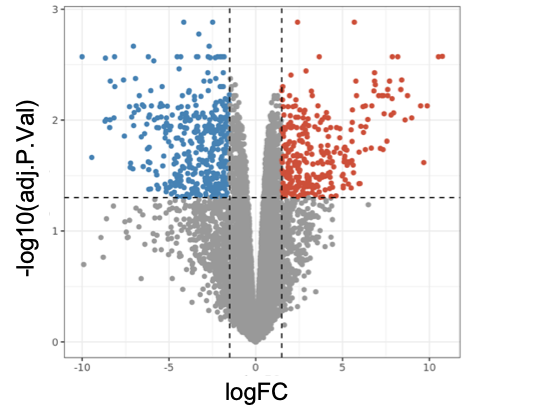
Este gráfico muestra que la mutación patogénica c.5946delT altera la actividad de cientos de genes (azul, subexpresados, rojo, sobreexpresados) con respecto a células epiteliales de mama con expresión de BRCA2 normal. / Aura Carreira, CBM
Los resultados destapan así un nuevo eje BRCA2–PCAF que modula de forma inesperada la actividad de NF-κB y reprograma la expresión de múltiples genes. La idea de que ciertas mutaciones de BRCA2 pueden “reconfigurar” la célula capturando enzimas clave y manipulando redes de señalización añade una capa de complejidad al papel de este gen en el cáncer.
Comprender estos mecanismos abre oportunidades para desarrollar terapias más personalizadas. “Saber qué tipo de mutación de BRCA2 tiene un paciente podría ayudar a predecir su respuesta a ciertos fármacos, como los inhibidores de PARP, y también permitir diseñar estrategias que corrijan o compensen los efectos de la proteína truncada”, indica Carreira.
En conjunto, este trabajo contribuye a una visión más completa y matizada del papel de BRCA2 en la biología del cáncer e impulsa nuevas líneas de investigación hacia tratamientos más precisos y eficaces.
Este trabajo ha sido financiado por una ayuda conjunta de la Worldwide Cancer Research (UK) y la Asociación Española Contra el Cáncer.
Referencia
Minello*, Gomez-Escudero*, Sridhara* et al., Nature Communications. DOI: 10.1038/s41467-025-67209-2
The ioChem-BD platform has reached 1,000 records, marking a significant achievement for open-access data in computational chemistry. Created by scientists at the Institute of Chemical Research of Catalonia (ICIQ) and the Universitat Rovira i Virgili (URV), ioChem-BD enables researchers to store, manage, share, and reuse data generated from computational chemistry and materials science projects. The platform is closely linked to ICIQ research activities and supports an expanding community of users worldwide.
“This milestone holds great relevance for our team and arriving here in 2025 is something we had not anticipated,” said Prof. Carles Bo, group leader at ICIQ and one of the creators of ioChem-BD. “We are very pleased to see how the platform continues to grow and support the community.”
This achievement highlights the growing importance of computational chemistry research. Today, more than a third of published scientific papers in chemistry, materials science, physics and biochemistry include computational studies, which account for around 30% of worldwide high-performance computing resources. ioChem-BD supports this expanding field by making results easier to publish, search and reuse.
A global platform for managing scientific data
ioChem-BD was created to help manage the increasing amounts of computational data produced by research. Traditional methods are no longer suitable for analysing the so-called Big Data generated by these studies. The platform provides services to store, organise, analyse, index and search data through a modular software system. Its central Find module, hosted at the Barcelona Supercomputer Center (BSC), offers a fast chemical-aware search engine open to the public.
The platform automates the extraction and transformation of raw numerical results into labelled information that researchers can publish, share and visually explore. Its user community includes academic researchers and companies.
ioChem-BD began in 2014 as an open software project led by Prof. Carles Bo and software engineer Moisés Àlvarez, with support from ICIQ computational chemistry groups led by Prof. Núria López and Prof. Feliu Maseras, in collaboration with URV, UAB and ICREA. Over the years it has received support from the RES supercomputing network, as well as funding from the European Research Council (ERC) Proof of Concept Grant BigData4Cat and the EU-funded OSCARS initiative.
“This isn’t simply a number,” said ioChem-BD project manager Dr Gabriela Dias Da Silva. “It represents a story that started as local project and, with time, evolved into a shared mission.”
Understanding records and the value of open science repositories
The 1,000 records represent collections of curated and published research data stored and shared through the platform. Repositories like ioChem-BD are essential for open science as they allow results to be made Findable, Accessible, Interoperable and Reusable (FAIR), supporting transparency and enabling researchers to build upon previous work.
Since its creation, ioChem-BD has been recognised by several major scientific organisations. It has been included by the ERC in its guidance on open research data; recommended by the American Chemical Society in guidelines for submitting computational results; and listed by the International Journal of Quantum Chemistry as a solution for sharing computational data. The platform has also been selected for The Collider entrepreneurship programme of the Barcelona Mobile World Capital Foundation.
The Centre for Plant Biotechnology and Genomics (CBGP-UPM-INIA/CSIC) welcomes the outcome of the negotiations between the Council of the European Union and the European Parliament regarding the Commission’s proposal for a regulation on new genomic techniques (NGTs).
El cáncer y las afecciones cardiovasculares y neurodegenerativas tienen como raíz común el envejecimiento. Pero la investigación de los últimos años ha desvelado que el envejecimiento no es un único proceso sino muchos, y ha llegado el momento de entender cómo interaccionan todos entre sí. Es decir, quienes han descubierto las piezas del puzle deben ahora montarlas.
Lo han expuesto recientemente en el Centro Nacional de Investigaciones Oncológicas (CNIO) los participantes en el CNIO-CaixaResearch Frontiers MeetingMolecular and Cellular Hallmarks of Aging: 3rd edition, un congreso que ha reunido a una veintena de ponentes de Europa y Estados Unidos y que ha sido organizado por Thomas Rando, director del Centro Broad de Investigación de Células Madre (Los Ángeles, EE.UU.), y los investigadores del CNIO Maria A. Blasco y Alejo Efeyan.
Co-organizado por Thomas Rando, director del Centro Broad de Investigación de Células Madre (Universidad de California en Los Ángeles, EE.UU.), y los investigadores del CNIO Maria A. Blasco y Alejo Efeyan, el encuentro ha reunido a una veintena de ponentes de Europa y Estados Unidos.
Más de una década desvelando los indicadores de envejecimiento
“El fin último es tratar las enfermedades asociadas al envejecimiento, cuya incidencia está aumentando y para las que no tenemos aún terapias que funcionen, y prolongar la salud en esta etapa de la vida”, señala Blasco.
Los procesos que contribuyen al envejecimiento son numerosos. El sistema de limpieza de las células deja de eliminar sustancias tóxicas. Hay células que dejan de dividirse, y se quedan en el estado llamado senescencia. El sistema inmunitario deja de reconocer amenazas, como la proliferación anómala de células que desembocarán en un tumor. Las células madre pierden la capacidad de diferenciarse en tipos distintos de células, y dejan de regenerar tejidos u órganos.
Estos sucesos no ocurren de forma aislada, pero así es como han sido estudiados tradicionalmente. “Ahora estamos empezando a entender que hay procesos que funcionan a diferentes niveles, molecular, celular y de órgano, y todos contribuyen al envejecimiento”, afirma Efeyan.
En 2013 se publicó en la revista Cell el estudio pionero Hallmarks of Aging, que sentó las bases del área al identificar nueve indicadores moleculares del envejecimiento y decir sobre cuáles se podría actuar. En 2023 una revisión aumentó a doce esos indicadores, procesos medibles que, al ser manipulados, aceleran o frenan el deterioro del cuerpo con la edad.
Reforzar la protección de los cromosomas
Blasco investiga los telómeros, estructuras moleculares que protegen los cromosomas. Su grupo en el CNIO ha demostrado que el acortamiento de los telómeros, que ocurre progresivamente con el paso del tiempo, está en el origen de enfermedades asociadas al envejecimiento como la fibrosis pulmonar.
Blasco ha creado una empresa para desarrollar tratamientos contra la fibrosis pulmonar basados en la activación de la telomerasa, la enzima encargada de reparar los telómeros.
Esta estrategia, regular la telomerasa, también fue abordada en el congreso por Steven Artandi (Instituto del Cáncer de Stanford) y Mary Armanios (Universidad Johns Hopkins, Baltimore, EE.UU.), cuyos resultados “validan el posible uso de la activación de la telomerasa para tratar enfermedades del envejecimiento”, indica Blasco.
Menos fármacos y más terapias biológicas
Las terapias celulares fueron igualmente un tema central. “El siglo XXI será el del uso de células como terapia”, opina Rando. Para él, las células madre “se podrían usar para regenerar tejidos, repararlos o reforzarlos a lo largo de toda la vida”.
Ana María Cuervo (Universidad Albert Einstein de Medicina, EE.UU.) habló del posible uso de la autofagia celular, el proceso de limpieza y reciclaje de las células, para ralentizar el envejecimiento e intentar prevenir las enfermedades que desencadena.
Eileen P. White investiga la caquexia, el deterioro del organismo que viene a ser la causa última de la mayoría de las muertes por cáncer; su fin es “prevenirla, revertirla o en general mejorar la calidad de vida de los pacientes”, afirma esta investigadora del Instituto Rutgers de Cáncer, EE.UU.
Las células senescentes
Es “inspirador”, dicen White y otros ponentes, descubrir tantas áreas de solapamiento en el congreso. Si la caquexia está relacionada con el metabolismo y el sistema inmunitario, “las células senescentes lanzan mensajes a las células vecinas, no podemos seguir estudiándolas como si estuvieran aisladas”, explica Efeyan, jefe del Grupo de Metabolismo y Señalización Celular del CNIO.
Se ha comprobado la capacidad de las células senescentes para avivar un tumor, y ya se han desarrollado fármacos para eliminarlas o inhibirlas, llamados senolíticos, que ya han llegado a la fase de ensayos clínicos.
El metabolismo y la dieta restrictiva
Estudios en células y en modelos animales confirman que “la restricción de alimento es la intervención más efectiva para extender la longevidad, ahora intentamos entender por qué”, afirma Efeyan. No obstante, “hay que tener mucho cuidado a la hora de extrapolar a la dieta humana los efectos en células o modelos animales”, subrayó.
Es un área de intensa investigación. Modificar el metabolismo mediante la restricción calórica puede afectar a “la interacción entre la senescencia, la resiliencia y la regeneración celulares”, explica Adam Antebi (Instituto Max-Planck para la Biología del Envejecimiento, Alemania).
Hábitos de vida saludables
Su intervención destacó que la respuesta a la alternancia entre el ayuno y la ingesta de alimentos depende de la edad, por lo que “a lo mejor en humanos el ayuno intermitente sería bueno a los cincuenta años, pero a los setenta puede ser diferente”.
Por su parte Pekka Katajisto (Universidad de Helsinki, Finlandia) expuso cómo una célula madre puede dejar de serlo si se manipula su metabolismo.
Guadalupe Sabio, jefa del Grupo de Interacciones Metabólicas del CNIO, habló de los beneficios del ejercicio para la salud metabólica y la respuesta inmunitaria, y múltiples ponencias aludieron a la nutrición.
Participantes en el CNIO-CaixaResearch Frontiers Meeting «Molecular and Cellular Hallmarks of Aging» / Christian Esposito (MadMoviex). CNIO
Los CNIO-CaixaResearch Frontiers Meetings son conferencias internacionales de gran prestigio sobre aspectos candentes de la investigación del cáncer. En ellos, una veintena de conferenciantes invitados procedentes de todo el mundo presentan sus hallazgos más recientes. Participan además otro centenar de expertos seleccionados por el interés de sus aportaciones en forma de pósters o presentaciones breves.
Research led by Donostia International Physics Center (DIPC) compares cold, warm, and wave dark matter models to explain surprising galactic shapes seen by the James Webb Space Telescope. The work published in Nature Astronomy opens a new window into the mysterious nature of dark matter
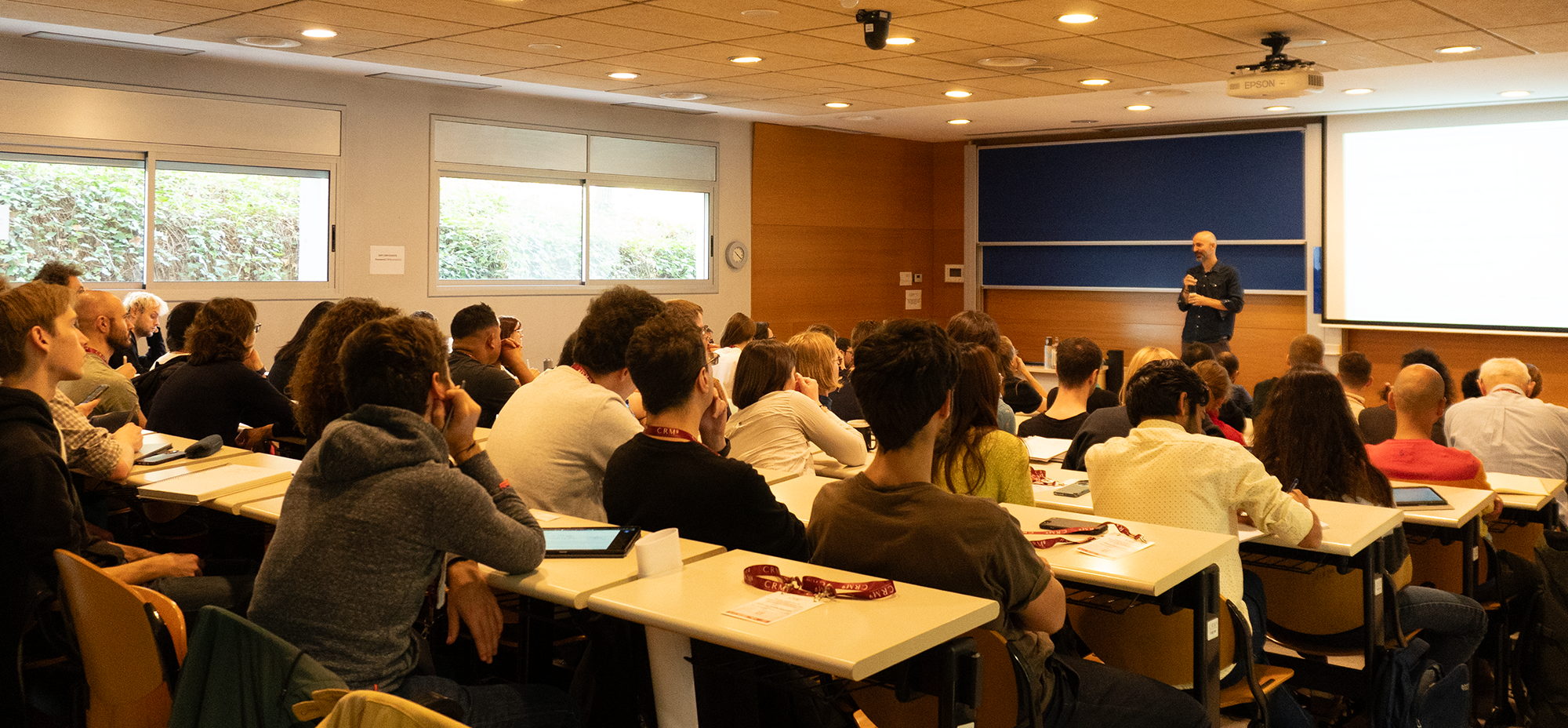
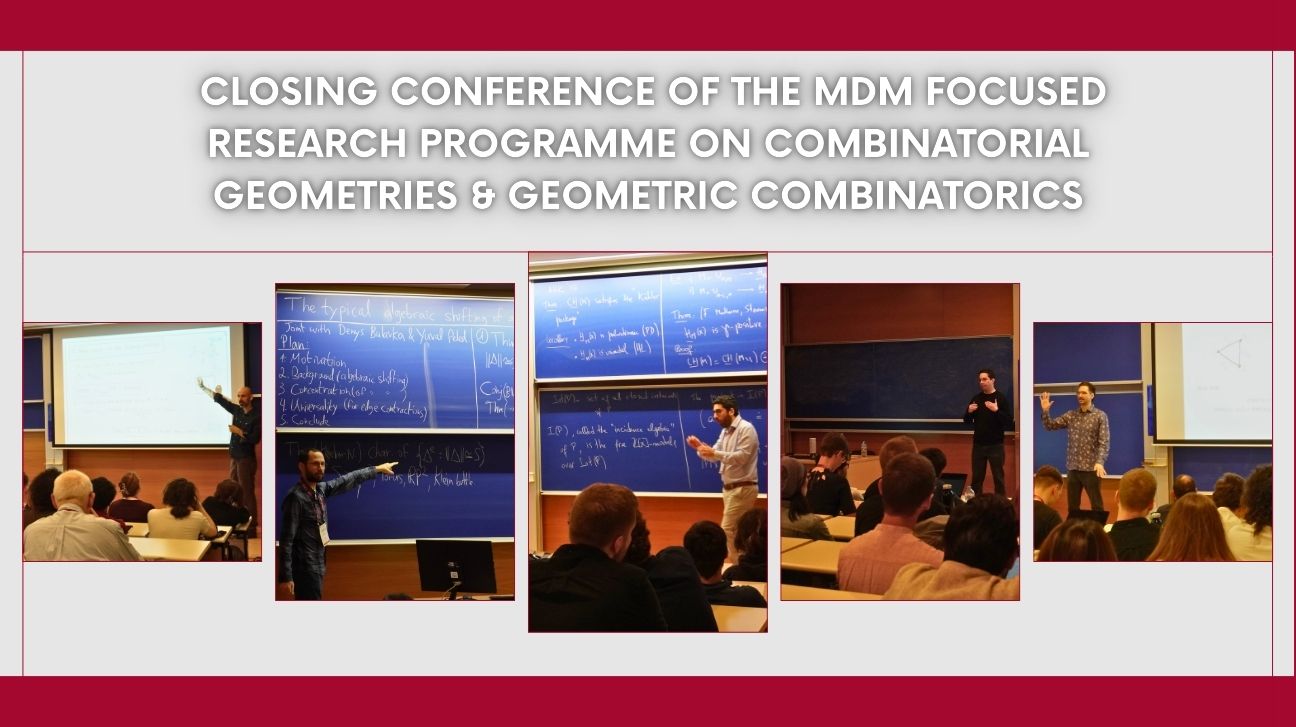
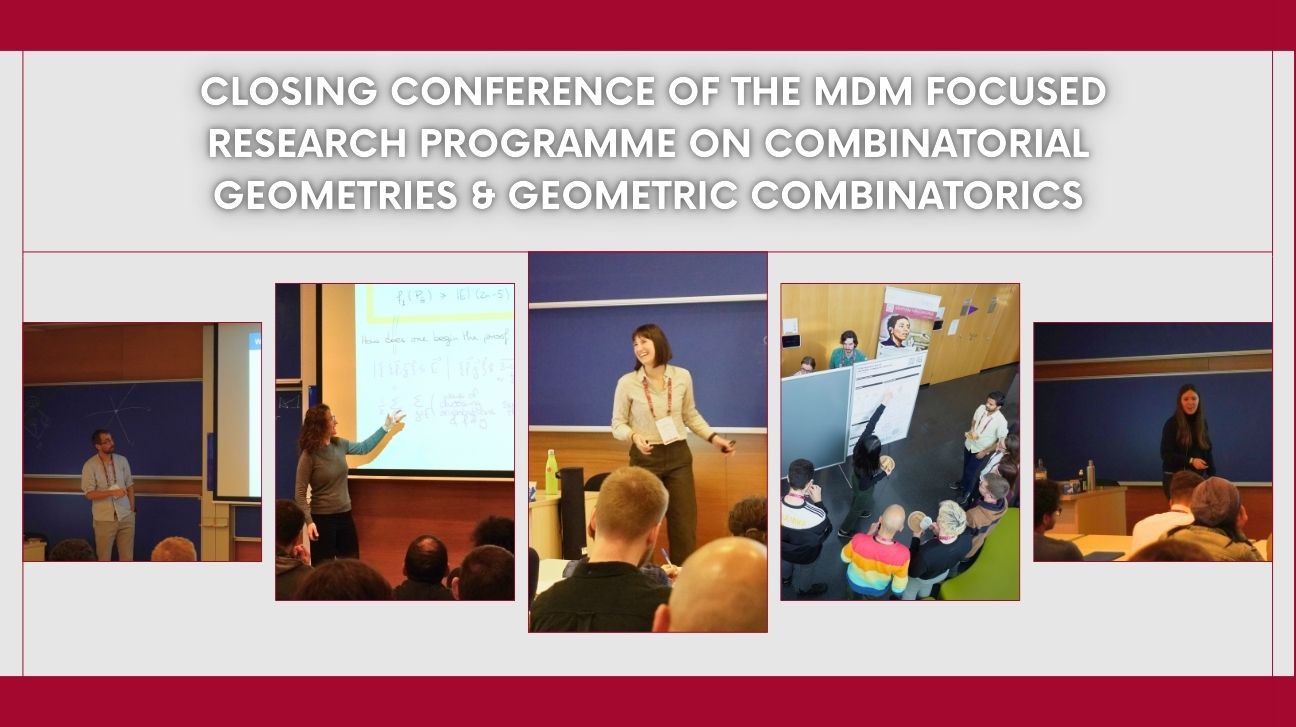
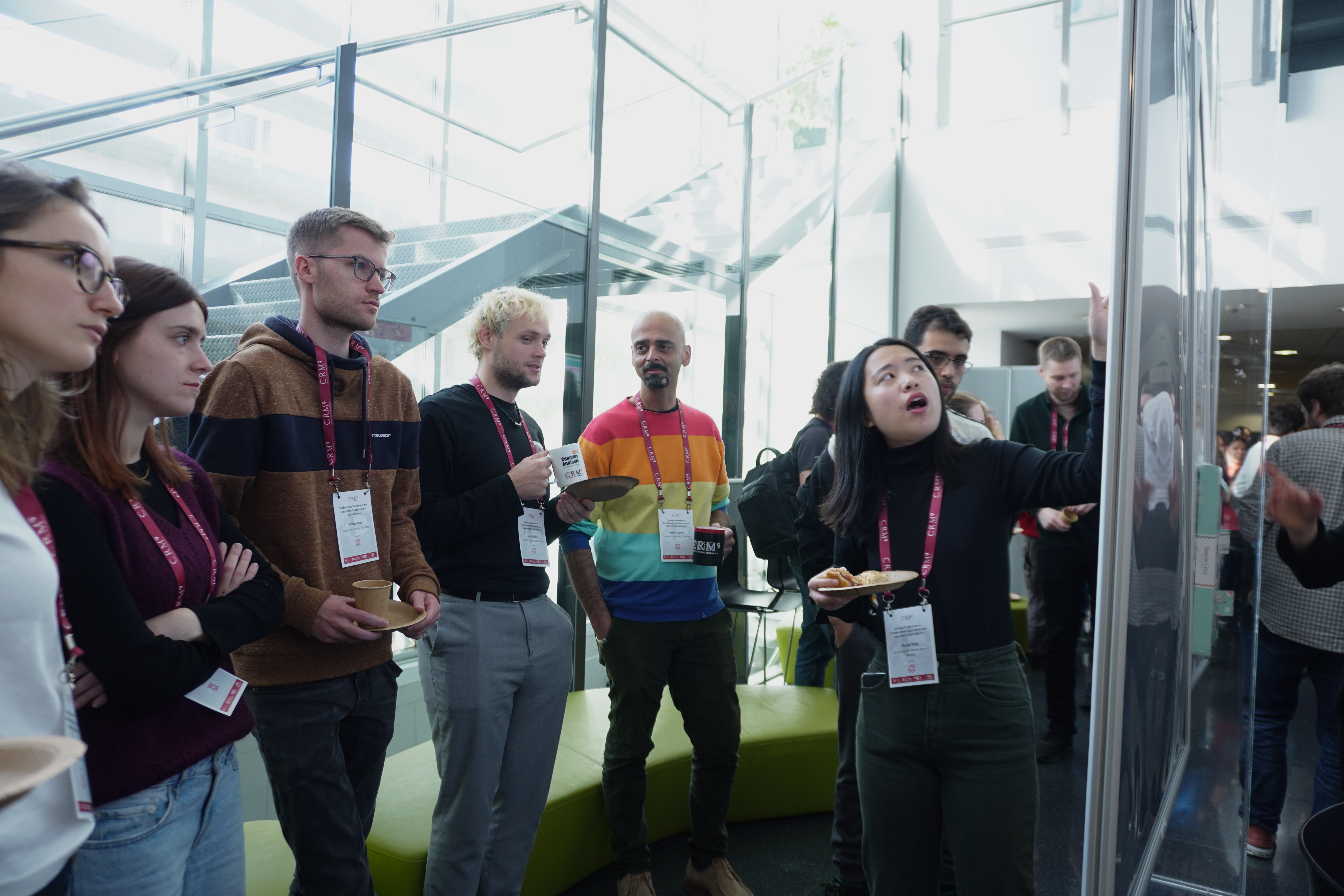
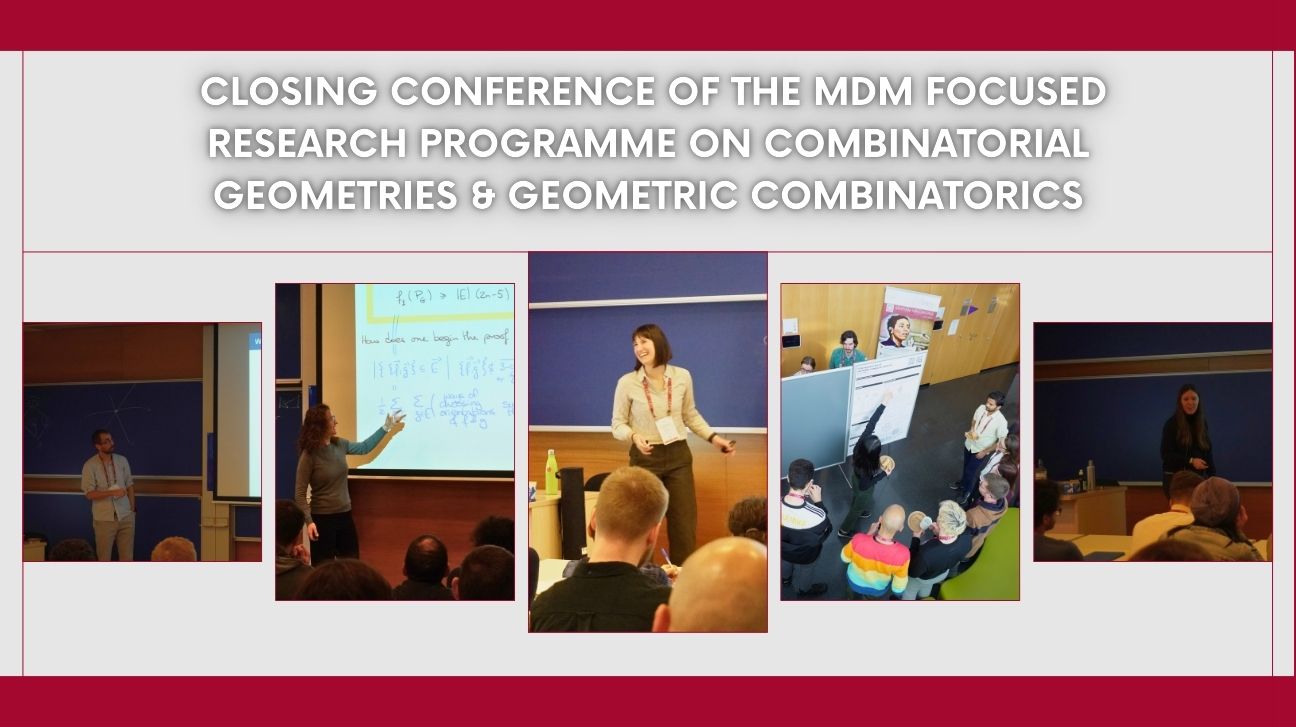
During five days, the CRM hosted the Closing Conference of the MDM Focused Research Programme on Combinatorial Geometries & Geometric Combinatorics. The event featured plenary talks, contributed sessions, and posters on topics from matroids and polytopes to tropical geometry and optimization. It showcased the vitality of the field and fostered international collaboration and new research directions.
The conference brought together international experts and young researchers to share advances in areas such as polytopes, matroids, Chow polynomials, and combinatorial structures related to geometry. Over five days, the program featured invited talks, contributed presentations, and poster sessions, fostering scientific exchange in a collaborative environment.
The program included eight plenary lectures addressing central topics in combinatorial geometry and matroid theory. Federico Ardila presented new inequalities for trees and matroids, connecting distance matrices with Lorentzian polynomials. Georg Loho showed how, based on Seymour’s decomposition, one can compute the basis generating polynomial of regular matroids without subtractions, enabling small ReLU neural networks for tropical optimisation. Giulia Codenotti analysed symmetric edge polytopes and their Ehrhart properties, while Luis Ferroni explored Chow polynomials and real-rootedness. Marie Brandenburg discussed minimal decompositions of piecewise linear functions via polyhedra. Spencer Backman introduced categorical associahedra and their realisation as polyhedral fans, linking combinatorics and moduli spaces. Kristóf Bérczi presented a new characterisation of skew-representable matroids using tensor products and rank inequalities, and Péter Csikvári examined progress and counterexamples related to the Merino–Welsh conjecture.
The contributed sessions showcased a wide range of approaches: from graph curve matroids and their connections to algebraic curves (Kevin Kühn), to the relationship between Chow polynomials and other families of polynomials, including the ab-index and chain polynomials (Elena Hoster), and advances on the Proximity Conjecture for group-labelled matroid bases (Tamás Schwarcz). Other talks explored topological and geometric properties such as shellings of tropical hypersurfaces (Lena Weis), root polytopes and their links to greedoids and Alexander polynomials (Lilla Tóthmérész), and computational classification of cube slices (Chiara Meroni). Further topics included the f-vector conjecture and h*-polynomials (Alex Fink), flow polytopes and framing lattices (César Ceballos), oriented valuated matroids in real tropical geometry (Ben Smith), smooth polytopes and symplectic geometry (Francisco Santos), algebraic shifting on surfaces (Eran Nevo), shellings of Bergman fans (Galen Dorpalen-Barry), and q-analogues of matroids (Relinde Jurrius).
Four poster sessions added breadth: polynomials and matroid properties, polyhedral structures, topological complexes, rigidity theory, symmetry, optimisation. Conversations ran long. Questions led to other questions. These sessions provided a dynamic space for exchanging ideas and exploring new research directions.
The conference highlighted the breadth and vitality of the field, with contributions ranging from combinatorial and geometric properties to computational applications and interdisciplinary connections with optimisation, neural network theory, and tropical geometry. Beyond the results presented, the event fostered dialogue between established researchers and emerging scholars, strengthening international collaboration and opening new avenues for research in combinatorial geometry and matroid theory.
It was the perfect closing for two months of work at the CRM; advanced courses, seminars, and collaborative projects that built slowly across September and October. Researchers arrived to study matroid decompositions and geometric structures; they left having constructed something less tangible but more useful: a shared vocabulary, a network of problems that spoke to each other. The talks in late November weren’t just presentations. They were what happens when you give people time to sit with ideas instead of racing past them, when conversations over coffee turn into conjectures, when someone’s offhand question in a seminar becomes another researcher’s opening. The conference didn’t end it. It marked a shift: from working together in the same building to working together across distance, carrying forward the questions they’d learned to ask.
Subscribe for more CRM News
Stay updated to our mailing list to get the lastest information about CRM activities.
During five days, the CRM hosted the Closing Conference of the MDM Focused Research Programme on Combinatorial Geometries & Geometric Combinatorics. The event featured plenary talks, contributed sessions, and posters on topics from matroids and polytopes to…
ICREA professor at the Universitat de Barcelona and CRM affiliated researcher Xavier Ros-Oton appears on Clarivate’s Highly Cited Researchers 2025 list, which this year reinstates the mathematics category after two years of exclusion.Citations are a strange way to…
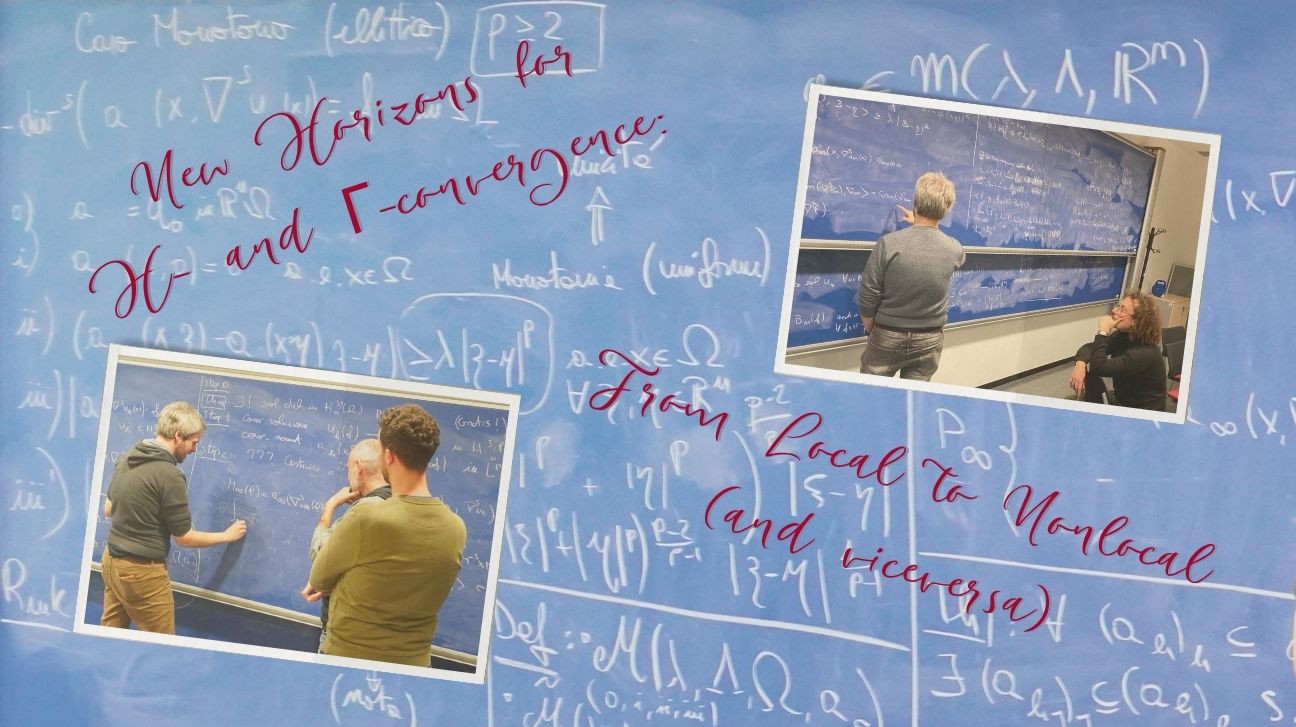
The researchers Maicol Caponi, Alessandro Carbotti, and Alberto Maione extended the H- and Γ-convergence theories to the setting of nonlocal linear operators and their corresponding energies. The authors were able to overcome the limitations of classical localization…
Diego Vidaurre has joined the Centre de Recerca Matemàtica through the ATRAE programme, bringing his expertise in modelling spontaneous brain activity across multiple data modalities. His work focuses on understanding how the brain’s intrinsic dynamics shape…
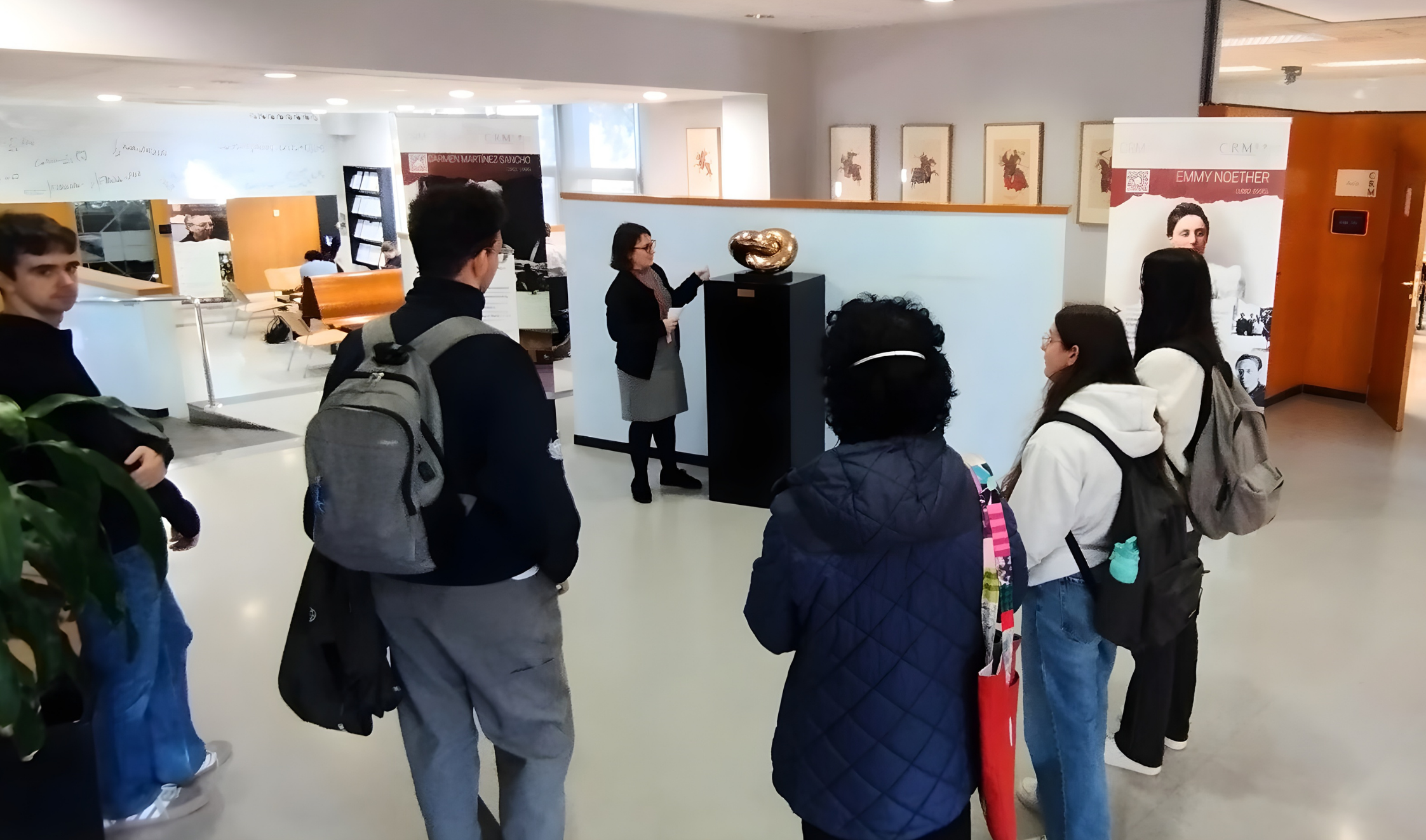
El CRM va participar en la 30a edició de la Setmana de la Ciència amb una ruta guiada que va combinar les biografies de dones matemàtiques amb obres d’art del centre, connectant ciència, història i creació artística.El 12 de novembre, el Centre de Recerca Matemàtica…
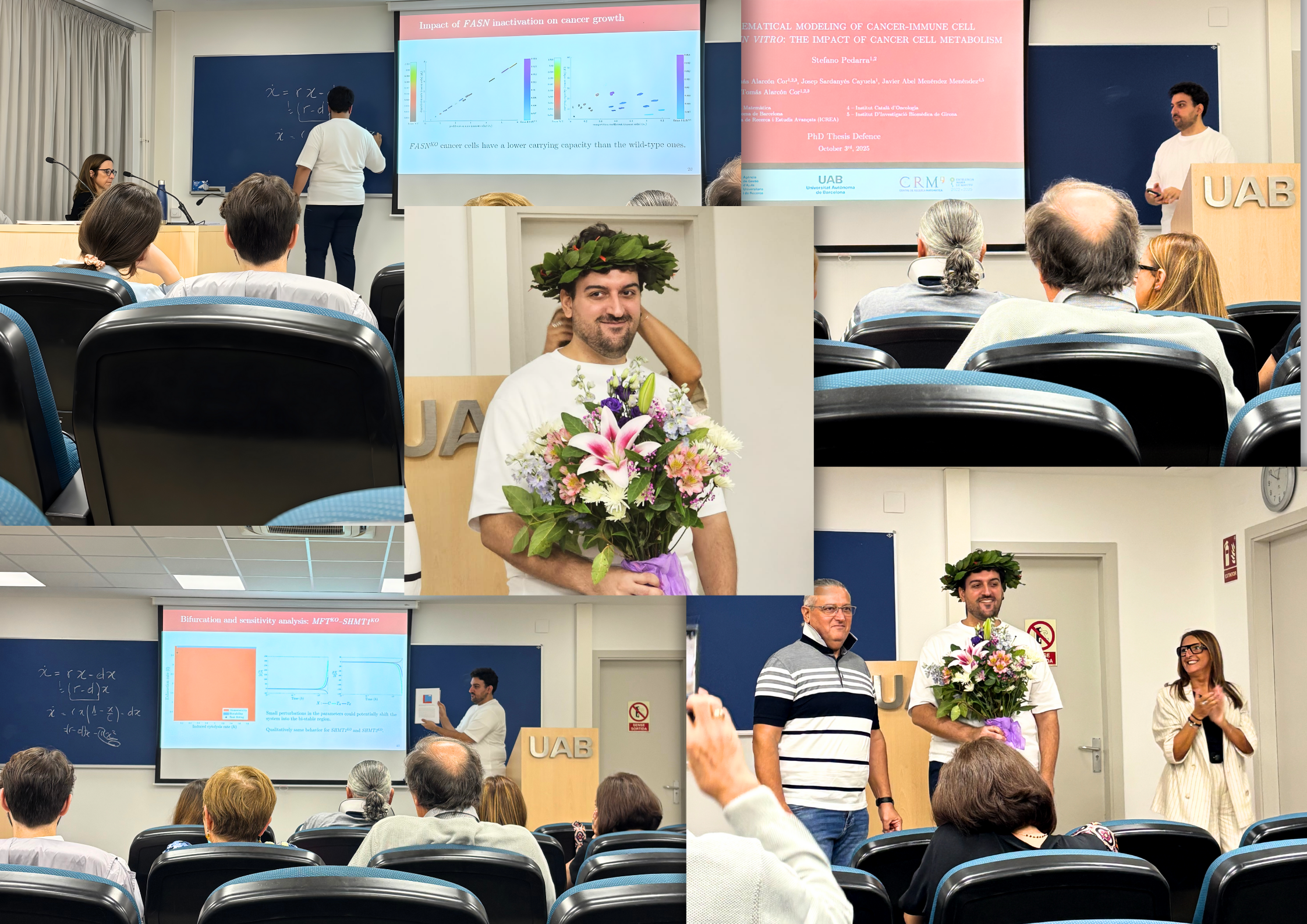
Stefano Pedarra has completed his PhD at the Centre de Recerca Matemàtica with a thesis exploring how tumour-cell metabolism shapes the immune system’s ability to fight cancer. His work brought mathematics and biology into direct conversation, from building models to…
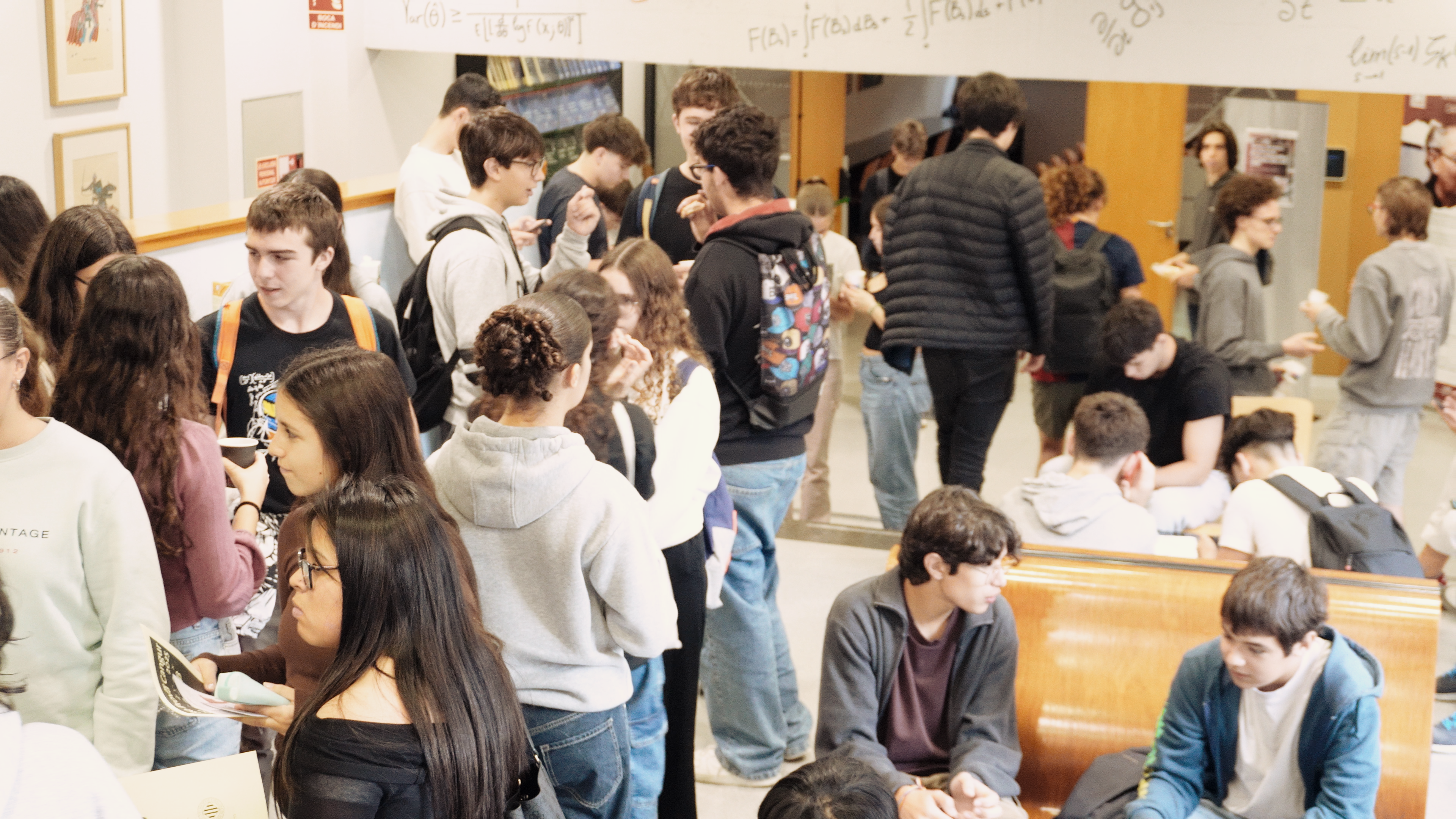
La prova de preselecció de Bojos per les Matemàtiques va reunir estudiants de tot Catalunya a la UAB i al CRM, amb presentacions a càrrec de Montse Alsina, presidenta de la Societat Catalana de Matemàtiques, Núria Fagella, degana de la Facultat de Matemàtiques i…
The XIII GEFENOL-DIFENSC Summer School gathered over thirty researchers from across Europe to explore how statistical physics helps explain complex phenomena in biology, ecology, networks, and social systems. In his closing lecture, Jordi Mompart (UAB) examined how…
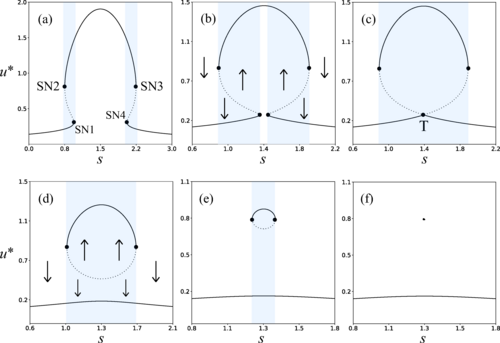
An international collaboration including researchers from the Centre de Recerca Matemàtica (CRM) has shown that when several bifurcations occur close to one another, their interaction can dramatically amplify critical slowing down effect – the progressive slowdown of…
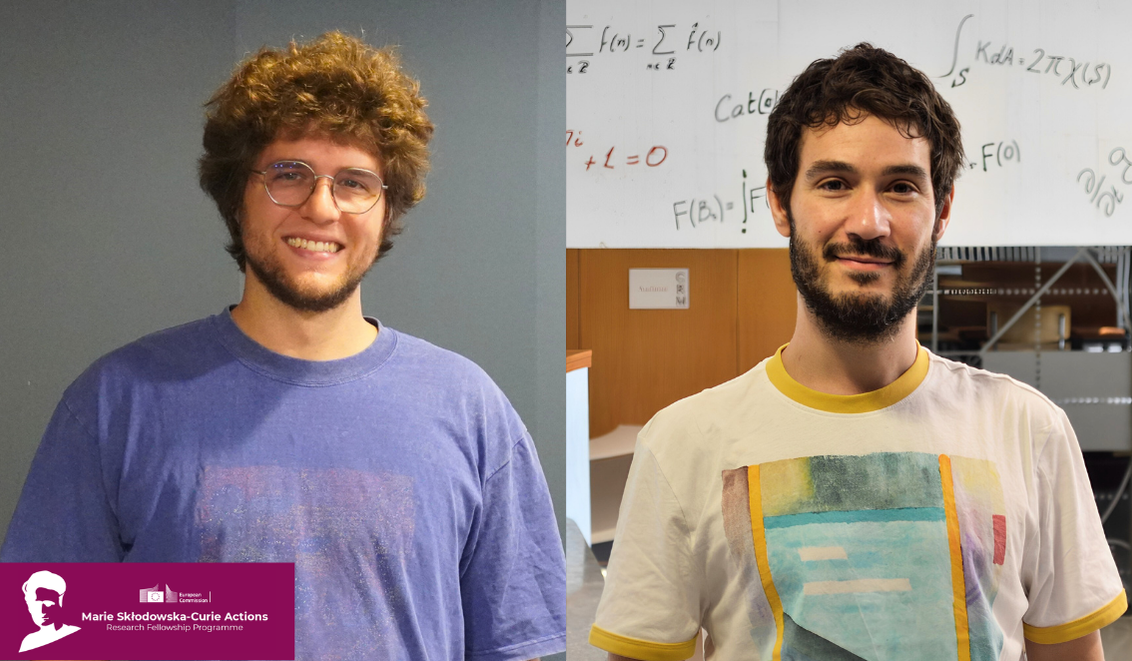
Gustavo Ferreira and Tássio Naia, CRM postdoctoral researchers and new Marie Skłodowska-Curie fellows. Gustavo Ferreira and Tássio Naia, who joined the CRM in 2023 through the María de Maeztu programme, have started their Marie Skłodowska-Curie postdoctoral…
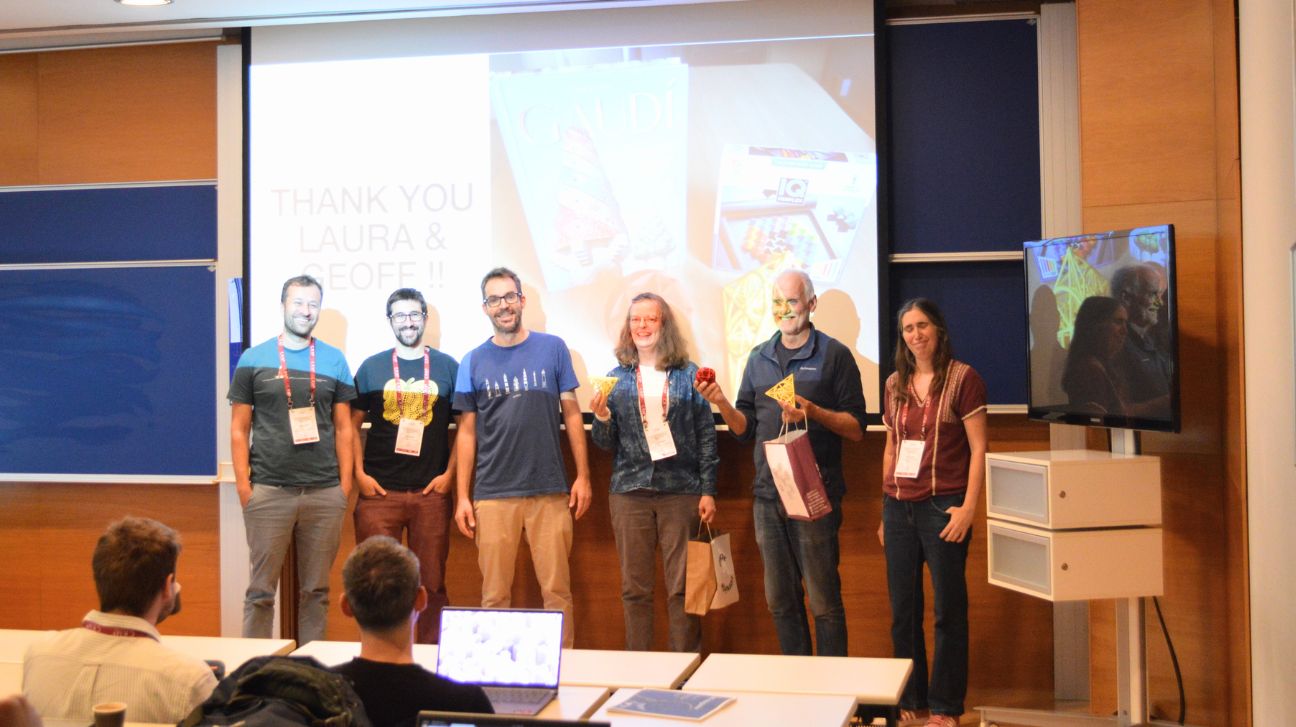
From October 13 to 17, 2025, the CRM hosted Matroid Week, a research school on combinatorial geometries and matroid theory. Courses by Laura Anderson and Geoff Whittle explored intersection properties and structural emergence in matroids. The event fostered deep…
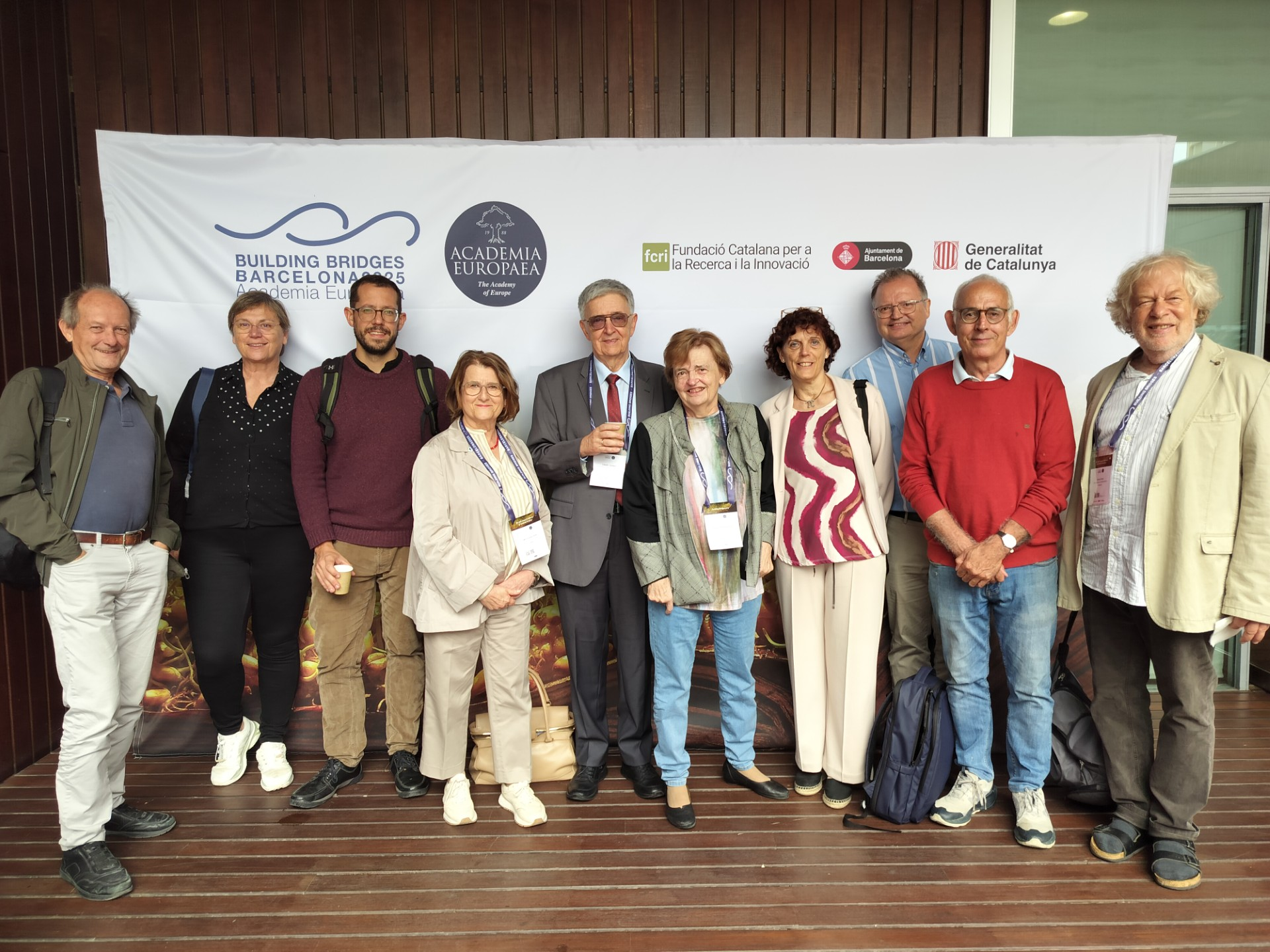
Mathematician László Lovász received the 2025 Erasmus Medal from the Academia Europaea yesterday at the PRBB in Barcelona, where he delivered the lecture “The Beauty of Mathematics”. Renowned for his work in graph theory and discrete mathematics, Lovász has shaped…
Abstract: Last July the LHC collided for the first time oxygen-16 and neon-20 isotopes. Since September the first measurements of hydrodynamic flow, transmutation as well as energy loss are now available. Oxygen and neon nuclei are much smaller than the conventional lead collisions and can therefore provide us answers to pressing questions on the tiniest droplets of quark-gluon plasma that can be produced at colliders. It also allows us to study how these light nuclei are shaped in a way that was never possible before. In this seminar I will explain the basic physics of these collisions including the highlights coming from the new measurements.


.png?itok=_JoZdEvB)