The ICTA-UAB hosted the grand final of the Urban Farm Challenge, an international university competition that seeks innovative ideas in sustainable urban agriculture.
Image
.png?itok=IU_9WHKh)

The ICTA-UAB hosted the grand final of the Urban Farm Challenge, an international university competition that seeks innovative ideas in sustainable urban agriculture.
Repte Experimenta is a science outreach programme led by the Universitat Rovira i Virgili (URV) that encourages secondary school students to discover science through inquiry, experimentation, and teamwork. Throughout the academic year, teams of students design and develop their own experiments with the guidance of scientific mentors from universities, research centres, and industry. The initiative is supported by the Spanish Foundation for Science and Technology (FECYT) and involves several partner institutions, including ICIQ, which contributes to mentoring, educational resources, and outreach activities.
As part of the programme’s closing activities, the winning teams of the 2026 edition visited ICIQ to enjoy a hands-on chemistry activity as part of their prize. During their visit to ICIQ, the winning students took part in a series of interactive chemistry experiments at the institute’s outreach laboratory. The activity offered them a glimpse into the world of chemical research while allowing them to continue exploring the scientific concepts behind their projects.
“Repte Experimenta gives students the opportunity to experience science as a process of discovery, creativity, and teamwork,” says Marta Llorens Fons, mentor in the programme. “It is always rewarding to see their enthusiasm and curiosity.”
The winning teams were selected during the Fira Experimenta 2026, held on 22 May at the Sescelades Campus of the URV in Tarragona. The event brought together 27 finalist teams from schools across Catalonia, who presented their projects to the public and a jury in what became a large open-air science fair attended by more than 700 visitors.

La entrada From Repte Experimenta to ICIQ: young scientists enjoy their prize se publicó primero en ICIQ.
Un equipo de investigación del Centro de Biología Molecular Severo Ochoa, centro mixto del CSIC y la UAM, ha demostrado que la aplicación de pulsos electromagnéticos multifrecuencia puede ralentizar significativamente el crecimiento tumoral y estimular la respuesta inmunitaria frente al cáncer en modelos preclínicos. El trabajo abre una nueva vía para desarrollar tratamientos oncológicos no invasivos basados en principios físicos en lugar de químicos o farmacológicos.
La tecnología estudiada, desarrollada por la empresa biotecnológica Paso Alto Group, tras más de quince años de investigación en el ámbito de la biofísica aplicada y la bioingeniería médica, utiliza campos electromagnéticos de muy baja frecuencia y alta intensidad aplicados de forma externa al organismo. A diferencia de muchas terapias actuales, no requiere procedimientos quirúrgicos ni la administración de fármacos, y busca aprovechar determinadas características biofísicas propias de las células tumorales con el objetivo de alterar selectivamente su funcionamiento.
“Los resultados muestran que es posible actuar sobre el tumor mediante una aproximación completamente diferente a las estrategias convencionales y hacerlo, además, sin detectar efectos adversos en los animales tratados”, explica la investigadora del CBM Yolanda Revilla, autora principal del estudio.
Para evaluar la eficacia de esta tecnología, los investigadores utilizaron un modelo de cáncer colorrectal en ratón que conserva un sistema inmunitario funcional. Los animales tratados con pulsos electromagnéticos mostraron una reducción consistente del crecimiento tumoral y una supervivencia significativamente mayor en comparación con los animales no tratados.
Uno de los hallazgos más relevantes del estudio fue la modificación del llamado microambiente tumoral, el ecosistema formado por células inmunitarias, vasos sanguíneos y otros componentes que rodean al cáncer y condicionan su crecimiento.
La eficacia dependió de factores como la intensidad y la frecuencia de aplicación del tratamiento. Los protocolos más tempranos e intensivos ofrecieron los mejores resultados, llegando a lograr un control tumoral notablemente superior.
“Este trabajo representa un paso importante porque demuestra por primera vez en un organismo completo que esta tecnología puede ejercer una actividad antitumoral relevante”, señala José María Almendral, investigador del CBM y autor del estudio.
Los análisis realizados revelaron que los tumores tratados presentaban amplias zonas de necrosis, una forma de muerte celular asociada a daños irreversibles. Además, los investigadores detectaron señales de estrés oxidativo y daños en el ADN de las células tumorales.
El estrés oxidativo ocurre cuando se acumulan moléculas altamente reactivas capaces de deteriorar componentes esenciales de la célula. Cuando este daño supera la capacidad de reparación celular, las células cancerosas pueden perder su viabilidad y morir.
Los autores proponen que los pulsos electromagnéticos desencadenan varios mecanismos simultáneos que, en conjunto, dificultan la supervivencia del tumor.
Los investigadores observaron un aumento significativo de macrófagos dentro de los tumores tratados. Estas células forman parte de la primera línea de defensa del sistema inmunitario y son capaces de detectar, engullir y eliminar células dañadas o anómalas.
Según los autores, este resultado sugiere que la terapia podría favorecer una forma de muerte celular especialmente visible para el sistema inmunitario, facilitando que las defensas naturales del organismo reconozcan mejor el tumor.
“Los datos indican que no estamos observando únicamente un efecto directo sobre las células cancerosas. También parece producirse una reprogramación del entorno tumoral que favorece la respuesta inmunitaria”, explica Konstantinos Stamatakis, investigador del CBM y autor principal del trabajo.
En algunos animales, los investigadores observaron un efecto especialmente llamativo: la desaparición completa del tumor. Además, estos animales mostraron resistencia cuando posteriormente fueron expuestos de nuevo a células tumorales, una observación que apunta a la posible generación de memoria inmunitaria antitumoral.
Aunque este resultado se detectó únicamente en un número reducido de animales y deberá confirmarse en estudios más amplios, abre la posibilidad de que este tipo de tratamiento no solo elimine tumores existentes, sino que contribuya a prevenir su reaparición.
Los autores subrayan que se trata de una investigación preclínica y que todavía será necesario optimizar numerosos parámetros antes de plantear su uso en pacientes. Entre otros aspectos, será preciso comprender con mayor detalle los mecanismos biológicos implicados y validar los resultados en nuevos modelos experimentales.
Aun así, el estudio sitúa los pulsos electromagnéticos multifrecuencia como una prometedora plataforma terapéutica emergente. Los investigadores ya exploran su posible combinación con inmunoterapias actuales para potenciar la respuesta antitumoral y superar mecanismos de resistencia que limitan la eficacia de algunos tratamientos.
El dispositivo utilizado en este estudio ha sido desarrollado por la compañía Paso Alto Biotechnology Inc.
Piredda R, Rodríguez Martínez LG, Martinez-Ortega J, López Ferraz A, Villatoro-Gómez S, Martín-García E, García-Bermejo ML, Almendral JM, Stamatakis K, Revilla Y. Effects of Multifrequency Electromagnetic Pulses on tumor growth in immunocompetent mice. Scientific Reports. 2026. doi: 10.1038/s41598-026-49151-5.
La entrada Un tratamiento basado en pulsos electromagnéticos frena tumores en ratones y activa las defensas se publicó primero en Centro de Biología Molecular Severo Ochoa.
The Centro Nacional de Investigaciones Cardiovasculares Carlos III (CNIC) and the AstraZeneca Foundation, with the participation of the European Society of Cardiology (ESC), today hosted the international meeting “SAFE HEARTS PLAN: Young Scientists Engaging with Europe’s Cardiovascular Health Plan” in Madrid.
The event brought together early career researchers, policymakers, clinicians, institutional representatives, industry stakeholders, and patient organizations from more than 15 countries to discuss the future of cardiovascular health in Europe and, in particular, how to accelerate the translation of scientific evidence into public policies and measurable changes in healthcare practice.
The meeting formed part of European outreach and awareness-raising activities linked to the SAFE HEARTS PLAN, the European Commission’s new strategy to strengthen prevention, early detection, and management of cardiovascular diseases across Europe.
Held in a hybrid format, the event aimed to connect new generations of scientists—especially early career researchers and healthcare professionals—with the European cardiovascular health framework. The initiative promoted practical dialogue across research, digital innovation, prevention, clinical practice, and public health.
The meeting was opened by Dr. Valentín Fuster, General Director of the CNIC, and Marina Pollán, Director of the Carlos III Health Institute (ISCIII), and was closed by Dr. Borja Ibáñez, CNIC Scientific Director.
In his remarks, Dr. Fuster highlighted the importance of engaging young scientists in European priorities: “At the CNIC, we are fully committed to this effort. The message for young researchers is clear: your work can help shape not only the future of science, but also the future of cardiovascular health in Europe.” He also stressed the CNIC’s contribution through major European initiatives such as JACARDI, which aims to improve the prevention and management of cardiovascular disease and diabetes across Europe through collaboration, implementation, and knowledge exchange.
Marta Moreno, Vice President of the Fundación AstraZeneca and Head of Corporate Affairs and Market Access at AstraZeneca Spain, underlined the scale of the challenge: “Cardiovascular disease is the leading cause of death in Europe, responsible for 10,000 deaths every day, more than two out of every five deaths, and costing the EU economy €282 billion annually.” She added: “We need to translate Europe’s excellent cardiovascular science into prevention and early detection that reach clinical practice equitably and at scale. That is why the Fundación AstraZeneca strongly supports the European Commission’s SAFE HEARTS PLAN as a key initiative to drive a coordinated, ambitious, and sustainable response to cardiovascular disease in Europe.”
Young researchers at the center of the dialogue
A defining feature of the meeting was the leading role of young researchers from the CNIC’s European Cure Heart and Brain MSCA COFUND program, who participated as speakers and moderators. The format enabled direct interaction with decision makers and key stakeholders, highlighting the importance of translational research in advancing prevention, early detection, equity, and implementation at the European level.
Throughout the day, participants examined the main challenges in reducing the burden of cardiovascular disease in Europe and agreed on the need to strengthen large scale implementation of existing strategies by integrating science, healthcare practice, and public policy.
Discussions emphasized the importance of reinforcing cardiovascular prevention from a population perspective, addressing risk factors, and promoting measures that act before major events occur. Participants stressed that European strategies must translate into sustainable interventions within healthcare systems.
A central theme was how digital innovation, including artificial intelligence, can support early detection, monitoring, and evaluation of cardiovascular health strategies, provided this is underpinned by robust health data governance, interoperable systems, and strong standards for trust and protection.
The meeting also addressed inequalities in disease burden and access to prevention, highlighting the need to incorporate equity as a key indicator of success, measuring not only activity but outcomes, and with particular attention to vulnerable populations.
Panelists agreed that the main challenge is no longer simply to generate evidence, but to translate that evidence into actionable policies supported by funding, accountability mechanisms, common indicators, and clearly defined care pathways linking detection, referral, treatment, and follow up.
International expert participation
The event featured contributions from leading experts including Antonio Parenti: (European Commission, DG SANTE), Kitti Almer (ESC), Héctor Bueno (CNIC and ESC committee), Aleida Alcaide (Spanish Ministry for Digital Transformation), Andreas Heddini (AstraZeneca), Folkert Asselbergs (ESC AI Chair), Birgit Beger (EHN), Sonya Babu Narayan (BHF), Cristina Pérez Herreras (Banco Santander), and Benedetta Armocida (JACARDI), among others. Representatives from institutions such as the Finnish Institute for Health and Welfare (THL), ALCER, and the Royal Danish Embassy in London also participated.
The launch of the SAFE HEARTS PLAN by the European Commission at the end of last year marked a major step forward in improving cardiovascular health across the EU. The initiative positions cardiovascular health management as an economic and competitiveness priority, recognizing the broad social and productivity impacts of cardiometabolic diseases, and provides member states with a structured framework for implementing or strengthening national cardiometabolic risk assessment programs through early diagnosis.

El mieloma múltiple es el segundo cáncer hematológico más común en adultos. Uno de los grandes avances en su tratamiento en los últimos años es la inmunoterapia de células CAR-T, en la que linfocitos T (glóbulos blancos) de la persona enferma se modifican para que puedan reconocer específicamente las células tumorales, y destruirlas.
Pero es una terapia celular compleja, lenta y muy costosa. Los linfocitos T primero se extraen del paciente, se modifican y cultivan en el laboratorio y después se reintroducen en el organismo, ya con la capacidad de dirigirse contra las células del cáncer.
El grupo de Luis Álvarez Vallina en el CNIO acaba de recibir financiación de la Deutsche José Carreras Leukämie Stiftung para un proyecto que busca modificar los linfocitos T dentro del propio organismo de la persona enferma. Se lograría con ello reducir los costes de fabricación y acortar el tiempo de tratamiento, lo que en última instancia permitiría tratar a más pacientes.
Se trata del proyecto LIVE-STAb (In vivo generation of engineered T cells secreting T-cell engager antibodies with targeted lentiviral vectors), co-dirigido por Christian J. Buchholz, del Paul-Ehrlich-Institut, en Alemania.
Los investigadores emplearán células puñal o STAb-T, que pueden considerarse una evolución de las células CAR-T. En ambos casos las células modificadas en el laboratorio reconocen un mismo antígeno solo presente en las células tumorales, de forma que se dirigen y atacan solo a las células de cáncer.
Pero las STAb-T, en las que el grupo de Vallina es experto, tienen ventajas sustanciales, entre ellas que logran reclutar a otras células T del organismo que no han sido modificadas, para que también combatan a las células cancerígenas. Se amplifica así el efecto de la terapia.
Como explica Álvarez Vallina, “desarrollaremos una estrategia pionera para generar células T STAb dirigidas contra el BCMA [un antígeno presente solo en las células de mieloma múltiple] directamente en el interior del paciente, lo que eliminará la necesidad de producir las células ex vivo. El proyecto evaluará la viabilidad, la eficacia y la seguridad de este enfoque innovador”.
El objetico de LIVE-STAb es “establecer un nuevo paradigma para las terapias con células T modificadas genéticamente, haciendo que las inmunoterapias avanzadas sean más rápidas, accesibles y escalables para los pacientes con mieloma múltiple y otros tipos de cáncer”.
La entrada Álvarez-Vallina investiga en el CNIO cómo generar células ‘puñal’ contra el mieloma múltiple dentro del cuerpo se publicó primero en CNIO.
Dr. Sherma, doctoral candidate under the supervision of Prof. Beatriz Prieto-Simón and Dr. Hedieh Haji Hashemi Varnosfaderani, has successfully defended his thesis. The dissertation, entitled Towards next-generation of porous nanostructure-based biosensing platforms for infectious disease diagnosis has been defended today, 15 june 2026.

The examination committee have been Dr. Mónica Campás (Institut de Recerca i Tecnologia Agroalimentàries, Spain), Dr. Thierry Noguer (Université Perpignan Via Domitia, France) and Prof. Bahareh Kherzi (Universitat Rovira i Virgili, Spain).

La entrada बधाई हो Dr. Verma se publicó primero en ICIQ.

El investigador estadounidense Todd O. Yeates es beneficiario de la nueva edición del programa Investigadores Visitantes de Fundación Occident en el Centro Nacional de Investigaciones Oncológicas (CNIO).
En su laboratorio de la Universidad de California en Los Angeles (Estados Unidos), Yeates
inició hace más de dos décadas el diseño de nanopartículas proteicas simétricas, diminutas ‘piezas de construcción’ que se autoconfiguran en laboratorio como proteínas con la forma y función que se desee.
“La idea era crear piezas que permitieran hacer arquitectura de proteínas”, afirma Yeates. Sus nanopartículas de proteínas se aplican a diversos campos de la investigación: para llevar fármacos hasta su punto de destino dentro del organismo, para desarrollar vacunas o para ver proteínas tan pequeñas que son indetectables hasta para los microscopios más potentes.
Visualizar proteínas-diana de fármacos oncológicos
Muchas proteínas implicadas en cáncer son pequeñas, difíciles de visualizar en los microscopios. El hoy investigador del CNIO Roger Castells-Graells combinó la tecnología de las nanopartículas de proteínas de Yeates con la crio-microscopía electrónica, y facilitó así el estudio de proteínas para las que se desarrollan actualmente compuestos de interés en cáncer.
Castells-Graells convirtió las nanopartículas artificiales en mega-estructuras capaces de enganchar proteínas más pequeñas, como parte de un gran andamio que resulta más fácil de visualizar. Así ha sido posible observar, por ejemplo, la interacción de determinados fármacos con sus proteínas diana –algo necesario a la hora de optimizar el diseño del fármaco. Este trabajo lo realizó durante su estancia como investigador posdoctoral en el laboratorio de Yeates en California.
Desde allí regresó a España gracias al programa Construyendo la Generación IA, dentro de la iniciativa Generación D, impulsada por Red.es y se incorporó al CNIO como jefe del grupo de Diseño Biomolecular y Nanomedicina Estructural, del programa de Biología Estructural. Hoy Castells-Graells quiere “incorporar esa tecnología y que el CNIO sea una institución pionera de España en combinarla con la inteligencia artificial para el diseño de proteínas”, asegura.

“Es tan emocionante que me está costando dormir”
Con este fin, y gracias al programa Investigadores Visitantes de Fundación Occident, Castells-Graells acogerá estos meses a su antiguo profesor en el CNIO en varias estancias, convencido de que su colaboración contribuirá a acelerar los avances de esa fusión de tecnologías.
Ya en las primeras semanas de trabajo su sintonía ha dado fruto: con los resultados obtenidos han elaborado un artículo científico que está ya en fase de revisión.
“Todd ha despertado el entusiasmo de todo el grupo, y otros grupos del programa”, afirma Castells-Graells. “Quiero pasar cada minuto que está aquí con él, porque tenemos muchísimos proyectos. Es tan emocionante que me está costando dormir estos días”.
Yeates y Castells-Graells colaborarán también con el Programa de Terapias Experimentales del CNIO, “para ver si nuestra tecnología puede ayudar en el desarrollo de nanopartículas contra proteínas implicadas en cáncer de próstata”.
Fundación Occident y el CNIO
El programa Investigadores Visitantes de Fundación Occident financia la estancia en el CNIO de un investigador que haya desarrollado su trabajo en un centro internacional de prestigio en los últimos cinco años. Estas visitas consolidan los lazos del grupo de investigación anfitrión con el del centro al que pertenece el investigador visitante, y permiten iniciar nuevas líneas de trabajo gracias al intercambio de ideas e intereses comunes.
La colaboración entre la Fundación Occident y el CNIO se remonta a 2009. El programa ha hecho posible que el CNIO reciba la visita de David Goldgar; Rama Khokha; Mercedes Rincón; Astrid Laegreid; Maria Sibilia; Robert Benezra; Peter Petzelbauer; André Nussenzweig; Stephan A. Hahn; Patrick Sung; Chaitanya R. Divgi; Marcin Nowotny; Madalena Tarsounas; Raúl Rabadán; Wolfgang Weninger; Scott Lowe; Sonia Laín; Eva Nogales, Raul Mostoslavsky, Albana Gatelli, Gonçalo Bernardes, Yardena Samuels y Todd Yeates.
Biografía de Todd Yeates
Tras doctorarse en la Universidad de California en Los Angeles (UCLA) con un trabajo sobre métodos de cristalografía de rayos X, Yeates se trasladó al Instituto Scripps de Investigación para realizar un posdoctorado sobre las cápsides virales, las estructuras de las cubiertas de proteínas que protegen el material genético de los virus. Al finalizar, regresó a la UCLA, donde instaló su laboratorio de biología estructural, computacional y sintética en el departamento de Química y Bioquímica. Allí ha estudiado los grandes complejos de proteínas que se dan en la naturaleza, e inventó el diseño de nanopartículas de proteínas que se aplican actualmente a diversos campos de la investigación. Para este fin su laboratorio ha realizado también avances en genómica computacional.
Sobre el CNIO
El Centro Nacional de Investigaciones Oncológicas (CNIO) es un centro público de investigación dependiente del Ministerio de Ciencia, Innovación y Universidades. Es el mayor centro de investigación en cáncer en España y uno de los más importantes en Europa. Integra a medio millar de científicos y científicas, más el personal de apoyo, que trabajan para mejorar la prevención, el diagnóstico y el tratamiento del cáncer.
Sobre Fundación Occident
Desde 1998 Fundación Occident es una entidad privada sin ánimo de lucro perteneciente a GCO (Grupo Catalana Occidente) creada en memoria de Jesús Serra Santamans, reconocido empresario y mecenas, fundador del grupo asegurador. La fundación cuenta con cinco líneas de actuación que articulan la acción de la entidad: Investigación, Empresa y docencia, Acción social, Deporte y Promoción de las artes. Dentro de la línea de investigación, su labor se centra en canalizar las labores de mecenazgo que el Grupo lleva desarrollando desde hace más de un siglo, promoviendo sus propios premios de investigación que reconocen la trayectoria investigadora de jóvenes científicos españoles en los ámbitos de la alimentación y la nutrición.
Además, promueve programas en los que acercan el conocimiento de expertos científicos internacionales a grupos de investigación españoles y otras colaboraciones en pro de los avances científicos en investigación cardiovascular y oncológica.
La entrada Todd Yeates, inventor del ‘lego de las proteínas’, diseñará en el CNIO nanomoléculas con potencial terapéutico como Investigador Visitante Fundación Occident se publicó primero en CNIO.
The Institute for Neurosciences (IN), a joint centre of the Spanish National Research Council (CSIC) and Miguel Hernández University of Elche (UMH), hosted the 19th edition of its ‘IN Progress Report’ Workshop on Friday, 12 June. This annual event brings together the Institute’s research community and provides an opportunity for one-third of its group leaders to present the work carried out in their laboratories over recent years, as well as the main research directions that will shape their scientific activity in the future.
The presentations provided an overview of the research currently being carried out at the Institute for Neurosciences CSIC-UMH, covering topics ranging from the development and function of neural circuits to the mechanisms underlying pain, ageing and neurodegenerative diseases, as well as the development of new diagnostic tools.
Researchers from the Scientific Programmes Building & Adapting Circuits into Functional Networks and Synaptic Modulation of Neural Circuits and Behavior presented studies aimed at understanding how brain circuits are organised, developed and regulated. Isabel del Pino, head of the Developmental and Cognitive Disorders Laboratory, introduced a new perspective on disorders associated with the NALCN gene, proposing that they should be understood as interneuron-driven circuitopathies. Sandra Jurado, who leads the Synaptic Neuromodulation Laboratory, discussed the dynamics and function of oxytocin release in neuronal dendrites. Ramón Reig, head of the Sensory-motor Processing by Subcortical Areas Laboratory, presented findings showing how dopamine synchronises multisensory responses in the dorsomedial striatum. Andreas Kardamakis, who leads the Neural Circuits in Vision for Action Laboratory, shared new insights into the neural circuits and computational mechanisms underlying visual attention and distraction.
The session also featured Isabel Pérez Otaño, head of the Plasticity and Remodeling of Neural Circuits Laboratory, who presented findings on non-conventional NMDA receptor signalling in oligodendrocytes and neurons. Juan Antonio Moreno Bravo, who leads the Development, Wiring and Function of Cerebellar Circuits Laboratory, discussed the processes that guide cerebellar development, from the assembly of local circuits to their integration into the neocortex.
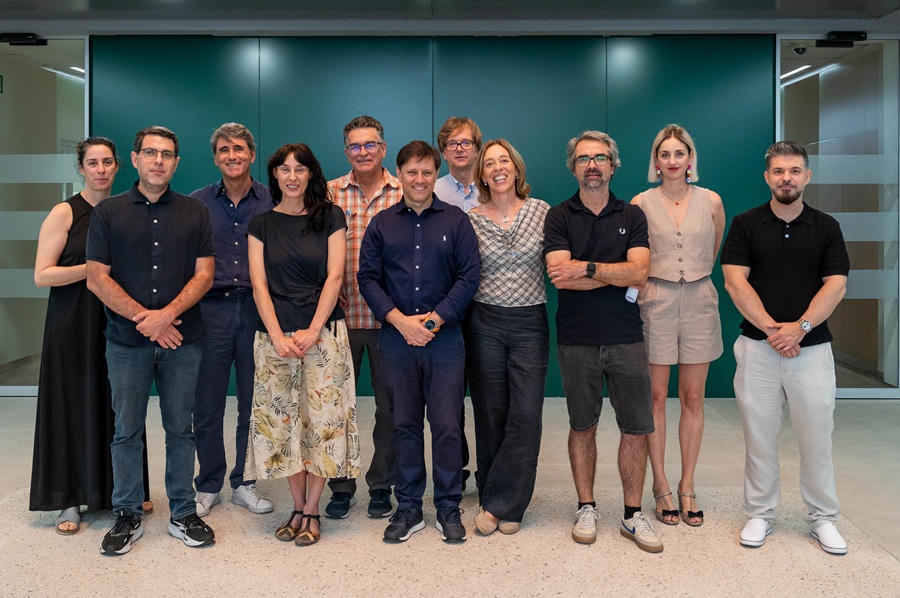
Speakers and organizer of the IN Progress Report 2026 meeting, held at the Institute of Neuroscience on 12 June. Source: IN CSIC-UMH.
Research focused on the cellular and molecular mechanisms of disease was represented by José P. López-Atalaya, head of the Cellular Plasticity and Neuropathology Laboratory and member of the Cell Plasticity in Brain Disease and Repair Scientific Programme, who presented advances in the understanding of the neuroimmune mechanisms involved in Alzheimer’s disease. Along similar lines, Javier Sáez Valero, who leads the Altered Molecular Mechanisms in Alzheimer’s Disease and Dementia Laboratory and is affiliated with the Translational Research of Neurological and Psychiatric Disorders Scientific Programme, presented new approaches for the study of biomarkers in neurodegenerative diseases, highlighting the importance of examining features that extend beyond their expression levels.
The session also included contributions from other IN CSIC-UMH scientific programs. Félix Viana, head of the Sensory Transduction and Nociception Laboratory and member of the Neurobiology of Pain & Inflammation Programme, presented research on the role of ion channels in pain transmission pathways. For his part, José Carlos Pastor Pareja, whose laboratory on Cell-to-tissue Architecture in the Nervous System is part of the programs Neural Stem Cell Regulation and Differentiation and Genetic & Epigenetic Bases of Individuality & Aging, presented new imaging strategies to better understand how the cellular and tissue architecture of biological systems is organized.
Finally, Silvia De Santis, head of the Translational Imaging Biomarkers Laboratory and affiliated with both the Human Cognition & Behaviour and the Translational Research of Neurological and Psychiatric Disorders Scientific Programmes, presented advances in the development of magnetic resonance imaging (MRI) biomarkers capable of tracking neuronal and glial changes associated with aging and Alzheimer’s disease.
Como en ediciones anteriores, las jornadas incluyeron un espacio dedicado al personal investigador predoctoral. Los estudiantes de segundo año del programa de doctorado del Instituto realizaron presentaciones breves de un minuto para introducir sus trabajos de investigación, que posteriormente expusieron durante una sesión de pósteres abierta a toda la comunidad científica del centro.
The event was organized by researcher Javier Morante, who served as Chair of the meeting together with researcher Juan Antonio Sánchez Alcañiz. The IN Progress Report meeting is one of the Institute for Neuroscience’s main internal forums for scientific exchange, helping to strengthen collaboration between laboratories, foster new synergies, and showcase the research being carried out at the IN CSIC-UMH.
Source: Institute for Neurosciences CSIC-UMH (in.comunicacion@umh.es)
La entrada The Institute for Neurosciences CSIC-UMH holds the 19th edition of its ‘IN Progress Report’ Workshop se publicó primero en Instituto de Neurociencias de Alicante.
Abstract: Rich dark sectors provide an attractive framework for addressing several puzzles in particle physics and cosmology within a single model. In this talk, I will present a simple sub-GeV dark-sector realization featuring a dark matter candidate, a light scalar mediator, and an extended neutrino sector. I will show how the model can reproduce the observed relic abundance, generate light neutrino masses, and satisfy cosmological constraints. I will then discuss its phenomenological implications, focusing on neutrino signals that could be probed by current and future neutrino telescopes.
Dr. Carla Casadevall, associated researcher at the Institute of Chemical Research of Catalonia (ICIQ), has been elected as Member of the Young Academy of Spain. This recognition comes just a few weeks after she was named a finalist for the 2026 Princess of Girona Award for Scientific Research.
Casadevall’s appointment was approved during the Academy’s Extraordinary General Assembly held on 9 June. In this call, ten new members were selected from a total of 151 candidates through an evaluation process conducted by an independent international committee of distinguished researchers. In addition to scientific excellence, the selection process considered factors such as multidisciplinarity, diversity and leadership potential.
The newly elected members represent a new generation of researchers committed not only to scientific excellence but also to knowledge transfer and the societal impact of research. With this appointment, Dr. Casadevall joins a leading institution dedicated to promoting young scientific talent and fostering interdisciplinary collaboration across different fields of knowledge.
Specialised in sustainable energy conversion, Casadevall’s research, carried out between Rovira i Virgili University (URV) and ICIQ, focuses on the development of photocatalytic technologies inspired by natural photosynthesis to produce clean fuels and high-value chemicals from solar energy and carbon dioxide (CO₂).
Her work explores bio-inspired systems, including polymeric microreactors and artificial membranes, capable of mimicking natural processes to improve the efficiency and selectivity of chemical reactions. This research is embodied in the BIOPOLE project, funded through an ERC Starting Grant awarded in 2025, which aims to develop a new generation of photocatalytic systems based on artificial compartmentalisation to optimise key processes in sustainable energy and chemical synthesis.
The formal medal award ceremony for the newly elected members of the Young Academy of Spain will take place on 26 November in Zaragoza.
About the Young Academy of Spain
Founded in 2019, the Young Academy of Spain aims to promote scientific careers among young people, raise the visibility of emerging research talent, and serve as a bridge between the scientific community, public administrations and international academic institutions.
One of its distinctive features is that membership is limited to a maximum of five years, ensuring continuous renewal among its fifty members while preserving the institution’s youthful spirit. The Academy is also characterised by its strong interdisciplinary nature, bringing together experts from fields as diverse as chemistry, artificial intelligence, neuroscience, philosophy, art history and the performing arts.
La entrada Dr. Carla Casadevall, ICIQ Associated Researcher, elected Member of the Young Academy of Spain se publicó primero en ICIQ.

A study led by ICN2 and the Institute of Microelectronics of Barcelona (IMB-CNM-CSIC) has developed a neural interface that brings together two graphene-based technologies in a single device, with the potential to improve current approaches to modulating brain activity. This advance could be key to developing future therapies for conditions such as epilepsy and brain damage.