Author Archive

Revelan factores potencialmente clave en la resistencia al daño de las células cancerosas

Un equipo del CABIMER (centro mixto CSIC-US-UPO-Junta de Andalucía), ha identificado factores que amenazan la supervivencia de las células en ausencia de mecanismos de vigilancia del ciclo celular, como en el caso de los tumores. La investigación ha revelado la capacidad de la proteína humana PrimPol, cuando es expresada en levaduras como organismos modelo, de prevenir la degradación masiva del ADN que ocurre cuando fallan estos mecanismos de vigilancia, un proceso denominado checkpoint. Los resultados sugieren un posible papel para esta proteína en la supervivencia de las células tumorales, ya que estas acumulan mutaciones en el checkpoint que les permiten ser resistentes a tratamientos como la quimioterapia.

El material genético (ADN) ha de replicarse de manera eficiente y fidedigna en cada división celular. Este proceso es el periodo más vulnerable del ciclo celular, por tanto, es esencial identificar los factores que pueden alterarlo. Uno de los principales mecanismos de vigilancia del ciclo celular es el punto de control o checkpoint de replicación, conservado por la evolución desde levaduras hasta humanos. Este punto de vigilancia supervisa la correcta replicación del ADN y, en caso de daño, coordina los sistemas de reparación, parando el ciclo celular. Cuando falla, la célula se vuelve especialmente vulnerable al daño en el ADN, lo que conlleva consecuencias letales irreversibles.

Publicado en la revista Nucleic Acids Research, el trabajo, cuyo primer autor es Iván Núñez Martín, identifica además tres factores específicos (Rad51, Mus81 y Rad5) como responsables de esta toxicidad, utilizando la levadura como organismo modelo. Aunque normalmente ayudan a la progresión de la replicación, estos mismos factores son responsables de la degradación masiva del ADN recién sintetizado en células que carecen del sistema de vigilancia, como ocurre en la mayoría de las células cancerígenas.
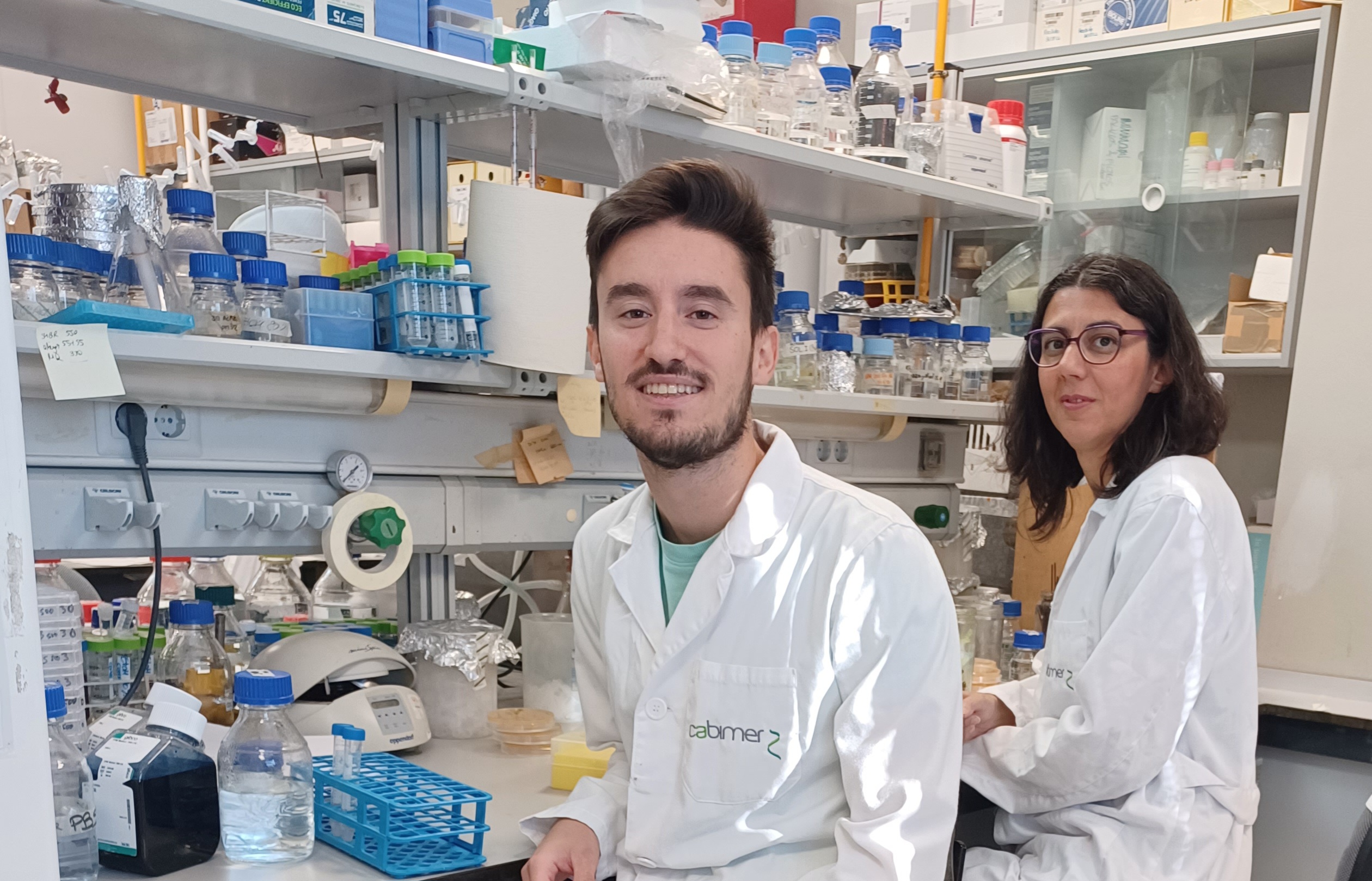
Iván Núñez Martín, primer autor del trabajo, junto a Belén Gómez González, investigadora de la Universidad de Sevilla que ha liderado el proyecto

“Dado que las células cancerosas acumulan mutaciones en el checkpoint que les permiten tolerar la proliferación celular descontrolada, estos hallazgos sugieren que la adquisición de mutaciones adicionales en factores como los identificados en este trabajo podrían ser responsables de quimioresistencia al promover la supervivencia al daño”, indica Belén Gómez González, investigadora de la Universidad de Sevilla (US) que ha liderado el proyecto.

Esta investigación se ha realizado en el grupo de Inestabilidad Genética y Cáncer del investigador Andrés Aguilera en CABIMER, en colaboración con John Diffley, del Instituto Francis Crick de Londres (Reino Unido), y Luis Blanco, del Centro de Biología Molecular Severo Ochoa (CBM-CSIC-UAM).


Referencia

Iván Núñez-Martín, Lucy S Drury, María I Martínez-Jiménez, Luis Blanco, John F X Diffley, Andrés Aguilera, Belén Gómez-González, S-phase checkpoint protects from aberrant replication fork processing and degradationNucleic Acids Research, DOI: 10.1093/nar/gkaf707


Contacto

CBM-CSIC-UAM Comunicación – comunicacion@csic.es

La entrada Revelan factores potencialmente clave en la resistencia al daño de las células cancerosas se publicó primero en Centro de Biología Molecular Severo Ochoa.

Go to Source

Ten years after the discovery, gravitational waves verify Stephen Hawking’s Black Hole Area Theorem

LIGO, Virgo and KAGRA celebrate the anniversary of the first gravitational waves detection and announce verification of Stephen Hawking’s Black Hole Area Theorem. IFAE is a member of both LIGO and Virgo Collaborations and has contributed to the analysis of the recent event GW250114.

Go to Source

European Heart Journal: CNIC scientists report the first use of CRISPR activation to treat a cardiac disease in mice

An international multidisciplinary team led by scientists at the Centro Nacional de Investigaciones Cardiovasculares (CNIC), with participation from scientists at Hospital Universitario Puerta de Hierro and the University of California San Diego, has demonstrated for the first time that CRISPR-based gene activation (CRISPRa) can be used to treat genetic heart disease in vivo. The study, published in the European Heart Journal and presented at the European Society of Cardiology Congress in Madrid, paves the way for novel targeted therapies for patients with genetic cardiac disorders. This approach could be especially useful for patients with conditions caused by mutations in genes too large to be targeted with conventional gene therapy.

The team made this discovery in a new animal model they developed that carries a truncating mutation in the filamin C gene (FLNC). Truncating variants in FLNC (FLNCtv) reduce the amount of Filamin C protein produced and are a frequent cause of genetic dilated cardiomyopathy and left ventricular non-dilated cardiomyopathy. Both diseases predispose patients to severe arrhythmias and increase the risk of sudden cardiac death. There are currently no specific therapies available for this type of mutation, and clinical options are limited to general heart failure treatments and implantable defibrillator devices.

The researchers developed a mouse model carrying a truncating FLNC mutation that reproduces the electrical abnormalities observed in patients, including increased vulnerability to drug-induced arrhythmias.

To restore gene function, the team designed a CRISPRa-based gene-therapy system packaged in a cardiotropic adeno-associated virus (AAVMYO). “This system does not cut DNA,” explains study first author Dr. Rodrigo Cañas Álvaro, “but instead uses a nuclease-inactive CRISPR protein fused to a transcriptional activator to switch on the FLNC promoter, thereby increasing Filamin production in the heart.”

After administration of the vector to adult mutant mice, the researchers observed normalization of FLNC RNA and protein expression to the levels found in healthy animals. Electrocardiogram recordings showed recovery of QRS amplitude and, most importantly, the complete disappearance of flecainide-induced arrhythmias.

“This study demonstrates for the first time that CRISPRa gene activation can reverse manifestations of a hereditary cardiomyopathy in an animal model,” says Dr. Enrique Lara-Pezzi, a CNIC and CIBERCV investigator and the lead author on the study. “Our results suggest that even after the disease has developed, it is possible to restore the heart’s electrical function through a targeted approach.”

Study collaborator Dr. Pablo Garcia-Pavía—head of the Inherited Cardiac Diseases Unit at Hospital Universitario Puerta de Hierro, CNIC and CIBERCV investigator—stresses the significance of the findings. “This research establishes the basis for the development of CRISPRa-AAV therapies not only for FLNC mutations but also for other cardiac disorders caused by insufficient production of essential proteins that cannot be targeted by conventional gene therapy.”

The study was funded by the Spanish Ministry of Science, Innovation, and Universities, the Spanish cardiovascular research network (CIBERCV), and the European Innovation Council of the European Union.

  • Cañas-Alvaro R, Lalaguna L, Rubio B, Ausiello A, López-Olañeta M, Serrano-Blanco RF, Ochoa JP, de la Pompa JL, Chavez A, García-Pavía P, Lara-Pezzi E. CRISPR activation to repair ECG abnormalities caused by a FLNC truncating variant in mice. Eur Heart J. 2025 Aug 31:ehaf703. doi: 10.1093/eurheartj/ehaf703

Go to Source

A Fourth Generation Synchrotron will place Catalonia and Spain at the Forefront of Research

The governments of Spain and Catalonia join forces to upgrade the ALBA Synchrotron facilities. This institutional agreement, which guarantees the necessary resources, was announced yesterday. This is also excellent news for ICN2, as it shares numerous projects and research lines with ALBA.

Go to Source

Bringing Justice into Ecosystem Services: Emerging Perspectives and Research

Johannes Langemeyer, a researcher at ICTA-UAB, is one of the editors of a special issue of the journal Ecosystem Services titled Equity and Justice in Ecosystem Services Research, which explores how fairness, diverse knowledge, and stakeholder voices shape the future of ecosystem services research.

Go to Source

Researchers discover how the interaction of two “epigenetic guardians” protects neuronal identity

Researchers discover how the interaction of two “epigenetic guardians” protects neuronal identity

  • This study shows that the enzymes KDM1A and KDM5C collaborate to prevent neurons from activating inappropriate genes, ensuring their proper function.
  • The findings, published in Cell Reports, open new avenues to understand the origin of neurological disorders associated with mutations in these genes, such as intellectual disability.

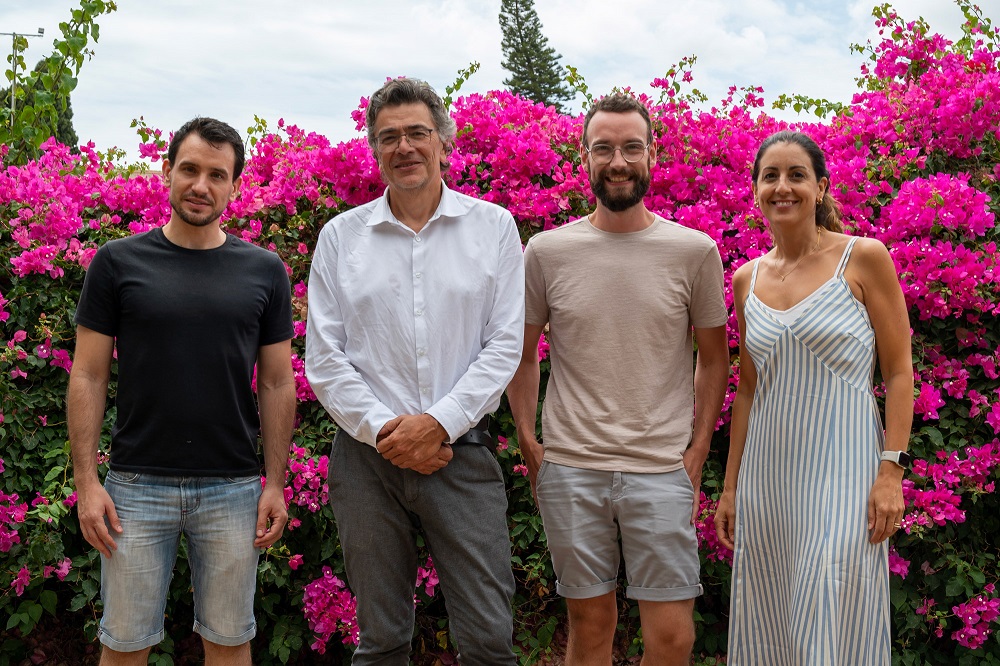
Photo: Sergio Niñerola, Ángel Barco, Juan Paraíso Luna, and Beatriz del Blanco, IN CSIC-UMH researchers

Neurons are highly specialized cells, and their proper functioning depends on preserving their identity throughout life. The team from the Transcriptional and Epigenetic Mechanisms of Neuronal Plasticity laboratory, led by Ángel Barco at the Institute for Neurosciences (IN), a joint center of the Spanish National Research Council (CSIC) and the Miguel Hernández University (UMH) of Elche, has identified that two enzymes, KDM1A and KDM5C, interact to act as true “epigenetic guardians”. Their role is to silence genes that do not belong to neurons and to keep only the appropriate instructions active.

To carry out this study, recently published in Cell Reports, the team used a mouse model in which they simultaneously deleted the KDM1A and KDM5C genes in neurons of the adult brain. This allowed them to investigate what happens when this epigenetic control is lost in mature neurons, and not only during development. “What is surprising is that the joint action of these two enzymes goes beyond the sum of their individual effects”, says Barco, explaining: “When both fail, the neurons begin to express genes that do not belong to it, with negative consequences for memory, learning ability, and the animal’s regulation of anxiety”.

Through a multidisciplinary approach combining genetics, molecular biology, electrophysiology, super-resolution microscopy, behavioral studies, and large-scale genomic analyses, the researchers observed that the loss of both enzymes profoundly alters the neuron’s epigenetic landscape: several genomic regions accumulated an epigenetic mark (H3K4me3), usually associated with active genes, in areas that should remain inactive. They also detected a disorganization in the three-dimensional structure of the neuronal genome. These changes result in alterations in neuronal physiology, such as increased excitability, which negatively impact the behavior and cognitive abilities of the mice.

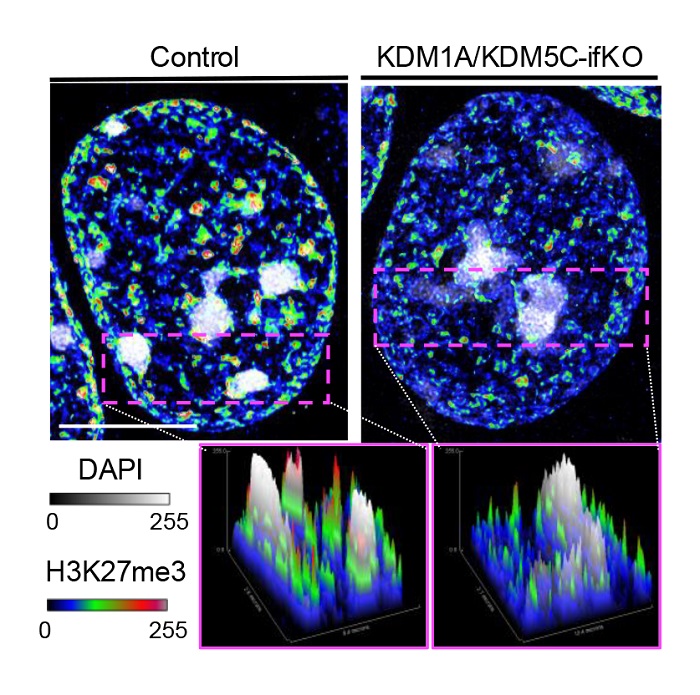
Images of the nucleus of an excitatory neuron of a control mouse (left) and a mouse in which KDM1A and KDM5C have been simultaneously deleted in the adult brain. The DAPI signal (DNA) is shown in gray, and the H3K27me3 signal, an epigenetic mark associated with repression, is shown in color. Source: Cell Reports.

These results represent progress in understanding the origin of neurological disorders associated with intellectual disability caused by mutations in epigenetic regulators: “Understanding how these enzymes interact not only helps us decipher the biology of neurons, but also to identify possible mechanisms involved in neurological diseases”, highlights Juan Paraíso Luna, co-first author of the article.

This study complements previous work from the same laboratory that had already demonstrated the relevance of each of these enzymes individually: KDM1A, essential to preserve the three-dimensional organization of the genome and prevent its deterioration associated with aging, and KDM5C, necessary to avoid erroneous transcriptions and to fine-tune neuronal responses to stimuli. The novelty now is that both proteins work together to maintain neuronal identity. “Mutations in the Kdm1a and Kdm5c genes have been associated in humans with intellectual disability and other neurological disorders, so this work opens the door to new research that can help us delve deeper into the origin of certain brain diseases”, concludes Barco.

“Cooperative control of neuron-specific repressive chromatin states by intellectual-disability-linked KDM1A and KDM5C demethylases.” Martín-González AM, Paraíso-Luna J, Niñerola S, Del Blanco B, Robles RM, Herrera ML, Muñoz-Viana R, Geijo-Barrientos E and Barco A. Cell Reports. 2025 44, 116201. DOI https://doi.org/10.1016/j.celrep.2025.116201

This work was made possible thanks to collaboration with the group of Professor Emilio Geijo, from the UMH Department of Physiology, and funding from La Marató de TV3, the Spanish State Research Agency, the Generalitat Valenciana, and the “LaCaixa” Foundation.

Source: Institute for Neurosciences CSIC-UMH (in.comunicacion@umh.es)

La entrada Researchers discover how the interaction of two “epigenetic guardians” protects neuronal identity se publicó primero en Instituto de Neurociencias de Alicante.

Go to Source

Boletín Amigos/as del CNIO 52

Boletín Amigos/as del CNIO 52

La entrada Boletín Amigos/as del CNIO 52 se publicó primero en CNIO.

Go to Source

Rising talent and research shine in the ICIQ Summer Fellowship Programme

The ICIQ Summer Fellowship Programme 2025 has been successfully concluded, offering a hands-on learning experience to eleven students. This unique opportunity, granted by ICIQ through the Severo Ochoa Excellence programme, provided the participants to immerse themselves in research projects, gaining insights and practical skills in chemistry and related fields.

Throughout the programme, the students were mentored by a PhD student or a senior researcher under the supervision and guidance of an ICIQ Group Leader, enabling them to apply theoretical knowledge to practical scenarios. This hands-on approach allowed participants to deepen their understanding of the subject matter while enhancing their problem-solving abilities in a research environment.

This week, during the closing ceremony of the Summer Fellows 2025 programme, all participants presented the research projects they have been working on during these two months of training. It was a working session that served as a shining example of emerging talent and research.


Reflecting on the programme’s success, Prof. Antonio M. Echavarren, ICIQ Group Leader and Scientific Director of the Severo Ochoa Programme at the Institute, stated, “throughout the programme, the students have displayed remarkable curiosity, commitment, and a genuine passion for science. Their performance not only reflects their potential but also inspires optimism for the future of research in chemistry.”

The closing ceremony took place yesterday, September 9th, and was chaired by Prof. Beatriz Prieto-Simón, Group Leader at ICIQ, and Dana Loughran, ICIQ Talent Officer.


These fellowships are funded by ICIQ with the support of the “Severo Ochoa Centres of Excellence Program (CEX2024-001469-S funded by MICIU/AEI/10.13039/501100011033)


La entrada Rising talent and research shine in the ICIQ Summer Fellowship Programme se publicó primero en ICIQ.

Go to Source

Search and study of massive runaway stars in the Milky Way and impact on high-energy binaries

Image
ICCUB Thesis
Thesis Defence

Search and study of massive runaway stars in the Milky Way and impact on high-energy binaries

Date
Place
“Aula Magna Enric Casassas”, Physics Faculty

Abstract: TBA

Tribunal:

President: Dr. Sergio Simón Díaz

Secretària: Dra. Mercè Romero Gómez  

Vocal: Dra. Julia Bodensteiner 


Suplents:

Dr. Benito Marcote 

Dr. Francesc Xavier Luri Carrascoso


Directors: Dr. Marc Ribó Gomis

                Dr. Josep Maria Paredes Poy

Tutor: Dr. Alberto Manrique Oliva

Go to Source

Transient sources with LST-1: study of novae, supernovae, and gamma-ray bursts

Image
ICCUB Thesis
Thesis Defence

Transient sources with LST-1: study of novae, supernovae, and gamma-ray bursts

Date
Place
Aula de graus Eduard Fonseré

Abstract: TBA

Tribunal:

President: Dr. Oscar Blanch Bigas

Secretària: Dra. Alicia López Oramas

Vocal: Dra. Roberta Zanin 


Suplents:

Dr. Abelardo Moralejo Olaizola 

Dra. Daniela Hadasch 


Directors: Dr. Marc Ribó Gomis i Dr. Pol Bordas Coma

Tutor: Dr. Alberto Manrique Oliva

Go to Source

Primordial non Gaussianity and its imprint on the Large Scale Structure of the Universe

Image
ICCUB Thesis
Thesis Defence

Primordial non Gaussianity and its imprint on the Large Scale Structure of the Universe

Date
Place
“Aula Magna Enric Casassas”, Physics Faculty
Abstract:

Constraining primordial non-Gaussianity (PNG) offers a unique lens into the physics of the early Universe, probing energy scales far beyond the reach of terrestrial experiments. The large-scale structure (LSS) of the Universe encodes valuable information, and ongoing galaxy surveys, such as DESI, have the potential to greatly improve current constraints. This thesis investigates how PNG affects LSS observables and how simulations can be used to characterize these effects. First, I introduce a novel framework to generate non-Gaussian initial conditions for cosmological simulations, enabling studies of non-standard models. I then provide examples of applications to oscillatory and scale-dependent scenarios, outlining their imprint on nonlinear clustering. Finally, I focus on local PNG, which induces a sharp scale-dependent feature in the galaxy power spectrum—one of the most promising avenues for testing multi-field inflation. Showing its dependence on dark matter halo assembly history, I will propose observational proxies calibrated on hydrodynamical simulations that link this effect to galaxy properties. Applied to quasar samples relevant for DESI, these results provide priors that strengthen upcoming constraints.


Tribunal:

President: Dr. Héctor Gil-Marín

Secretari: Dr. Santiago Javier Avila Pérez

Vocal: Dr. Matteo Viel


Suplents:

Dr. Marc Manera Miret

Dr. Raul Jimenez


Directora: Dra. Licia Verde

Tutor: Dr. Alberto Manrique Oliva

Go to Source

How do plant cell walls respond to pests?

Many researchers investigate about the defense mechanisms of these plant structures against pathogens; however, their role against herbivores has received less attention. This review, conducted by the “Dissecting Plant-Defense-Growth Trade-offs” group from the CBGP, identifies promising new lines of research for developing strategies to strengthen crop resistance, with important implications for sustainable agriculture and food security.

Go to Source

Sidebar