Author Archive

The MAGIC Collaboration held its 1st data-analysis open school

On the 8th and 9th of September, the MAGIC Collaboration held its [1st data-analysis school open to the public](https://acme-magic-odas.sciencesconf.org/).

Go to Source

DESI DR1 Now Available at CosmoHub

The Port d’Informació Científica (PIC) has set up a European mirror of the DESI DR1 public release, making the full dataset available through its storage system: [DESI DR1 Mirror @ PIC](https://webdav-hdfs.pic.es/data/public/DESI)

Go to Source

Loterías conmemora el 50 aniversario del Centro de Biología Molecular Severo Ochoa con un billete especial

Loterías y Apuestas del Estado ha puesto a la venta un billete conmemorativo en honor al 50 aniversario del Centro de Biología Molecular Severo Ochoa (CBM), que participará en el sorteo del 20 de septiembre.

El billete conmemorativo se convierte en un símbolo de la historia y el futuro del centro. En él se plasma la silueta del edificio moderno inaugurado en 2008, emblema de innovación y apertura al conocimiento; el busto de Severo Ochoa, cuya visión inspiró la creación del CBM; y el logo del cincuentenario, donde la doble hélice del ADN se transforma en el número 50, evocando la unión entre la esencia de la vida y el medio siglo de investigación de vanguardia que define al centro.

El CBM fue fundado en 1975 por Severo Ochoa, junto a Federico Mayor Zaragoza, Eladio Viñuela —marido de la también investigadora del CBM Margarita Salas—, Antonio García Bellido y David Vázquez, todos ellos referentes en sus áreas y responsables de dar al centro un carácter multidisciplinar. Este espíritu sigue vivo hoy en día, con investigación puntera en neurociencia, virología, inmunología, microbiología, biología molecular, genética, enfermedades infecciosas y enfermedades raras, entre otras disciplinas.

La celebración del cincuentenario tendrá lugar los días 29 y 30 de septiembre, con un acto institucional y una conferencia científica internacional que reunirá a ponentes de prestigio mundial. Entre ellos destacan tres premios Nobel, varios galardonados con el Premio Gairdner y otras distinciones internacionales, consolidando al CBM como un referente global en investigación biomédica.

Más allá de los logros y la excelencia científica, este aniversario rinde homenaje a la comunidad humana que hace posible al CBM: más de 800 personas, organizadas en más de 90 laboratorios y 26 servicios científico-técnicos y de gestión, cuya entrega colectiva sostiene día a día la generación de conocimiento. Ellos son la verdadera esencia del centro y el motor que impulsa su futuro.


La entrada Loterías conmemora el 50 aniversario del Centro de Biología Molecular Severo Ochoa con un billete especial se publicó primero en Centro de Biología Molecular Severo Ochoa.

Go to Source

Las enfermedades psiquiátricas y el consumo de alcohol y drogas limitan la capacidad del cerebro para generar nuevas neuronas

Un estudio liderado por investigadoras del Consejo Superior de Investigaciones Científicas (CSIC), entidad adscrita al Ministerio de Ciencia, Innovación y Universidades, ha demostrado que distintas enfermedades psiquiátricas, como el trastorno bipolar, así como hábitos de vida poco saludables, como el consumo de alcohol o drogas, afectan de forma negativa a la capacidad del cerebro humano para generar nuevas neuronas sanas.

El trabajo, publicado en la revista Cell Stem Cell, constituye el primer estudio histológico que demuestra la existencia de células madre en división en el cerebro humano adulto. Este hallazgo confirma que el proceso conocido como neurogénesis hipocampal adulta, es decir, el nacimiento de nuevas neuronas a lo largo de la vida en el hipocampo, una región del cerebro clave para la memoria y el estado de ánimo, es un proceso real y activo en el ser humano.

En 2021, el equipo liderado por María Llorens-Martín, investigadora del Centro de Biología Molecular Severo Ochoa (CBM, CSIC-UAM), ya describió cómo nuestro cerebro es capaz de generar nuevas neuronas a partir de células madre gracias a la existencia de un nicho celular especializado presente en muy pocas regiones del cerebro, entre ellas, el hipocampo. Este nacimiento de nuevas neuronas otorga a los mamíferos una gran capacidad de adaptación gracias a lo que se conoce como plasticidad cerebral. Sin embargo, los resultados del equipo investigador indicaban que la neurogénesis hipocampal adulta disminuye a lo largo del envejecimiento y que el propio hipocampo presenta una notable sensibilidad a enfermedades neurodegenerativas.

Ahora, el nuevo estudio del grupo de Llorens-Martín demuestra la vulnerabilidad de la neurogénesis hipocampal en relación a ciertos trastornos de salud mental. En concreto, la investigación revela que la depresión, la esquizofrenia y el trastorno bipolar alteran de manera selectiva las fases iniciales del proceso de neurogénesis, impidiendo la proliferación adecuada de las células madre y limitando la generación de nuevas neuronas. “Nuestros resultados demuestran que las etapas iniciales e intermedias de la neurogénesis adulta, así como distintos componentes del nicho celular que la sostiene, son especialmente sensibles a estas enfermedades, así como una vulnerabilidad selectiva de distintas poblaciones celulares a cada una de las enfermedades estudiadas”, explica la investigadora del CBM y líder del estudio.

Este avance ha sido posible gracias a la utilización de material humano de altísima calidad, procedente del Neuropathology Consortium, del Stanley Medical Research Institute (EE. UU.), y al perfeccionamiento de sofisticadas técnicas desarrolladas en el laboratorio de Llorens-Martín en el CBM-CSIC-UAM.


Hábitos de vida, vasos sanguíneos y neurogénesis

El trabajo también revela que factores demográficos como la edad y el sexo, así como diversos hábitos de vida, influyen en la neurogénesis adulta, tanto en sujetos neurológicamente sanos como en pacientes con enfermedades psiquiátricas.

En relación al primer ámbito señalado, el estudio muestra que algunas de las alteraciones en neurogénesis son sistemáticamente más acusadas en mujeres que en hombres con varias de estas patologías. “Ello podría tener relevancia clínica, dada la mayor prevalencia de enfermedades psiquiátricas, como la depresión, en pacientes del sexo femenino”, destaca Llorens-Martín. Respecto al alcohol, uno de los hallazgos más relevantes es el efecto diferencial de su consumo: en personas sanas, incluso un consumo mínimo provoca alteraciones comparables a las observadas en niveles elevados de ingesta; en pacientes con trastornos psiquiátricos, sin embargo, se observa un claro efecto dosis-respuesta, de modo que, a mayor consumo, mayor es el grado de alteración. Por último, en relación a las drogas, “su consumo acentúa aún más las alteraciones en neurogénesis que presentan los pacientes con enfermedades psiquiátricas”, añade la investigadora.

Otro de los resultados significativos del estudio es la relación entre el estado de los vasos sanguíneos del hipocampo y la capacidad de generar nuevas neuronas. La severidad y duración de la enfermedad psiquiátrica correlacionan con alteraciones vasculares en esta región, lo que apunta a la importancia del nicho neurogénico (el microambiente especializado donde nacen las neuronas) en la plasticidad cerebral y en la vulnerabilidad del cerebro humano frente a estas patologías. Los datos sugieren que, cuanto mayor es la duración de estas enfermedades, el nicho neurogénico sufre un daño progresivo (o acumulativo), lo cual repercute de manera aún más negativa en el proceso de neurogénesis.


Futuras terapias para tratar trastornos psiquiátricos

“Este marco integrador, que combina aspectos clínicos, factores demográficos y sociales, nos permite avanzar hacia una comprensión más profunda de la regulación multifactorial del proceso de neurogénesis adulta en seres humanos”, señala Llorens-Martín. “Aunque aún es necesario determinar si estas alteraciones son una causa o una consecuencia de las enfermedades psiquiátricas, nuestros datos podrían sentar las bases para el diseño de futuras estrategias terapéuticas destinadas a restaurar la neuroplasticidad cerebral en estos trastornos, así como a prevenir estas patologías”.

Dado el papel clave que el nacimiento de nuevas neuronas en el hipocampo tiene sobre funciones como la memoria, el aprendizaje y la regulación del estado de ánimo, este estudio subraya tanto la relevancia biológica como el desafío clínico de estudiar este proceso en seres humanos. Además, pone en valor la excepcional dificultad de acceder a muestras cerebrales de alta calidad, imprescindibles para avanzar en el conocimiento de la salud mental.

La investigación, liderada por el CSIC, ha contado con la participación de la Universidad Autónoma de Madrid (UAM) y el Centro de Investigación Biomédica en Red (CIBERNED); y con la financiación del European Research Council (ERC Consolidator Grant), el Ministerio de Ciencia, Innovación y Universidades, la BrightFocus Foundation, el Consejo Nacional de Ciencia y Tecnología del Gobierno de México y la Secretaría de Educación, Ciencia, Tecnología e Innovación del Gobierno de la Ciudad de México.


Referencia

Berenice Márquez-Valadez*, Marta Gallardo-Caballero*, María Llorens-Martín. Human adult hippocampal neurogenesis is shaped by neuropsychiatric disorders, demographics, and lifestyle-related factors. Cell Stem Cell. 32, 1–18. October 2, 2025. DOI: doi.org/10.1016/j.stem.2025.08.010


Contacto

CBM Comunicación – comunicacion@cbm.csic.es

La entrada Las enfermedades psiquiátricas y el consumo de alcohol y drogas limitan la capacidad del cerebro para generar nuevas neuronas se publicó primero en Centro de Biología Molecular Severo Ochoa.

Go to Source

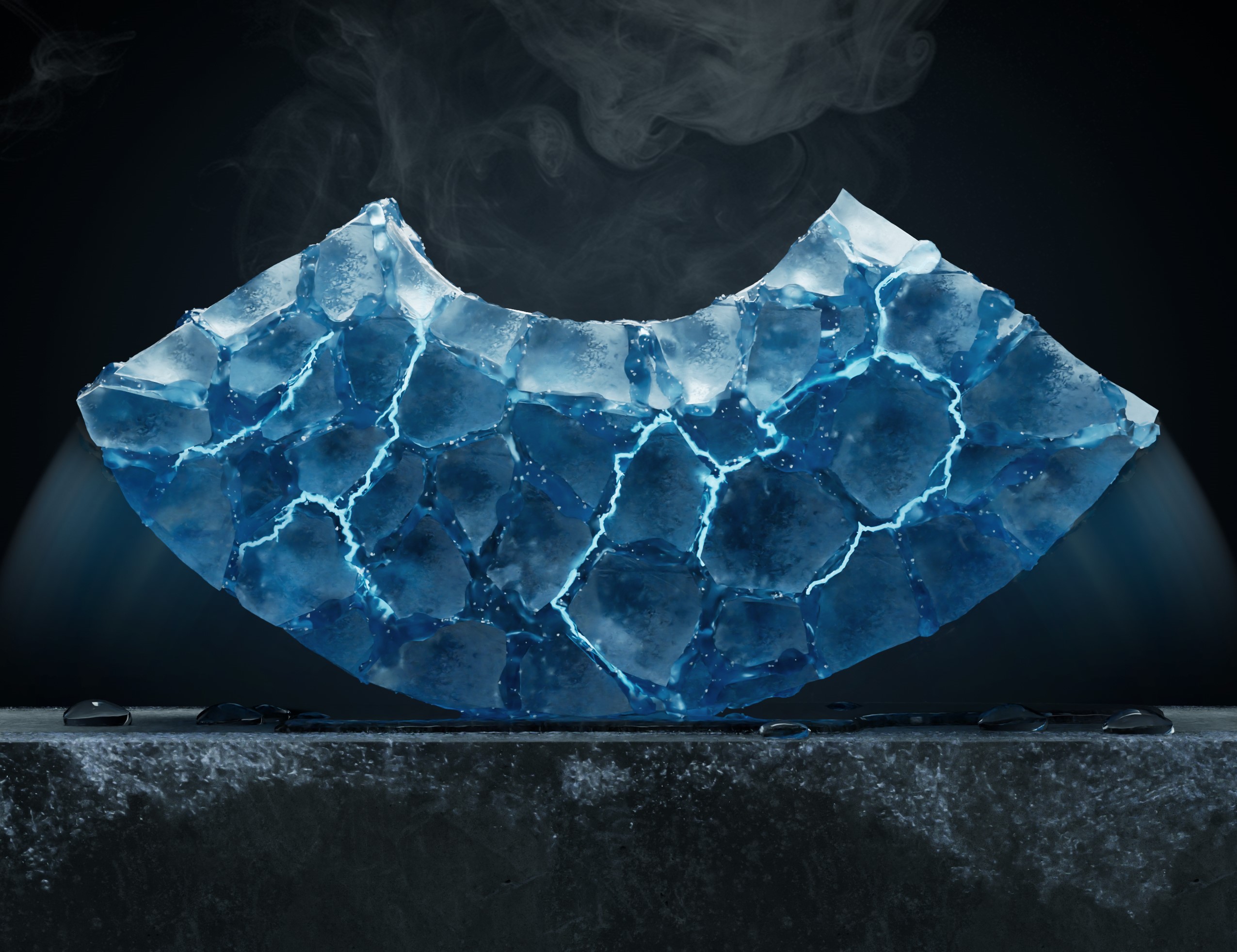
Salty Ice: a New Way to Generate Electricity in Extreme Conditions

Researchers at ICN2 have co-led a study showing that adding salt to regular ice considerably boosts its ability to produce electricity when bent. The discovery could pave the way for new electronic devices or for generating power in extreme environments such as polar regions.

Go to Source

Un algoritmo que predice si un cáncer de páncreas se ha extendido a otros órganos podrá ayudar a evitar cirugías innecesarias

Núria Malats, Nannan Xue y Sergio Checa, en el Centro Nacional de Investigaciones Oncológicas (CNIO). /Pilar Gil. CNIO

El cáncer de páncreas sigue siendo uno de los principales retos para la oncología, un tumor en que las nuevas terapias personalizadas o de inmunoterapia todavía no dan resultado y que está en aumento. Gran parte del esfuerzo se centra en lograr detectarlo cuanto antes, porque la mayoría de los casos se diagnostican en fase ya tardía. Pero la investigación también busca ayudar a tomar la mejor decisión clínica una vez que se tiene un diagnóstico.

A la hora de decidir si operar o no, es esencial saber si el tumor primario ya se ha extendido a otros órganos. Si lo ha hecho -si hay metástasis-, la cirugía no está indicada. El problema es que en cáncer de páncreas esto es muy difícil de determinar. Hoy día, una parte importante de pacientes, cuyas metástasis no fueron detectadas a tiempo, sufren una intervención que no les beneficia.

Un equipo liderado por Núria Malats, del Centro Nacional de Investigaciones Oncológicas (CNIO), ha desarrollado un algoritmo que predice con precisión la existencia de metástasis a partir de imágenes médicas del tumor primario.

Se trata de un modelo de aprendizaje profundo “prometedor a la hora de ayudar a los cirujanos y médicos en la detección de metástasis, lo que podría perfeccionar la planificación quirúrgica y mejorar los resultados de los pacientes con cáncer de páncreas”, se afirma en la publicación de la revista GUT.

“Es fundamental saber si hay metástasis antes de decidir operar”

“Si una persona con cáncer de páncreas ya tiene metástasis, una operación no solo no cura, sino que puede empeorar su situación”, explica Malats, jefa del grupo de Epidemiología Genética y Molecular del CNIO. “La cirugía es muy invasiva y puede hacer que el paciente sufra más, sin mejorar su pronóstico. Por eso es fundamental saber a tiempo si hay metástasis antes de decidir operar. Nuestro algoritmo predice con precisión la presencia de metástasis utilizando imágenes que ya se hacen de forma rutinaria”.

El algoritmo PMPD (Pancreatic cancer Metastasis Prediction Deep-learning algorithm), que emplea inteligencia artificial, fue puesto a prueba con los datos de cerca de 250 pacientes del ensayo clínico holandés PREOPANC1 sobre primera opción de tratamiento en cáncer de páncreas –y cuyo investigador principal, Casper Van Eijck, ha participado en el trabajo que ahora se publica–. El algoritmo tuvo una alta tasa de éxito.

Evitar efectos secundarios innecesarios

En concreto, el algoritmo PMPD clasificó con precisión el 56% de las metástasis en el conjunto PREOPANC-DPCG, “un resultado prometedor en el cáncer de páncreas, especialmente en este tipo de diagnóstico tan complejo”, señala Malats.

El rendimiento del modelo se mantuvo independientemente de la ubicación de la metástasis. El tamaño y la ubicación del tumor primario, el sexo y la edad del paciente tampoco afectaron a la capacidad de predicción.

El resultado es especialmente positivo si se tiene en cuenta a los pacientes del estudio PREOPANC-DPCG cuyas metástasis solo fueron detectadas en quirófano. El algoritmo PMPD predijo el 65,8% de estas metástasis, lo que significa que, de haberse empleado en su momento, “estos pacientes podrían haberse ahorrado la intervención quirúrgica”, dice Malats.

“Una segunda opinión basada en datos”

El algoritmo también pronostica el desarrollo de la enfermedad. Como explica Malats, “no solo dice si hay metástasis ahora, sino que intenta predecir si van a aparecer en los próximos meses. Esto ayuda a los médicos a decidir mejor si operar o no, a planear tratamientos más ajustados al riesgo del paciente y a evitar intervenciones innecesarias”.

Es un desarrollo liderado por el grupo del CNIO con la colaboración de personas expertas en medicina, informática y estadística de instituciones de España y Holanda.

El éxito del algoritmo se debe a que ha sido entrenado con muchos datos médicos reales (imágenes de escáneres TAC y datos clínicos). También, añade Malats, a que emplea técnicas de inteligencia artificial “que detectan patrones difíciles de ver para el ojo humano”.

El algoritmo está diseñado como una herramienta complementaria, explica la investigadora del CNIO: “ayuda a los médicos (radiólogos, oncólogos y cirujanos, sobre todo) a tomar decisiones, pero no reemplaza su juicio profesional. Sirve como una segunda opinión basada en datos, que puede hacer que el diagnóstico sea más rápido, más preciso y menos arriesgado para el paciente”.

Siguiente paso: validar con pacientes en hospitales

Hay, no obstante, limitaciones. Hace falta “más validación en diferentes hospitales y poblaciones”, afirma Malats. Y, como todo desarrollo IA, puede dar falsos positivos (decir erróneamente que hay metástasis) o falsos negativos (no verlas cuando sí existen).

Por eso, uno de los próximos objetivos del grupo es probar el algoritmo en pacientes reales, en tiempo real, en colaboración con hospitales como Vall d’Hebron (Barcelona), el Ramón y Cajal y Gregorio Marañón (Madrid), el Centro Universitario de Navarra y con el Grupo Holandés de Cáncer de Páncreas (Dutch Pancreatic Cancer Group, DPCG). También se busca la participación de hospitales en China y Uruguay, para conseguir la máxima heterogeneidad de imágenes posible.

Cuentan para ello con casi 800.000 euros de financiación del Ministerio para la Transformación Digital, en el proyecto Implementación en hospitales terciarios del algoritmo IA-PMPD para la predicción de metástasis de cáncer de páncreas y demostración de su rendimiento a tiempo real. 

Financiación:

Pancreatic cancer AI for genomics and personalized Medicine (PANCAIM Study). H2020 #101016851.

Sobre el Centro Nacional de Investigaciones Oncológicas (CNIO)

El Centro Nacional de Investigaciones Oncológicas (CNIO) es un centro público de investigación dependiente del Ministerio de Ciencia, Innovación y Universidades. Es el mayor centro de investigación en cáncer en España y uno de los más importantes en Europa. Integra a medio millar de científicos y científicas, más el personal de apoyo, que trabajan para mejorar la prevención, el diagnóstico y el tratamiento del cáncer.

La entrada Un algoritmo que predice si un cáncer de páncreas se ha extendido a otros órganos podrá ayudar a evitar cirugías innecesarias se publicó primero en CNIO.

Go to Source

New therapeutic pathway found for combatting the most aggressive liver cancer

A multidisciplinary team from the Biogipuzkoa Institute for Health Research, the Department of Health and Osakidetza [Basque Public Health Service], in collaboration with the University of the Basque Country (EHU) and the Donostia International Physics Centre (DIPC), among others, has developed and patented a new chemotherapy formula that has proven to be highly effective against an aggressive type of liver cancer with a very poor prognosis known as cholangiocarcinoma. The study, published recently in the prestigious Journal of Hepatology, opens up new therapeutic possibilities not only for treating cholangiocarcinoma, but also other solid tumours that are resistant to conventional cancer treatments

Go to Source

Supermassive Black Holes Shrouded by Dust in Early Universe

Image
Figure 1: An artist’s impression of a dust-shrouded quasar in the early Universe. (Credit: NAOJ)
Credits
Figure 1: An artist’s impression of a dust-shrouded quasar in the early Universe. (Credit: NAOJ)
English
Scientific background

In the present Universe, 13.8 billion years after the Big Bang, almost all galaxies host supermassive black holes at their centers, with masses exceeding millions of times that of the Sun. These black holes remain dormant most of the time, but when they accrete surrounding matter, they emit strong radiation and become powerful objects called quasars. The intense radiation from a quasar is believed to significantly affect the growth and evolution of its host galaxy by expelling the gas inside the galaxy. As galaxies trace the evolution of the visible Universe, understanding supermassive black holes is crucial for deciphering how the Universe was shaped into the form we see today.
ICREA researcher at the University of Barcelona’s Institute of Cosmos Sciences, Kazushi Iwasawa, is a core member of this work on obscured quasars as well as the collaboration that searches for quasars in the early universe using the Subaru Telescope. Iwasawa led an X-ray study of a subsample of the obscured quasars presented here (the paper is now under review). 

Despite the key role supermassive black holes play in the Universe, there remains a fundamental mystery as to how they ever formed. Many supermassive black holes have already been found as early as 1 billion years after the Big Bang, which implies that their formation must have occurred even earlier. For this reason, extensive searches for quasars have targeted the early epoch, sometimes called the “Cosmic Dawn,” when the Universe was less than 1 billion years old. An important clue to understanding their formation mechanism is their number density-that is, the number of supermassive black holes per unit volume of space. If the number is high, they must have formed relatively frequently and widely, possibly as remnants of first-generation stars. Conversely, a low number density would suggest formation under special conditions, such as the direct collapse of massive objects due to self- gravity, forming initial black holes.

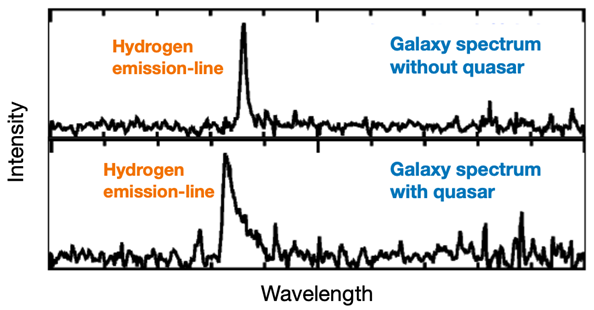
When a supermassive black hole is active as a quasar, it shines so brilliantly that it can be detected even at great distances, corresponding to earlier times in the Universe. In quasar light, we see a “broad emission line,” broadened by the Doppler effect from gas orbiting at high velocity around the central black hole (Figure 2). Detecting such a broad emission line is a definitive sign of an active supermassive black hole in a galaxy.

Examples of galaxy spectra. The graphs show light intensity versus wavelength. A sharp peak in the spectrum, called an

Figure 2: Examples of galaxy spectra. The graphs show light intensity versus wavelength. A sharp peak in the spectrum, called an “emission line,” appears when hydrogen emits light at a specific wavelength. In a normal galaxy (top), emission lines are narrow. In a galaxy hosting a quasar (bottom), fast-moving gas near the black hole broadens the lines. (Credit: Yoshiki Matsuoka/NAOJ)

Earlier work by research groups led by U.S. and European researchers used this method to discover quasars at the Cosmic Dawn. The research team in this study joined the effort, using the Subaru Telescope, and has discovered more than 200 quasars.
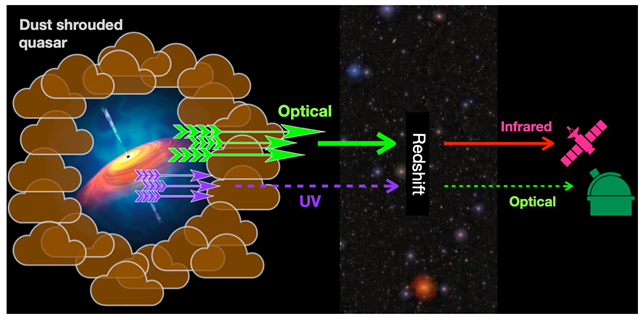
However, conventional surveys face limitations due to observational technology: quasars were identified by using the ultraviolet light they emit—which appears as visible light from Earth (Figure 3)—as a marker. Ultraviolet light is easily absorbed by dust, and many galaxies contain a substantial amount of dust. When a quasar resides in such a galaxy, its ultraviolet light is largely absorbed and does not reach us. This has led to the suspicion that quasars discovered in conventional surveys represent only a fraction of the true population, with many more hidden by dust.

Observing Hidden Quasars

The research team focused on the most luminous galaxies discovered in the wide-area survey conducted with Hyper Suprime-Cam on the Subaru Telescope (HSC-SSP). These galaxies were initially found while searching for quasars, but since no broad emission lines were detected at the time, they were not considered to be quasars. Still, signs of a powerful energy source had led the team to suspect for more than 10 years that hidden quasars might be present. The launch of JWST was a game changer. For the first time, the team could observe visible light from these galaxies—which reaches Earth as infrared light—allowing them to see through dust that would block ultraviolet light (Figure 3).

Figure 3: Schematic diagram showing how a quasar hidden by dust is observed. Light from a quasar in the early Universe is stretched by cosmic redshift, so ultraviolet light reaches Earth as visible light and visible light reaches Earth as infrared. When a quasar is covered by dust, ultraviolet light is absorbed and cannot escape, but infrared observations can capture the visible light that passes through the dust. Detecting such faint infrared light from early quasars required observations with JWST. (Credit: Yoshiki Matsuoka/NAOJ)

Figure 3: Schematic diagram showing how a quasar hidden by dust is observed. Light from a quasar in the early Universe is stretched by cosmic redshift, so ultraviolet light reaches Earth as visible light and visible light reaches Earth as infrared. When a quasar is covered by dust, ultraviolet light is absorbed and cannot escape, but infrared observations can capture the visible light that passes through the dust. Detecting such faint infrared light from early quasars required observations with JWST. (Credit: Yoshiki Matsuoka/NAOJ)

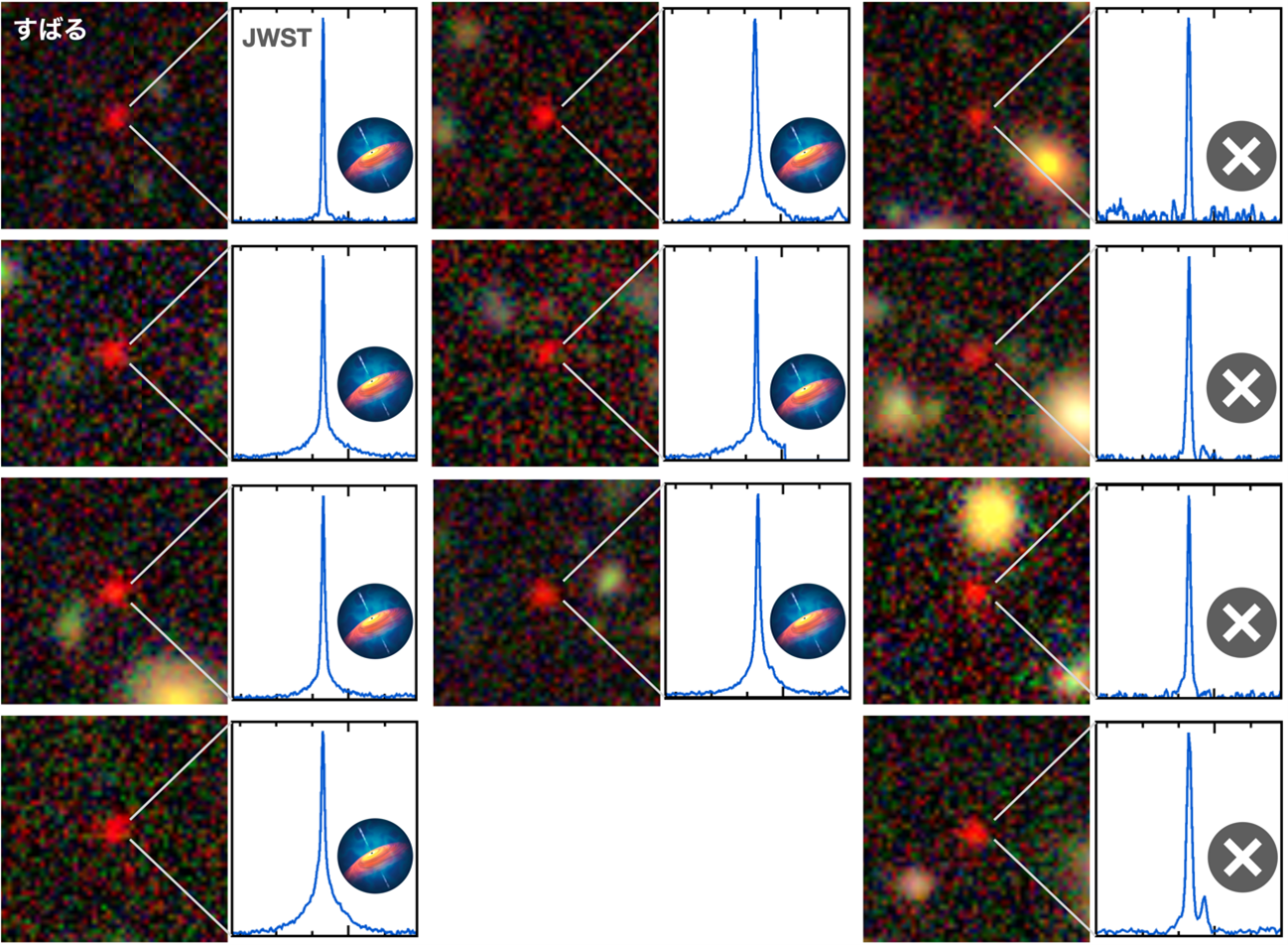
Observations were carried out with the NIRSpec spectrograph onboard JWST from July 2023 to October 2024, targeting 11 of the most luminous galaxies discovered by the Subaru Telescope. Seven of them clearly show broad emission lines, a telltale sign of a quasar (Figure 4). This confirms the presence of dust-shrouded quasars. These are the first dust-obscured luminous quasars discovered at the Cosmic Dawn (Note 1).

Figure 4: Galaxies observed in this study. The left panels show images taken by the Subaru Telescope at the time of discovery. The right panels show spectra obtained from follow-up observations with JWST, capturing the Hα emission line of hydrogen at a wavelength of 650 nanometers. In the seven galaxies on the left, hydrogen gas is orbiting rapidly around a supermassive black hole, producing a broadened emission line due to the Doppler effect. In the remaining four galaxies, the emission line is narrower, and the presence of a supermassive black hole could not be confirmed. (Credit: Yoshiki Matsuoka/NAOJ/NASA )

Figure 4: Galaxies observed in this study. The left panels show images taken by the Subaru Telescope at the time of discovery. The right panels show spectra obtained from follow-up observations with JWST, capturing the Hα emission line of hydrogen at a wavelength of 650 nanometers. In the seven galaxies on the left, hydrogen gas is orbiting rapidly around a supermassive black hole, producing a broadened emission line due to the Doppler effect. In the remaining four galaxies, the emission line is narrower, and the presence of a supermassive black hole could not be confirmed. (Credit: Yoshiki Matsuoka/NAOJ/NASA)

A closer look at the spectra revealed that these quasars emit energy equivalent to a few trillion Suns and are powered by black holes with masses of a few billion Suns. These values are comparable to ordinary, unobscured quasars known from the Cosmic Dawn. The team also found that dust absorbs about 70% of the visible light and nearly all (99.9%) of the ultraviolet light from these quasars, which explains why they were missed in previous surveys.
By comparing the number densities of quasars, the team concluded that dust-obscured quasars are at least as common as the previously known, conventional quasars. This means that the number of bright quasars in the early Universe is at least twice as high as previously thought.
Dr. Yoshiki Matsuoka of Ehime University, who led this study comments:
“This discovery was only possible with the unique combination of two powerful telescopes. The Subaru Telescope’s wide and sensitive survey allowed us to spot rare, luminous galaxies, and JWST was able to catch the faint infrared light from the hidden quasars. This shows how effective the approach of ‘Discover with Subaru Telescope, explore with James Webb’ can be.”

Future prospects

The team foresees two main directions for future research. First, they plan to follow up on the obscured quasars to see whether they differ fundamentally from conventional ones. JWST spectra contain emission lines from various elements, revealing the physical conditions near the black holes. They also plan to use the ALMA telescope to study the host galaxies in detail.
Second, the team aims to expand the search for hidden black holes to a broader population of galaxies, including less luminous ones, in order to reveal the full population of supermassive black holes in the early Universe. They already have a new JWST program approved, and the upcoming observations are scheduled to start early next year.
These results appeared as Matsuoka et al. “SHELLQs. Bridging the Gap: JWST Unveils Obscured Quasars in the Most Luminous Galaxies at z > 6” in the Astrophysical Journal on July 14, 2025.
(Note 1) A few possible candidates for dust-obscured quasars at the Cosmic Dawn have been reported previously. However, they remain inconclusive because no broad emission line was detected. Recent JWST observations discovered numerous new objects called “Little Red Dots,” many of which show broad emission lines. These are thought to host black holes but are much fainter than the quasars previously discovered in the early Universe. In contrast, this study has uncovered the first examples of supermassive black holes at the Cosmic Dawn that are as luminous as the conventional quasars, but have been dimmed by their surrounding dust.

Relevant links:

Date
SEO Title
Supermassive Black Holes Shrouded by Dust in Early Universe

Go to Source

Simulations solve centuries-old cosmic mystery – and discover new class of ancient star systems

Image
Credit University of Surrey, Matt Orkney, Andrew Pontzen & Ethan Taylor
Credits
University of Surrey, Matt Orkney, Andrew Pontzen & Ethan Taylor
English

For centuries, astronomers have puzzled over the origins of one of the universe’s oldest and densest stellar systems, known as globular clusters. Now, a University of Surrey-led study published in Nature has finally solved the mystery using detailed simulations – while also uncovering a new class of object that could already be in our own galaxy. 

Globular clusters are dense collections of hundreds of thousands to millions of stars found orbiting around galaxies, including the Milky Way. Unlike galaxies, they show no evidence of dark matter, and their stars are unusually uniform in age and chemical composition – traits that have left scientists debating their formation since their discovery in the 17th century. 

Surrey researchers used ultra-high-resolution simulations that can trace the Universe’s 13.8-billion-year history in unprecedented detail, allowing them to watch globular clusters form in real-time within their virtual cosmos, called EDGE. The simulations find multiple pathways for their creation and, unexpectedly, the emergence of a new class of star system – “globular cluster-like dwarfs” – that sits between globular clusters and dwarf galaxies in terms of their properties.  

Dr Matt Orkney, Postdoctoral researcher at the University of Barcelona’s Institute of Cosmos Sciences, said: 

The origin of globular clusters has long puzzled astrophysicists. The EDGE simulations represent a major leap in understanding the diverse pathways of their formation, including clusters born in the violent interactions between merging galaxies, and those formed within their own dark matter structures. 

Working in collaboration with Durham University, the University of Bath, the University of Hertfordshire, Carnegie Observatories and the American Museum of Natural History in the USA, Lund University in Sweden and the University of Barcelona in Spain, researchers used the UK’s DiRAC National Supercomputer facility to run the EDGE simulations over several years. To put the scale into perspective, if the largest simulations were run on a standard or high-end laptop, they would take decades to complete. These simulations not only recreated realistic globular clusters and dwarf galaxies but also predicted a previously unknown class of object.  

Conventional dwarf galaxies are typically dominated by dark matter, with around a thousand times more of the mysterious substance than stars and gas combined. However, the newly identified ‘globular cluster-like dwarfs’ appear similar to regular star clusters when observed, yet still contain a significant amount of dark matter – meaning telescopes may have already found them in the real universe and classified them as regular globular clusters. This small difference would place them in a unique position to study both dark matter and cluster formation. 

Several known Milky Way satellites, such as the “ultra-faint” dwarf galaxy Reticulum II, are likely candidates. If confirmed, they could become prime sites for the search for pristine, metal-free stars born in the early Universe and new locations to test models for the ever-elusive “dark matter”. 

Professor Justin Read, Chair of Astrophysics at the University of Surrey, said: 

“The EDGE project set out to build the most realistic simulation of the very smallest galaxies in the Universe – one that could follow all 13.8 billion years of its history while still zooming in on the tiny details, like the blast from a single exploding star. It took years to run on the UK’s DiRAC National Supercomputer, but the payoff has been extraordinary. At a resolution of just 10 light years, fine enough to capture the effects of individual supernovae, we’ve been able to show that globular clusters can form in at least two different ways, both without dark matter.” 

The next step is to confirm the existence of these globular cluster-like dwarfs through targeted observations with telescopes, including the James Webb Space Telescope and upcoming deep spectroscopic surveys. If they do, it could give astronomers new ways to test dark matter theories and offer some of the best chances to find the Universe’s very first generation of “metal-free” stars. 


News Type
Date
SEO Title
Simulations solve centuries-old cosmic mystery – and discover new class of ancient star systems

Go to Source

Ten years after the discovery, gravitational waves verify Stephen Hawking’s Black Hole Area Theorem

Image
Virgo
English

LIGO, Virgo and KAGRA celebrate the anniversary of the first gravitational waves detection and announce verification of Stephen Hawking’s Black Hole Area Theorem

On September 14, 2015, a signal arrived on Earth, carrying information about a pair of remote black holes that had spiraled together and merged. The signal had traveled about 1.3 billion years to reach us at the speed of light—but it was not made of light. It was a different kind of signal: a quivering of space-time called gravitational waves, first predicted by Albert Einstein 100 years prior. On that day 10 years ago, the twin detectors of the Laser Interferometer Gravitational-Wave Observatory (LIGO) made the first-ever direct detection of gravitational waves. The LIGO and Virgo collaborations announced it to the world in February 2016, after six months of analysis and verification. 

The historic discovery meant that researchers could now sense the universe through three different means. Light waves, such as X-rays, optical, radio, and other wavelengths of light, as well as high-energy particles called cosmic rays and neutrinos had been captured before, but this was the first time researchers had witnessed a cosmic event through its gravitational warping of space-time. For this achievement, first dreamed up more than 40 years prior, three of the LIGO founders won the 2017 Nobel Prize in Physics: MIT’s Rainer Weiss, professor of physics, emeritus (who recently passed away at age 92); Caltech’s Barry Barish; and Caltech’s Kip Thorne. 

LIGO, which consists of detectors in both Hanford, Washington and Livingston, Louisiana,  the Virgo detector in Italy and KAGRA in Japan operate in coordination and currently are routinely observing roughly one black hole merger every three days. Together, the gravitational-wave-hunting network, known as LVK (LIGO, Virgo, KAGRA), has captured a total of more than 300 black hole mergers, most of which are already confirmed while others await further analysis. During the network’s current science run, the fourth since the first run in 2015, the LVK has discovered about 230 candidate black hole mergers, more than doubling the number caught in the first three runs.

The dramatic rise in the number of LVK discoveries over the past decade is owed to several improvements to their detectors—some of which involve cutting-edge quantum precision engineering. These gravitational-wave interferometers remain by far the most precise rulers for making measurements ever created by humans. The space-time distortions induced by gravitational waves are incredibly minuscule. To sense them, LIGO and Virgo must detect changes in space-time smaller than 1/10,000 the width of a proton. That’s 700 trillion times smaller than the width of a human hair.

The Clearest Signal Yet 

The  improved sensitivity of the instruments is exemplified in a recent discovery of a black hole merger referred to as GW250114 (the numbers denote the date the gravitational-wave signal arrived at Earth: January 14, 2025). The event was not that different from the first-ever detection (called GW150914)—both involve colliding black holes about 1.3 billion light-years away with masses between 30 to 40 times that of our Sun. But thanks to 10 years of technological advances reducing instrumental noise, the GW250114 signal is dramatically clearer. 

“We can hear it loud and clear, and that lets us test the fundamental laws of physics,” says LIGO team member Katerina Chatziioannou, Caltech assistant professor of physics and William H. Hurt Scholar, and one of the leading authors of a new study on GW250114 published in the Physical Review Letters.

By analyzing the frequencies of gravitational waves emitted by the merger, the LVK team was able to provide the best observational evidence captured to date for what is known as the black hole area theorem, an idea put forth by Stephen Hawking in 1971 that says the total surface areas of black holes cannot decrease. When black holes merge, their masses combine, increasing the surface area. But they also lose energy in the form of gravitational waves during the phenomenon. Additionally, the merger can cause the combined black hole to increase its spin, which leads to it having a smaller area. The black hole area theorem states that, despite these competing factors, the total surface area must grow in size.

Later, Hawking and physicist Jacob Bekenstein concluded that a black hole’s area is proportional to its entropy, or degree of disorder. The findings paved the way for later groundbreaking work in the field of quantum gravity, which attempts to unite two pillars of modern physics: general relativity and quantum physics.

In essence, the detection (made just by LIGO, since Virgo was undergoing routine maintenance and KAGRA was offline during this particular observation) allowed the team to “hear” two black holes growing as they merged into one, verifying Hawking’s theorem. The initial black holes had a total surface area of 240,000 square kilometers (roughly the size of United Kingdom), while the final area was about 400,000 square kilometers (almost the size of Sweden)—a clear increase. This is the second test of the black hole area theorem; an initial test was performed in 2021 using data from the first GW150914 signal, but because that data was not as clean, the results had a confidence level of 95 percent as compared to 99.999 percent for the new data.
Kip Thorne recalls Hawking phoning him to ask whether LIGO might be able to test his theorem immediately after he learned of the 2015 gravitational-wave detection. Hawking died in 2018 and sadly did not live to see his theory observationally verified. “If Hawking were alive, he would have reveled in seeing the area of the merged black holes increase,” Thorne says.

The trickiest part of this type of analysis had to do with determining the final surface area of the merged black hole. The surface areas of pre-merger black holes can be more readily gleaned as the pair spiral together, roiling space-time and producing gravitational waves. But after the black holes merge, the signal is not as clearcut. During this so-called ringdown phase, the final black hole vibrates like a struck bell.
In the new study, the researchers were able to precisely measure the details of the ringdown phase, which allowed them to calculate the mass and spin of the black hole, and subsequently determine its surface area. More precisely, they were able, for the first time, to confidently pick out two distinct gravitational-wave modes in the ringdown phase. The modes are like characteristic sounds a bell would make when struck; they have somewhat similar frequencies but die out at different rates, which makes them hard to identify. The improved data for GW250114 meant that the team could extract the modes, demonstrating that the black hole’s ringdown occurred exactly as predicted by math models
Another study from the LVK, submitted to Physical Review Letters today, places limits on a predicted third, higher-pitch tone in the GW250114 signal, and performs some of the most stringent tests yet of general relativity’s accuracy in describing merging black holes. 

“Analyzing strain data from the detectors to detect transient astrophysical signals, send out alerts to trigger follow-up observations from telescopes  or publish physics results gathering information from up to hundreds of events is quite a long journey – adds Nicolas Arnaud, CNRS researcher in France and  Virgo coordinator of the fourth science run – Out of the many skilled steps that such  a complex framework requires, I see the humans behind all these data, in particular those who are on duty at any time, watching over our instruments. There are LVK scientists in all regions, pursuing a common goal: literally, the Sun never goes down above our collaborations!”

Pushing the limits

LIGO and Virgo have also unveiled neutron stars over the past decade. Like black holes, neutron stars form the explosive deaths of massive stars, but they weigh less and glow with light. Of note, in August of 2017, LIGO and Virgo witnessed an epic collision between a pair of neutron stars—a kilonova—that sent gold and other heavy elements flying into space and drew the gaze of dozens of telescopes around the world, which captured light ranging from high-energy gamma rays to low-energy radio waves. The “multi-messenger” astronomy event marked the first time that both light and gravitational waves had been captured in a single cosmic event. Today, the LVK continues to alert the astronomical community to potential neutron star collisions, who then use telescopes to search the skies for signs of another kilonova. 

“The global LVK network is essential to gravitational-wave astronomy,” says Gianluca Gemme, Virgo spokesperson and director of research at INFN (Istituto Nazionale di Fisica Nucleare). “With three or more detectors operating in unison, we can pinpoint cosmic events with greater accuracy, extract richer astrophysical information, and enable rapid alerts for multi-messenger follow-up. Virgo is proud to contribute to this worldwide scientific endeavor.”

Other LVK scientific discoveries include the first detection of collisions between one neutron star and one black hole; asymmetrical mergers, in which one black hole is significantly more massive than its partner neutron star; the discovery of the lightest black holes known, challenging the idea that there is a “mass gap” between neutron stars and black holes; and the most massive black hole merger seen yet with a merged mass of 225 solar masses. For reference, the previous record-holder for the most massive merger had a combined mass of 140 solar masses.

In the coming years, the scientists of LVK hope to further fine tune their machines, expanding their reach deeper and deeper into space. They also plan to use the knowledge they have gained to build another gravitational-wave detector, LIGO India. Looking farther into the future, scientists are working on a concept for even larger detectors.The European project, called Einstein Telescope, plans to build one or two huge underground interferometers with arms of more than 10 kilometers, The US one, called Cosmic Explorer, would be similar to the current LIGO but with arms 40 kilometers long. Observatories on this scale would allow scientists to hear the earliest black hole mergers in the universe and, possibly, the echo of the gravitational shakes of the very first moments of our universe.

“This is an amazing time for gravitational wave research: thanks to instruments such as Virgo, LIGO and KAGRA, we can explore a dark universe that was previously completely inaccessible. – said Massimo Carpinelli,  professor at University of Milano Bicocca and director of the European Gravitational Observatory in Cascina  – The scientific achievements of these 10 years are triggering a real revolution in our view of the Universe. We are already preparing a new generation of detectors such as the Einstein Telescope in Europe and Cosmic Explorer in the US, as well as the LISA space interferometer, which will take us even further into space and back in time. In the coming years, we will certainly be able to tackle these extraordinary challenges thanks to increasingly broad and solid cooperation between scientists, different countries and institutions, both at European and global level.”

The LIGO-Virgo-KAGRA Collaboration

LIGO is funded by the NSF and operated by Caltech and MIT, which together conceived and built the project. Financial support for the Advanced LIGO project was led by the NSF with Germany (Max Planck Society), the United Kingdom (Science and Technology Facilities Council), and Australia (Australian Research Council) making significant commitments and contributions to the project. More than 1,600 scientists from around the world participate in the effort through the LIGO Scientific Collaboration, which includes the GEO Collaboration. Additional partners are listed at my.ligo.org/census.php.

The Virgo Collaboration is currently composed of approximately 1.000 members from 175 institutions in 20 different (mainly European) countries. The European Gravitational Observatory (EGO) hosts the Virgo detector near Pisa in Italy, and is funded by Centre National de la Recherche Scientifique (CNRS) in France, the National Institute of Nuclear Physics (INFN) in Italy, the National Institute of Subatomic Physics (Nikhef) in the Netherlands, The Research Foundation – Flanders (FWO) and the Belgian Fund for Scientific Research (F.R.S.–FNRS). A list of the Virgo Collaboration groups can be found at: https://www.virgo-gw.eu/about/scientific-collaboration/ More information is available on the Virgo website at https://www.virgo-gw.eu

KAGRA is the laser interferometer with 3-kilometer arm length in Kamioka, Gifu, Japan. The host institute is the Institute for Cosmic Ray Research (ICRR), the University of Tokyo, and the project is co-hosted by National Astronomical Observatory of Japan (NAOJ) and High Energy Accelerator Research Organization (KEK). KAGRA collaboration is composed of more than 400 members from 128 institutes in 17 countries/regions. KAGRA’s information for general audiences is at the website gwcenter.icrr.u-tokyo.ac.jp/en/. Resources for researchers are accessible from gwwiki.icrr.u-tokyo.ac.jp/JGWwiki/KAGRA.

News Type
Date
SEO Title
Ten years after the discovery, gravitational waves verify Stephen Hawking’s Black Hole Area Theorem

Go to Source

El telescopio James Webb descubre un inmenso chorro protoestelar en los confines de la Vía Láctea

El descubrimiento, fruto de observaciones del telescopio James Webb, ha permitido al equipo investigador poner a prueba las teorías sobre la formación de estrellas masivas. El chorro se ha detectado en Sharpless 284, una región de formación estelar donde la metalicidad es significativamente más baja que en otras zonas de nuestra galaxia.

Go to Source

Results of the 2025 Jot Down Science Contest

The winners and finalists of the 2025 edition have been announced in its four categories: essay, narrative, illustration and photography.

Go to Source

Sidebar