Author Archive

Lens Mass Estimate in the Galactic Disk Extreme Parallax Microlensing Event Gaia19dke

Lens Mass Estimate in the Galactic Disk Extreme Parallax Microlensing Event Gaia19dke

Maskoliunas M.; Wyrzykowski L.; Howil K.; Mikolajczyk P.J.; Zielinski P.; Kaczmarek Z.; Kruszyriska K.; Jabloriska M.; Zdanavicius J.; Pakstiene E.; Cepas V.; Rybicki K.A.; Janulis R.; Stonkute E.; Gromadzki M.; Ihanec N.; Adomaviciene R.; Siskauskaite K.; Bronikowski M.; Sivak P.; Stankeviciute A.; Sitek M.; Ratajczak M.; Pylypenko U.; Gezer I.; Awiphan S.; Bachelet E.; Bakowska K.; Boyle R.P.; Bozza V.; Brincat S.M.; Burgaz U.; Butterley T.; Carrasco J.M.; Cassan A.; Cusano F.; Damljanovic G.;
Acta Astronomica, Vol. 74, (2024)
Article

Go to Source

Euclid: The rb−M* relation as a function of redshift I. The 5 × 10⁹ M☉ black hole in NGC 1272

Euclid: The rb−M* relation as a function of redshift I. The 5 × 10⁹ M☉ black hole in NGC 1272

Saglia R.; Mehrgan K.; de Nicola S.; Thomas J.; Kluge M.; Bender R.; Delley D.; Erwin P.; Fabricius M.; Neureiter B.; Andreon S.; Baccigalupi C.; Baldi M.; Bardelli S.; Bonino D.; Branchini E.; Brescia M.; Brinchmann J.; Caillat A.; Camera S.; Capobianco V.; Carbone C.; Carretero J.; Casas S.; Castellano M.; Castignani G.; Cavuoti S.; Cimatti A.; Colodro-Conde C.; Congedo G.; Conselice C.J.; Conversi L.; Copin Y.; Courbin F.; Courtois H.M.; Degaudenzi H.; De Lucia G.; Dinis J.; Dupac X.; Dusini
Astronomy and Astrophysics, Vol. 692, Num. A124 (2024)
Article

Go to Source

New stellar age estimates using SPInS based on Gaia DR3 photometry and LAMOST DR8 abundances

New stellar age estimates using SPInS based on Gaia DR3 photometry and LAMOST DR8 abundances

Casamiquela L.; Reese D.R.; Lebreton Y.; Haywood M.; Di Matteo P.; Anders F.; Jash R.; Katz D.; Cerqui V.; Boin T.; Kordopatis G.
Astronomy and Astrophysics, Vol. 692, Num. A243 (2024)
Article

Go to Source

Undergraduate setup for measuring the Bell inequalities and performing quantum state tomography

Undergraduate setup for measuring the Bell inequalities and performing quantum state tomography

Lahoz Sanz R.; Lozano Martín L.; Brú i Cortés A.; Duocastella M.; Gomez J.M.; Juliá-Díaz B.
EPJ Quantum Technology, Vol. 11, Num. 86 (2024)
Article

Go to Source

Cosmological simulations of scale-dependent primordial non-Gaussianity

Cosmological simulations of scale-dependent primordial non-Gaussianity

Baldi M.; Fondi E.; Karagiannis D.; Moscardini L.; Ravenni A.; Coulton W.R.; Jung G.; Liguori M.; Marinucci M.; Verde L.; Villaescusa-Navarro F.; Wandelt B.D.
Journal of Cosmology and Astroparticle Physics, Vol. 2024, Num. 053 (2024)
Article

Go to Source

Measurement of (Formula presented), (Formula presented), and (Formula presented) Decay Parameters Using (Formula presented) Decays

Measurement of (Formula presented), (Formula presented), and (Formula presented) Decay Parameters Using (Formula presented) Decays

Dekkers S.; Egede U.; Fujii Y.; Hadavizadeh T.; Henderson R.D.L.; Lane J.J.; Liu F.L.; Monk M.; Song R.; Walton E.J.; Ward J.A.; Bediaga I.B.; Camargo Magalhaes P.; Cruz Torres M.; De Freitas Carneiro Da Graca U.; De Miranda J.M.; dos Reis A.C.; Falcao L.N.; Gomes A.; Massafferri A.; Santoro L.; Sundfeld D.; Torres Machado D.; Amato S.; De Paula L.; Ferreira Rodrigues F.; Gandelman M.; Hicheur A.; Lopes J.H.; Nasteva I.; Nogarolli P.; Otalora Goicochea J.M.; Polycarpo E.; Rangel M.S.; Souza De P
Physical Review Letters, Vol. 133, Num. 261804 (2024)
Article

Go to Source

Toward a unified description of hadron scattering at all energies

Toward a unified description of hadron scattering at all energies

Stamen D.; Winney D.; Rodas A.; Fernández-Ramírez C.; Mathieu V.; Montaña G.; Pilloni A.; Szczepaniak A.P.
Physical Review D, Vol. 110, Num. 114023 (2024)
Article

Go to Source

Higher-derivative corrections to the Kerr quasinormal mode spectrum

Higher-derivative corrections to the Kerr quasinormal mode spectrum

Cano P.A.; Capuano L.; Franchini N.; Maenaut S.; Völkel S.H.
Physical Review D, Vol. 110, Num. 124057 (2024)
Article

Go to Source

A Search Using GEO600 for Gravitational Waves Coincident with Fast Radio Bursts from SGR 1935+2154

A Search Using GEO600 for Gravitational Waves Coincident with Fast Radio Bursts from SGR 1935+2154

Abac A.G.; Abbott R.; Abouelfettouh I.; Acernese F.; Ackley K.; Adhicary S.; Adhikari N.; Adhikari R.X.; Adkins V.K.; Agarwal D.; Agathos M.; Aghaei Abchouyeh M.; Aguiar O.D.; Aguilar I.; Aiello L.; Ain A.; Ajith P.; Akutsu T.; Albanesi S.; Alfaidi R.A.; Al-Jodah A.; Alléné C.; Allocca A.; Al-Shammari S.; Altin P.A.; Alvarez-Lopez S.; Amato A.; Amez-Droz L.; Amorosi A.; Amra C.; Ananyeva A.; Anderson S.B.; Anderson W.G.; Andia M.; Ando M.; Andrade T.; Andres N.; Andrés-Carcasona M.; Andrić T.; A
Astrophysical Journal, Vol. 977, Num. 20 (2024)
Article

Go to Source

The CIMCYC offers six positions under the Youth Employment Program at the UGR

Pasillo del centro CIMCYC con vistas a la montaña

The Mind, Brain and Behavior Research Center (CIMCYC) offers six positions within the call: “Convocatoria 2025 para la contratación de jóvenes investigadores y personal técnico de apoyo y de gestión a la I+D+I del Programa de Empleo Juvenil de la Consejería de Universidad, Investigación e Innovación de la Junta de Andalucía, en el marco del Programa Fondo Social Europeo Plus 2021-2027”. This initiative is part of the Youth Employment Program of the Ministry of University, Research and Innovation of the Regional Government of Andalusia, under the framework of the 2021–2027 European Social Fund Plus Program.
Seguir leyendo

Go to Source

El CIMCYC oferta 6 plazas en el Programa de Empleo Juvenil en la UGR

Pasillo del centro CIMCYC con vistas a la montaña

El Centro de Investigación Mente, Cerebro y Comportamiento (CIMCYC) oferta seis plazas en la “Convocatoria 2025 para la contratación de jóvenes investigadores y personal técnico de apoyo y de gestión a la I+D+I del Programa de Empleo Juvenil de la Consejería de Universidad, Investigación e Innovación de la Junta de Andalucía, en el marco del Programa Fondo Social Europeo Plus 2021-2027”
Seguir leyendo

Go to Source

Eropean Heart Journal: Pioneering technique allows the first-in-human repair of defective mechanical heart valves without surgery

A team led by the Centro Nacional de Investigaciones Cardiovasculares (CNIC) and Hospital Clínico Universitario de Valladolid has developed and clinically applied a minimally invasive technique that, for the first time, enables the treatment of defective mechanical aortic valves using a catheter-based approach. The procedure avoids high-risk open-heart surgery and opens new therapeutic possibilities for patients who previously had no realistic options. The two research groups, led respectively by Dr. Borja Ibáñez and Dr. Alberto San Román, are part of the Spanish cardiovascular research network CIBERCV .

Mechanical heart valves have been used for decades to treat severe aortic valve disease, with their high durability making them particularly attractive for younger patients. However, when these prostheses fail—due either to obstruction of their mobile discs or other malfunctions—the only available treatment until now has been repeat open-heart surgery, a high-risk procedure that is not feasible for many patients.

“We were encountering patients with severely dysfunctional mechanical valves for whom no reasonable therapeutic option existed,” explains Dr. Ibáñez, CNIC Scientific Director, cardiologist at Hospital Universitario Fundación Jiménez Díaz, and senior author of the study published in European Heart Journal. “The risk of repeat surgery was prohibitive, and until now there were no effective percutaneous alternatives.”

Unlike biological valves, mechanical valves could not previously be treated with catheter-based techniques. The new study describes the first minimally invasive alternative for these complex cases. Specifically, the researchers developed and validated a strategy known as mechanical valve-in-valve (ViMech), which enables the catheter-mediated implantation of a new valve inside a defective mechanical valve after controlled removal of its mobile discs.

“This study combines preclinical research and clinical application—a rarity in developments of this type—and demonstrates that an experimental concept can be translated safely to patients,” notes Dr. Ibáñez.

The team first developed and tested the technique in experimental models, demonstrating that the mechanical valve discs can be fragmented and retrieved safely using catheter-based tools and protection systems designed to prevent debris from entering the bloodstream. The procedure was then translated to the clinical setting and applied for the first time in patients with severely damaged mechanical valves and extremely high surgical risk.

“The ability to remove the discs of a mechanical valve in a controlled manner and treat the patient via catheter represents a radical change in the management of these highly complex cases,” says joint first author Dr. Ignacio J. Amat Santos, interventional cardiologist at Hospital Clínico Universitario de Valladolid.

The interventions were performed without open-heart surgery and with very rapid recovery in patients at extreme risk, adds CNIC cardiologist and joint first author Dr. Carlos Real.
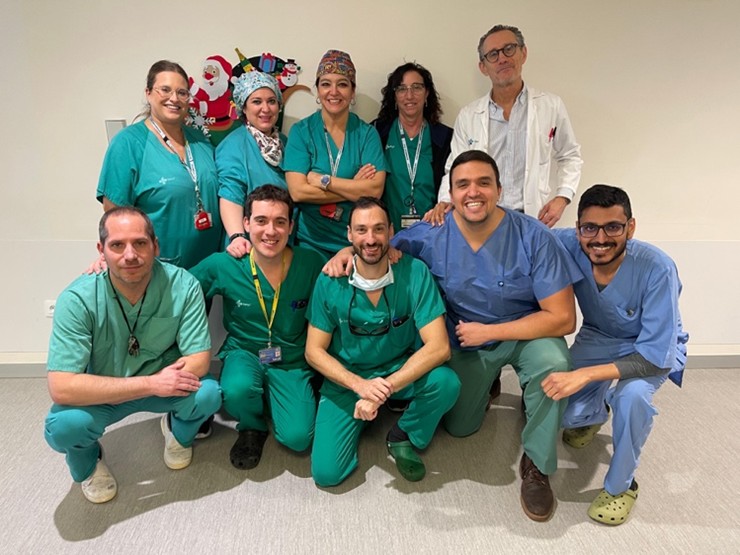
The study reports the first three ViMech transcatheter aortic valve implantation procedures performed in humans, in patients aged 67 to 79 who had undergone multiple previous cardiac surgeries or had severe mechanical valve-related complications that made conventional reoperation impossible. In all cases, the procedure immediately restored valve function, with a very favorable clinical course and no major neurological or vascular events during follow-up.

“In these first patients, the procedure was successfully performed through the femoral artery, avoiding open surgery,” adds Dr. San Román, Chief of Cardiology at Hospital Clínico de Valladolid. “Once the mechanical discs were removed, a new transcatheter heart valve was implanted, restoring normal blood flow. All patients remained clinically stable during follow-up.”

In addition, Dr. San Román notes that in some cases the procedure allowed significant simplification of the antithrombotic regimen, avoiding the lifelong anticoagulation usually required for mechanical valves. This has a direct impact on safety and quality of life in very fragile patients.

At six-month follow-up, all patients were alive, asymptomatic, and functioning normally with their transcatheter prostheses, with no significant ischemic or hemorrhagic events.

The authors note that the study has limitations, including the small number of treated patients and the need to further investigate the optimal antithrombotic strategy after this procedure. Even so, the study represents the first complete demonstration—from laboratory development to patient application—that percutaneous treatment of defective mechanical valves is feasible.

The authors conclude that this strategy could transform the clinical management of thousands of patients in the future by offering a less aggressive option and significantly expanding therapeutic possibilities in interventional cardiology.

Go to Source

Sidebar