Author Archive

TANC The Apocalypse Is Not Coming: A transdisciplinary conference involving ICTA-UAB

From 12 to 15 May 2026, the UAB will host TANC. The Apocalypse Is Not Coming, an international transdisciplinary conference that will take place at the Faculty of Arts and Humanities. The event is organised by a consortium of UAB institutions and external partners, with researchers from the ICTA-UAB actively participating in the conference’s organising committee.

Go to Source

Rubén López Coto, Co-Coordinator of the “Science Working Group” of the CTAO Collaboration

A team from the Institute of Astrophysics of Andalusia (IAA-CSIC) has obtained images with unprecedented detail showing cross-sections of a young star’s jet, revealing its internal structure and how it interacts with its environment. The finding, published in Nature Astronomy, allows scientists to confirm for the first time a theoretical model proposed three decades ago regarding the dynamics of stellar jets.

Go to Source

Dissociation and Regeneration of Charmonia within microscopic Langevin simulations

Image
Dissociation and Regeneration of Charmonia within microscopic Langevin simulations
Seminar

Dissociation and Regeneration of Charmonia within microscopic Langevin simulations

Date
Place
Pere Pascual V5.07 Room and via Zoom

Abstract: We present a microscopic model to study the formation, as well as dissociation and recombination processes of charmonium states in the quark gluon plasma. In this classical approach, heavy quarks are described as Brownian particles in a background medium of light constituents. The heavy-quark dynamics are modelled by a Fokker-Planck equation with constant transport coefficients, which is then implemented through relativistic Langevin simulations. The heavy quarks interact classically via a Coulomb-like screened potential, enabling the formation of charmonium states. These bound states may dissociate due to screening effects of the potential and through scatterings with plasma particles. Using box simulations at fixed temperature and volume, we demonstrate the full equilibration of the system. In order to model the phenomenology of a heavy-ion collision, we then implement a dynamical description, where the evolution of the expanding medium is parametrized by a boost invariant fireball. This allows us to study the elliptic flow and nuclear modification factor of the charm and anticharm quarks, as well as of charmonia, at RHIC and LHC energy, and compare the results to experimental data. 

Go to Source

Alicante brings together young researchers at the FENS-Hertie Winter School on advanced technologies for understanding brain diversity

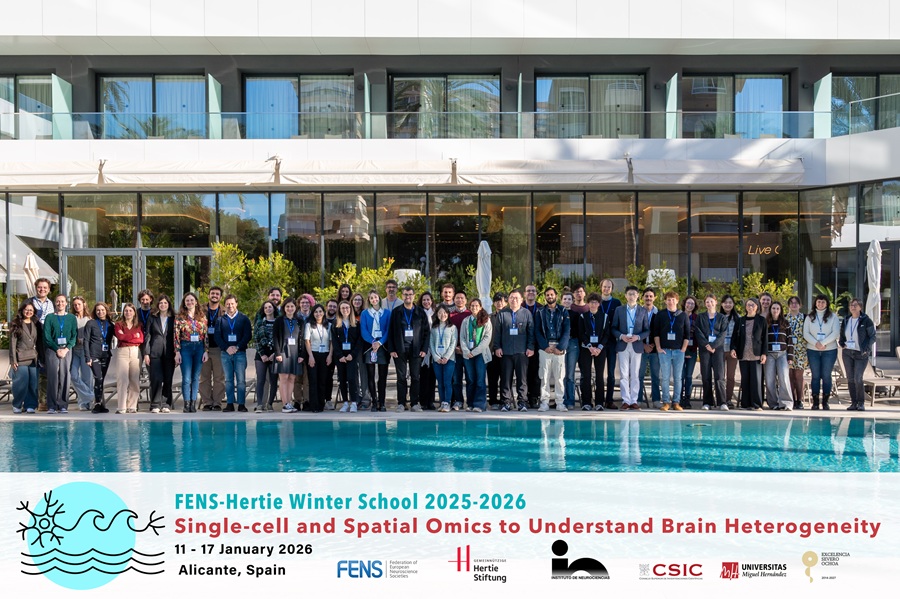
Participants at the FENS-Hertie Winter School in Alicante, January 11–17. Photo credit: IN CSIC-UMH

The Institute for Neurosciences (IN), a joint center of the Spanish National Research Council (CSIC) and Miguel Hernández University of Elche (UMH), hosted the FENS-Hertie Winter School 2025–2026 in Alicante from January 11 to 17. This international advanced training event, titled ‘Single-cell and Spatial Omics to Understand Brain Heterogeneity,’ brought together PhD students and postdoctoral researchers from several countries. The scientific program was organized by Gonçalo Castelo-Branco (Karolinska Institute, Sweden) and Ana Mendanha Falcao (University of Minho, Portugal).

During an intensive week of activities, participants received specialized training in the most cutting-edge single-cell and spatial omics methodologies, including transcriptomics, epigenomics, lipidomics, and proteomics, applied to the study of the brain. These technologies are transforming our understanding of cellular heterogeneity in the nervous system, as well as the mechanisms underlying its normal functioning and various neurological disorders.

The academic program combined lectures delivered by internationally leading scientists, hands-on sessions, participant presentations, and spaces for scientific discussion, fostering a highly interactive and collaborative environment. This format allowed not only the acquisition of advanced technical knowledge but also the exchange of ideas and the establishment of new collaborative networks in the emerging field of neuro-omics, a set of disciplines that use high-throughput technologies to study the brain at molecular and cellular scales.

Among the activities carried out, a practical computational session focused on the analysis of spatial omics data stood out. The session, titled ‘Computational Pipelines for Spatial Omics Data,’ was led by José P. López-Atalaya, head of the Cellular Plasticity and Neuropathology laboratory at the IN, together with Ángel Márquez-Galera, head of the institute’s Systems Administration and Bioinformatics Service, Violeta Duran Laforet, a postdoctoral researcher in the Cellular Plasticity and Neuropathology laboratory, and Lorenzo Puche-Aroca, a PhD researcher in the Development, Plasticity and Reprogramming of Sensory Circuits laboratory. During this practical session, participants had the opportunity to work directly with computational tools for the analysis and interpretation of these complex data.

Según destacan los organizadores locales del evento, Guillermina López-Bendito, Francisco Martini y Silvia De Santis, investigadores del IN, acoger una Winter School de FENS en Alicante supone “un reconocimiento al papel del Instituto de Neurociencias en la investigación europea en neurociencia y ofrece una oportunidad excepcional para formar a la próxima generación de investigadores en tecnologías que están transformando el campo”. Además, subrayan que “el carácter internacional del curso y la diversidad de procedencias de los participantes enriquecen enormemente el intercambio científico y refuerzan la proyección internacional del centro”.

According to the local organizers of the event, Guillermina López-Bendito, Francisco Martini, and Silvia De Santis, researchers at the IN, hosting a FENS Winter School in Alicante, represent “recognition of the Institute for Neurosciences role in European neuroscience research and provide an exceptional opportunity to train the next generation of researchers in technologies that are transforming the field”. They also emphasize that ‘the international nature of the course and the diversity of participants’ backgrounds greatly enrich scientific exchange and strengthen the institute’s international profile.

The FENS-Hertie Winter School is part of the advanced training program promoted by the Federation of European Neuroscience Societies (FENS), in collaboration with the Hertie Foundation, a prestigious German foundation dedicated to promoting excellence in biomedical research. This edition of the event was co-organized by the Institute for Neurosciences (CSIC–UMH), further establishing Alicante as a hub for excellence in neuroscience training at the European level.

Source: Institute for Neurosciences CSIC-UMH (in.comunicacion@umh.es)


La entrada Alicante brings together young researchers at the FENS-Hertie Winter School on advanced technologies for understanding brain diversity se publicó primero en Instituto de Neurociencias de Alicante.
Go to Source

PsychoBeers “El tiempo en la mente: Tiempo, cultura y religión”,

PsychoBeers
Tras la pausa navideña, la iniciativa de divulgación científica PsychoBeers retoma su actividad. La primera sesión de 2026 tendrá lugar el miércoles 28 de enero, a las 20:30h en la Sala Planta Baja de Granada. Bajo el título “El tiempo en la mente: Tiempo, cultura y religión”, el evento contará con la participación de la investigadora Carmen Callizo Romero, del Instituto Cultura y Sociedad de la Universidad de Navarra.

Seguir leyendo

Go to Source

ICIQ joins the TERRA-MED doctoral programme to train researchers in sustainability and climate resilience

ICIQ is one of the implementing partners in TERRA-MED, a new doctoral programme that will train 33 early-stage researchers to address major climate and environmental challenges in Mediterranean regions. ICIQ participation includes hosting two of the doctoral fellows and participate in the organisation of network-wide training actions. 

The initiative is led by the Euroregion Pyrenees – Mediterranean (Euroregió), which brings together Occitania (France), Catalonia and the Balearic Islands (Spain), three territories that are particularly vulnerable to the impacts of climate change. These shared challenges call for coordinated, cross-border research efforts capable of delivering innovative and locally adapted solutions.

The programme is supported by a dedicated training framework, co-designed by 12 Implementing Partners and 22 Associated Partners. It aims to nurture a new generation of scientific talent capable of driving innovation in climate adaptation, resource efficiency, and sustainable development. Within this framework, activities will combine high-level research, technological innovation, territorial governance, and public-private cooperation. Fellows will also develop transversal skills, strengthening their careers and preparing them to become future leaders in sustainability and environmental innovation.

Doctoral projects will be jointly supervised by academic and non-academic partners, ensuring strong alignment between scientific excellence and real-world needs. The programme strongly encourages mobility and collaboration, with fellows working closely with universities, research centres, public administrations and socio-economic actors across the three participating regions. 

Through its participation in TERRA-MED, ICIQ reaffirms its commitment to research excellence and to advancing a more sustainable and climate-resilient future for the Mediterranean region. 

Co-funded under the Marie Skłodowska-Curie COFUND 2025 call of the European Commission’s Horizon Europe programme, TERRA-MED has recently been announced as one of the awarded projects, to be started in January 2027. It is the first MSCA COFUND initiative coordinated by an euroregion. With a total budget of €8.1 million, it is also the largest competitive research funding project ever led by the Euroregion Pyrenees-Mediterranean. 


Further information is available in the following press release: L’Euroregió Pirineus-Mediterrània impulsa un programa pioner de doctorat en sostenibilitat i resiliència climàtica, published on Govern.cat.


La entrada ICIQ joins the TERRA-MED doctoral programme to train researchers in sustainability and climate resilience se publicó primero en ICIQ.

Go to Source

Researcher Victoria Reyes García receives the Rei Jaume I Award in Environmental Protection 

Victoria Reyes García, ICREA professor at ICTA-UAB, received the Rei Jaume I Award in the Environmental Protection category from King Felipe VI in a ceremony in which the seven awardees expressed their desire to work to transform reality through knowledge and to open paths where others only see limits.

Go to Source

Adherence to the Mediterranean diet in most Barcelona households is low or moderate

Adherence to the Mediterranean diet in urban households across Barcelona is low or moderate, despite its widely recognized benefits for cardiovascular, metabolic, and mental health.

Go to Source

Dr. Álvaro Fernández-Llamazares at first author meeting of 2nd IPBES Global Assessment

ICTA-UAB researcher Dr. Álvaro Fernández-Llamazares is among the 117 leading global scientists selected by the Intergovernmental Science-Policy Platform on Biodiversity and Ecosystem Services (IPBES) who are meeting in Paris this week for the first author session of the 2nd Global Assessment on Biodiversity and Ecosystem Services. 

Go to Source

First comprehensive investigation shows large support for core ideas of degrowth, but not the label

The first major study into public attitudes toward degrowth – the notion that high-income economies should prioritise wellbeing over growing production – reveals significant public support for its key ideas across both the UK (74-84%) and the US (67-73%).

Go to Source

Scientists call for urgent measures to protect underwater forests in a new global Marine Animal Forests Manifesto

Scientists from around the world are calling for urgent action to protect, restore, and sustainably manage one of the ocean’s least known yet most important ecosystems: the Marine Animal Forests.

Go to Source

Fossil fuel industry’s “false climate solutions” reinforce its power and aggravate environmental injustice

Many so-called low-carbon projects promoted by major oil and gas companies — including hydrogen, biofuels, carbon capture and storage, and carbon offsetting — operate as false solutions that not only fail to effectively reduce emissions, but also prolong the lifespan of fossil fuel infrastructures, entrench environmental injustices, and reinforce the political and economic power of the very industry responsible for the climate crisis.

Go to Source

Sidebar