Abstract: I will present a simple holographic model of closed universes originating from the black hole interior in JT gravity. The model relies on the insertion of a heavy operator to support the baby universe, together with a first-order phase transition between a black hole phase and an empty AdS phase. To this end, I will employ the Maldacena–Qi phase transition of two coupled SYK systems to construct thermal pure states in SYK dominated by the baby universe saddle below the transition temperature. The bulk entanglement with the universe remains parametrically large in N below the transition. I will conclude by discussing various properties of this model.
Abstract: In this talk, we will construct a family of complete bases for the non-perturbative Hilbert space of quantum gravity and use this to address two puzzles regarding the Hilbert space of quantum gravity. Firstly, Gibbons and Hawking proposed that the Euclidean gravity path integral with periodic boundary conditions in time computes the thermal partition sum of gravity. As a corollary, the derivative of the associated free energy with respect to the Euclidean time period results in the celebrated black hole entropy formula S=A/4G. Why is this interpretation correct? That is, why does this path integral compute a trace over the gravity Hilbert space? We show that the quantity computed by the Gibbons-Hawking path integral is equal to an a priori different object — an explicit thermal trace over the Hilbert space spanned by states produced by the Euclidean gravity path integral. Secondly, Holography suggests that the Hilbert space of quantum gravity with two asymptotic boundaries should factorise into two copies of the single-boundary gravity Hilbert space. However, the existence of spacetimes with Einstein-Rosen bridges connecting the two boundaries seems to contradict this. We will show that the non-perturbative, two-boundary Hilbert space factorises nonetheless. One implication of our results is that universes containing a horizon can sometimes be understood as superpositions of horizonless geometries entangled with a closed universe.
Dr. Gimeno, doctoral candidate under the supervision of Prof. Marcos García Suero, has successfully defended his PhD thesis. The dissertation, entitled Stereoselective Single-Carbon Insertion into C–C Bonds by Carbynoid Species has been publicly defended on Thursday, 11 December 2025.
Abstract
The optimization of lead compounds in medicinal chemistry is tightly linked to advances in organic synthesis, yet traditional strategies often rely on de novo synthesis, making the process costly and time-consuming. The emergence of skeletal editing has provided a powerful alternative, enabling late-stage remodelling of molecular backbones through the insertion, deletion, or transmutation of single atoms while preserving the relative orientation of pendant substituents. Although its precise definition has been debated, skeletal editing is generally understood as transformations that selectively reshape the molecular core, whereas reactions confined to peripheral functional groups are categorized as peripheral editing. Within this framework, single-carbon insertion has attracted particular attention, as it allows the direct incorporation of a carbon atom into preexisting bonds, streamlining synthetic routes, expanding chemical space, and providing access to scaffolds otherwise difficult to obtain.
In this doctoral thesis will find the discovery and development of new stereoselective single-carbon insertion methodologies based on carbynoid species. Two complementary strategies are presented: the modification of molecular skeletons through the insertion of a monovalent carbon atom into C–C single bonds, and the atroposelective ring expansion of biaryl scaffolds. Altogether, this thesis highlights the potential of carbyne transfer as a powerful tool for skeletal editing, enabling access to previously unattainable regions of chemical space and offering new opportunities for the streamlined synthesis of complex scaffolds and molecules of relevance in drug.
The evaluation committee has been composed of Prof. José M. Lassaletta (Instituto de Investigaciones Químicas CSIC-US, Spain), Prof. José L. Vicario (Universidad del País Vasco, Spain) and Prof. Dorota Gryko (Polish Academy of Sciences, Poland)
Reunido el patronato en su sesión ordinaria del 11 de diciembre del 2025, en base a las funciones que le confiere el artículo 9 de los Estatutos vigentes, se ha aprobado por unanimidad el Plan de Actuación del 2026, diseñado para cumplimiento de los nuevos objetivos estratégicos del centro tanto a nivel científico como administrativo, además de la política General de Recursos humanos.
Dada la situación actual del centro, el Patronato ha aprobado, a propuesta del gerente, la realización de una auditoría externa sobre la contratación y gestión económica independiente a la auditoría que está llevando a cabo por el Tribunal de Cuentas para los años 2022-2024. También se señala la creación de un puesto de carácter permanente que reportará directamente a los órganos de gobierno en materia de cumplimiento normativo, canal de denuncias y transparencia y buen gobierno.
El Patronato agradece al director gerente y a la dirección científica en funciones su profesionalidad y el trabajo realizado desde su nombramiento.
The study, published in PNAS, presents a detailed map of how multiple cerebellar projections to the rest of the brain develop, identifying when and how these connections are established and consolidated.
The results show that this connectivity emerges much earlier than expected, suggesting that the cerebellum may act as an early ‘hub’ essential for organizing the brain’s initial architecture.
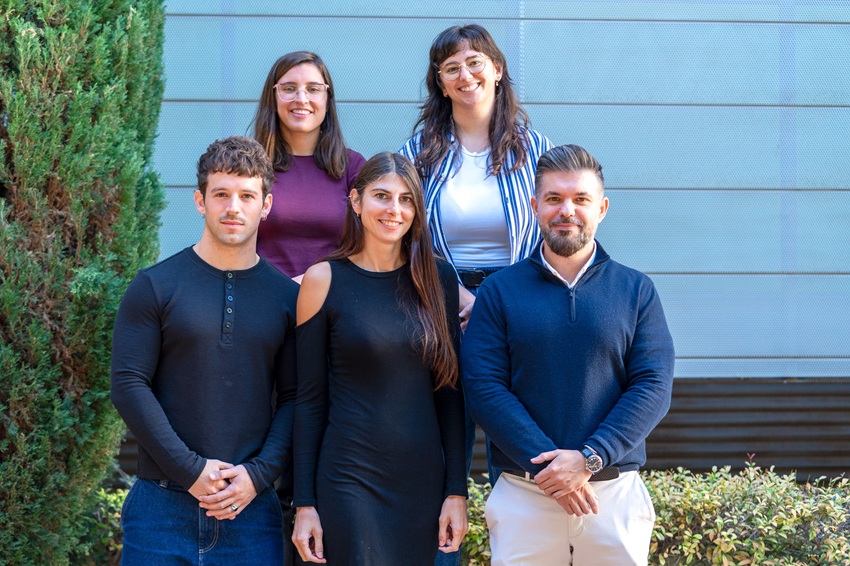
Photo: Top to bottom, left to right: Raquel Murcia Ramón, Ángeles Arzalluz Luque, Sergio Muñoz Cobos, Martina Riva, and Juan Antonio Moreno Bravo, researchers at the IN CSIC-UMH
A team of researchers at the Institute for Neurosciences (IN), a joint center of the Spanish National Research Council (CSIC) and Miguel Hernández University of Elche (UMH), has reconstructed for the first time how the cerebellum establishes its connections with the rest of the brain during the earliest stages of life. The work, published in the journal Proceedings of the National Academy of Sciences (PNAS), describes in detail the phases in which these neural connections emerge, expand, and are refined, offering the first comprehensive map of the development of cerebellar projections across the mouse brain.
Although the cerebellum has traditionally been associated with motor control, growing evidence shows that it also plays a role in processes such as emotional regulation, social behavior, and other cognitive functions. However, until now, it was not precisely known when it began interacting with other regions of the brain, communication that is fundamental for these cerebellar roles. This gap motivated the work of the group Development, Wiring and Function of Cerebellar Circuits, led by Juan Antonio Moreno Bravo at the IN.
Three key stages
The team has shown that the pathways connecting the cerebellum with other brain areas develop following a highly organized pattern: “We observed that cerebellar projections begin to form very early, already in the embryo, when the first axons start connecting with their target regions”, explains Moreno Bravo. These connections then expand rapidly and massively, accompanying the intense brain growth that takes place during these early stages.
Finally, during the first postnatal weeks, the circuits undergo a refinement period in which the definitive connections are consolidated. “This stepwise sequence allowed us to pinpoint the periods when the cerebellum may start influencing other brain regions, even while it is still in an immature developmental stage. These early periods represent highly relevant windows for understanding how the brain establishes its internal architecture”, adds the researcher.
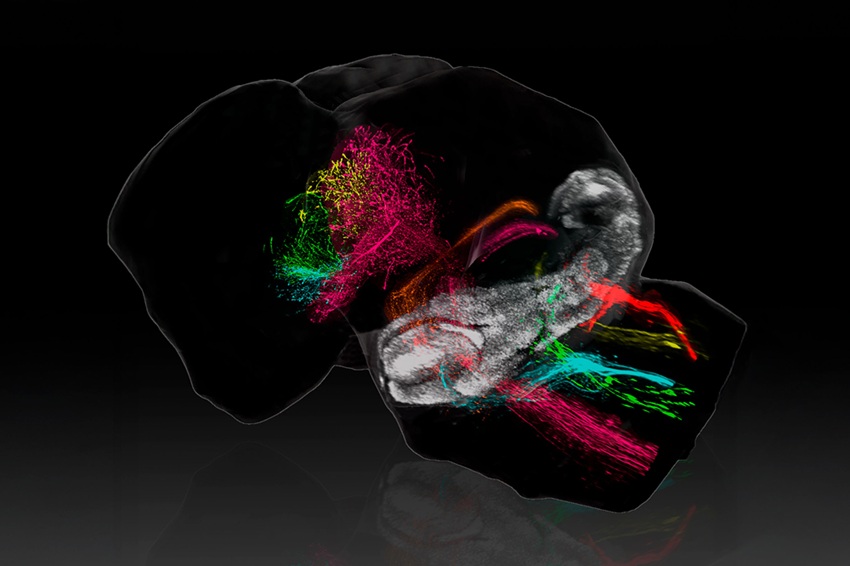
This work was made possible thanks to a combination of cutting-edge genetic tools and whole-brain three-dimensional imaging techniques. Using specific fluorescent markers, the researchers labeled the different neurons of the deep cerebellar nuclei, the main output pathway of the cerebellum. They then applied advanced tissue-clearing and microscopy methods to visualize the axons in three dimensions and track their trajectory from origin to target regions.
The image shows how the cerebellum (white) sends its projections across the brain of a newborn mouse. A wide network of color-coded axons reveals how this tiny structure connects with multiple brain regions during a critical period of early development. Source: IN CSIC-UMH.
“Seeing these projections in 3D, how they emerge in the embryo and spread throughout the brain, was truly fascinating”, says Raquel Murcia Ramón, first author of the study. “Many of these connections had never been seen with such precision, and being able to observe their evolution in time allowed us to reconstruct a full developmental story of these circuits”, she adds.
Beyond the detailed mapping, the results point to a broader idea: the cerebellum may play a much earlier and more influential role in shaping the developing brain than previously thought. “It has traditionally been assumed that the cerebellum matures late and that its involvement in complex functions emerges gradually and only at later stages. Our work suggests the opposite: the cerebellum begins building its network very early and may already be actively contributing to the formation of circuits in other brain regions from initial developmental phases”, explains Moreno Bravo. This perspective, he argues, “may help us rethink the role of the cerebellum in development, not as a late modulator of movement, but as an early node contributing to the construction of broader brain networks”.
The map generated by the IN CSIC-UMH team constitutes a reference tool for understanding how cerebellar connectivity is structured from the very beginning of life. In addition, it provides a detailed temporal framework to investigate how early experiences, genetic factors, or environmental conditions may alter the developing cerebellum and, consequently, the neural networks it connects with. “This work lays the groundwork for exploring not only how the cerebellum contributes to typical brain development, but also how cerebellar alterations could give rise to pathological conditions, including some linked to neurodevelopmental disorders”, researchers note.
This study was supported by funding from the European Research Council (ERC) under the European Union’s Horizon 2020 research and innovation program, the Spanish State Research Agency (AEI) – Ministry of Science, Innovation and Universities, and the Severo Ochoa Program for Centers of Excellence.
“Brain-wide mapping of developmental trajectories of cerebellar efferent projections.” Murcia-Ramón R, Riva M, Muñoz-Cobos S, Arzalluz-Luque Á and Moreno-Bravo JA. 2025. Proceedings of the National Academy of Sciences (PNAS) 122 (48) e2521091122.
La Universidade da Coruña (UDC) acaba de nombrar doctora honoris causa a la investigadora Marisol Soengas, jefa del grupo de Melanoma del Centro Nacional de Investigaciones Oncológicas (CNIO). Para la UDC, Soengas «ha desarrollado una carrera científica de prestigio internacional, al tiempo que ha demostrado su compromiso y activismo en defensa del liderazgo de las mujeres en la ciencia».
Soengas empezó sus estudios universitarios en la Universidade da Coruña, donde descubrió que quería dedicarse a la biología molecular. Se trasladó entonces a la Universidad Autónoma de Madrid, para doctorarse en 1996 con Margarita Salas como directora de tesis. Enseguida se trasladó a Estados Unidos, primero al Laboratorio Cold Spring Harbor, en Nueva York, y en 2002 a la Universidad de Michigan.
Desde 2008 dirige el Grupo de Melanoma del CNIO. Entre sus resultados más relevantes está el desarrollo del sistema “MetAlert”, que permite visualizar cómo las células de melanoma preparan rutas de diseminación antes de que ocurran las metástasis. MetAlert fue reconocidos como la investigación biomédica de 2017 por Nature.
Aademás, la investigación de su grupo dio lugar a la creación de la compañía española Highlight Therapeutics, que ha desarrollado el compuesto BO-112. Se trata del primer candidato a fármaco oncológico nacido de la investigación del CNIO que ha llegado a estudios en pacientes, mostrando actividad contra distintos tipos de cáncer.
Marisol Soengas pertenece desde 2022 a EMBO, la Organización Europea de Biología Molecular, una membresía que reconoce el alto impacto de sus contribuciones. Ha presidido la Asociación Española de Investigación sobre el Cáncer (ASEICA).
Ha recibido además numerosos galardones, entre ellos el Premio Carmen y Severo Ochoa de Investigación en Biología Molecular 2021; la Medalla Fritz Anders de la European Society for Pigment Cell Research (ESPCR), que reconoce a los investigadores más relevantes en el campo del melanoma; y el Premio Maria Larcher Award for Women in Science de la European Association for Cancer Research. También los premios María Josefa Wonenburger Planellsy Fernández Latorre. Es igualmente reconocida por su faceta como promotora de actividades para mejorar el desarrollo profesional de las mujeres en ciencia.
Igualmente, la UDC ha nombrado doctor honoris causa al neurocientífico estadounidense Emery N. Brown, por su contribución «significativa» a la comprensión del funcionamiento de los anestésicos en el cerebro. Brown es profesor de Neurociencia en el Instituto Tecnológico de Massachusetts y ocupa la cátedra de Anestesia en la Facultad de Medicina de Harvard.
The #científiques initiative — a joint programme of the Fundació Catalana per a la Recerca i la Innovació (FCRI) and the Barcelona Institute of Science and Technology (BIST) — has released the image for its 2026 edition, featuring Tamara Vázquez Schröder, researcher at IFAE, as the scientist highlighted in this year’s campaign.
The Spanish Ministry of Science, Innovation and Universities has allocated new funding to Spain’s participation in major international gravitational-wave infrastructures, with the Institut de Física d’Altes Energies (IFAE) designated as the institution through which these contributions will be channelled.
Desde el Centro de Investigación Mente, Cerebro y Comportamiento (CIMCYC) de la Universidad de Granada, junto con la Universidad de Castilla-La Mancha, se ha llevado a cabo un estudio para conocer la relación entre el estrés y la calidad de vida física y mental de las y los cuidadores de niños y niñas con trastornos del neurodesarrollo con el desempeño de las actividades de la vida diaria de estos niños y niñas.
Seguir leyendo
The Mind, Brain and Behavior Research Center (CIMCYC) at the University of Granada, in collaboration with the University of Castilla-La Mancha, has conducted a study to investigate the relationship between stress and the physical and mental quality of life of caregivers of children with neurodevelopmental disorders and the performance of these children in activities of daily living.
Seguir leyendo
El cáncer y las afecciones cardiovasculares y neurodegenerativas tienen como raíz común el envejecimiento. Pero la investigación de los últimos años ha desvelado que el envejecimiento no es un único proceso sino muchos, y ha llegado el momento de entender cómo interaccionan todos entre sí. Es decir, quienes han descubierto las piezas del puzle deben ahora montarlas.
Lo han expuesto recientemente en el Centro Nacional de Investigaciones Oncológicas (CNIO) los participantes en el CNIO-CaixaResearch Frontiers MeetingMolecular and Cellular Hallmarks of Aging: 3rd edition, un congreso que ha reunido a una veintena de ponentes de Europa y Estados Unidos y que ha sido organizado por Thomas Rando, director del Centro Broad de Investigación de Células Madre (Los Ángeles, EE.UU.), y los investigadores del CNIO Maria A. Blasco y Alejo Efeyan.
Co-organizado por Thomas Rando, director del Centro Broad de Investigación de Células Madre (Universidad de California en Los Ángeles, EE.UU.), y los investigadores del CNIO Maria A. Blasco y Alejo Efeyan, el encuentro ha reunido a una veintena de ponentes de Europa y Estados Unidos.
Más de una década desvelando los indicadores de envejecimiento
“El fin último es tratar las enfermedades asociadas al envejecimiento, cuya incidencia está aumentando y para las que no tenemos aún terapias que funcionen, y prolongar la salud en esta etapa de la vida”, señala Blasco.
Los procesos que contribuyen al envejecimiento son numerosos. El sistema de limpieza de las células deja de eliminar sustancias tóxicas. Hay células que dejan de dividirse, y se quedan en el estado llamado senescencia. El sistema inmunitario deja de reconocer amenazas, como la proliferación anómala de células que desembocarán en un tumor. Las células madre pierden la capacidad de diferenciarse en tipos distintos de células, y dejan de regenerar tejidos u órganos.
Estos sucesos no ocurren de forma aislada, pero así es como han sido estudiados tradicionalmente. “Ahora estamos empezando a entender que hay procesos que funcionan a diferentes niveles, molecular, celular y de órgano, y todos contribuyen al envejecimiento”, afirma Efeyan.
En 2013 se publicó en la revista Cell el estudio pionero Hallmarks of Aging, que sentó las bases del área al identificar nueve indicadores moleculares del envejecimiento y decir sobre cuáles se podría actuar. En 2023 una revisión aumentó a doce esos indicadores, procesos medibles que, al ser manipulados, aceleran o frenan el deterioro del cuerpo con la edad.
Reforzar la protección de los cromosomas
Blasco investiga los telómeros, estructuras moleculares que protegen los cromosomas. Su grupo en el CNIO ha demostrado que el acortamiento de los telómeros, que ocurre progresivamente con el paso del tiempo, está en el origen de enfermedades asociadas al envejecimiento como la fibrosis pulmonar.
Blasco ha creado una empresa para desarrollar tratamientos contra la fibrosis pulmonar basados en la activación de la telomerasa, la enzima encargada de reparar los telómeros.
Esta estrategia, regular la telomerasa, también fue abordada en el congreso por Steven Artandi (Instituto del Cáncer de Stanford) y Mary Armanios (Universidad Johns Hopkins, Baltimore, EE.UU.), cuyos resultados “validan el posible uso de la activación de la telomerasa para tratar enfermedades del envejecimiento”, indica Blasco.
Menos fármacos y más terapias biológicas
Las terapias celulares fueron igualmente un tema central. “El siglo XXI será el del uso de células como terapia”, opina Rando. Para él, las células madre “se podrían usar para regenerar tejidos, repararlos o reforzarlos a lo largo de toda la vida”.
Ana María Cuervo (Universidad Albert Einstein de Medicina, EE.UU.) habló del posible uso de la autofagia celular, el proceso de limpieza y reciclaje de las células, para ralentizar el envejecimiento e intentar prevenir las enfermedades que desencadena.
Eileen P. White investiga la caquexia, el deterioro del organismo que viene a ser la causa última de la mayoría de las muertes por cáncer; su fin es “prevenirla, revertirla o en general mejorar la calidad de vida de los pacientes”, afirma esta investigadora del Instituto Rutgers de Cáncer, EE.UU.
Las células senescentes
Es “inspirador”, dicen White y otros ponentes, descubrir tantas áreas de solapamiento en el congreso. Si la caquexia está relacionada con el metabolismo y el sistema inmunitario, “las células senescentes lanzan mensajes a las células vecinas, no podemos seguir estudiándolas como si estuvieran aisladas”, explica Efeyan, jefe del Grupo de Metabolismo y Señalización Celular del CNIO.
Se ha comprobado la capacidad de las células senescentes para avivar un tumor, y ya se han desarrollado fármacos para eliminarlas o inhibirlas, llamados senolíticos, que ya han llegado a la fase de ensayos clínicos.
El metabolismo y la dieta restrictiva
Estudios en células y en modelos animales confirman que “la restricción de alimento es la intervención más efectiva para extender la longevidad, ahora intentamos entender por qué”, afirma Efeyan. No obstante, “hay que tener mucho cuidado a la hora de extrapolar a la dieta humana los efectos en células o modelos animales”, subrayó.
Es un área de intensa investigación. Modificar el metabolismo mediante la restricción calórica puede afectar a “la interacción entre la senescencia, la resiliencia y la regeneración celulares”, explica Adam Antebi (Instituto Max-Planck para la Biología del Envejecimiento, Alemania).
Hábitos de vida saludables
Su intervención destacó que la respuesta a la alternancia entre el ayuno y la ingesta de alimentos depende de la edad, por lo que “a lo mejor en humanos el ayuno intermitente sería bueno a los cincuenta años, pero a los setenta puede ser diferente”.
Por su parte Pekka Katajisto (Universidad de Helsinki, Finlandia) expuso cómo una célula madre puede dejar de serlo si se manipula su metabolismo.
Guadalupe Sabio, jefa del Grupo de Interacciones Metabólicas del CNIO, habló de los beneficios del ejercicio para la salud metabólica y la respuesta inmunitaria, y múltiples ponencias aludieron a la nutrición.
Participantes en el CNIO-CaixaResearch Frontiers Meeting «Molecular and Cellular Hallmarks of Aging» / Christian Esposito (MadMoviex). CNIO
Los CNIO-CaixaResearch Frontiers Meetings son conferencias internacionales de gran prestigio sobre aspectos candentes de la investigación del cáncer. En ellos, una veintena de conferenciantes invitados procedentes de todo el mundo presentan sus hallazgos más recientes. Participan además otro centenar de expertos seleccionados por el interés de sus aportaciones en forma de pósters o presentaciones breves.