.png?h=71d2e119&itok=X1uFIEq1 "cimcyc talks Heleen Slagter")
The Master in Cognitive and Behavioral Neuroscience invites to the CIMCYC Talks “Plasticity of the attentive mind” with Dr. Heleen Slagter, researcher from the Vrije Universiteit Amsterdam.
Seguir leyendo
Luisa Xiomara Hallado Abaunza a PhD student who is under Dr. Elisabet Romero supervision has successfully defended her PhD thesis entitled “Steady-state spectroscopic studies in evolutionary artificial bio-inspired chromophore-protein assemblies: excitonic interactions development towards solar-energy conversion systems” publicly on Friday, 28 November.
The members of the evaluation committee were Dr. Bruce Lichtenstein (University of Portsmouth, United Kingdom), Dr. Sara Hernández Mejías (IMDEA Nanomaterials, Spain) and Prof. Beatriz Prieto-Simón (ICIQ).
Luisa Xiomara Hallado Abaunza is from Bucaramanga, Santander, Colombia. She earned her Bachelor’s degree in Chemistry at the Universidad Industrial de Santander (UIS), completing her thesis at the Instituto de Ciencias Físicas (ICF), UNAM, through the Pacific Alliance programme. She later pursued a Master’s in Chemical Sciences at the FAMOE laboratory (ICF–UNAM), supported by a CONACYT scholarship, where she worked on basic research involving nitrogenated bases, plasma generation, laser fragmentation, and mass spectrometry techniques (TOF-MS and Reflectron-TOF-MS).
She enjoys a wide variety of hobbies, including artistic activities, learning languages, cooking, baking, hiking, gardening, and crop harvesting. Regarding external funding, she conducted her PhD studies under her supervisor’s ERC Starting Grant.

Why did you become a scientist?
I had become a Scientist because when I was 8-year-old I had watched a program where they cloned organs. As my scientific curiosity was not killed during my studies year and I was not accepted in the medicine program I stared the chemistry studies in my public hometown university. Later during the 3rd semester, I had the opportunity to go to Russia to study Medicine, but I had rejected it, as I had already proposed to myself to attend classes at the best faculty in Chemistry in Latino America which is at UNAM and I also wanted to have a PhD before being 30 because that seems cool, exiting and interesting.
What is your thesis about?
The project focused on spectroscopic studies over artificial protein systems to which chromophores are added for mimic photosynthesis reaction centers. Thus, I had performed Absorptions, Circular Dichroism, Linear Dichroism and Fluorescence measurements over different samples; varying also the chromophore that is attached to the system. Chromophores are the key molecules for starting the light harvesting process, thus it is needed to optimize via rational design the distance between them and the position inside the protein.
What will you miss the most from ICIQ?
I would miss the different set-ups, soft skill training opportunities, teams and people with which I was able to collaborate and learn new thing. Also, I will miss the socialization opportunities during lunch time, the recently included activities from the social committee and green ICIQ.
What do you wish you had known at the beginning of your PhD?
You need to have stretch contact with your supervisor, thus it should be stablished for at least one meeting per month. Additionally, you should have a backup project in case that the main project that you are working on is not advancing.
From your experience at ICIQ, what do you think we can improve?
It should be clarified in the web page which PhD grands are compatible with Severo Ochoa- ICQ funding for performing a research stay.
Additionally, the group leaders should have a compromise for training themselves and improve their managing skills. Moreover, it should be created a mechanism in their evaluation that check their projects stages and mentor them in their early career stages, helping them to succeed while improving their team experience.
Who/What has been your biggest influence/motivation?
My family, especially my mother who was always there during these years, she deserves the PhD more than me.
Chemistry/Science is fun because…
It makes you believe that you could improve the world, as it is everywhere
If you were a piece of lab equipment, what would you be?
I would be a cryostat, as you can decrease the sample temperature and observe their spectral bands more defined as the sample vibrational energy is lower as the molecules are frozen.
Tell us something about you that people might not know…
I really enjoy being in nature, explore it, observe it, and learn new things about it. Additionally in the countryside farm I have my own honeycomb, during my next vacations in Colombia I plan to build there an earth oven, design the ducks pond and improve the insects house.

La entrada Muchas felicidades, Dra. Hallado Abaunza! se publicó primero en ICIQ.
Three exhibitions opened today at the Faculty of Physics of the University of Barcelona, paying tribute to Assumpció Català y Poch, who was a professor of Mathematics and Astronomy at the UB and the first female professor of astronomy in Spain. The event was attended by the UB vice-rector for Culture, Heritage and Memory, Agustí Alcoberro; the dean of the Faculty, Eugeni Graugés; the director of the UB’s Department of Quantum Physics and Astrophysics, Montserrat Guilleumas; and the director of the Catalan Women’s Institute, Alba García.
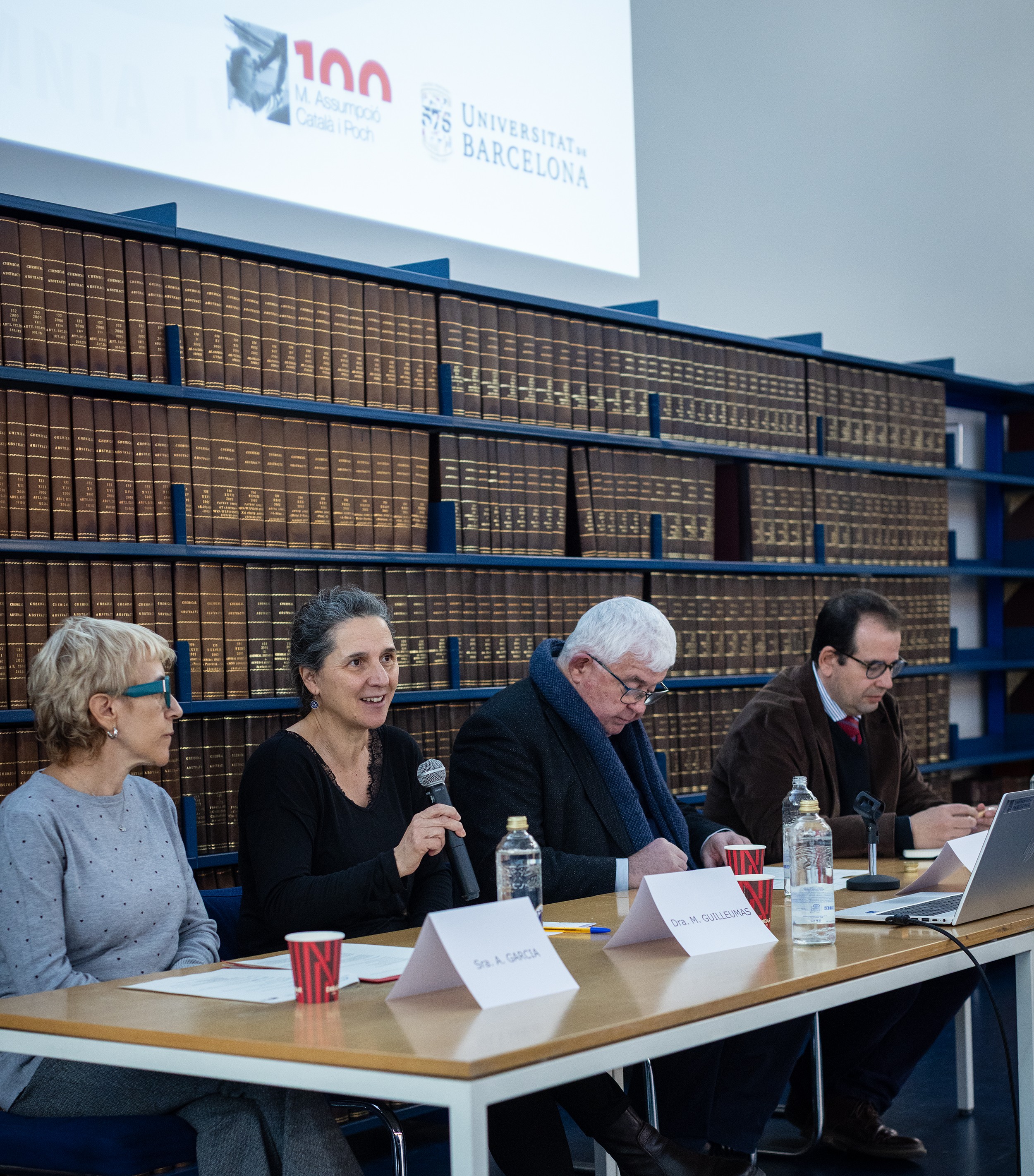
This initiative is part of the commemoration of the centenary of the scientist’s birth, which began in February with an event at the Historic Building, and counts with the support of the Institute of Cosmos Sciences of the University of Barcelona (ICCUB), the CRAI Library of Physics and Chemistry of the UB, the Vicerectory of Culture, Heritage and Memory of the UB and the UB Physics Faculty.
The three exhibitions explore different facets of Assumpció Català’s life and professional career. The virtual exhibition “Assumpció Català i la Universitat de Barcelona. Una trajectòria pionera en el món universitari i científic”, curated by Dolores Pulido and Maria Murillo, presents Català’s educational journey, from her beginnings as a university student (she was one of the first women to graduate with a degree in science, in 1952) to becoming the first woman to obtain a doctorate in mathematics.
In addition, the M. Asunció Català Poch Collection from the CRAI Library at Physics and Chemistry is also on display, curated by Eduard Masana, Trini Cadefau, Sabina Panadero, and Aurora Aguilera. Documents related to Català’s professional career, donated to the CRAI by the Department of Quantum Physics and Astrophysics donated in 2023, are on display. Most of the collection consists of scientific research and university teaching materials, as well as documentation relating to her involvement in various scientific societies. Català played a key role in training and supporting new generations of astronomers at the UB and made a significant contribution to the European Space Agency’s Hipparcos project (1989 – 1993).
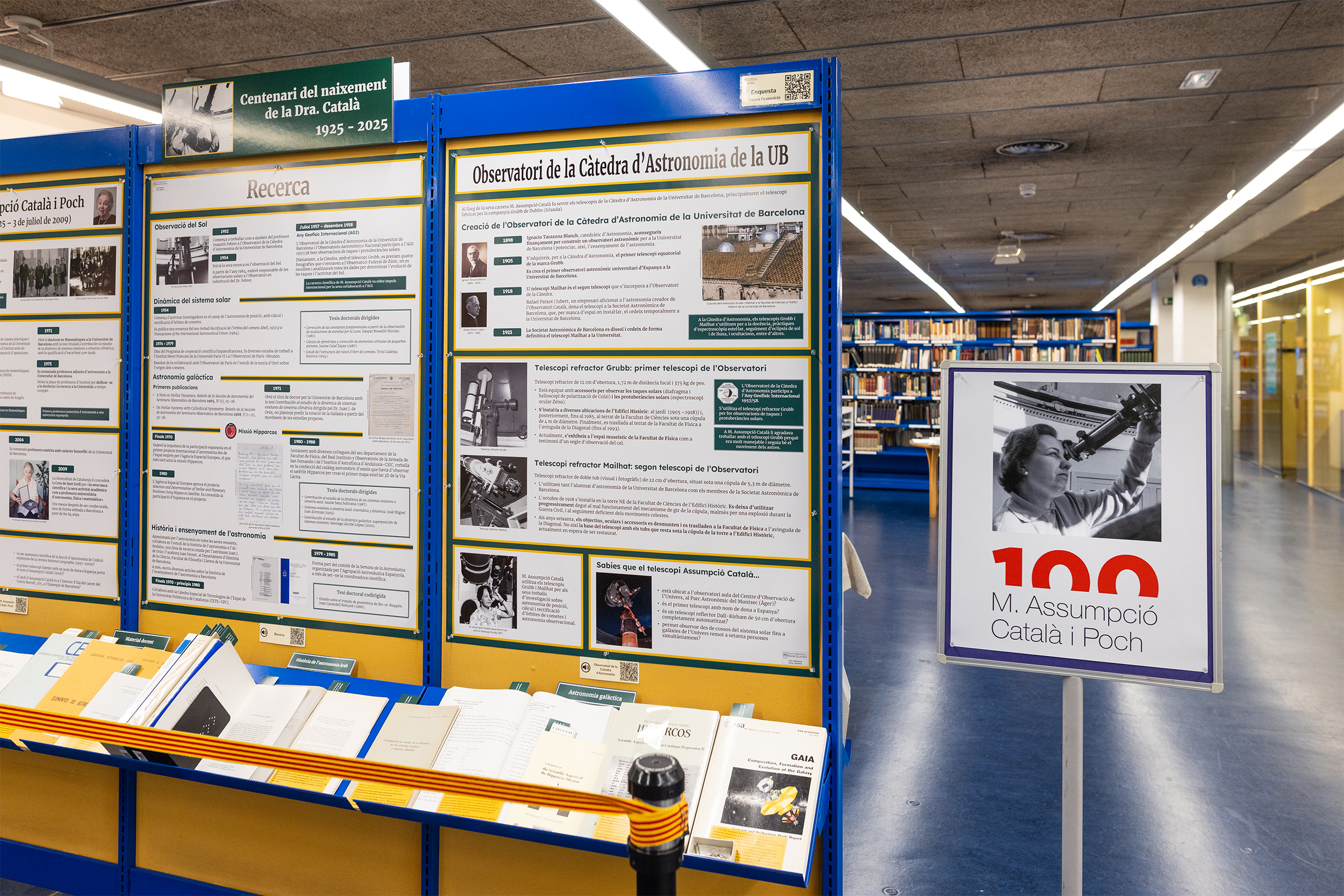
Finally, there is also a collection of historical astronomical instruments, curated by Joan Manel Hernández, Trini Cadefau and Anna Argudo, which is part of the Faculty of Physics’ collection of scientific instruments. Noteworthy pieces include the eyepiece of the Grubb telescope, with which Català began studying solar activity in 1954, and the Zeiss spectroscope, with which she kept a daily record of sunspots and protuberances during the International Geophysical Year (1957). This exhibition was created with the specific support of the ICCUB.

The Institute of Chemical Research of Catalonia (ICIQ) and UCB Biopharma presented the 3rd UCB Lecture Award to Professor Tobias Ritter, recognising his contributions to the field of chemistry. The award honours a scientist whose work has significantly advanced chemical research and its applications.
Professor Ritter, director at the Max-Planck-Institut für Kohlenforschung and faculty member at RWTH Aachen and Massachusetts General Hospital, delivered a lecture entitled “Late-Stage Functionalizations”. His talk addressed chemoselective reactions for modifying complex molecules and reviewed their relevance in areas such as drug and agrochemical development, protein modification, and the synthesis of positron-emission tomography (PET) tracers. He also discussed recent developments in C–H thianthrenation and the broader implications of thianthrenium chemistry for catalysis and medicine.
The programme included a presentation by Dr Riccardo di Sanza of UCB, who outlined his career path and offered an overview of the company’s drug discovery process, from target identification to clinical trials. His talk emphasised the multidisciplinary nature of contemporary pharmaceutical research.
For the first time, the event incorporated a poster session aimed at increasing the participation of the local scientific community and fostering interaction between researchers and the invited speakers.
Professor Marcos García Suero, ICIQ group leader and promoter of the initiative, stated: “This event has become an important platform for celebrating scientific excellence while creating meaningful exchanges between academia and industry. Each edition brings new opportunities for dialogue and collaboration.”
The third edition of the UCB Lecture Award reinforces the ongoing partnership between ICIQ and UCB Biopharma and continues to highlight leading international research in chemistry.

La entrada ICIQ and UCB Biopharma distinguish Professor Tobias Ritter at the 3rd UCB Lecture se publicó primero en ICIQ.
ICTA-UAB researcher Dr. Álvaro Fernández-Llamazares is among the 117 leading global scientists selected by the Intergovernmental Science-Policy Platform on Biodiversity and Ecosystem Services (IPBES) who are meeting in Paris this week for the first author session of the 2nd Global Assessment on Biodiversity and Ecosystem Services.

ICN2 was one of the co-organisers of this year’s edition of the conference, which has established itself as one of the most important materials science gatherings in Spain.
ICIQ has been awarded support from the 2025 call of the Diputació de Tarragona, a programme that strengthens research centres that generate projects contributing to territorial development through scientific, technological and innovative initiatives. The call also promotes actions that enhance cultural, scientific, economic and social capacities, while supporting effective knowledge transfer across the Tarragona region.
The funded project, New Carbon Chemistry: Impact on the Territory (Nova química del carboni: impacte al territori), ran from January 2024 to June 2025. Its main goal has been to lay the foundations for new research and innovation initiatives within the framework of industrial decarbonisation and a circular and sustainable economy across the Tarragona, Terres de l’Ebre and Penedès regions.
The project focused on four key action areas:
1. Developing new chemical systems featuring advanced catalysts and strategies for molecule valorisation
2. Innovating in materials and processes for green hydrogen use as well as converting converting CO₂ into fuels and high-value products using waste, industrial gases and water as feedstocks
3. Exploring new synthetic routes for pharmaceuticals and chemical sensors, including approaches that enable the recovery and valorisation of critical metals from urban and industrial waste
4. Promoting scientific education and outreach to bring sustainable chemistry closer to citizens, students and socioeconomic agents
To advance these objectives, ICIQ worked closely with local institutions and organisations, including the Universitat Rovira i Virgili, research centres such as IPHES, ICAC and IISPV, the Eurecat technology centre, and several companies across the territory.
The project also included a communication and outreach dimension. Activities developed in collaboration with local media, including Més Tarragona, Diari de Tarragona and Ràdio Tarragona, and with town halls and public administrations such as those of Tarragona, La Canonja and the Port of Tarragona, have helped bring ICIQ’s research closer to citizens. These efforts have reached communities across Tarragona, Reus, Valls, El Vendrell, Falset, Cambrils, Salou, Sant Carles de la Ràpita and other towns, inspiring scientific vocations among students participating in ICIQ’s educational programmes.


With the support of €96.433,74 from the Diputació de Tarragona, the project “Nova química del carboni: impacte al territori” strengthened ICIQ’s commitment to advancing research that contributes to a more sustainable and competitive future for the region and its citizens.
Amb el suport de la Diputació de Tarragona.

La entrada ICIQ awarded funding from the Diputació de Tarragona to advance sustainable carbon chemistry in the territory se publicó primero en ICIQ.
As part of the 30th Science Week, organised by the Catalan Foundation for Research and Innovation (FCRI) with the support of the Government of Catalonia, institutions across the region offered a wide range of free activities from 7 to 16 November. The initiative aims to bring science and technology closer to society and to inspire scientific vocations among young people.
First Apulia TDR Competition
One of the most significant events of the week was the first edition of the Apulia TDR Competition, which showcased high-school research projects in the field of chemistry.
Eight finalists presented their TDRs (for their name in catalan of the high-school research projects, Treball de Recerca) at ICIQ in front of science education specialists, accompanied by their families and tutors. The projects included original and diverse approaches, and the students briefly introduced their work and answered questions about their results and motivation.
Five finalist mentions were awarded, along with three main prizes: first place went to Daniela Calderón, second to Silvia Bravo, and third to Erola Abellà.


Science outreach through play: SUPERVAL lands in La Canonja
On Tuesday 11, as part of its ongoing collaboration with La Canonja City Council, ICIQ brought the card game SUPERVAL to the public library — an educational activity designed by Marta Llorens and Arnau Jordà as an outreach initiative in the context of the european project with the same name. The idea is simple: to learn chemistry through play and strategy. SUPERVAL introduces players to the carbon and nitrogen cycles, helping them understand the processes involved, how industrial activity can alter them, and what measures can help restore environmental balance and protect ecosystems.
That same morning, the outreach team was recorded by InfoK (3CAT) visiting Escola de la Canonja. InfoK is the first and only news program designed for children, developed by the Television of Catalonia. The game and its objectives were showcased through a playful session with students, helping to spread chemistry concepts through audiovisual storytelling.


Chemistry for everyone: Family experiment day
ICIQ also hosted ‘Química en família’ on Friday 14, a hands-on evening where families could explore chemistry through curiosity and play. Ten ICIQ researchers (Anna Arnanz, Angelo Scopano, Xavier Abel-Snape, Miguel Sellés, Ruggero Bonetto, Marta Romero, Angie Johana Bolaños, Luis Merchante, Antonio Paparesta and Anil Kumar) volunteered as science facilitators, guiding experiments, demonstrations, and answering questions from both children and adults.


Reaching schools and hosting international visitors
Beyond the events held on site, ICIQ researchers travelled to several schools across Catalonia, including Barcelona, Creixell, and La Bisbal de Falset. Sergi Grau, Gemma Aragay, Eugenia Martínez, Santi Gené, Juan Felipe Tirado, Eva Prat, and Marta Grados shared their experience as scientists, running workshops and activities that introduced real research to the classroom — awakening scientific curiosity and inspiring future vocations among 350 students.
The Science Week also welcomed 18 students aged between 13 and 18 from a Montessori school in Westfalia, Germany. During their time in Tarragona the group showed a particular interest in sustainability and catalysis-related research. They toured the ICIQ facilities guided by Joan Mayans, interacting with researchers, and learning first-hand how chemistry is contributing to a more sustainable future.
All these activities were promoted within the framework of the European project ERN-ApuliaMED, HORIZON-MSCA-2023-CITIZENS-01 – GA 101162513.

SUPERVAL projcet is funded by the European Union under grant agreement No. 101115456.

La entrada ICIQ celebrates the 30th Science Week in Catalonia se publicó primero en ICIQ.

