Abstract: In this work we provide the missing link between two approaches aimed at characterizing the effect of long perturbation modes in Inflation. We consider the “Inflationary Fossils'” approach, that characterizes the power-spectrum of the inflaton field in presence of other long and non dynamical “fossil” fields, and a technique that computes, beyond perturbation theory, the power-spectrum of a scalar field in presence of a “large” fluctuation of a second field.
We clarify a few points on the applicability of the non-perturbative technique. We prove in six distinct cases, one involving a violation of the consistency conditions, that the non-perturbative approach, once expanded to first order in the coupling, matches the perturbative result following the Fossils’ approach.
We believe that this non-perturbative technique extends to all orders the Fossils’ approach, resumming infinitely many diagrams of standard in-in perturbation theory.
Abstract: Effective field theories (EFTs) provide a systematic framework to parametrise unknown ultraviolet (UV) physics. In de Sitter space, the long-wavelength dynamics of light scalar fields is naturally described by stochastic inflation, which can be viewed as an EFT obtained after integrating out subhorizon modes. This framework highlights that qualitatively new behaviour arises when the EFT cutoff lies below the Hubble scale H. In this talk, we investigate two complementary ways of constructing and understanding EFTs in this regime.
First, we derive an EFT by integrating out heavy fields in a UV-complete theory, obtaining an effective lambdaphi^4description in de Sitter space with a cutoff set by the heavy mass scale. We perform a complete analytic matching to two explicit UV completions, including both tree-level and loop contributions. When the cutoff lies well above H, the EFT admits a unitary description, with exponentially suppressed corrections. When the cutoff is lowered below H, the effective dynamics becomes intrinsically non-unitary: the system evolves into a mixed state and exhibits diffusive behaviour, in close analogy with stochastic inflation.
Second, we construct an EFT directly by integrating out high-energy modes using a time-dependent cutoff, without reference to a specific UV completion. We show that the resulting effective dynamics reproduces the same physical predictions as the UV-matched theory. Together, these results provide a unified picture of EFTs for light fields in de Sitter space, interpolating between unitary and stochastic descriptions.

A report by Mobile World Capital ranks the institute at the forefront of scientific centres driving deep tech companies in 2025. It highlights the institute’s role in transforming research excellence into technology-based businesses with a real societal impact.
Abstract: Unitarity of the Cabibbo-Kobayashi-Maskawa (CKM) quark mixing matrix is one of the cornerstones of the Standard Model. The unitarity constraint that involves the top-row matrix elements, $|V_{ud}|^2+|V_{us}|^2+|V_{ub}|^2=1$ is particularly important because all elements are measured very precisely permitting a test at the 0.01% level. At this accuracy, $V_{ub}sim10^{-3}$ is irrelevant, and the unitarity constraint reduces to the two-flavor Cabibbo unitarity pattern with a single Cabibbo angle $theta_C$ and $V_{ud}=costheta_C$ and $V_{us}$. At present, a mild deficit is observed, $|V_{ud}|^2+|V_{us}|^2=0.9985(7)$. As such, this deficit may suggest some new physics, but to make this claim, all Standard Model ingredients must be firmly under control. I review these ingredients across theory and experiment and review the most recent developments.
Abstract: I will discuss the problem of the black hole singularity and its possible solutions. I will argue that a “fuzzball picture” for two-charge, 1/4-BPS states supplants the singular black hole solution for typical states, employing an effective action approach and performing an ensemble average over solutions. For three-charge 1/8-BPS states, I will present new results for an ensemble-averaged solution in which a long nearly-AdS2 throat rolls over to a “star” region, where an infalling observer encounters a horizon-free and non-singular sphere of string theoretic matter.

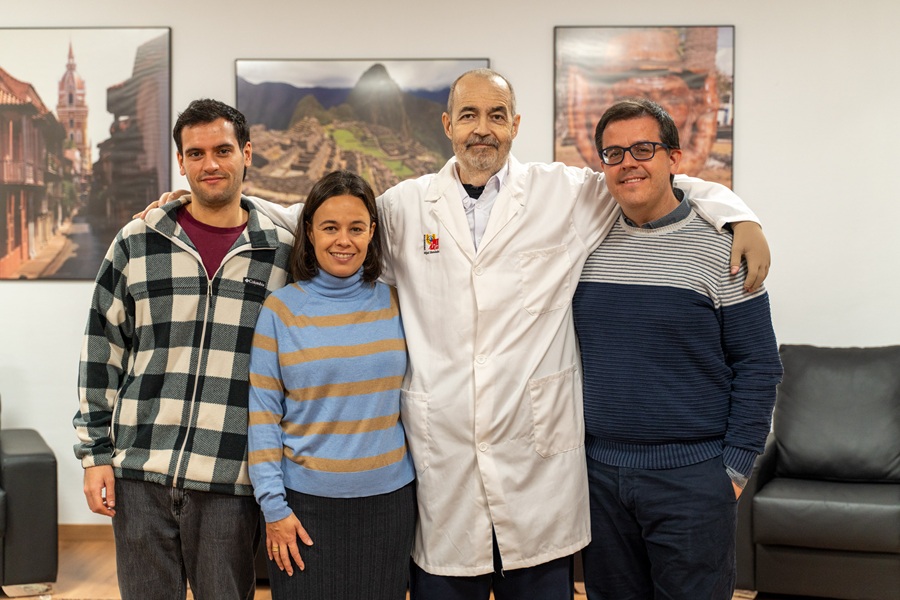
(Photo: IN UMH-CSIC researchers Abraham Torregrosa, María Salud García Gutiérrez, Jorge Manzanares, and Francisco Navarrete.)
Chronic alcohol consumption profoundly alters the expression of genes in the endocannabinoid system in key brain regions, according to a study led by the Institute of Neurosciences (IN), a joint research centre of Miguel Hernández University of Elche (UMH) and the Spanish National Research Council (CSIC). The work, published in the journal Addiction, shows how these changes affect areas involved in reward, impulse control, and decision-making, and opens new paths to better understand the biology of addiction and improve its treatment.
“Alcoholism is one of the leading causes of disease and death worldwide, yet despite its social and health impact, available therapeutic options remain limited”, explains Jorge Manzanares, lead author of the study and head of the Translational Neuropsychopharmacology of Neurological and Psychiatric Diseases laboratory. “That is why understanding what changes in the brain after decades of consumption is key to developing more effective therapies”, he adds.
In this context, the study focused on analysing the neurobiological mechanisms associated with alcohol use disorder by examining post-mortem brain tissue from individuals who had consumed alcohol chronically for an average of 35 years. Specifically, the researchers investigated changes in the endocannabinoid system, which is closely linked to reward and addiction mechanisms.
The endocannabinoid system is a chemical communication network that regulates essential functions such as pleasure, memory, mood, and stress response. It is composed of receptors such as CB1 and CB2, their natural ligands, and enzymes responsible for their degradation, including FAAH and MGLL. “This system acts as a fine modulator of brain function and plays a central role in reward and motivation processes”, explains Manzanares.
Although it was already known that alcohol interacts with this system, there was little evidence based on studies of the human brain. The new work provides a detailed view of how chronic alcohol consumption alters the expression of key genes of the endocannabinoid system in brain regions involved in addiction.
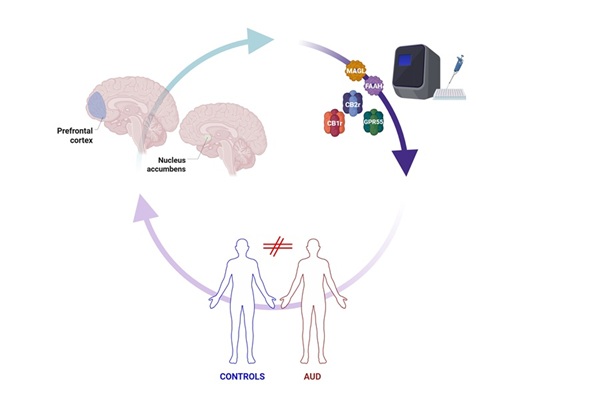
The researchers analysed two core areas of the mesocorticolimbic system: the prefrontal cortex, which is associated with judgement, planning, and decision-making, and the nucleus accumbens, considered the central hub of reward and habit formation.
By comparing samples from individuals with alcohol use disorder with those from non-addicted individuals, the team observed a marked imbalance in the expression of several endocannabinoid system genes. In particular, they detected a strong increase in the CB1 receptor: expression of the gene encoding this receptor rose by 125% in the prefrontal cortex and by 78% in the nucleus accumbens. “This receptor is closely involved in the reinforcement of addictive behaviours and the risk of relapse”, notes researcher María Salud García Gutiérrez, first author of the study.
In contrast, expression of the CB2 receptor gene was reduced by approximately 50% in both regions. “Since the CB2 receptor plays neuroprotective and anti-inflammatory roles, its reduction suggests an impairment of the brain’s defence mechanisms against alcohol-induced damage”, explains the researcher.
Another striking finding was the alteration of the GPR55 receptor, known as an ‘orphan’ receptor because for years its natural ligand was unknown. The researchers found higher levels of GPR55 in the prefrontal cortex, with a 19% increase, but significantly lower levels in the nucleus accumbens, with a 51% reduction. This study is the first to document changes in this gene in humans with alcohol use disorder.

Chronic alcohol consumption alters gene expression of the endocannabinoid system in brain regions involved in reward and behavioral control. Source: IN UMH-CSIC.
In addition, the team observed changes in the enzyme FAAH, which is responsible for degrading anandamide, an endocannabinoid produced by the nervous system that influences anxiety and pleasure. In individuals with alcoholism, FAAH gene expression was lower in the prefrontal cortex but 24% higher in the nucleus accumbens, potentially altering the availability of these regulatory substances.
One of the strengths of the study is the use of brain tissue samples from the New South Wales Tissue Resource Centre in Sydney (Australia). These samples came from individuals with chronic alcoholism who did not consume other illicit drugs, making it possible to isolate the specific effects of alcohol on the human brain without the usual interference of polysubstance use. “This approach provides a clearer picture of how alcohol alone reshapes gene expression in brain regions that are key to addiction”, says García Gutiérrez.
According to the authors, these findings help to better understand why the brains of people with alcohol use disorder show increased vulnerability to relapse and reduced executive control. Identifying which components of the endocannabinoid system are altered, and in which brain regions, opens the door to new, more specific and personalised therapeutic targets.
The authors of the study are also members of the Primary Care Addiction Research Network of the Instituto de Salud Carlos III, as well as the Alicante Institute for Health and Biomedical Research (ISABIAL). The work also involved the participation of researcher Gabriel Rubio from the Hospital 12 de Octubre Health Research Institute (i+12).
This research was funded by the Carlos III Health Institute, the Spanish Ministry of Science, Innovation and Universities, and the Spanish Ministry of Health, within the framework of national research networks on addictions and health, with the support of ISABIAL. The Institute for Neurosciences is accredited as a Severo Ochoa Centre of Excellence.
Source: UMH Communications Service (comunicacion@umh.es) / Institute for Neurosciences UMH-CSIC (in.comunicacion@umh.es)
La entrada Researchers at the Institute for Neurosciences UMH–CSIC identify key genetic alterations in the brains of people with alcoholism se publicó primero en Instituto de Neurociencias de Alicante.
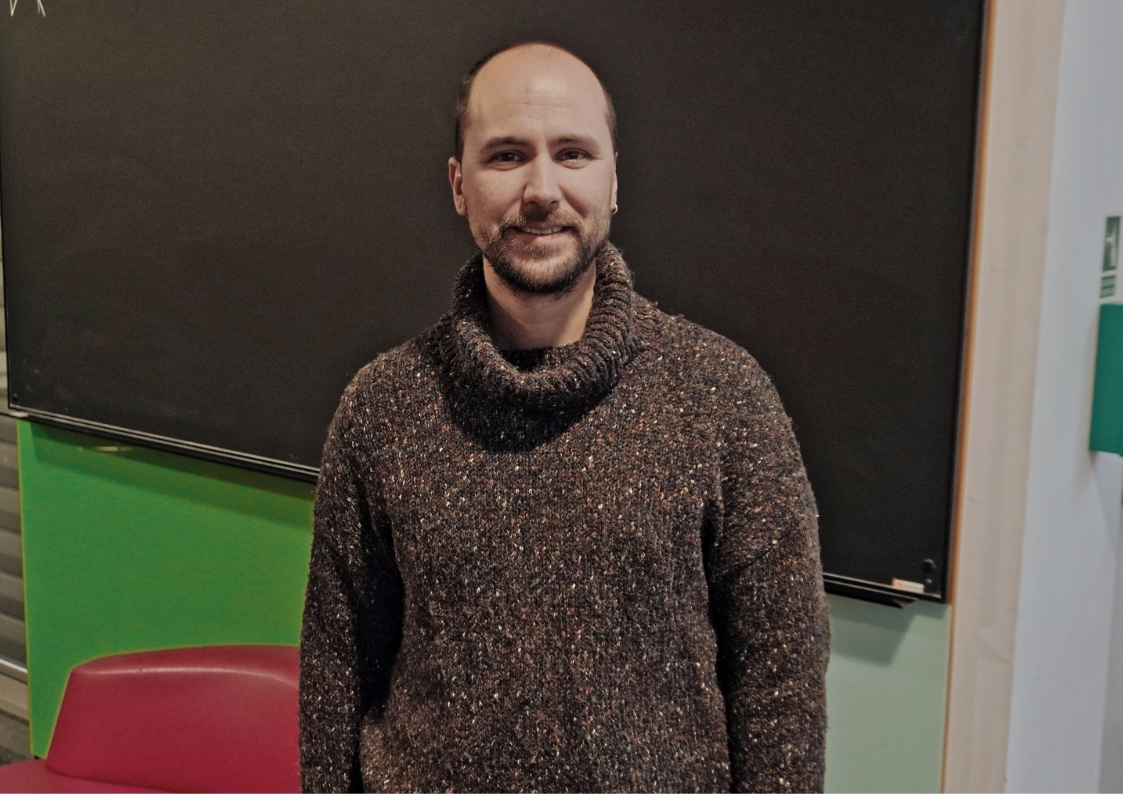
Axel Masó returns to CRM as a postdoctoral researcher after a two-year stint at the Knowledge Transfer Unit. He joins the Mathematical Biology research group and KTU to work on the Neuromunt project, an interdisciplinary initiative that studies physiological responses to mountain risks.
Axel Masó completed his PhD in physics at the Universitat Autònoma de Barcelona, studying stochastic processes with resets, mathematical models that describe random movements that repeatedly return to a starting point. “The inspiration was the movement of birds around a nest,” he explains, “a stochastic movement around a point, but with a return always to the same point.”
The week he defended his dissertation, he started working at the CRM Knowledge Transfer Unit. “I went from being in one very specific project for four years to being in three or four projects over two years, very diverse ones within the transfer unit,” Axel recalls. The shift was drastic: from the extended timeline of doctoral work to shorter research cycles, from a single theoretical question to multiple problems requiring tailored mathematical solutions.
“Looking back now, those two years feel like an entire training period,” he reflects. Even in his final months, starting yet another new project, the learning curve remained steep. The work fulfilled something his doctoral research hadn’t. “I had the birds in mind, but I was making my models thinking someone else would use them,” he says. “In contrast, at the KTU, I felt there was much more accountability; we were making models that were already grounded in very concrete situations. That gave me a lot of enthusiasm and really motivated me to work on something like that.”
“I don’t just need to do research, I need the research to matter. Doing research is a way to impact things I care about.”
The position required expanding his mathematical toolkit and working with diverse collaborators. Each project demanded not only different mathematical approaches but also different ways of communicating them, from private investors without scientific training to research centres requiring statistical or mathematical tools for specific projects. The challenge wasn’t merely technical; it was about translation. “Mathematics is probably the most rigorous thing humans have created,” Axel observes. “So, stepping outside that rigour to explain something, it’s an exercise.”
He describes a tension familiar to many researchers: mathematical work values complexity and precision, but external partners need clarity and utility. “When you’re doing it for yourself, you appreciate the difficulty, you explore all the complexity it has,” he explains. “But when you have to explain it to the people who will use it, you have to bring it down without it losing its value.”
After two years, he left CRM. Took a gap year. During that pause, something crystallised. “I’ve always had a very academic profile,” he says, “and I feel there’s a kind of wave or narrative around academic profiles that you’re wasting your time if you stay in academia because companies value you much more, you’ll have a much more stable, much calmer life, and here things go from two years to two years.” The thinking was compelling, and he considered opportunities outside academia. But after the break, “I feel I want to do what I want to do, which is research on something that motivates me.”
Now he’s back at CRM as a postdoctoral researcher on the Neuromunt project, joining the Mathematical Biology research group in a shared position with the Knowledge Transfer Unit. Neuromunt is a three-year interdisciplinary initiative studying physiological responses to mountain risks. The project brings together mountain guides, rescue teams, university researchers, and sports science specialists. Partners include the Institut Nacional d’Educació Física de Catalunya, universities in Perpignan and Toulouse, the Universitat Politècnica de Catalunya, and CRM.
Field expeditions will collect electroencephalogram and electrocardiogram data from subjects facing winter mountain conditions. Axel’s work, working with the rest of the research team, centres on analysing these physiological signals. “We’ll try to study these electroencephalograms, for example, to see if there are signals of the risks that occur in the mountains in the reaction or activation of the brain,” he explains. The research connects directly to the mountain guides and rescue teams who will be among the study subjects. “The research results will have almost immediate impact because they themselves will be the subjects.”
The project also includes training programs for mountain guides, professional athletes, and rescue teams like GRAE (Grup d’Actuacions Especials dels Bombers), with mountain safety as a central focus. “It’s a very good project because of the diversity of people involved, from the most scientific part of research to people who are really in the mountains every day earning their living or facing these risks,” Axel says.
The move to Neuromunt represents a shift in research timeline and focus. “I don’t think I just need to do research, I need the research to have meaning,” Axel says. “I feel that doing research is a way to impact things that matter to me.” His time at the Knowledge Transfer Unit shaped this perspective. Working with different types of stakeholders reinforced that impact matters as much as methodology. “What I needed now was for the impact to interest me, not just that the research generates impact, but that I care about the impact.”
After experiencing different research contexts, from theoretical physics to applied mathematics with external partners, Axel has chosen to focus on a single project. “One thing that working at the transfer unit and all that diversity of projects made me realise is that I needed to return to a single project that really motivated me,” he says. “More than several projects that motivate me quite a bit.” When the Neuromunt position appeared, “I felt there would be nothing that would motivate me more than this right now.”
Like the stochastic processes he studied during his PhD, Axel has returned to his starting point. But the path matters. The bird doesn’t circle back to the nest unchanged. The detour through diverse projects, external partners, and that deliberate pause reshaped what he was looking for in research. He’s back at CRM, but with a clearer sense of what makes the work meaningful: not just the mathematics, but the impact it creates and whether that impact matters to him.
Sometimes you need to leave to understand why you came back.

|
|
CRM CommPau Varela
|
Axel Masó returns to CRM as a postdoctoral researcher after a two-year stint at the Knowledge Transfer Unit. He joins the Mathematical Biology research group and KTU to work on the Neuromunt project, an interdisciplinary initiative that studies…
The 4th Barcelona Weekend on Operator Algebras, held at the CRM on January 30–31, 2026, brought together experts to discuss recent advances and open problems in the field.The event strengthened the exchange of ideas within the community and reinforced the CRM’s role…
Ander Movilla has joined CRM as a Beatriu de Pinós postdoctoral fellow. Working with Tomás Alarcón, Movilla will develop mathematical models that capture not just the static architecture of DNA but its dynamic behaviour; how chromosome contacts shift as chemical marks…
A continuació podeu consultar la publicació dels criteris de priorització de les sol·licituds dels ajuts Joan Oró per a la contractació de personal investigador predoctoral en formació (FI 2026), dirigits a les universitats públiques i privades del…
Over 100 researchers gathered at the Centre de Recerca Matemàtica to explore the mathematical foundations needed to understand modern artificial intelligence. The three-day workshop brought together mathematicians working on PDEs, probability, dynamical systems, and…
From 19 to 23 January 2026, the CRM hosted the 8th International Conference on the Anthropological Theory of the Didactic (CITAD 8), a leading international event in the field of didactics research that brought together researchers from different countries in…
From October to November 2025, María Ángeles García Ferrero held the CRM Chair of Excellence, collaborating with Joaquim Ortega-Cerdà on concentration inequalities and teaching a BGSMath course on the topic. Her main research focuses on the Calderón problem,…
Brian Wetton, from the University of British Columbia, spent last October at CRM collaborating with Tim Myers on computational models for filtration systems. His career has evolved from pure numerical analysis to applied mathematics with industrial partners, working…
Researchers at the Centre de Recerca Matemàtica, in collaboration with IIT Kharagpur and UPC, have developed a mathematical model that accurately predicts the performance of fluoride-removal water filters made of mineral-rich carbon (MRC) and…
The Centre de Recerca Matemàtica recently hosted a research programme on Combinatorial Geometries and Geometric Combinatorics, focusing on the overlap between polytopes and matroids. Martina Juhnke, a member of the scientific committee, reflects on how this programme…
In October 2025, the Centre de Recerca Matemàtica hosted Josefine Meyer (ISTA) and Cate MacColl (University of Queensland) for a month-long research stay following their participation in the BAMB! Summer School. Despite studying vastly different subjects, from…
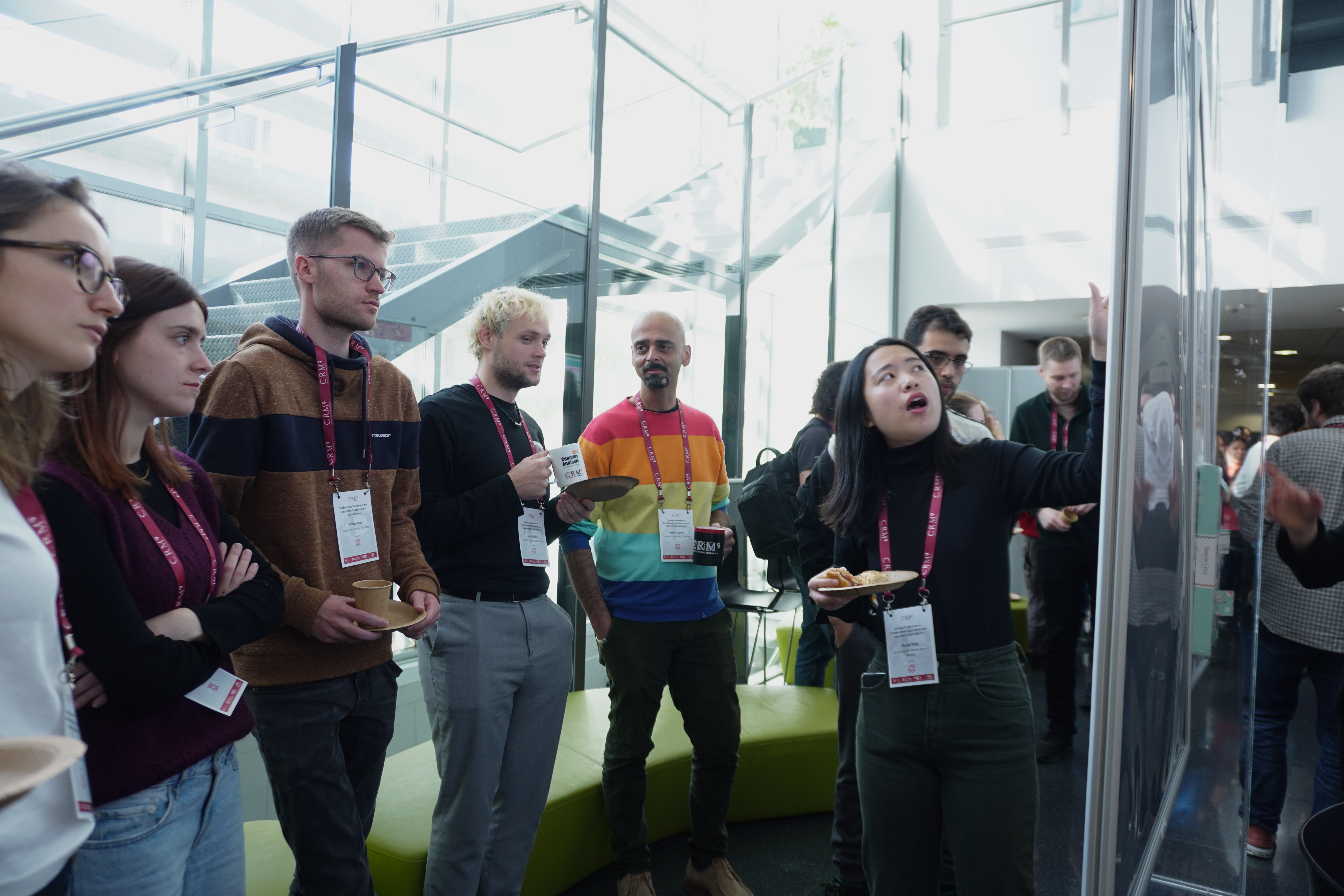
During five days, the CRM hosted the Closing Conference of the MDM Focused Research Programme on Combinatorial Geometries & Geometric Combinatorics. The event featured plenary talks, contributed sessions, and posters on topics from matroids and polytopes to…
The post Axel Masó Returns to CRM as a Postdoctoral Researcher first appeared on Centre de Recerca Matemàtica.
Abstract: The origin of de Sitter entropy is more enigmatic than that of black holes, presenting a fundamental challenge to quantum gravity. While the Gibbons-Hawking formula suggests a statistical interpretation, a concrete construction of the accessible microstates for a static patch observer is still lacking. In this talk, I present a systematic approach to this problem by constructing microstates in “centaur” geometries —solutions that flow from an asymptotic AdS₂ boundary to a dS₂ static patch in the interior. Employing techniques from wormhole statistics and the gravitational path integral, we recover the expected area law for the entropy. Furthermore, we extend this microstate-counting method to the case of a finite-length Einstein–Rosen bridge. This reveals that the Hilbert space of the flow geometry horizon can be spanned by states with a purely dS bridge, with no AdS portion. Our work thus provides a controlled holographic framework for realizing de Sitter microstates. Time permitting, I will also describe ongoing research into the information content of Hawking pairs in cosmology using the algebraic framework.
Abstract: Strongly correlated quantum systems pose a central challenge across nuclear, atomic, and condensed-matter physics: their collective behavior emerges from interactions that are too strong and complex for mean-field or perturbative approaches, and their many-body wave functions live in exponentially large spaces. In this talk, I will introduce neural quantum states (NQS) as a flexible variational framework for representing and optimizing many-body wave functions in fermionic systems with both continuous and discrete degrees of freedom. After briefly reviewing the variational Monte Carlo method, I will show how modern neural-network architectures can encode high-dimensional correlations, fermionic antisymmetry, and physical symmetries directly into the wave function ansatz. I will then highlight recent applications of NQS to strongly correlated systems, including ultracold Fermi gases, neutron-star matter, and atomic nuclei. These examples illustrate how a common computational framework can describe pairing, clustering, and long-range correlations across traditionally separate subfields.