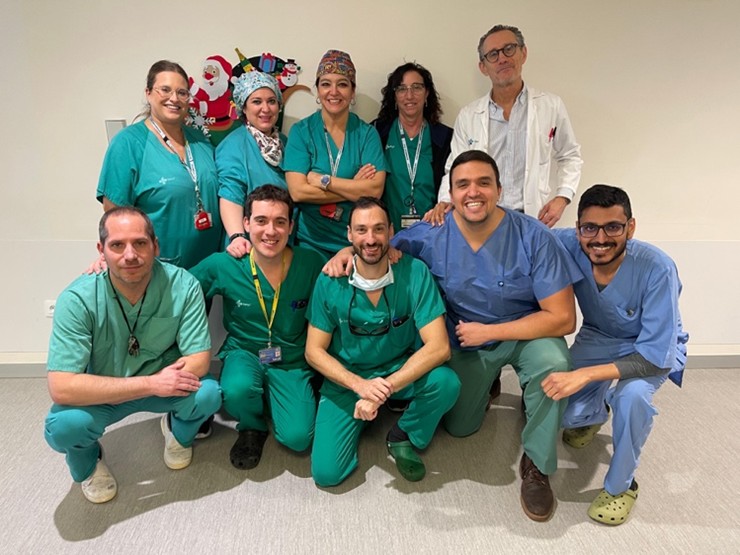
A team led by the Centro Nacional de Investigaciones Cardiovasculares (CNIC) and Hospital Clínico Universitario de Valladolid has developed and clinically applied a minimally invasive technique that, for the first time, enables the treatment of defective mechanical aortic valves using a catheter-based approach. The procedure avoids high-risk open-heart surgery and opens new therapeutic possibilities for patients who previously had no realistic options. The two research groups, led respectively by Dr. Borja Ibáñez and Dr. Alberto San Román, are part of the Spanish cardiovascular research network CIBERCV .
Mechanical heart valves have been used for decades to treat severe aortic valve disease, with their high durability making them particularly attractive for younger patients. However, when these prostheses fail—due either to obstruction of their mobile discs or other malfunctions—the only available treatment until now has been repeat open-heart surgery, a high-risk procedure that is not feasible for many patients.
“We were encountering patients with severely dysfunctional mechanical valves for whom no reasonable therapeutic option existed,” explains Dr. Ibáñez, CNIC Scientific Director, cardiologist at Hospital Universitario Fundación Jiménez Díaz, and senior author of the study published in European Heart Journal. “The risk of repeat surgery was prohibitive, and until now there were no effective percutaneous alternatives.”
Unlike biological valves, mechanical valves could not previously be treated with catheter-based techniques. The new study describes the first minimally invasive alternative for these complex cases. Specifically, the researchers developed and validated a strategy known as mechanical valve-in-valve (ViMech), which enables the catheter-mediated implantation of a new valve inside a defective mechanical valve after controlled removal of its mobile discs.
“This study combines preclinical research and clinical application—a rarity in developments of this type—and demonstrates that an experimental concept can be translated safely to patients,” notes Dr. Ibáñez.
The team first developed and tested the technique in experimental models, demonstrating that the mechanical valve discs can be fragmented and retrieved safely using catheter-based tools and protection systems designed to prevent debris from entering the bloodstream. The procedure was then translated to the clinical setting and applied for the first time in patients with severely damaged mechanical valves and extremely high surgical risk.
“The ability to remove the discs of a mechanical valve in a controlled manner and treat the patient via catheter represents a radical change in the management of these highly complex cases,” says joint first author Dr. Ignacio J. Amat Santos, interventional cardiologist at Hospital Clínico Universitario de Valladolid.
The interventions were performed without open-heart surgery and with very rapid recovery in patients at extreme risk, adds CNIC cardiologist and joint first author Dr. Carlos Real.

The study reports the first three ViMech transcatheter aortic valve implantation procedures performed in humans, in patients aged 67 to 79 who had undergone multiple previous cardiac surgeries or had severe mechanical valve-related complications that made conventional reoperation impossible. In all cases, the procedure immediately restored valve function, with a very favorable clinical course and no major neurological or vascular events during follow-up.
“In these first patients, the procedure was successfully performed through the femoral artery, avoiding open surgery,” adds Dr. San Román, Chief of Cardiology at Hospital Clínico de Valladolid. “Once the mechanical discs were removed, a new transcatheter heart valve was implanted, restoring normal blood flow. All patients remained clinically stable during follow-up.”
In addition, Dr. San Román notes that in some cases the procedure allowed significant simplification of the antithrombotic regimen, avoiding the lifelong anticoagulation usually required for mechanical valves. This has a direct impact on safety and quality of life in very fragile patients.
At six-month follow-up, all patients were alive, asymptomatic, and functioning normally with their transcatheter prostheses, with no significant ischemic or hemorrhagic events.
The authors note that the study has limitations, including the small number of treated patients and the need to further investigate the optimal antithrombotic strategy after this procedure. Even so, the study represents the first complete demonstration—from laboratory development to patient application—that percutaneous treatment of defective mechanical valves is feasible.
The authors conclude that this strategy could transform the clinical management of thousands of patients in the future by offering a less aggressive option and significantly expanding therapeutic possibilities in interventional cardiology.
Abstract: Matchgate unitaries are fundamental to quantum computation due to their relation to non-interacting fermions and their utility in benchmarking quantum hardware. In fault-tolerant settings, general unitaries must be decomposed into discrete sets compatible with error-correction primitives, typically the Clifford+T gate set. Here, we propose an alternative paradigm: compiling matchgates using only matchgates. By leveraging the correspondence between n-qubit matchgate circuits and the standard representation of SO(2n), we reduce the compilation task from 2^n times 2^n unitaries to 2n times 2n matrices, achieving an exponential reduction in dimensionality. Our first result identifies a discrete gate set that densely generates the matchgate group. We then address approximate synthesis, rigorously showing that approximation errors in the SO(2n) representation propagate only linearly into the full unitary representation. Finally, we characterize exact synthesis, demonstrating that matchgates meeting specific algebraic conditions can be exactly synthesized without ancilla qubits. This allows us to frame optimal synthesis as a Boolean satisfiability (SAT) problem, enabling the construction of circuits with provable guarantees on depth.
Abstract: Motivated by recent observations of exotic hadrons in the near-threshold energy region, the internal structure of near-threshold states has been intensively studied. In various works, a qualitative measure, called the compositeness, has been used to characterize the structure of near-threshold states. The compositeness represents the fraction of the hadronic molecular component in the wavefunction [1]. It is shown that in the limit where the binding energy goes to zero, the compositeness becomes unity as a consequence of the low-energy universality [2]. This indicates that the states exactly at the threshold commonly have a purely molecular structure, independently of the details of the system. Based on this fact, near-threshold states with small but finite eigenenergies are naively expected to be molecular dominant states whose compositeness is close to unity (the threshold energy rule) [3]. However, this rule is empirical, and its theoretical foundation has not yet been established. To understand the nature of near-threshold exotic hadrons, we aim to provide the theoretical foundation of the threshold rule by analyzing the structure of near-threshold states in light of the low-energy universality.
We first focus on near-threshold bound states slightly below the threshold with small and negative eigenenergies. Using an effective field theory model, the model dependence of the compositeness of bound states is examined. We show that the shallow bound states are usually composite dominant without significant fine tuning, which is explained by the emergence of the low-energy universality [4]. This provides the theoretical foundation of the threshold energy rule for bound states. We then consider the structure of the near-threshold resonances, which exist above the threshold with small and positive excitation energy. Using the effective range expansion, we calculate the compositeness of near-threshold resonances, and find that the near-threshold resonances are non-composite dominant [5]. This shows that the structure of near-threshold resonances is completely different from that of bound states, which is another aspect of near-threshold phenomena that deviates from the expectations based on the threshold energy rule. Finally, we also discuss how the Coulomb interaction affects the structure of the near-threshold states.
References:
[1] T. Kinugawa, T. Hyodo, Eur. Phys. J. A 61 , 154 (2025).
[2] T. Hyodo, Phys. Rev. C 90, 055208 (2014).
[3] K. Ikeda, and N. Takigawa, and H. Horiuchi, Prog. Theor. Phys. Suppl. E68, 464-475 (1968).
[4] T. Kinugawa and T. Hyodo, Phys. Rev. C 109 , 045205 (2024).
[5] T. Kinugawa and T. Hyodo, arXiv:2403.12635 [hep-ph].
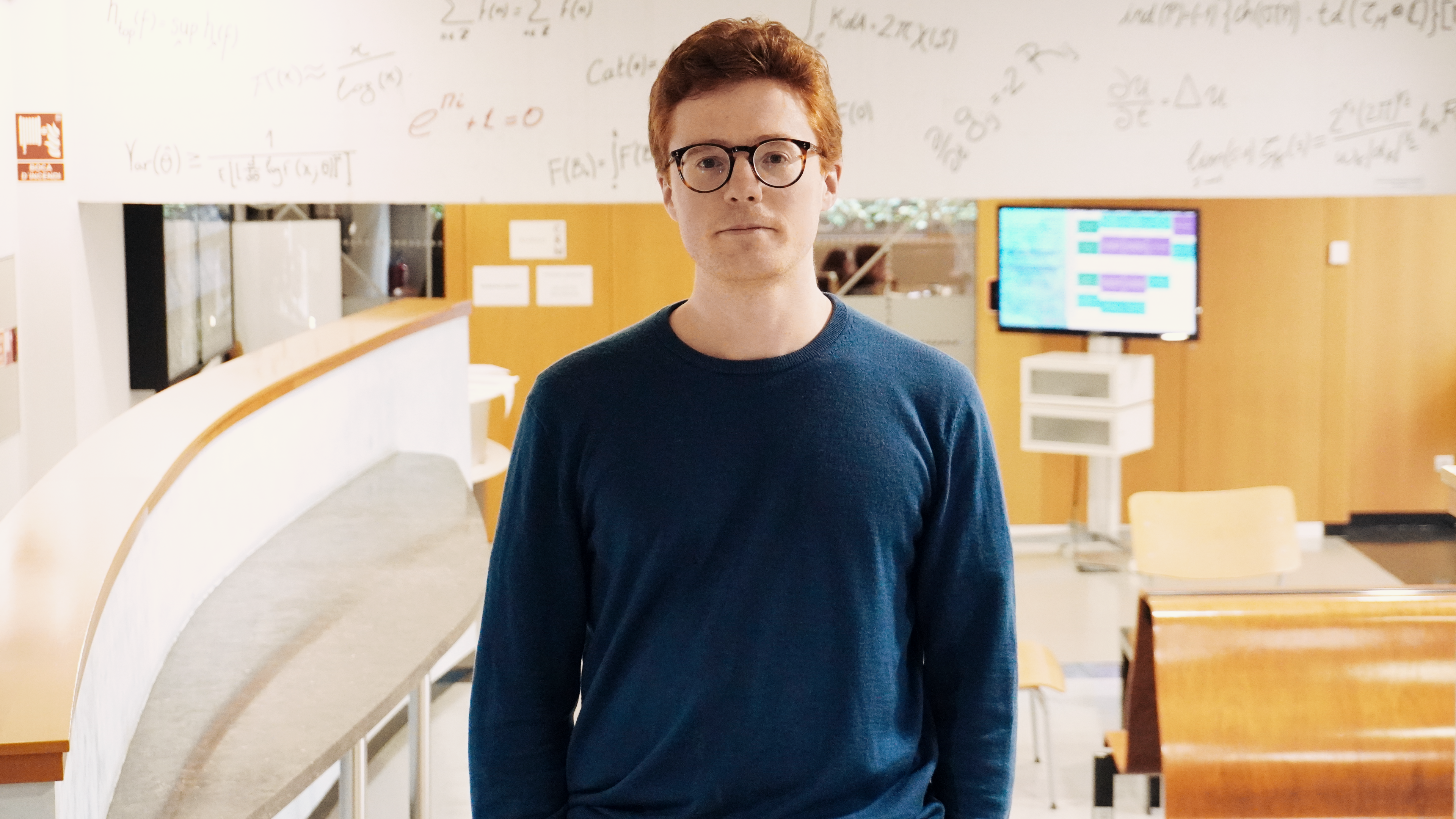
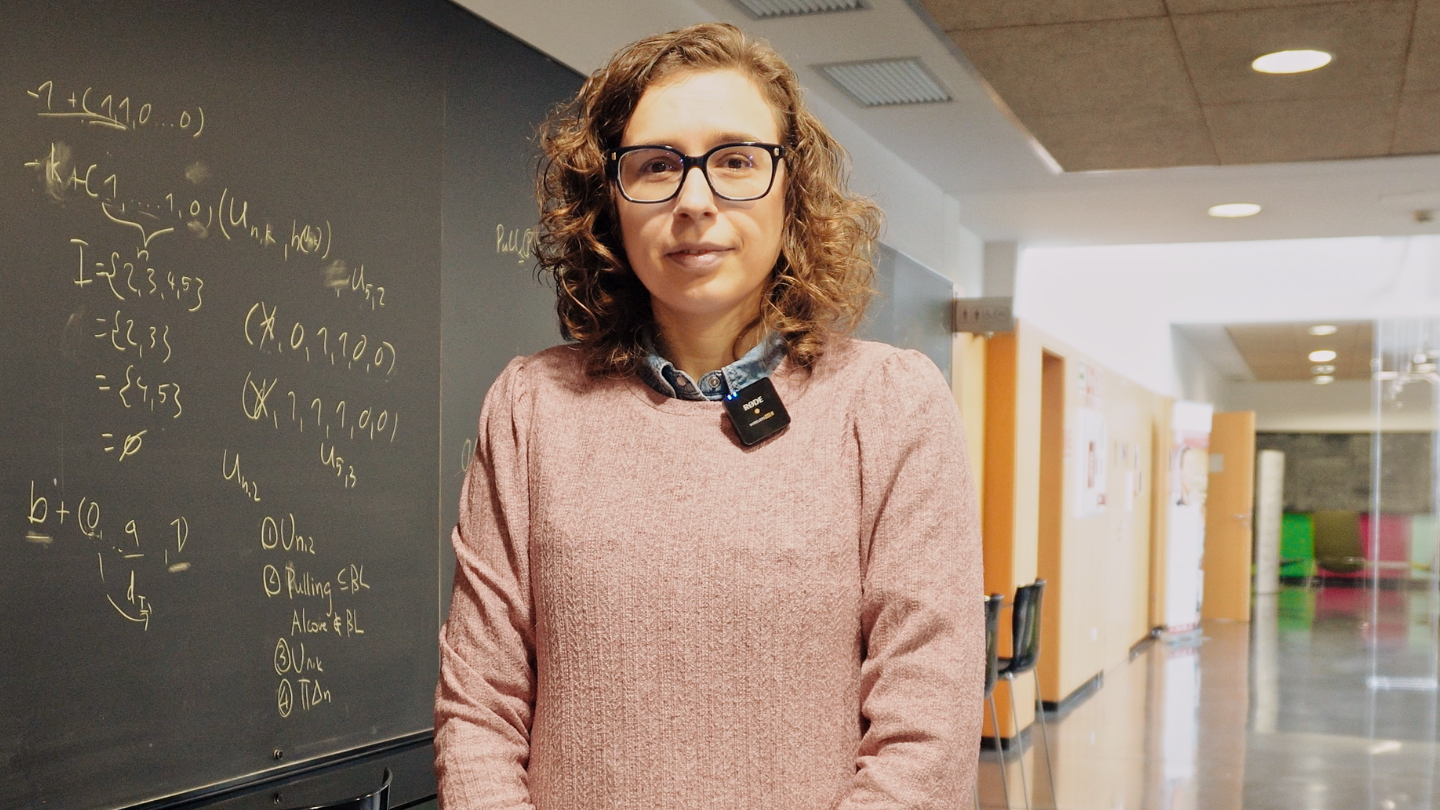
Ander Movilla has joined CRM as a Beatriu de Pinós postdoctoral fellow. Working with Tomás Alarcón, Movilla will develop mathematical models that capture not just the static architecture of DNA but its dynamic behaviour; how chromosome contacts shift as chemical marks on histones change over time.
Ander Movilla Miangolarra has joined the Centre de Recerca Matemàtica with a physicist’s training, a biologist’s curiosity, and a mathematician’s toolkit. His path here traces an unusual trajectory, from studying how droplets form inside cells to understanding how chromosomes fold in three dimensions, but the thread connecting it all is a fascination with how physical principles shape biological behaviour.
Movilla arrives at CRM as a Beatriu de Pinós postdoctoral fellow, a program funded by the Catalan Government’s AGAUR that brings international researchers to Catalonia for three-year research stays.
Working with CRM principal investigator Tomás Alarcón, he’ll join the Mathematical Biology research group at CRM to tackle one of molecular biology’s most intricate puzzles: how the three-dimensional architecture of chromosomes influences which genes get expressed.
Movilla’s background is in physics, he completed his undergraduate degree at the University of the Basque Country, but his PhD at Institut Curie in Paris was already crossing disciplinary boundaries. He worked on reaction-diffusion equations, the mathematical framework that describes how substances spread and interact in space. But these weren’t the textbook versions.
“They weren’t the classic ones that you’d use for solutions where these things don’t happen,” Movilla explains. “They were for cases where, due to different interactions between the solutes, these droplets form.” He was studying liquid-liquid phase separation: how the cytoplasm inside cells spontaneously organises into distinct compartments, like oil separating from water in a vinaigrette. It’s a phenomenon that’s become central to understanding cellular organisation, especially under stress conditions when metabolic components aggregate into visible droplets.
“Describing that mathematically, especially in a way that’s intelligible to a human and not just a thousand-by-thousand matrix that only a computer can understand, that’s also an interesting question from a purely mathematical standpoint.”
The work was computationally driven but biologically motivated. Then, three months into his PhD, reality intervened. “The experimentalists said, well, this can’t actually be done in the end. And so, your project collapses,” he recalls. “You start thinking, okay, now what do we do?” It was an early lesson in research pragmatism. “I think in science, most of the things you try don’t work out,” Movilla says. “Of course, the ones that do work out get published, and everything goes well. But you try many things that don’t work. And I learned that in the first three months of my PhD.”
During his postdoctoral work at the John Innes Centre in Norwich, UK, Movilla shifted his focus to gene regulation and epigenetics. The questions became more explicitly biological: How do cells with identical DNA differentiate into neurons, skin cells, or muscle? How do they maintain their identities across divisions?
The answers involve histones, proteins that bind to DNA and control whether a gene is expressed. Histone modifications form patterns: blocks with one type of modification, others without, and some stretches are empty in the middle. Tomás Alarcón has been working on mathematical models of these patterns for years, and lately he’s been focused on how they relate to chromosome folding. The patterns appear linear when you look at a genome browser, but in the cell nucleus, the DNA is folded in three dimensions, and that matters.
“When you look at the genome browser, as biologists typically do, it shows up as a line,” Movilla explains. “But then in the cell nucleus, it’s all folded.” Regions of the chromosome that are far apart on the linear sequence might be physically adjacent in three-dimensional space, and that proximity matters. “In zones where there are contacts between the chromosomes, it’s much more likely that those histone interactions happen, even if they’re far apart.”
Tomás Alarcón at CRM has been working on mathematical models of histone modifications for years, examining how these chemical patterns relate to chromosome folding. But most of that work has treated the structure as relatively static. Movilla’s project aims to make it dynamic.
When there’s a contact between two parts of the chromosome, you get a network of contacts. If the network is fixed, you know what it is, and how to describe it. But when that network becomes dynamic, the challenge changes entirely. “When that network is no longer static but adaptive, because the histones change due to their own dynamics, which then implies that the contacts change, that network is no longer static,” Movilla says. “And describing that mathematically, especially in a way that’s intelligible to a human and not just a thousand-by-thousand matrix that only a computer can understand, well, that’s also an interesting question from a purely mathematical standpoint.”
This is where the interdisciplinary work becomes essential. Movilla will be working with data from cell lines, clones of pluripotent embryonic cells that can be experimentally differentiated into various cell types. The datasets are massive: expression levels of 20,000 genes at the single-cell level, histone modifications mapped across the genome, and chromosome conformation capture experiments showing three-dimensional contacts. “You end up with gigabytes and gigabytes of data that’s very complicated to work with,” he says. “And I think one of the things that could help us understand it better would be these kinds of mathematical approaches, where you try to extract the most important things from that data.”
One of the aspects of the work Movilla finds compelling is the bidirectional exchange with experimentalists. Mathematical models don’t just analyse data, they generate hypotheses. “At the John Innes Centre, we often tried to encourage information to flow both ways,” he says. “They inform us on how to do the analyses and what would be important in these data. But then our model, based on these analyses, might suggest you could try this experiment, and you might observe this. This model perhaps tells you that this gene could be important.”
Sometimes the predictions are more tentative. “You tell them; I don’t have much confidence, so don’t invest too many resources in this. But I’ll leave it there as an idea.” Other times, given the data and the model’s assumptions, the direction is clearer. “That’s usually what ends up getting done, because experimentalists generally go for what they’re most confident in,” Movilla says.
The work calls for a steady relationship with uncertainty and failure. For Movilla, that feels inseparable from doing research. A project that collapsed three months into his PhD made the point clearly and early. The CRM now welcomes Ander Movilla as a Beatriu de Pinós postdoctoral fellow for the next three years.

Ander Movilla trained as a physicist, earning a bachelor’s degree at the University of the Basque Country before completing a PhD in Paris at the Institut Curie, Université PSL. His doctoral work focused on reaction–diffusion equations, with particular attention to systems where components interact and solutions depart from ideal behaviour. During a postdoctoral stay at the John Innes Centre in Norwich, he turned his attention to gene regulation and epigenetics, developing stochastic models to make sense of data from genomics experiments. At the CRM, working with Tomás Alarcón, he builds on this line of work by studying models that capture the three-dimensional organization of chromosomes and its relationship with gene expression.
The Beatriu de Pinós fellowship, launched in 2005 and managed by the Catalan Agency for Management of University and Research Grants (AGAUR), is one of Catalonia’s flagship programs for attracting international postdoctoral talent. The fellowship provides three-year contracts and research funding to support early-career researchers as they develop independent research programs within Catalan institutions. The program is open to researchers from any country who have completed at least two years of postdoctoral work outside Spain and aims to strengthen Catalonia’s science and technology ecosystem through international mobility and interdisciplinary collaboration.
|
|
CRM CommPau Varela
|
Ander Movilla has joined CRM as a Beatriu de Pinós postdoctoral fellow. Working with Tomás Alarcón, Movilla will develop mathematical models that capture not just the static architecture of DNA but its dynamic behaviour; how chromosome contacts shift as chemical marks…
A continuació podeu consultar la publicació dels criteris de priorització de les sol·licituds dels ajuts Joan Oró per a la contractació de personal investigador predoctoral en formació (FI 2026), dirigits a les universitats públiques i privades del…
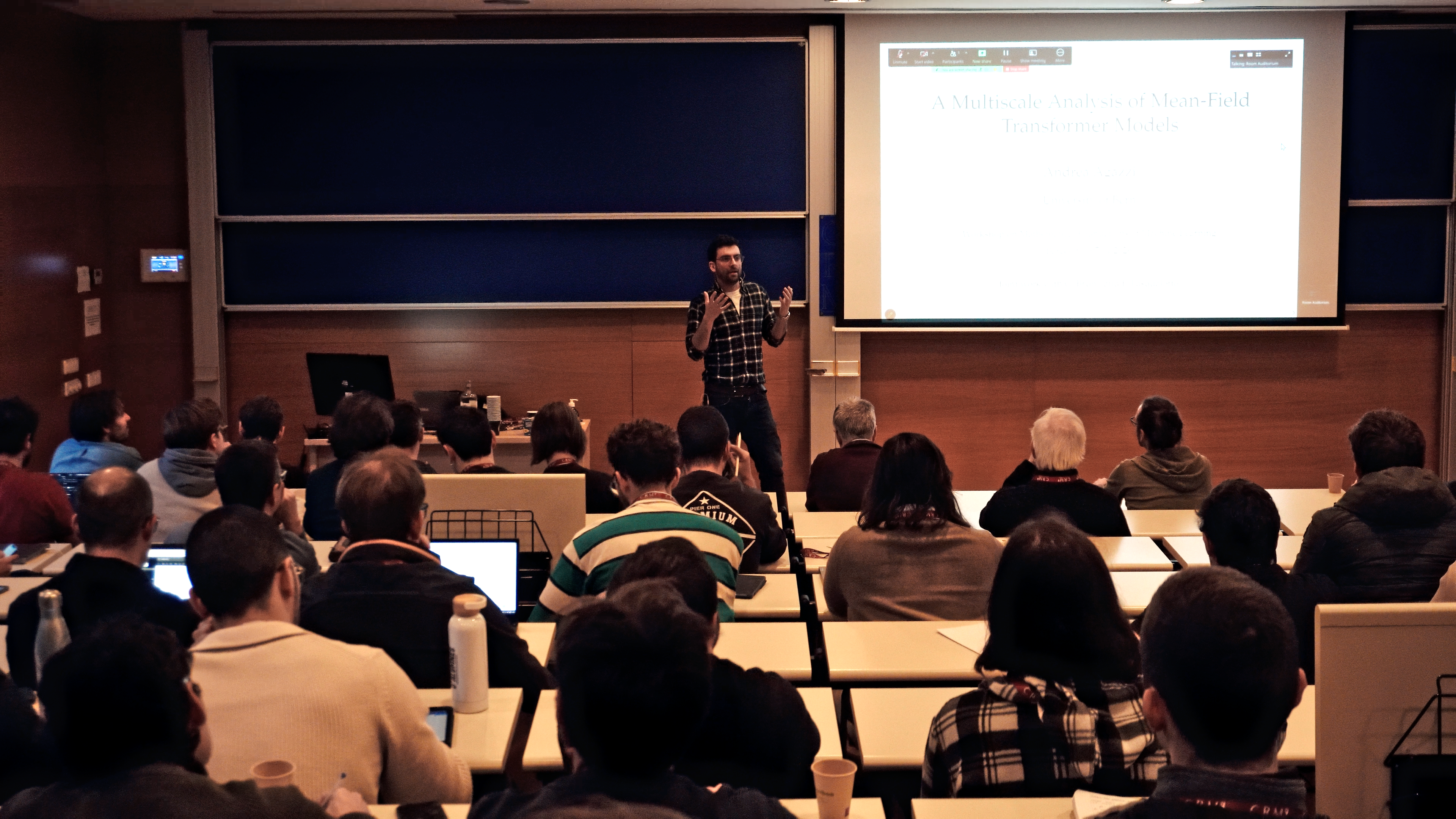
Over 100 researchers gathered at the Centre de Recerca Matemàtica to explore the mathematical foundations needed to understand modern artificial intelligence. The three-day workshop brought together mathematicians working on PDEs, probability, dynamical systems, and…
From 19 to 23 January 2026, the CRM hosted the 8th International Conference on the Anthropological Theory of the Didactic (CITAD 8), a leading international event in the field of didactics research that brought together researchers from different countries in…
From October to November 2025, María Ángeles García Ferrero held the CRM Chair of Excellence, collaborating with Joaquim Ortega-Cerdà on concentration inequalities and teaching a BGSMath course on the topic. Her main research focuses on the Calderón problem,…
Brian Wetton, from the University of British Columbia, spent last October at CRM collaborating with Tim Myers on computational models for filtration systems. His career has evolved from pure numerical analysis to applied mathematics with industrial partners, working…
Researchers at the Centre de Recerca Matemàtica, in collaboration with IIT Kharagpur and UPC, have developed a mathematical model that accurately predicts the performance of fluoride-removal water filters made of mineral-rich carbon (MRC) and…
The Centre de Recerca Matemàtica recently hosted a research programme on Combinatorial Geometries and Geometric Combinatorics, focusing on the overlap between polytopes and matroids. Martina Juhnke, a member of the scientific committee, reflects on how this programme…
In October 2025, the Centre de Recerca Matemàtica hosted Josefine Meyer (ISTA) and Cate MacColl (University of Queensland) for a month-long research stay following their participation in the BAMB! Summer School. Despite studying vastly different subjects, from…
During five days, the CRM hosted the Closing Conference of the MDM Focused Research Programme on Combinatorial Geometries & Geometric Combinatorics. The event featured plenary talks, contributed sessions, and posters on topics from matroids and polytopes to…
ICREA professor at the Universitat de Barcelona and CRM affiliated researcher Xavier Ros-Oton appears on Clarivate’s Highly Cited Researchers 2025 list, which this year reinstates the mathematics category after two years of exclusion.Citations are a strange way to…
The researchers Maicol Caponi, Alessandro Carbotti, and Alberto Maione extended the H- and Γ-convergence theories to the setting of nonlocal linear operators and their corresponding energies. The authors were able to overcome the limitations of classical localization…
The post From Phase Separation to Chromosome Architecture: Ander Movilla Joins CRM as Beatriu de Pinós Fellow first appeared on Centre de Recerca Matemàtica.