To mark International Women’s Day, the Spanish National Centre for Cardiovascular Research (CNIC) will host the art exhibition “Shared Discovery: Creative Works by Women in Science“, an initiative that highlights the role of women in science through art and seeks to be a space for encounter, dialogue, and inspiration.
The works submitted in the different disciplines (photography, painting, sculpture and mixed media) should serve to give the public access to different areas of scientific knowledge, raise awareness of the roles played by women and encourage reflection on the impact of their work on society.
Deadline for submission of works: 15 February 2026
La Alianza de Centros Severo Ochoa y Unidades María de Maeztu (SOMMa) celebra el reconocimiento a la excelencia científica otorgado en los Premios de Investigación de la Comunidad de Madrid 2025, que distinguen trayectorias consolidadas y jóvenes investigadores e investigadoras con impacto nacional e internacional en distintas áreas del conocimiento.
Entre las personas galardonadas este año se encuentran investigadores vinculados a centros de excelencia acreditados que forman parte de SOMMa, lo que vuelve a poner de relieve el papel estratégico de estas instituciones en el avance del conocimiento y en la generación de evidencia científica de alto impacto al servicio de la sociedad.
En la categoría de trayectoria científica, el Premio Margarita Salas ha sido concedido a Santiago Rodríguez de Córdoba, doctor en Biología por la Universidad Complutense de Madrid y profesor de investigación ad honorem en el Consejo Superior de Investigaciones Científicas (CSIC). Fundador del laboratorio de Diagnóstico Genético-Molecular del Complemento (D-COM), su trabajo ha sido clave para el diagnóstico genético y funcional de enfermedades relacionadas con el sistema del complemento.
El Premio Julián Marías ha recaído en Jesús Gonzalo Muñoz, catedrático de Economía de la Universidad Carlos III de Madrid, perteneciente a una Unidad María de Maeztu integrada en SOMMa. Sus investigaciones en econometría y economía del cambio climático constituyen una referencia internacional y tienen implicaciones directas en el diseño de políticas públicas basadas en evidencia científica.
De izquierda a derecha: presidenta de la Comunidad de Madrid, Isabel Díaz Ayuso y Francisco Javier Llorca, director del grupo de investigación en materiales estructurales avanzados y nanomateriales en IMDEA Materiales y Emilio Viciana Duro, Consejero de Educación, Ciencia y Universidades de la Comunidad de Madrid
Por su parte, el Premio Miguel Catalán ha sido otorgado a Francisco Javier Llorca, catedrático de Ciencia de Materiales de la Universidad Politécnica de Madrid y director del grupo de investigación en materiales estructurales avanzados y nanomateriales en IMDEA Materiales, centro Severo Ochoa y miembro de SOMMa. Su trayectoria ha sido pionera en la aplicación de herramientas computacionales y simulación multiescala para el diseño y procesamiento de materiales avanzados.
Categoría de investigadores e investigadoras menores de 40 años
En la modalidad dirigida a jóvenes investigadores, el Premio Margarita Salas ha sido concedido ex aequo a Miguel Ángel Mompeán, doctor en Biofísica por la Universidad Autónoma de Madrid y licenciado en Química y Bioquímica por la Universidad de Murcia, líder de un grupo especializado en resonancia magnética nuclear de biosólidos; y a Dolores Serrano, licenciada y doctora en Farmacia por la Universidad Complutense de Madrid, especializada en el diseño de sistemas personalizados de administración de fármacos mediante biotecnología.
El Premio Julián Marías, también ex aequo, ha distinguido a Mónica García, licenciada y doctora en Historia por la Universidad de Oviedo, cuyos trabajos se centran en la historia de las mujeres y las emociones en la España del siglo XX; y a Jorge Miguel Alves, doctor en Relaciones Internacionales por la Universidad de Minho (Portugal) e investigador del CSIC, especializado en democracia participativa.
Finalmente, el Premio Miguel Catalán en la categoría de menores de 40 años ha sido concedido a Daniel García, doctor en Ingeniería Mecánica y Organización Industrial por la Universidad Carlos III de Madrid, por su trabajo en la conceptualización de estructuras inteligentes y su aplicación en el ámbito de la investigación biomédica.
Los Premios de Investigación de la Comunidad de Madrid, que llevan los nombres de Margarita Salas, Miguel Catalán y Julián Marías, reconocen tanto la excelencia a lo largo de toda una trayectoria profesional como la calidad de la investigación realizada por científicos y científicas en etapas tempranas de su carrera.
SOMMa subraya que estos reconocimientos ponen de manifiesto la fortaleza del sistema científico madrileño y español, así como la relevancia del programa de acreditaciones Severo Ochoa y María de Maeztu, que identifica y refuerza a los centros y unidades capaces de desarrollar investigación de frontera con impacto internacional y retorno social.
Desde la Alianza SOMMa trasladamos nuestra enhorabuena a todas las personas galardonadas por unas trayectorias y aportaciones científicas que contribuyen de manera decisiva al avance del conocimiento y al bienestar de la sociedad.
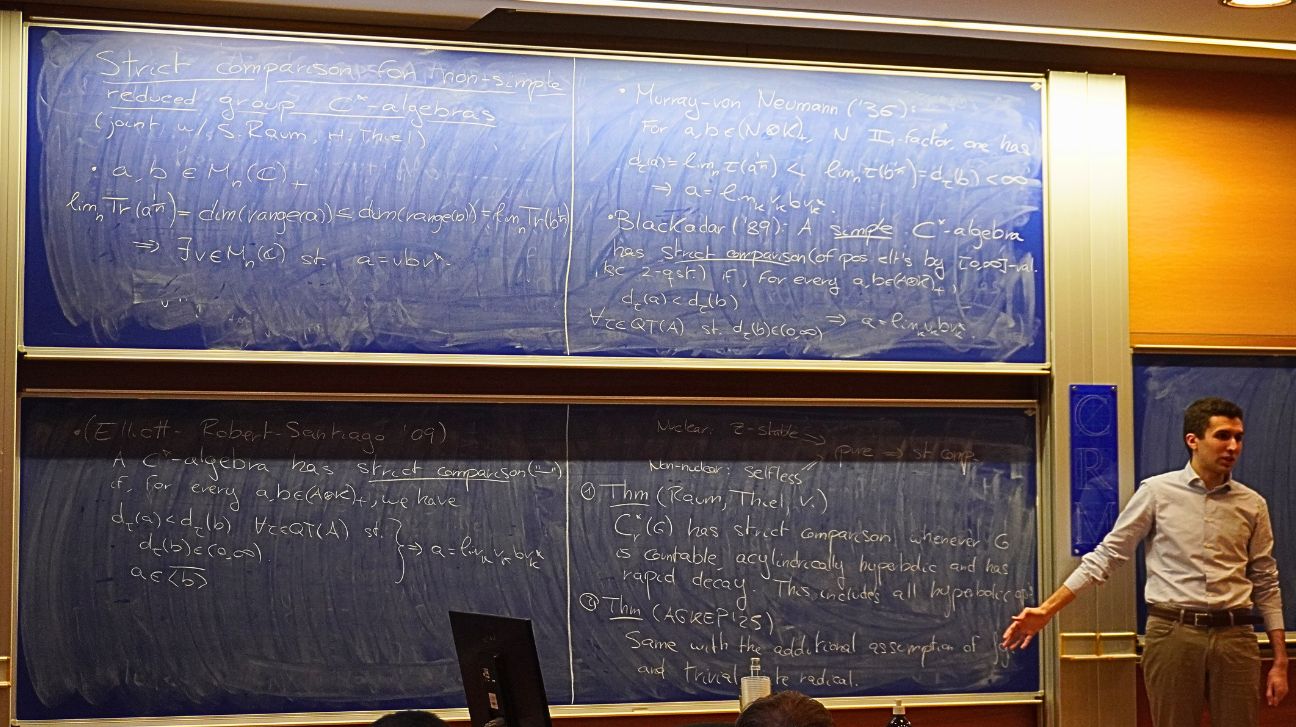
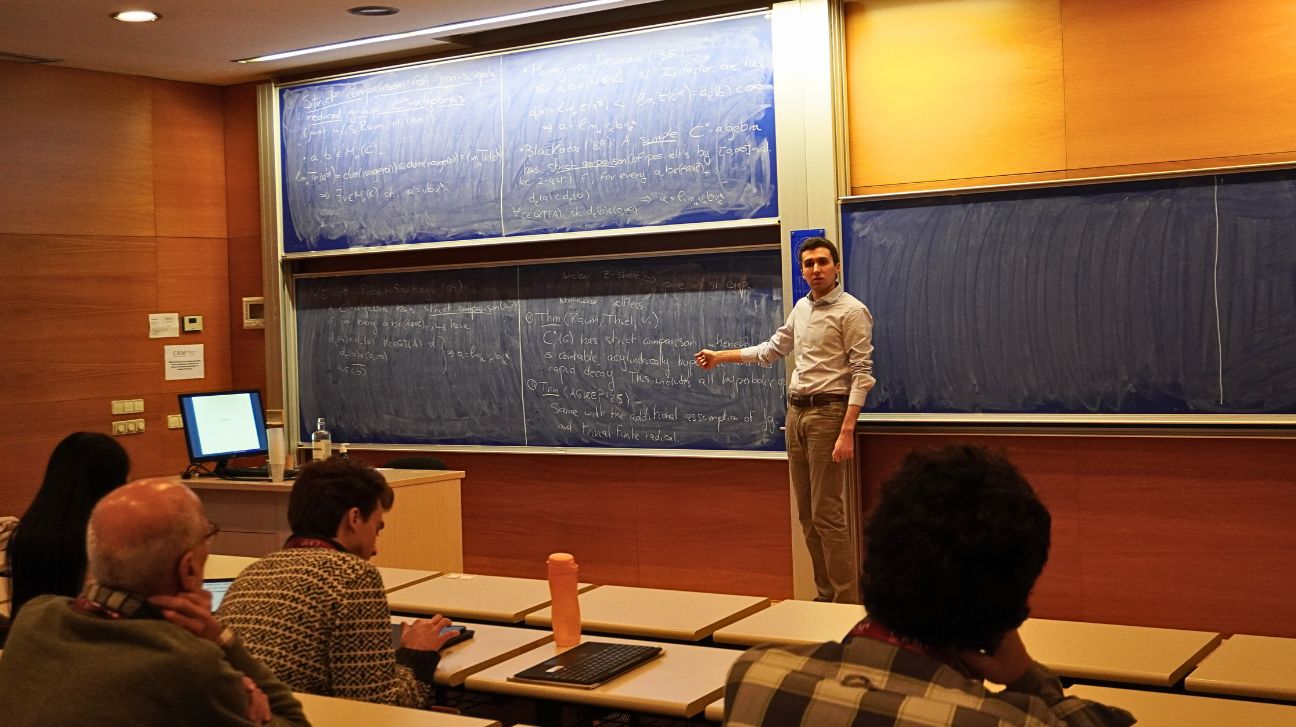
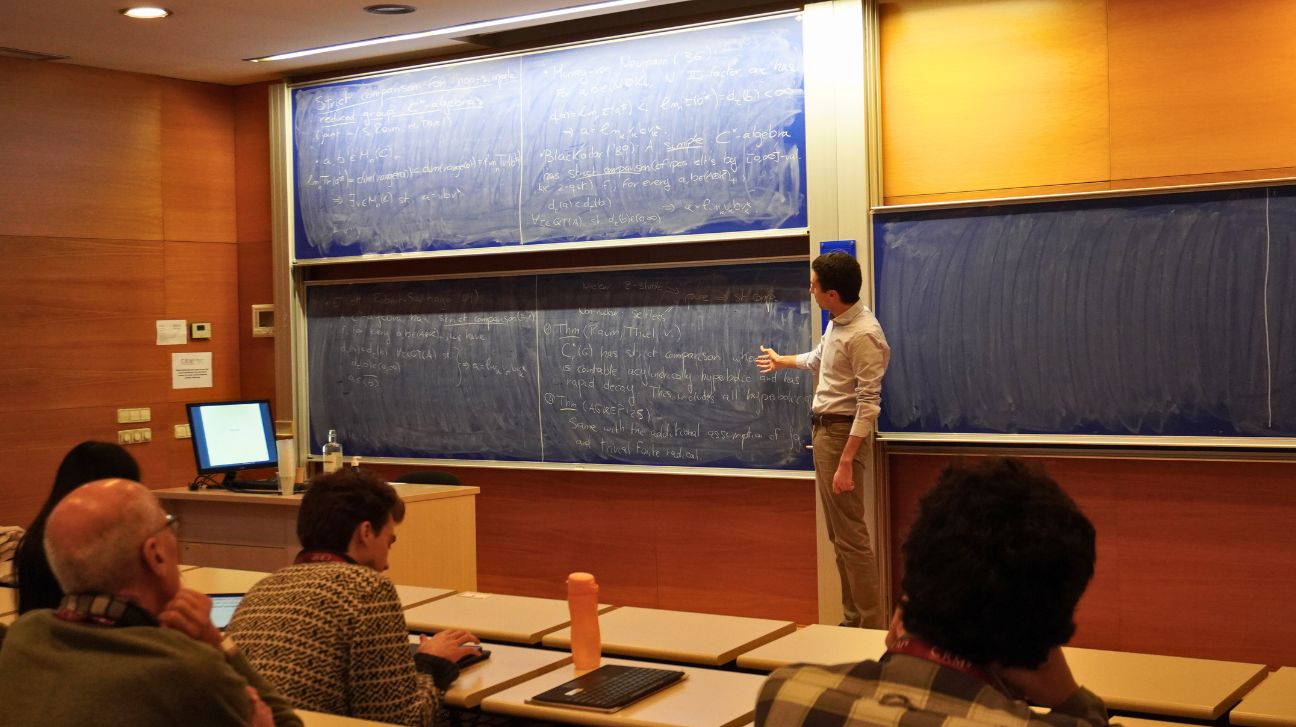
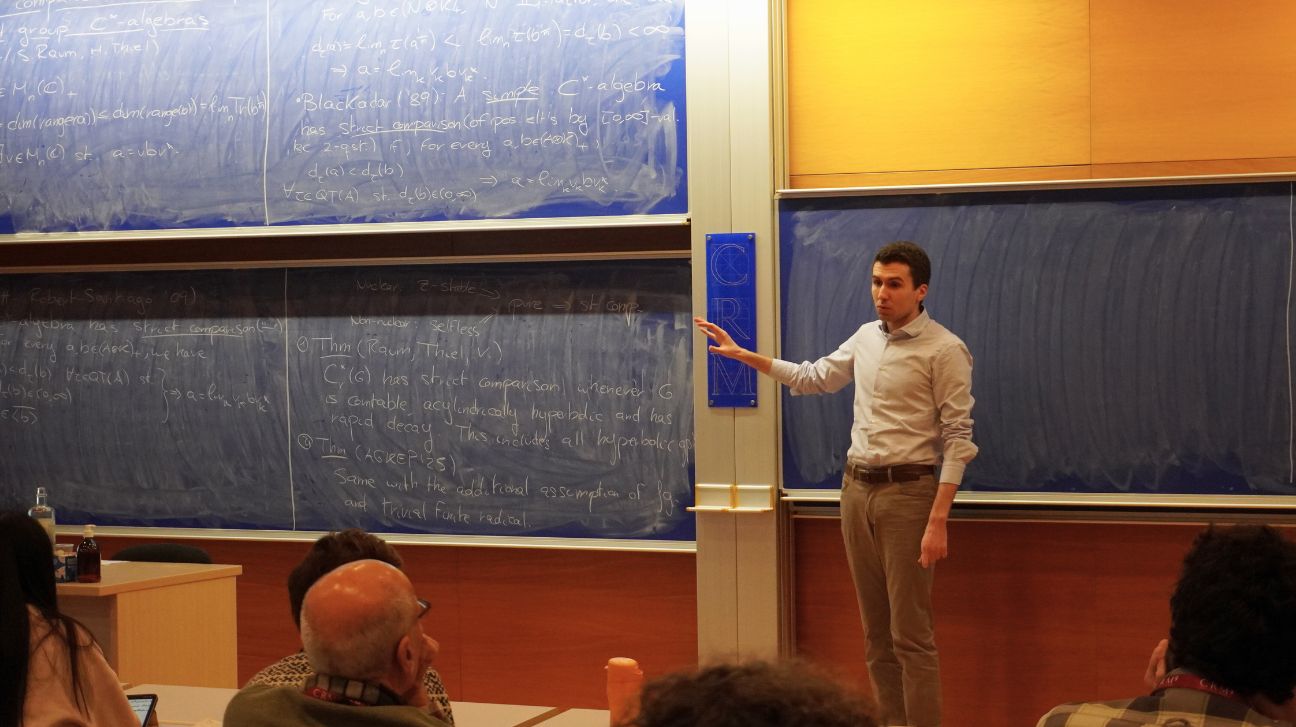
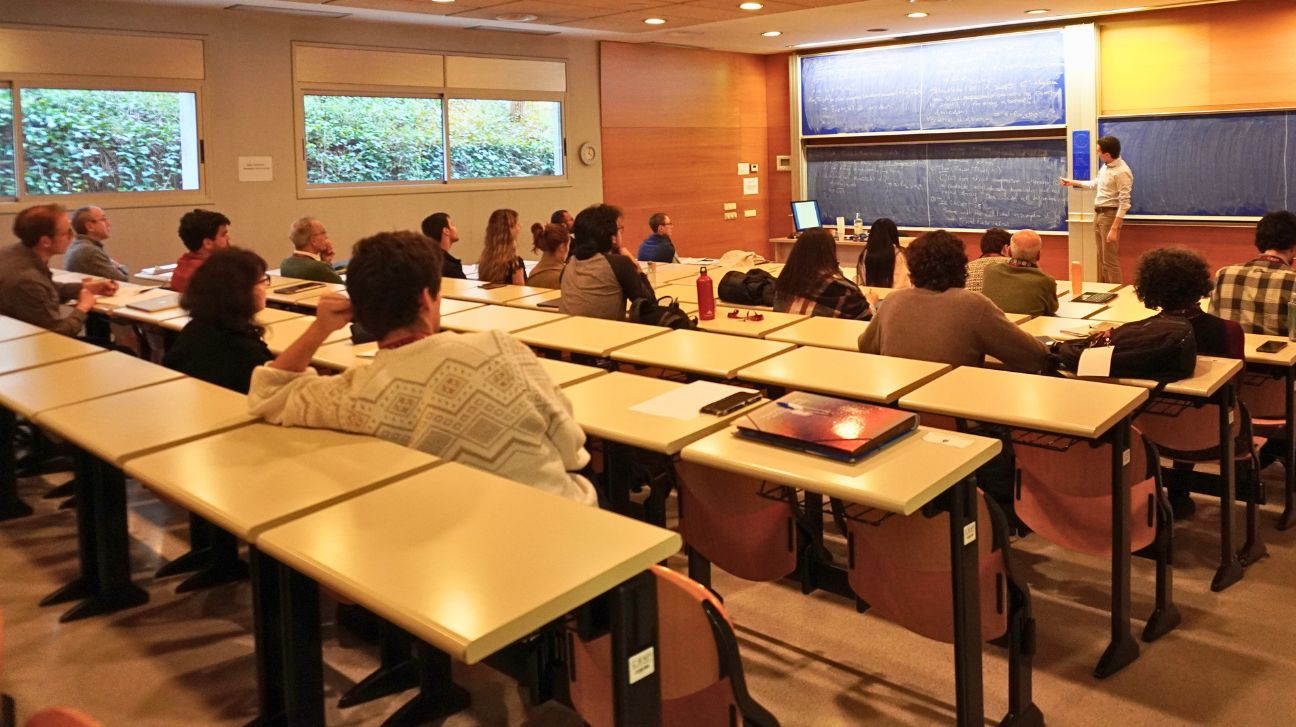
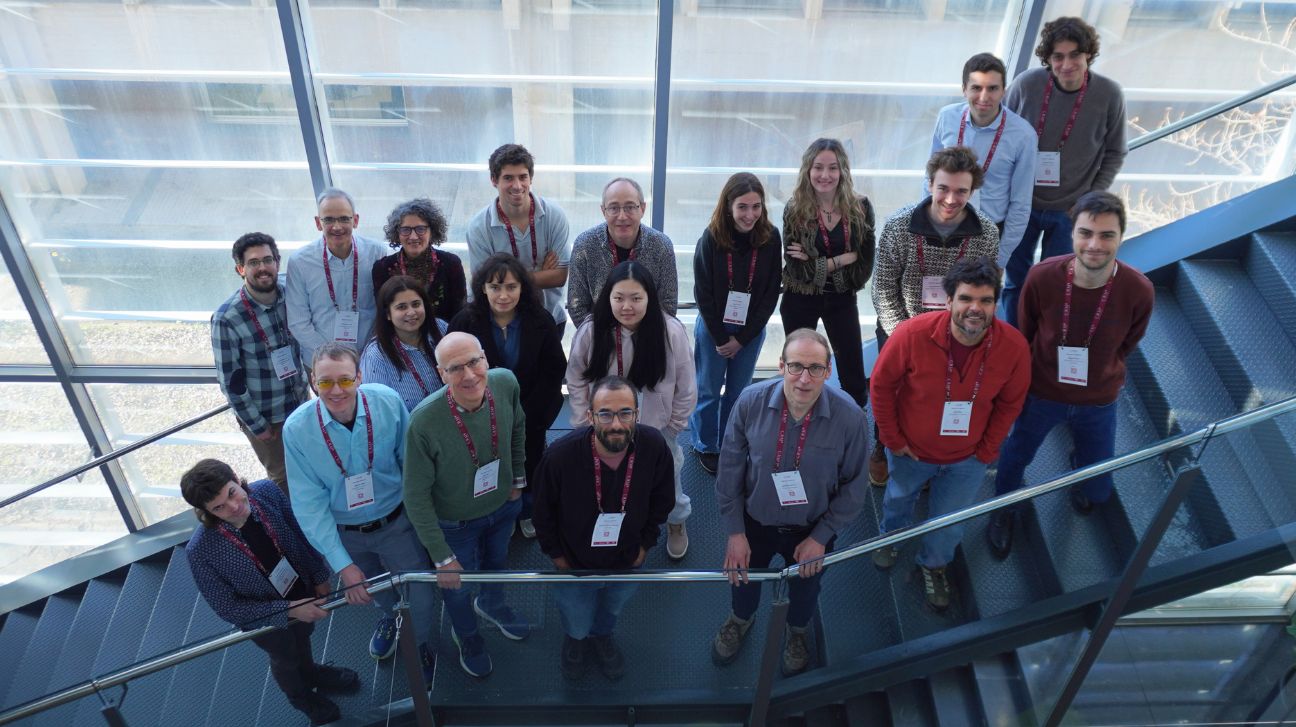
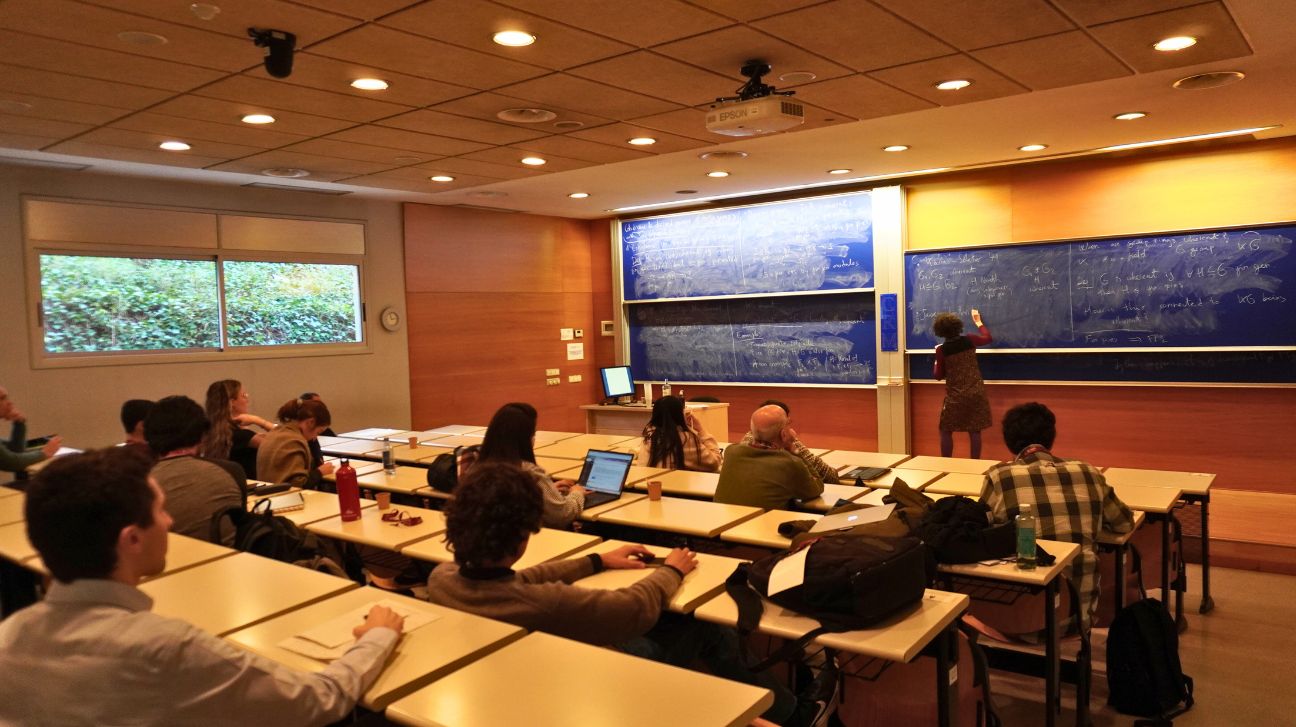
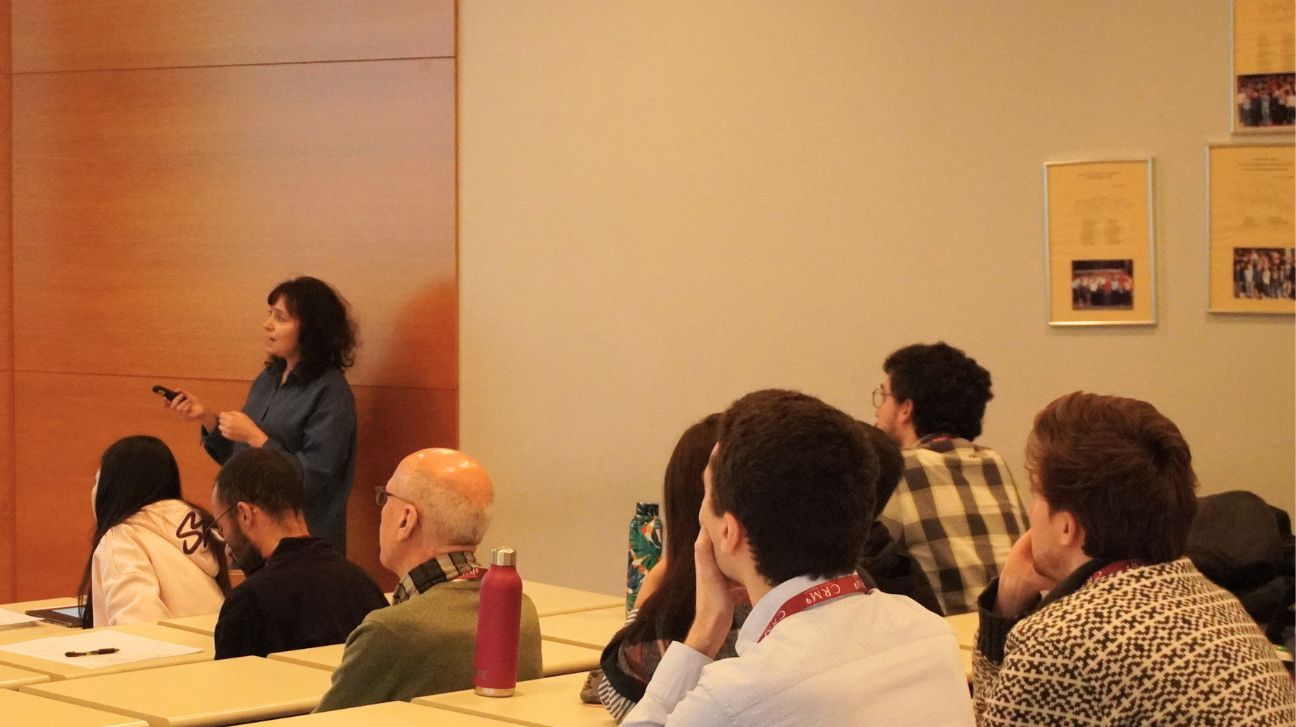
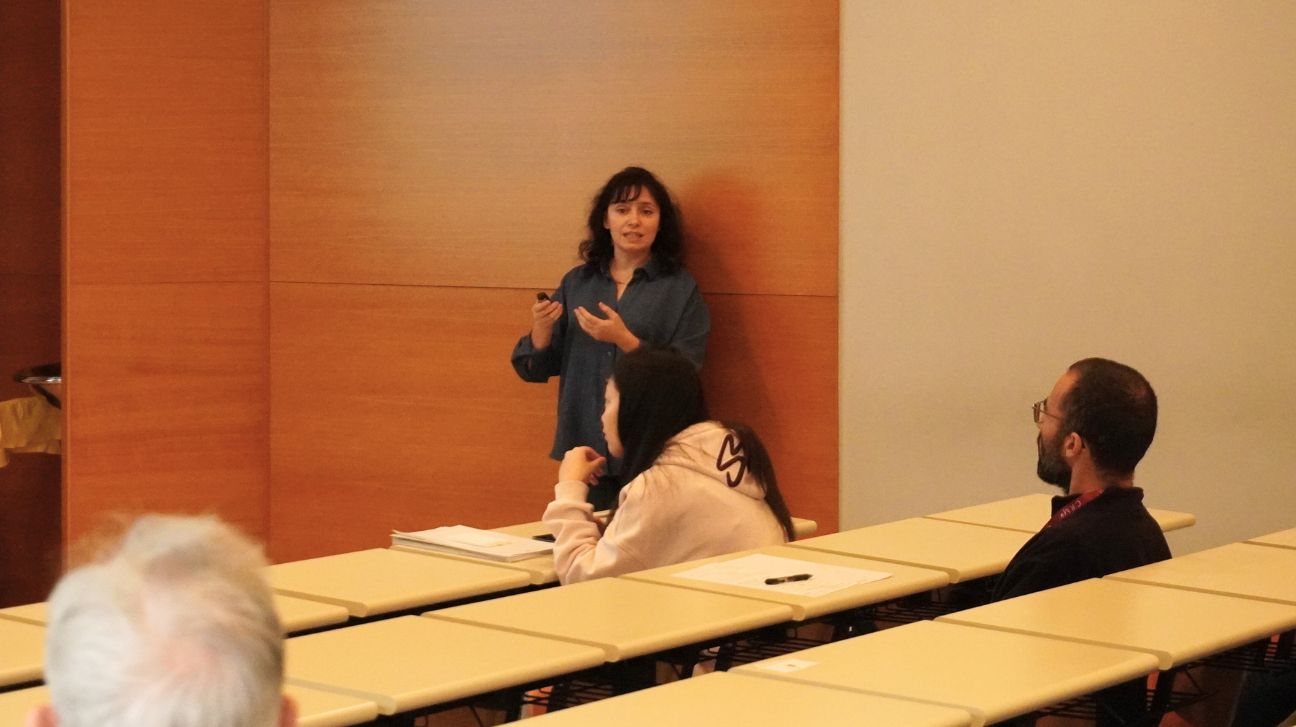
The 4th Barcelona Weekend on Operator Algebras, held at the CRM on January 30–31, 2026, brought together experts to discuss recent advances and open problems in the field. The event strengthened the exchange of ideas within the community and reinforced the CRM’s role as a key meeting point for research in C*-algebras and related areas.
The Centre de Recerca Matemàtica (CRM) hosted the 4th Barcelona Weekend on Operator Algebras on January 30–31, 2026. The meeting was devoted to the algebraic theory of operator algebras, with a particular focus on C*-algebras, their invariants, and their interactions with group theory, dynamics, and mathematical logic.
The aim of the event was to bring together international experts and early-career researchers to share recent advances, foster new connections between research lines, and further consolidate this workshop as a reference meeting point for the operator algebras community.
Talks and speakers
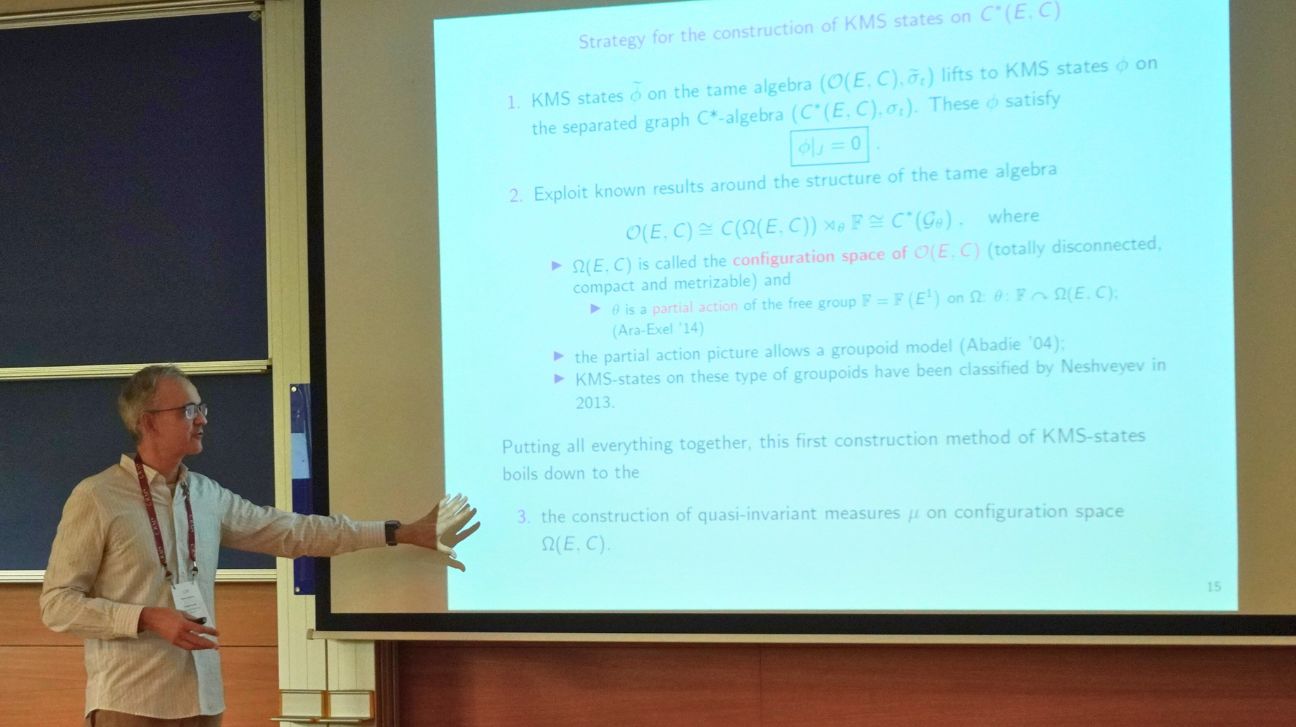
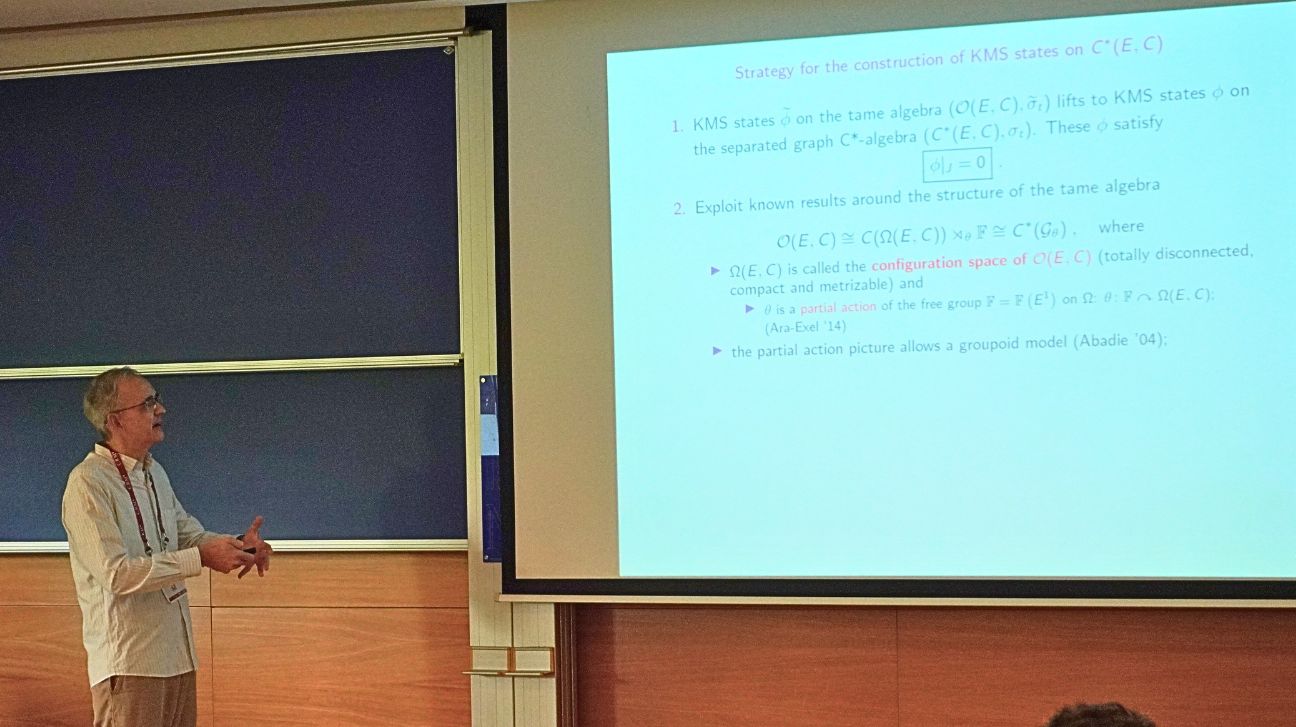
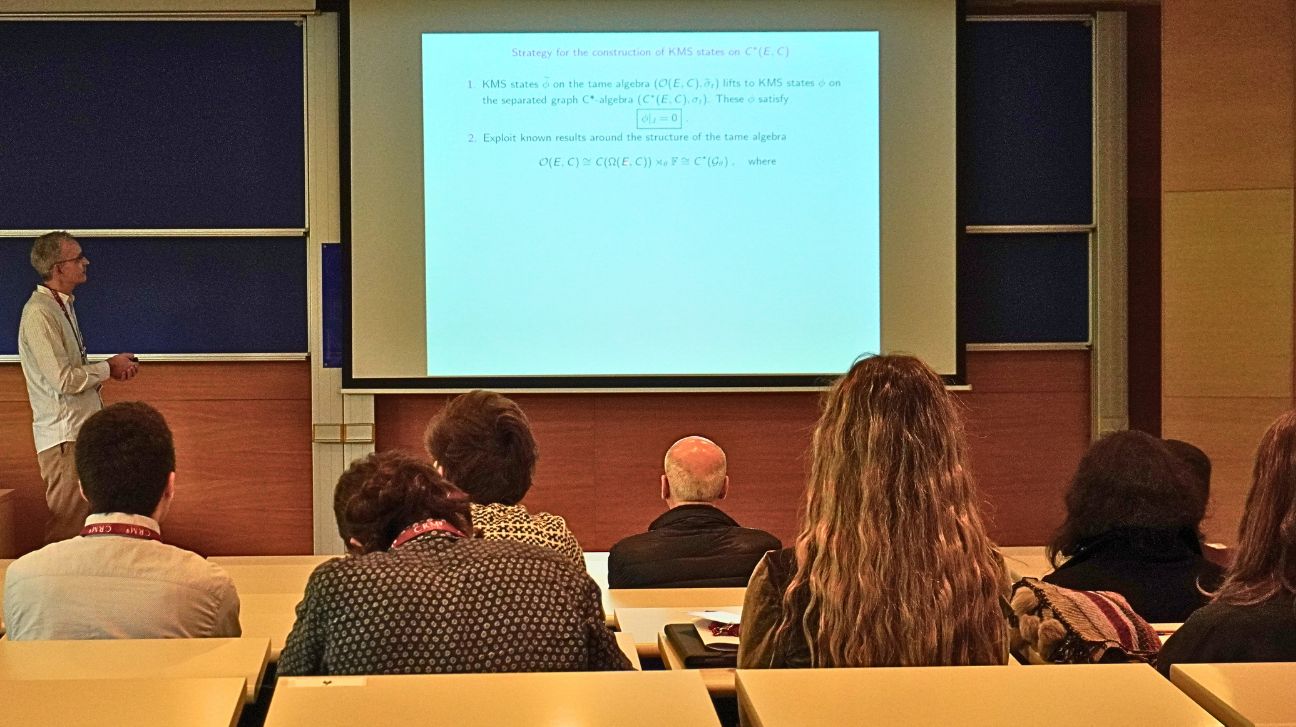
Fernando Lledó (Universidad Carlos III de Madrid) opened the program with KMS States for Separated Graph Algebras – I, introducing a measure-theoretic approach to equilibrium states and laying the conceptual foundations for the topic.
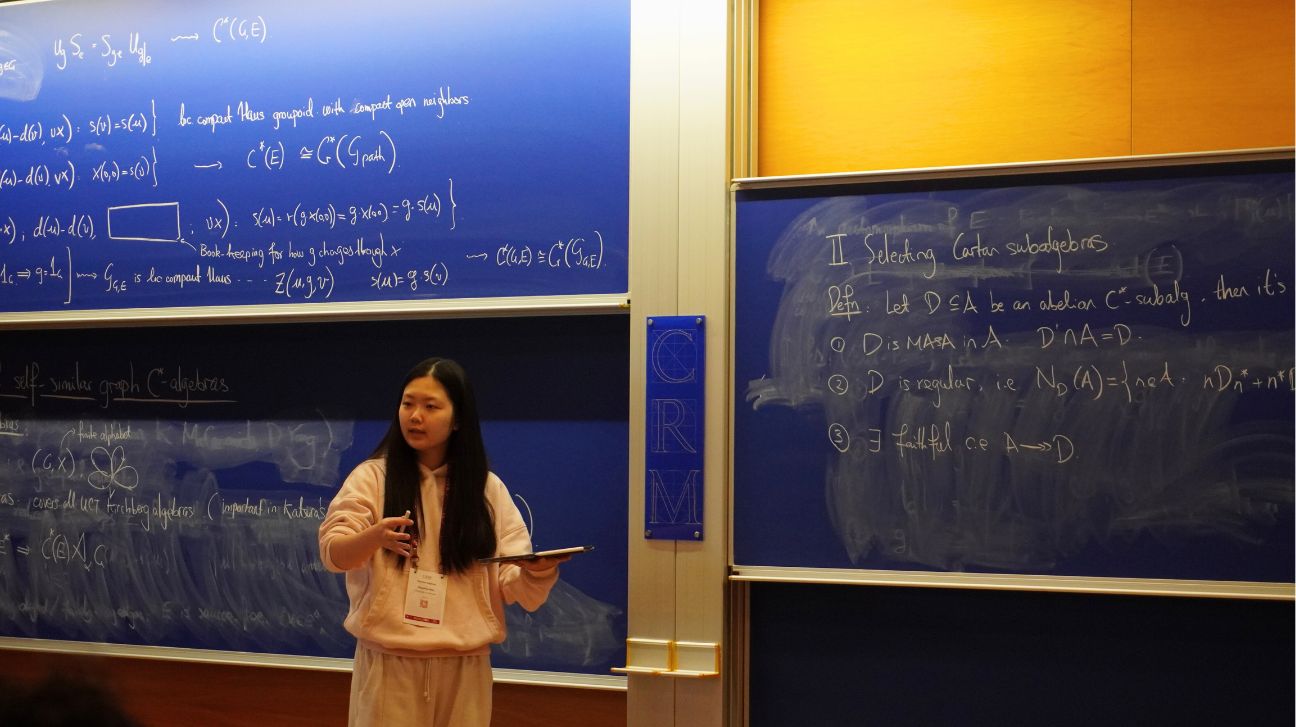
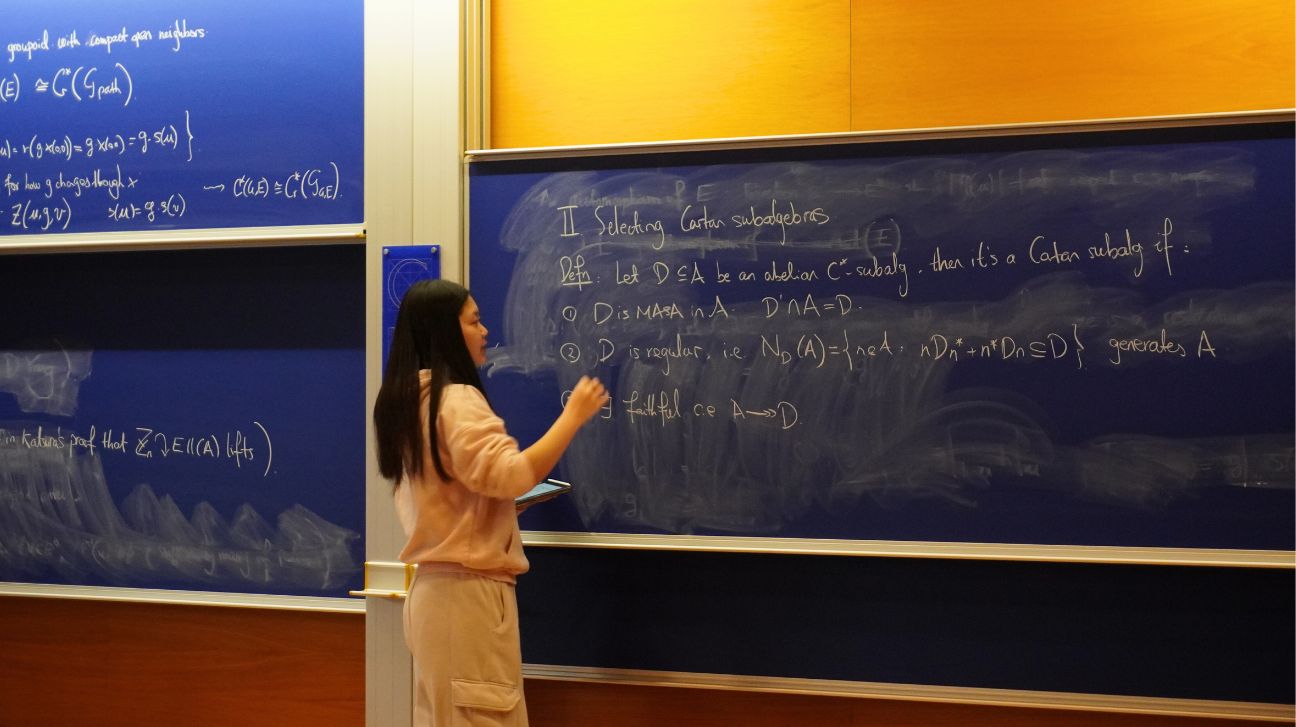
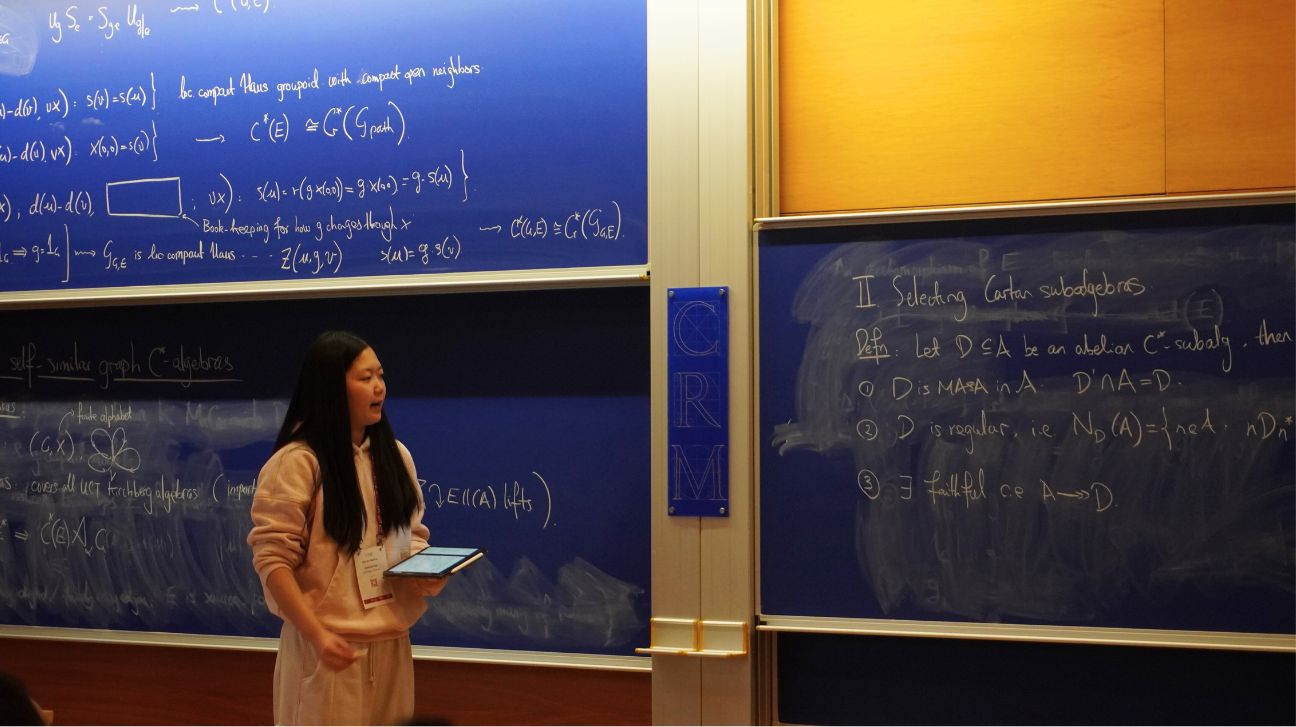
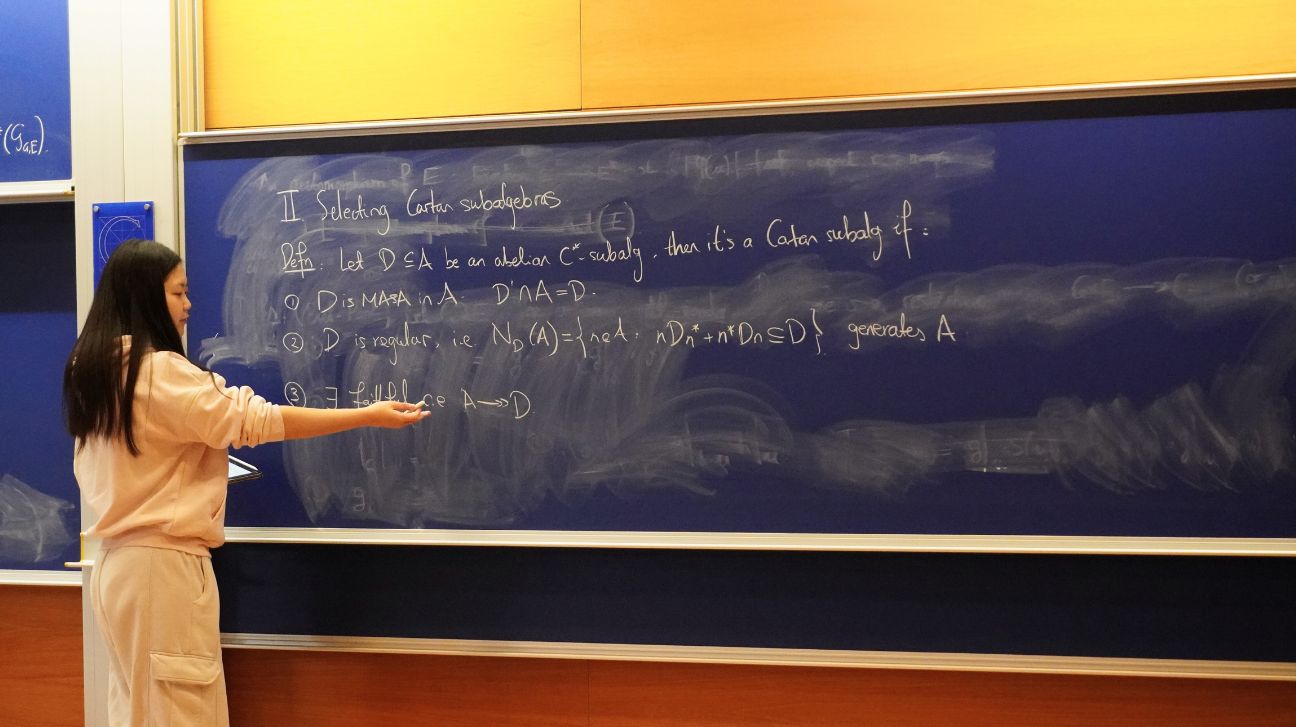
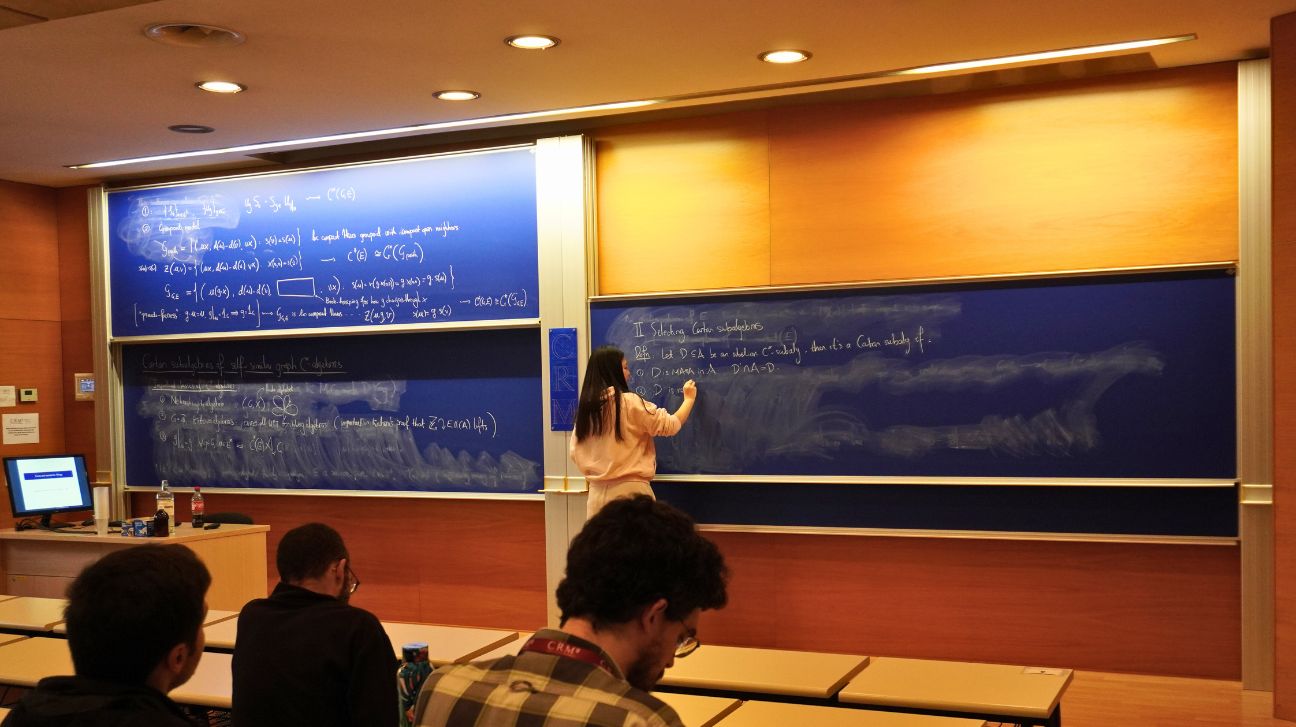
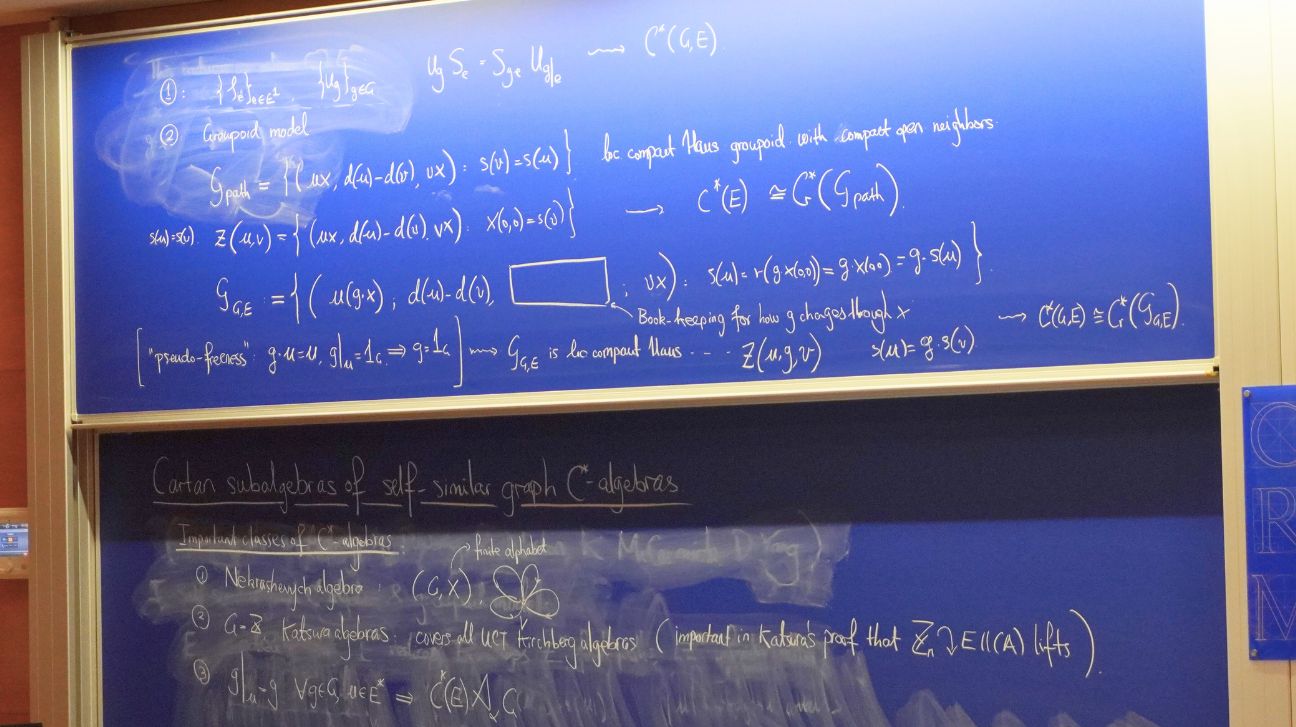
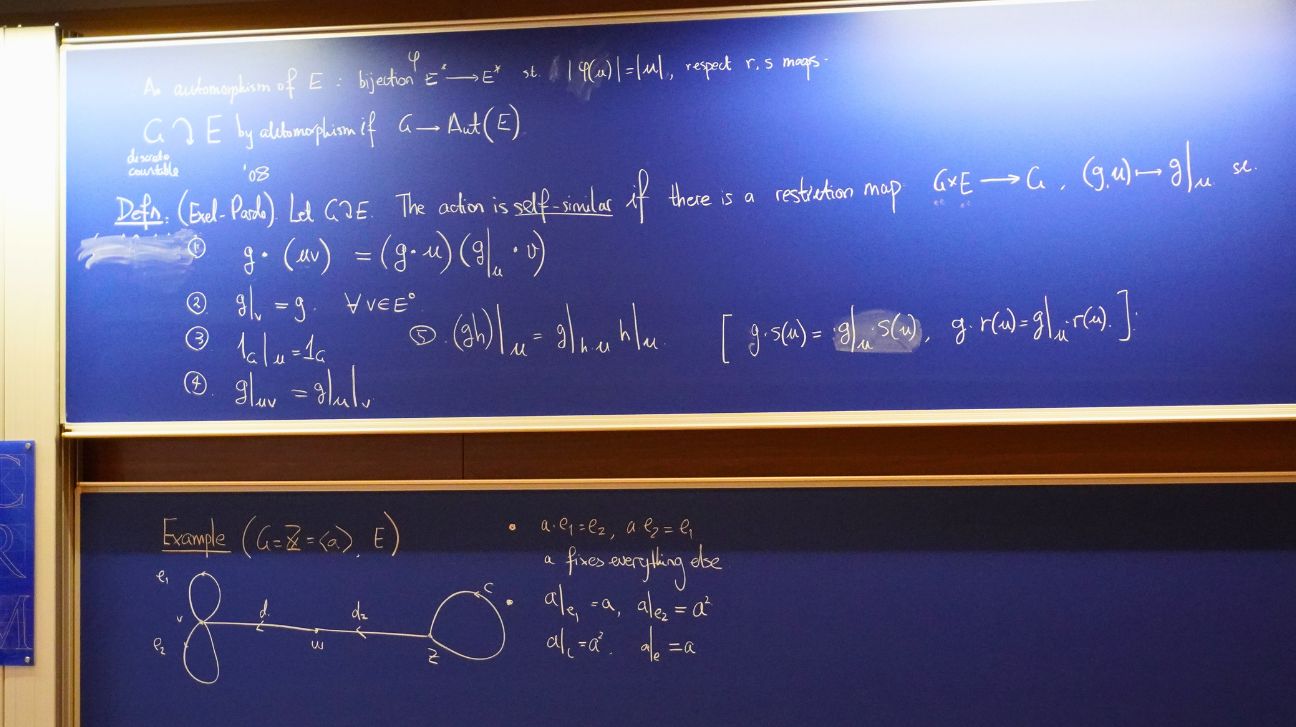
Shanshan Hua(University of Münster) examined Cartan Subalgebras of Self-Similar Graph Algebras, extending known descriptions beyond the locally faithful setting and constructing new groupoid models that recover part of the original self-similar dynamics.
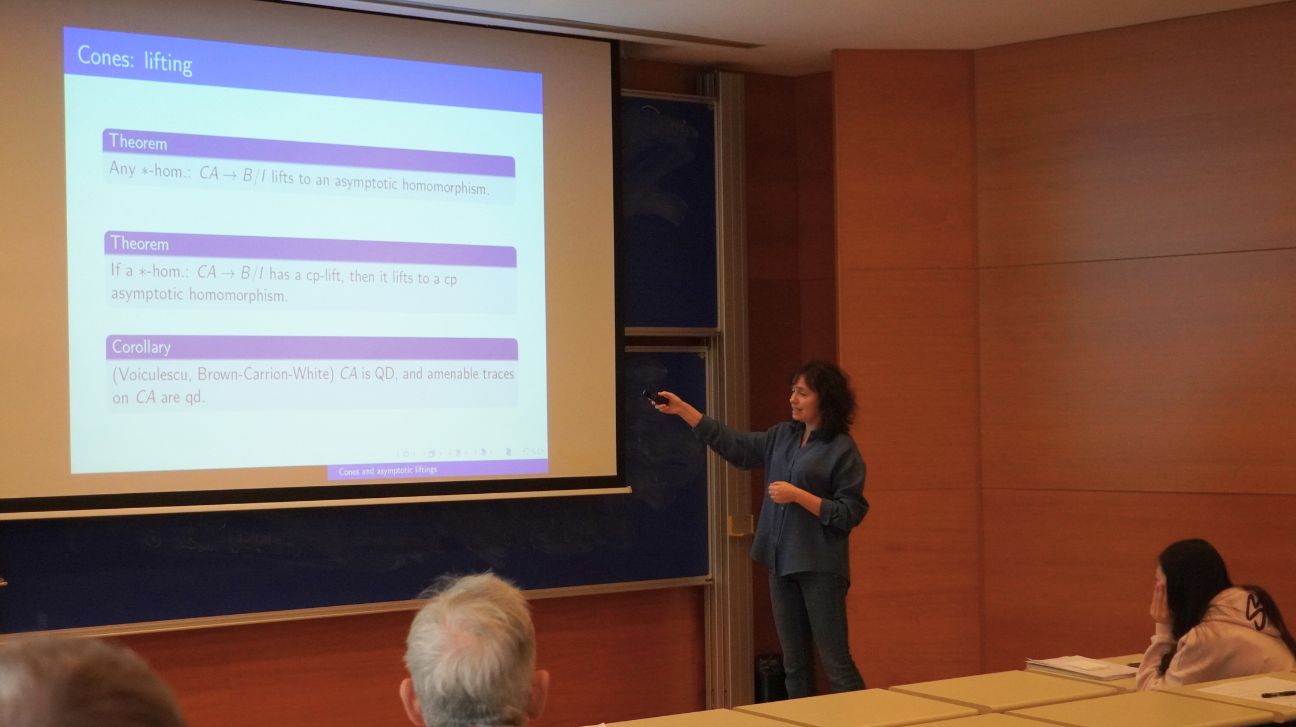
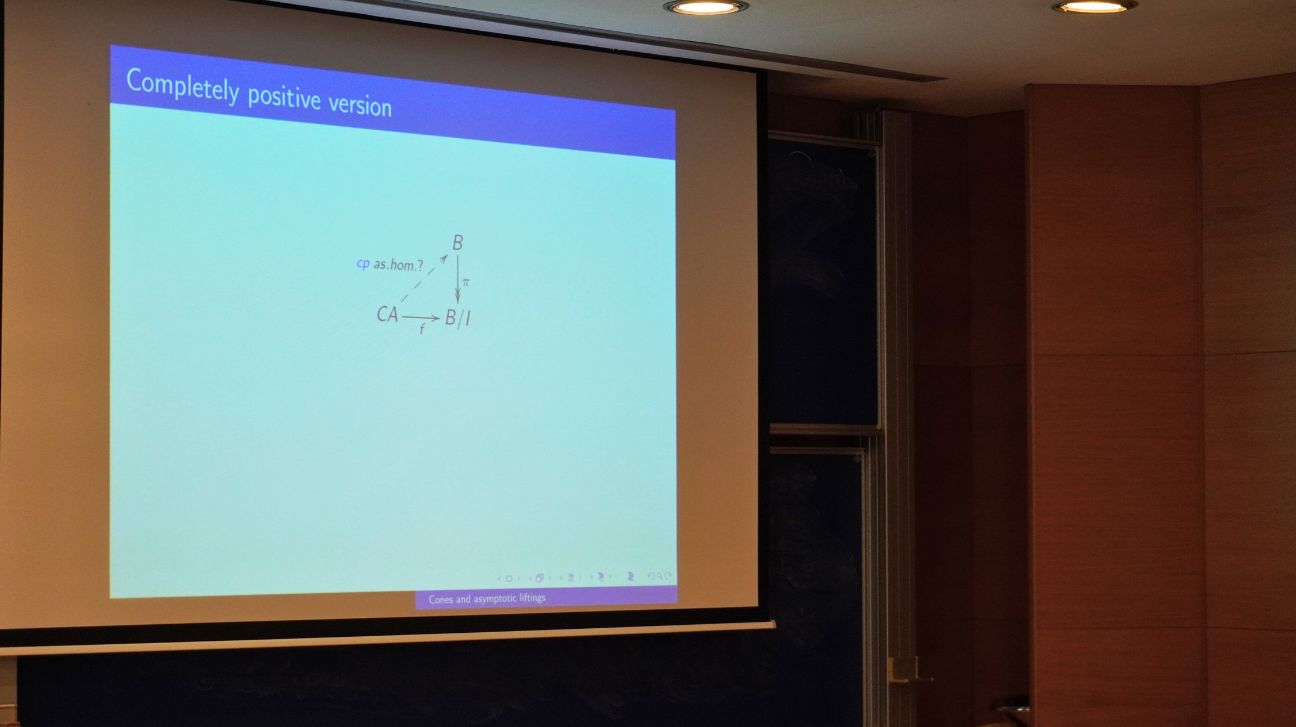
Tatiana Shulman (University of Gothenburg) spoke on Cones and Asymptotic Liftings, focusing on cone C*-algebras and analysing both established and new properties—such as quasidiagonality and homotopy invariance—and their role in understanding deep algebraic phenomena.
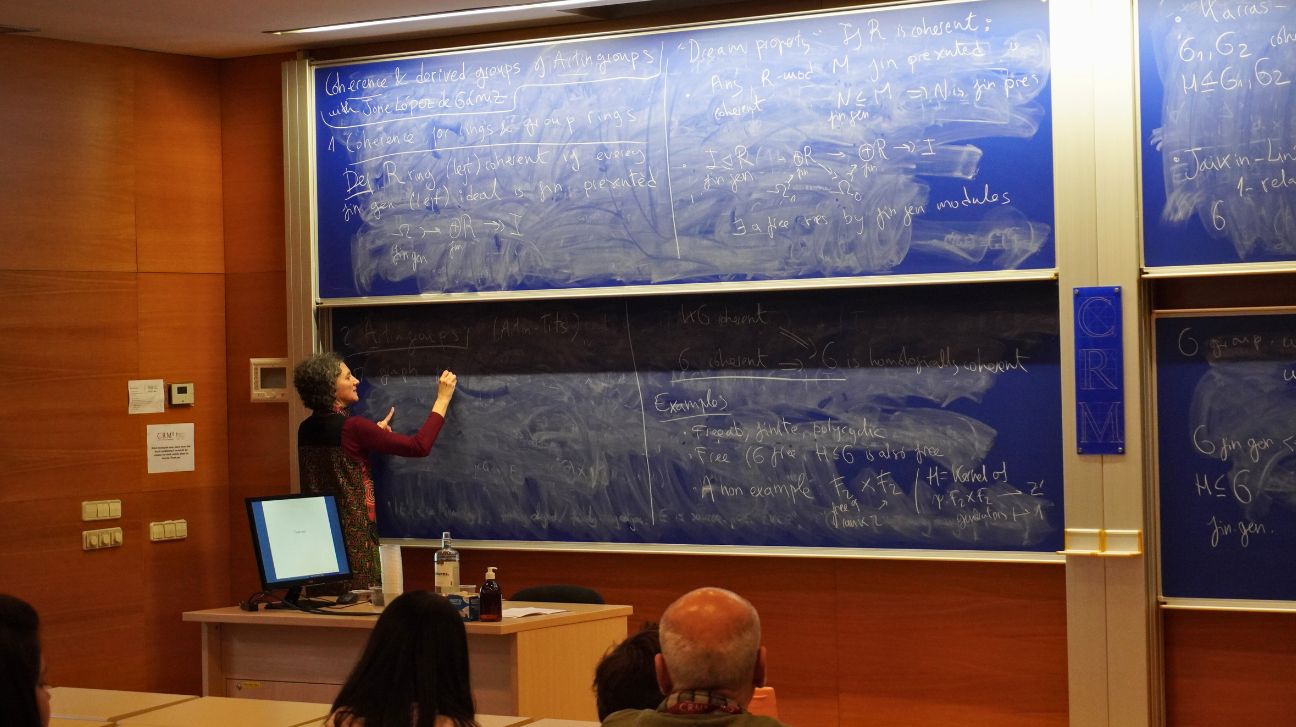
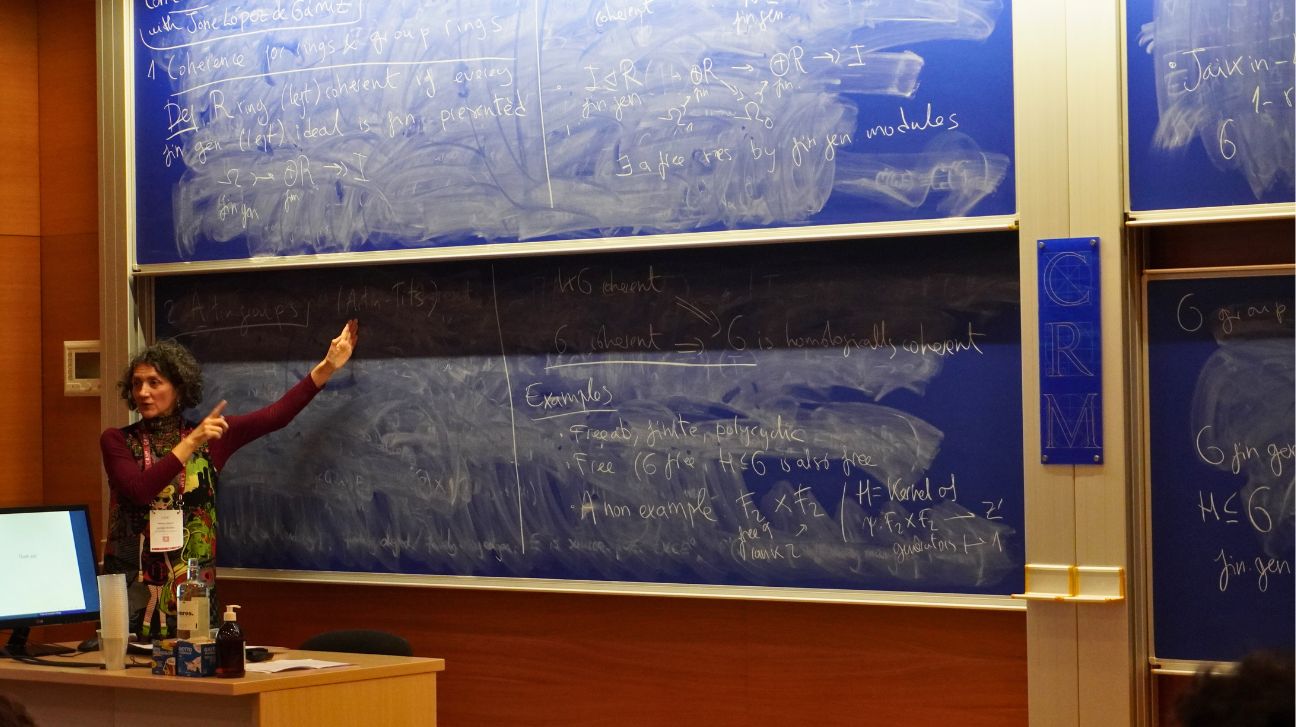
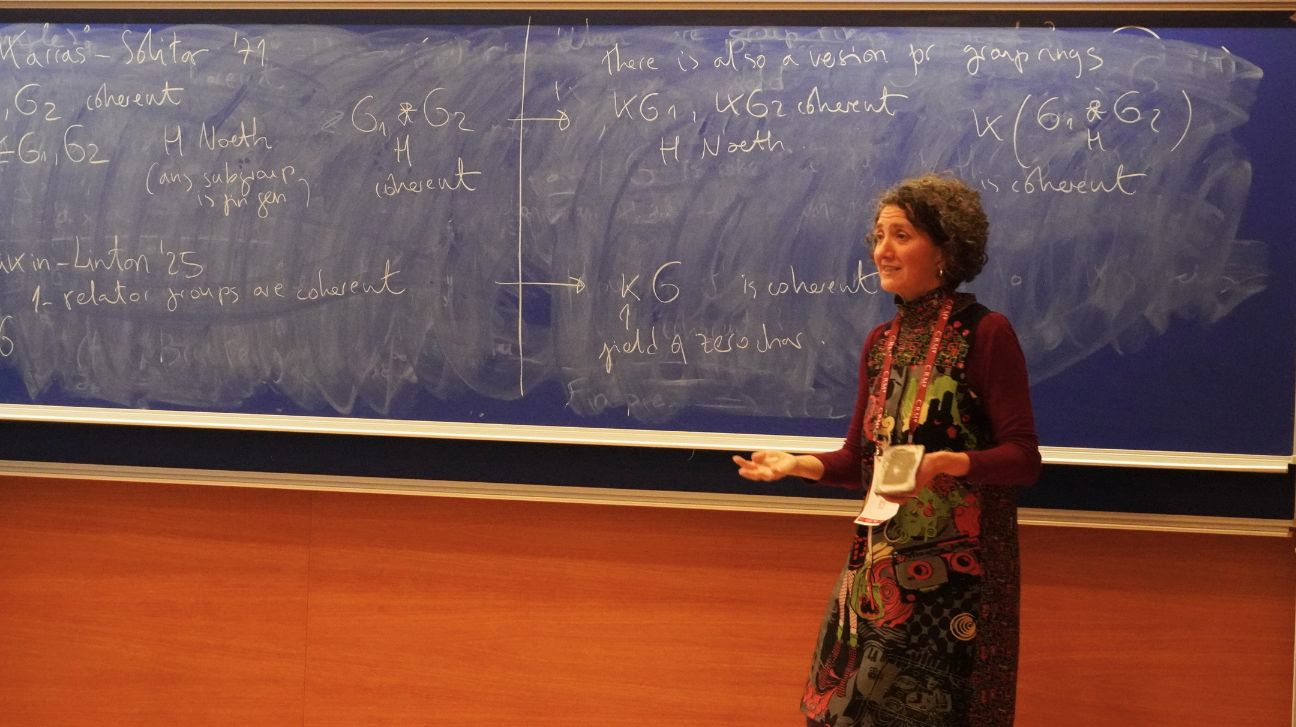
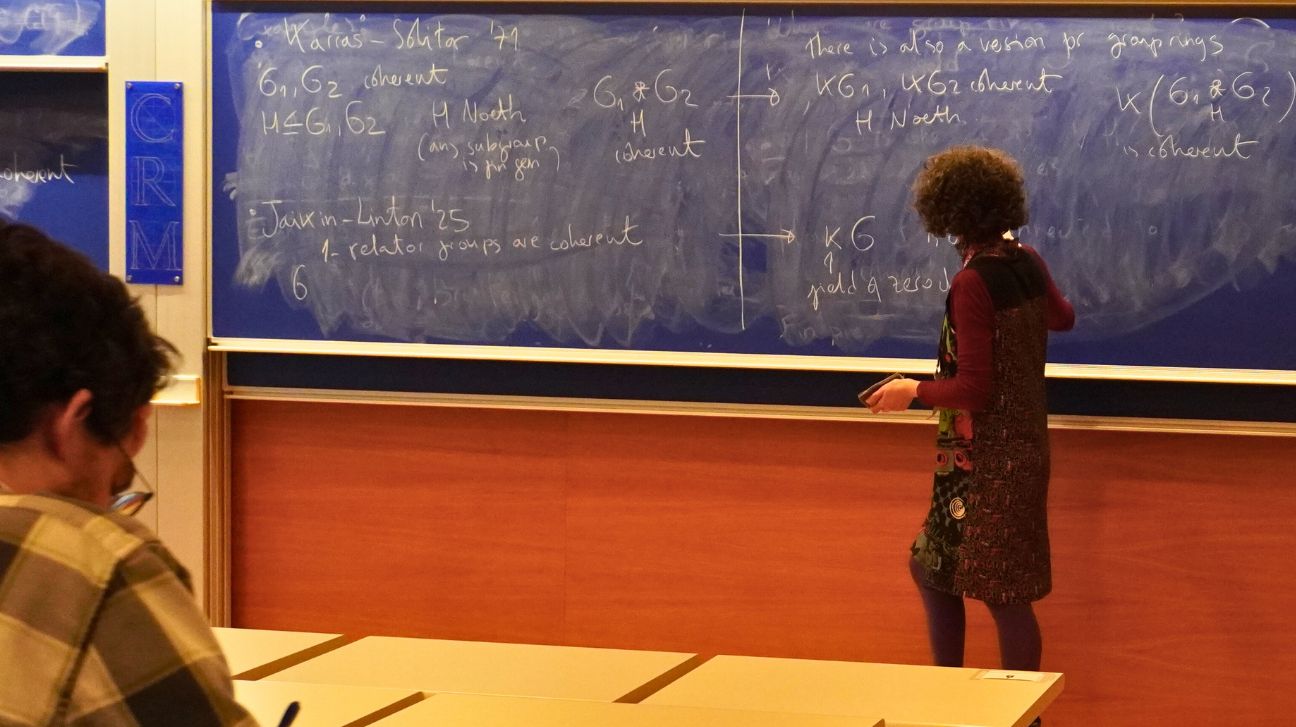
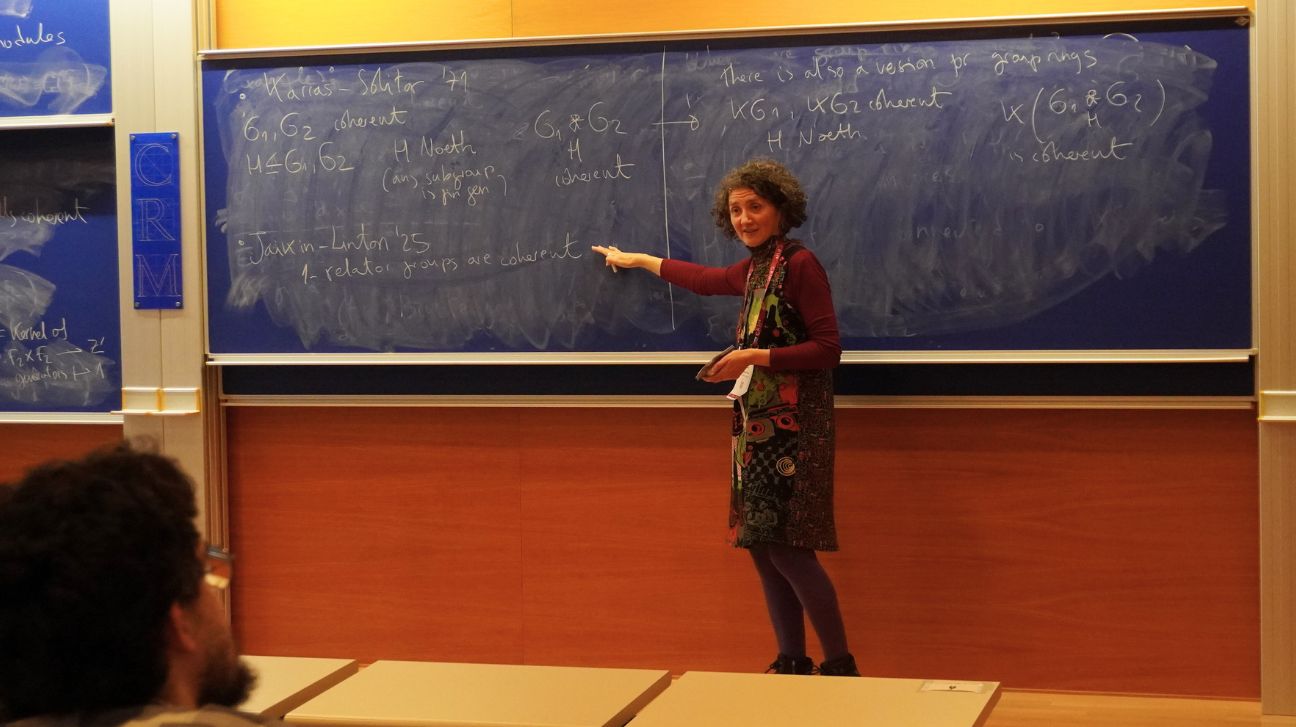
Conchita Martínez (Universidad de Zaragoza) addressed Coherence and Derived Groups of Artin Groups, showing that the characterization of coherence in terms of the derived group holds in full generality and discussing its still poorly understood relationship with the coherence of group rings.
Eduard Vilalta (Universitat Politècnica de Catalunya) presented Strict Comparison for Twisted Group C*-Algebras, highlighting recent progress on strict comparison and its versatility, with applications ranging from classification results to classical problems in group theory.
Guillem Quingles (Universitat Autònoma de Barcelona) focused on The Cuntz Semigroup of Rings of Continuous Functions on One-Dimensional Spaces, describing this invariant in terms of monoids of intervals and revealing notable differences between real-valued and complex-valued function rings.
Apurva Seth (University of Oxford) concluded the first day with The Radius of Comparison for Actions on Simple AH Algebras, constructing explicit actions of on simple C*-algebras that allow precise control of the radius of comparison before and after forming crossed products.
Joachim Zacharias (University of Glasgow) reported on AF-Embeddability for Decomposition Rank One Algebras, addressing key structural questions relevant to the classification program for C*-algebras.
Ben Bouwen (Czech Academy of Sciences) discussed Embeddings into the Ultrapower of the Jiang–Su Algebra, a central problem in the model theory of C*-algebras related to existential closure, showing that cones over separable C*-algebras embed into the ultrapower of the Jiang–Su algebra and proposing this embeddability as a new regularity property.
Joan Claramunt (Universitat Politècnica de Catalunya) closed the event with KMS States for Separated Graph Algebras – II, presenting a second method to construct KMS states for general separated graph C*-algebras and broadening the range of available techniques for studying these systems.
A space for mathematical exchange
The CRM is particularly pleased to have hosted this fourth edition of the Barcelona Weekend on Operator Algebras, which has strengthened its role as a high-level forum for scientific exchange, encouraged dialogue across different algebraic perspectives, and reinforced the ties of an active, diverse, and steadily growing international research community.
Subscribe for more CRM News
Stay updated to our mailing list to get the lastest information about CRM activities.
The 4th Barcelona Weekend on Operator Algebras, held at the CRM on January 30–31, 2026, brought together experts to discuss recent advances and open problems in the field.The event strengthened the exchange of ideas within the community and reinforced the CRM’s role…
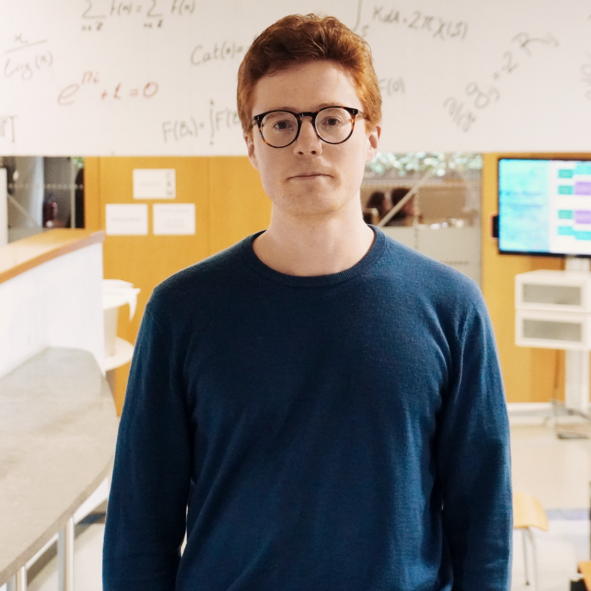
Ander Movilla has joined CRM as a Beatriu de Pinós postdoctoral fellow. Working with Tomás Alarcón, Movilla will develop mathematical models that capture not just the static architecture of DNA but its dynamic behaviour; how chromosome contacts shift as chemical marks…
A continuació podeu consultar la publicació dels criteris de priorització de les sol·licituds dels ajuts Joan Oró per a la contractació de personal investigador predoctoral en formació (FI 2026), dirigits a les universitats públiques i privades del…
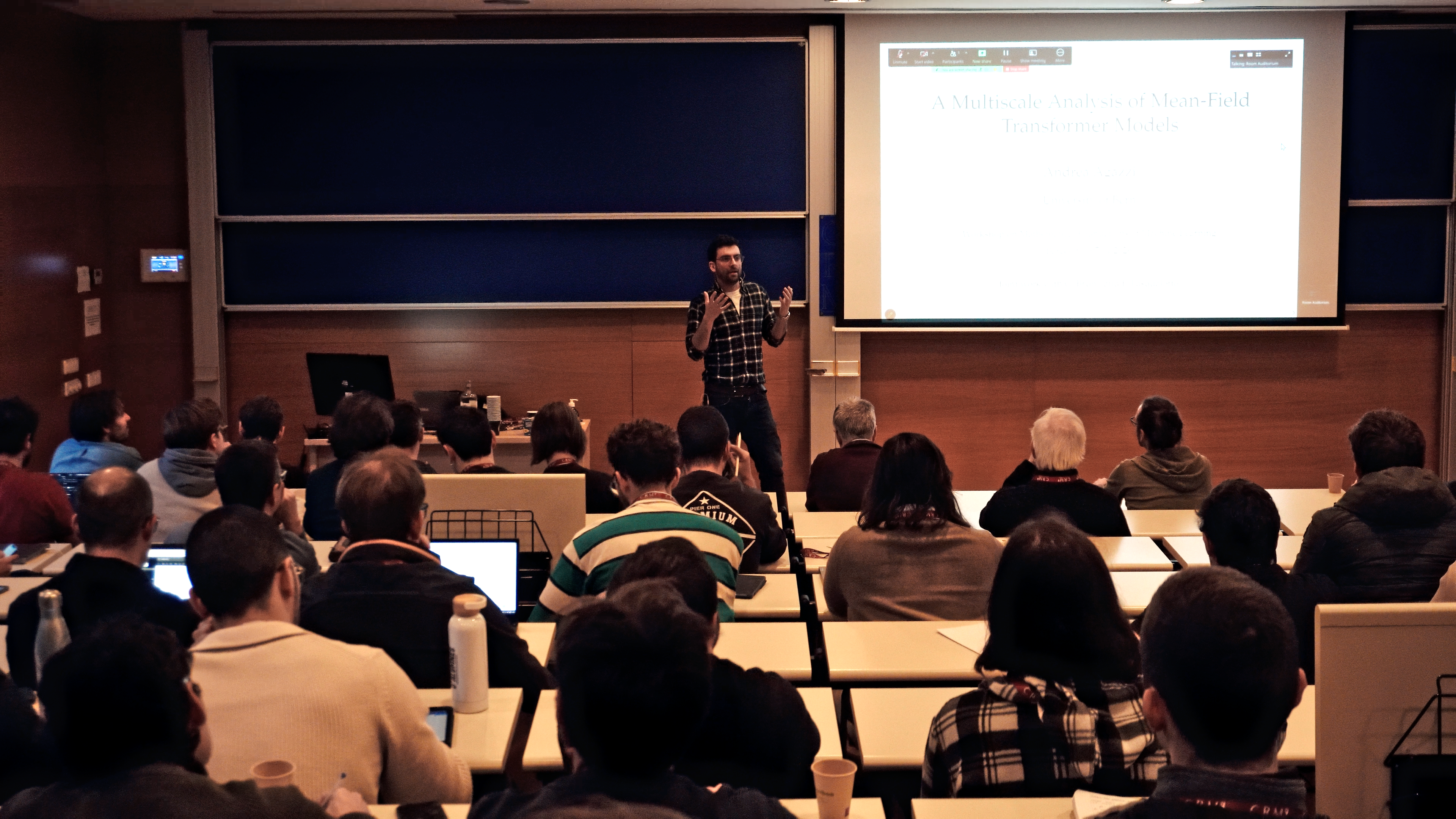
Over 100 researchers gathered at the Centre de Recerca Matemàtica to explore the mathematical foundations needed to understand modern artificial intelligence. The three-day workshop brought together mathematicians working on PDEs, probability, dynamical systems, and…
From 19 to 23 January 2026, the CRM hosted the 8th International Conference on the Anthropological Theory of the Didactic (CITAD 8), a leading international event in the field of didactics research that brought together researchers from different countries in…
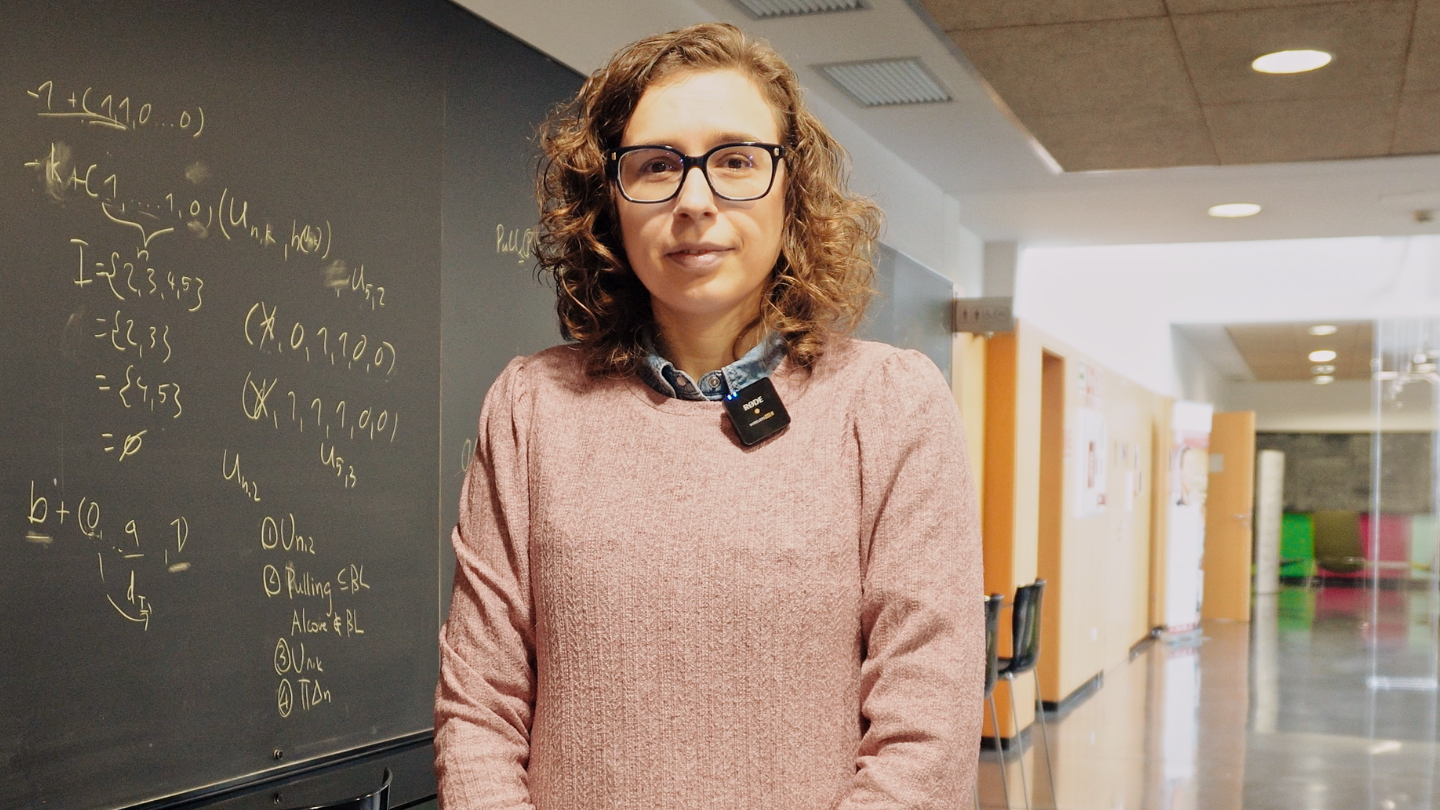
From October to November 2025, María Ángeles García Ferrero held the CRM Chair of Excellence, collaborating with Joaquim Ortega-Cerdà on concentration inequalities and teaching a BGSMath course on the topic. Her main research focuses on the Calderón problem,…
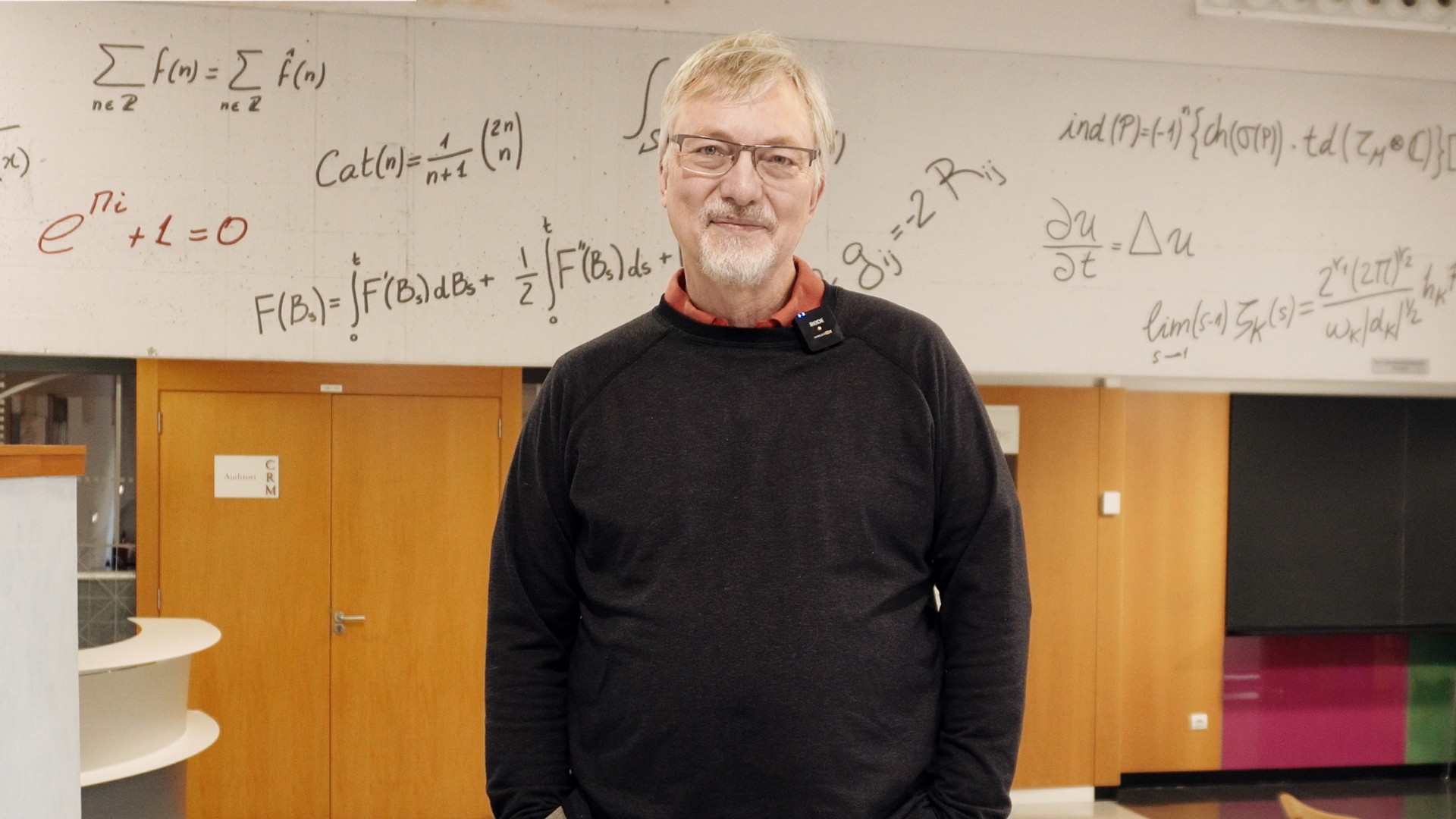
Brian Wetton, from the University of British Columbia, spent last October at CRM collaborating with Tim Myers on computational models for filtration systems. His career has evolved from pure numerical analysis to applied mathematics with industrial partners, working…
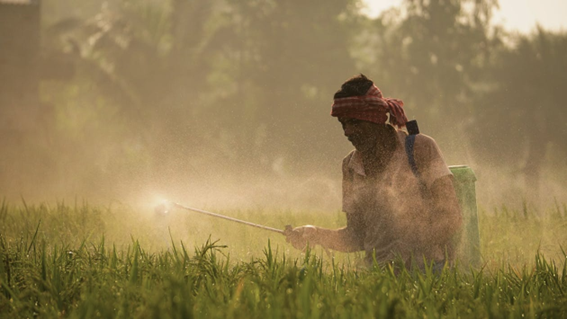
Researchers at the Centre de Recerca Matemàtica, in collaboration with IIT Kharagpur and UPC, have developed a mathematical model that accurately predicts the performance of fluoride-removal water filters made of mineral-rich carbon (MRC) and…
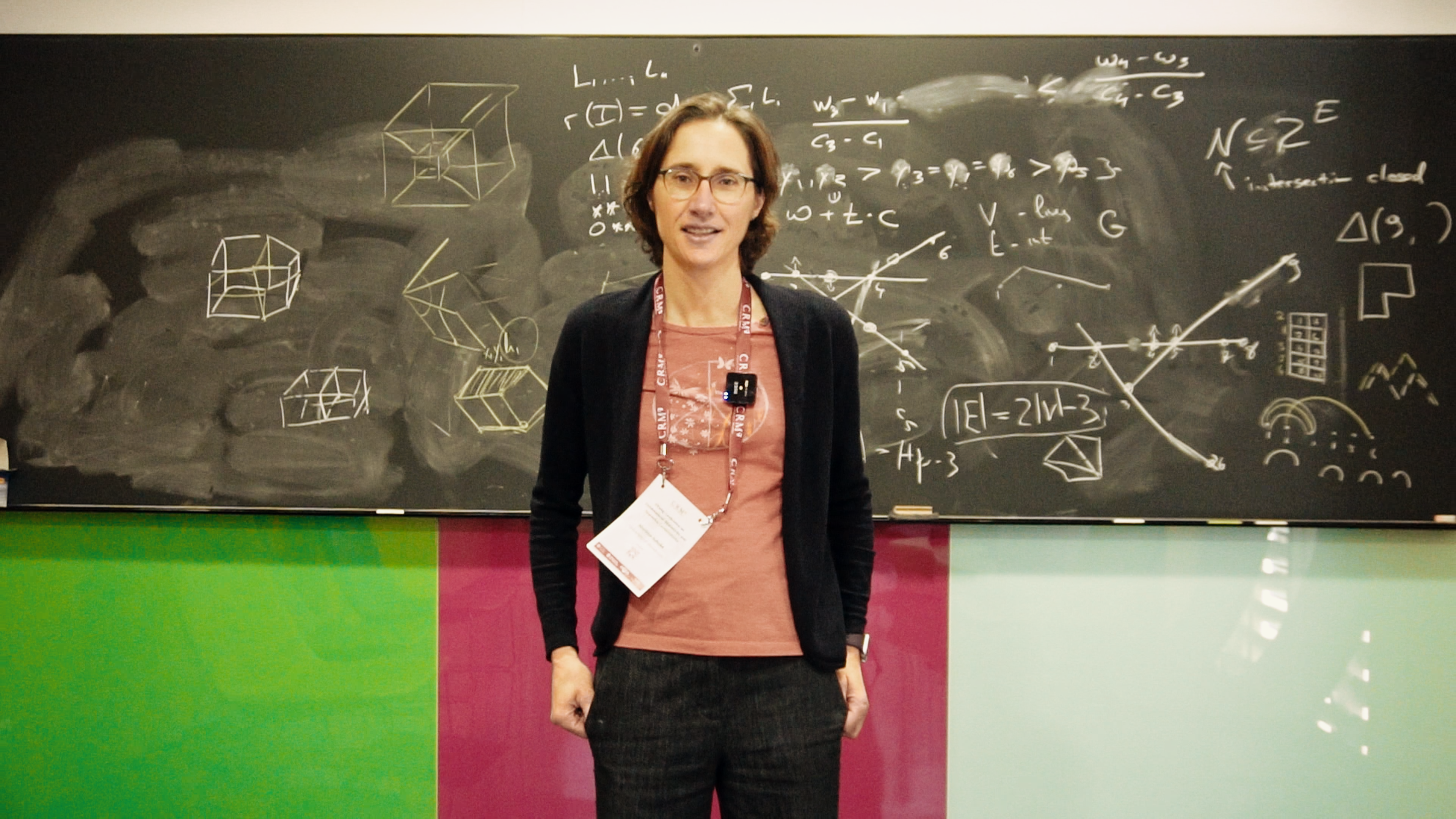
The Centre de Recerca Matemàtica recently hosted a research programme on Combinatorial Geometries and Geometric Combinatorics, focusing on the overlap between polytopes and matroids. Martina Juhnke, a member of the scientific committee, reflects on how this programme…
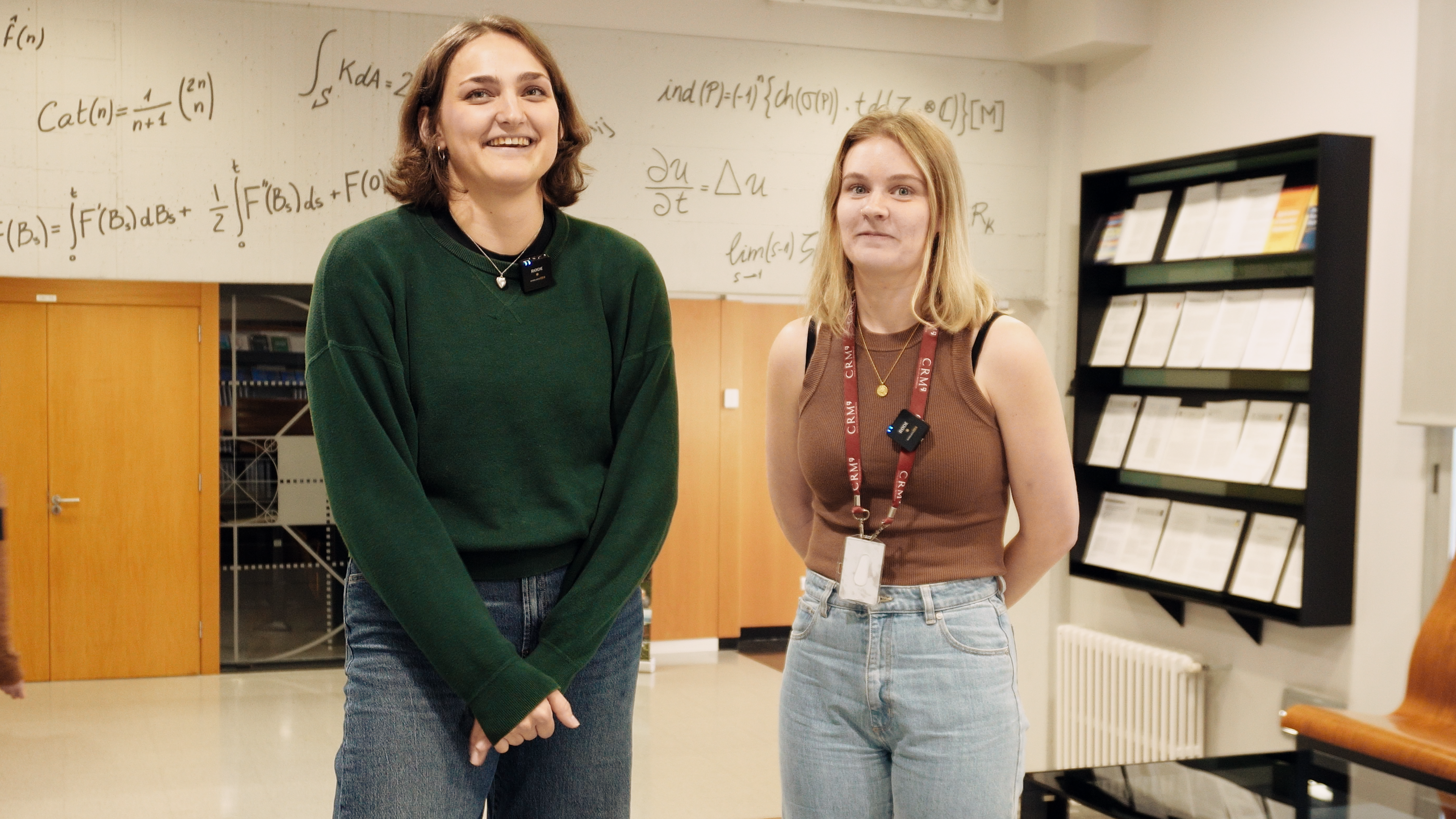
In October 2025, the Centre de Recerca Matemàtica hosted Josefine Meyer (ISTA) and Cate MacColl (University of Queensland) for a month-long research stay following their participation in the BAMB! Summer School. Despite studying vastly different subjects, from…
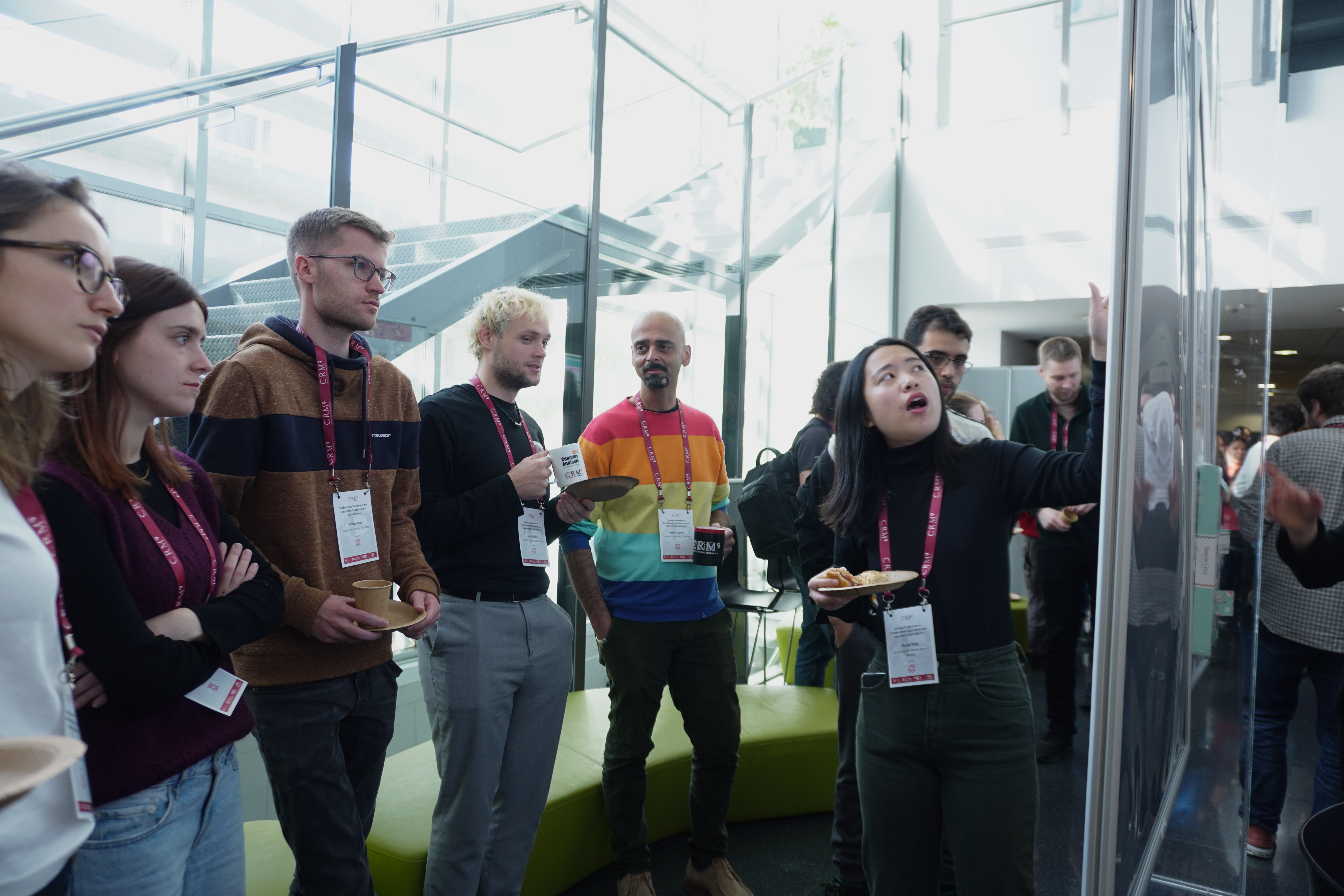
During five days, the CRM hosted the Closing Conference of the MDM Focused Research Programme on Combinatorial Geometries & Geometric Combinatorics. The event featured plenary talks, contributed sessions, and posters on topics from matroids and polytopes to…
ICREA professor at the Universitat de Barcelona and CRM affiliated researcher Xavier Ros-Oton appears on Clarivate’s Highly Cited Researchers 2025 list, which this year reinstates the mathematics category after two years of exclusion.Citations are a strange way to…
The Barcelona Techno Weeks are a series of events that focus on a specific technological topic of interest for both academia and industry. These events include keynote presentations by world experts, networking activities, and a comprehensive course on solid state radiation detection. CERN and ICCUB organized three editions of the Techno Week in the past, which focused on semiconductor radiation detectors in 2016, 2018, 2021 and 2023.
Course on semiconductor detectors
The core of the 8th Techno Week is a comprehensive in-person course on solid state radiation detection, which covers topics such as the physics of interaction of radiation with matter, signal formation in detectors, different solid state radiation and photon detection technologies, detector analog and digital pulse processing readout circuits, detector packaging and advanced interconnect technologies and the use of radiation and photon detectors in scientific and industrial applications. The event also includes a participant poster session, presentations from industry professionals and a series of laboratories and social events.
The next edition will take place from the 13th to the 17th July 2026 and it will be in-person. The course is divided into four sections: Sensors and Interconnects, Microelectronics, Detector Technologies, and Applications.
Objectives
Explain fundamentals of interaction of radiation with matter and signal formation.
Understand different solid state radiation and photon detection technologies (including monolithic sensors, CMOS imagers, SPAD sensors, etc).
Review detector analog and digital pulse processing readout circuits (with emphasis in microelectronics and ASIC design).
Provide an insight of packaging and advanced interconnect technologies (hybrid sensors, 3D integration, etc).
Survey the use of radiation and photon detectors in industrial applications.
Present new trends in radiation and photon detection.
In addition to the lectures from experts, the event includes a participant poster session and presentations from industry professionals combined with a series of laboratories and social events.
Who it is aimed at
The event is aimed at researchers, postdocs, PhD students, and industry professionals working in fields such as particle detectors, astronomy, space, medical imaging, scientific instrumentation, material analysis, neutron imaging, process monitoring and control. It offers a good opportunity for young researchers to meet with senior experts from academia and industry.
Lecturers
Gerard Ariño-Estrada (IFAE)
Rafael Ballabriga (CERN)
Marco Carminati (Politecnico di Milano)
Edoardo Charbon (EPFL)
Perceval Coudrain (CEA)
David Gascón (ICCUB)
Alberto Gola (FBK)
Sergio Gómez (UPC)
Carlos Granja (Advacam, VSB-TU Ostrava)
Daniel Hynds (U. of Oxford)
Boris Korzh (U. Geneva)
Carla Marin (ICCUB)
Andrei Nomerotski (CTU)
Angelo Rivetti (TIFPA and INFN Torin)
Dennis Schaart (TU Delft)
Francesc Serra (CNM)
Walter Snoeys (CERN)
Renato Turchetta (IMASENIC)
Organization Team
Scientific Organizing Committee
Rafael Ballabriga (CERN), Co-Chair
David Gascón (ICCUB-IEEC), Chair
Sergio Gomez (Serra Hunter- UPC)
Daniel Guberman (ICCUB)
Joan Mauricio (ICCUB)
Eduardo Picatoste (ICCUB)
Andreu Sanuy (ICCUB)
Local Organizing Committee
Anna Argudo (ICCUB)
Esther Pallarés (ICCUB)
ICCUB industrial collaborations in microelectronics and related technologies
There’s a strong industrial participation in the Barcelona Technoweek. Companies participate giving lectures and talks in industrial sessions, in the industrial exhibition and as sponsors.
Acknowledgements
This event is part of the grant CEX2019-000918-M funded by MCIN/AEI/10.13039/501100011033.
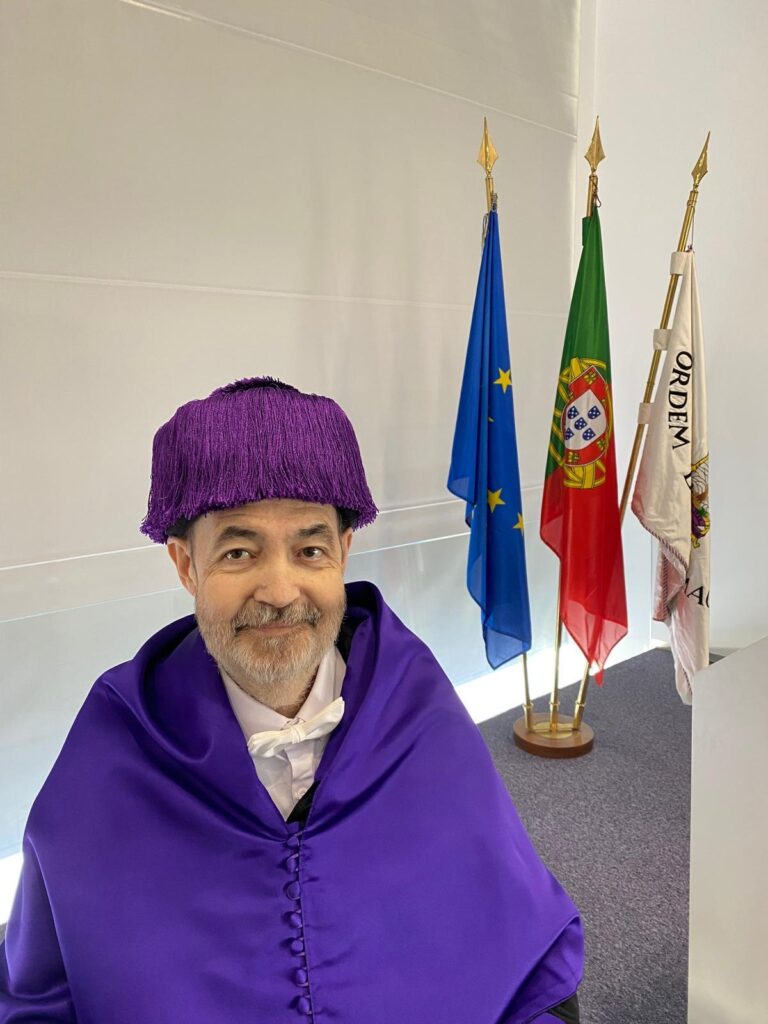
Researcher Jorge Manzanares, who leads the Translational neuropsychopharmacology of neurological and psychiatric diseases Laboratory at the Institute of Neurosciences (IN), a joint research center of the Spanish National Research Council (CSIC) and the Miguel Hernández University of Elche (UMH), has been formally appointed Corresponding Member of the Academy of Pharmaceutical Sciences of Portugal during a solemn ceremony held on January 31 in the city of Porto. The decision regarding his appointment was adopted during the Assembly of Full Members, held on November 11, 2025.
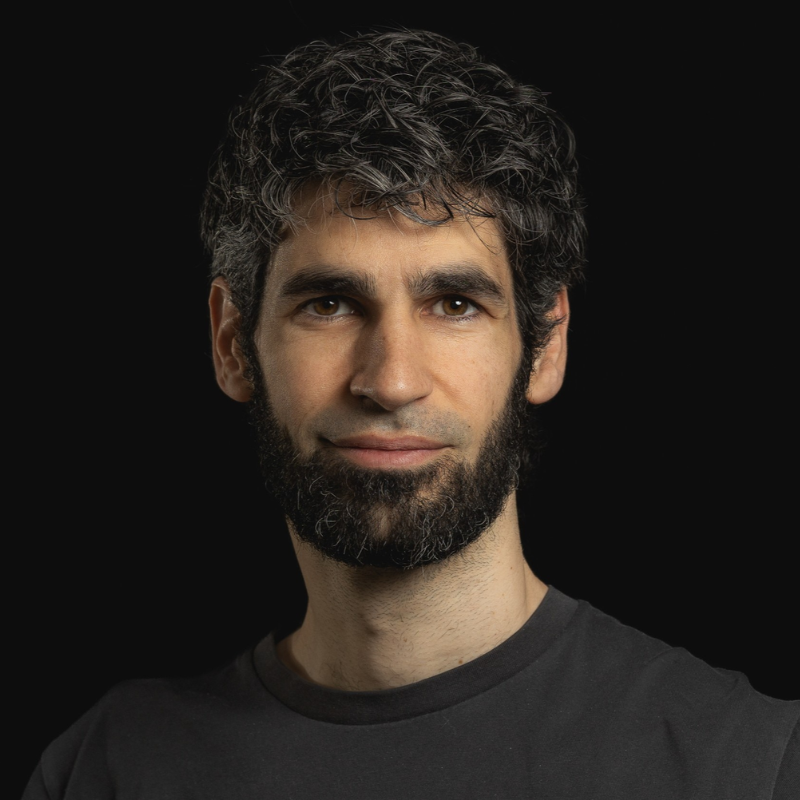
Photo: Researcher Jorge Manzanares, IN-CSIC-UMH
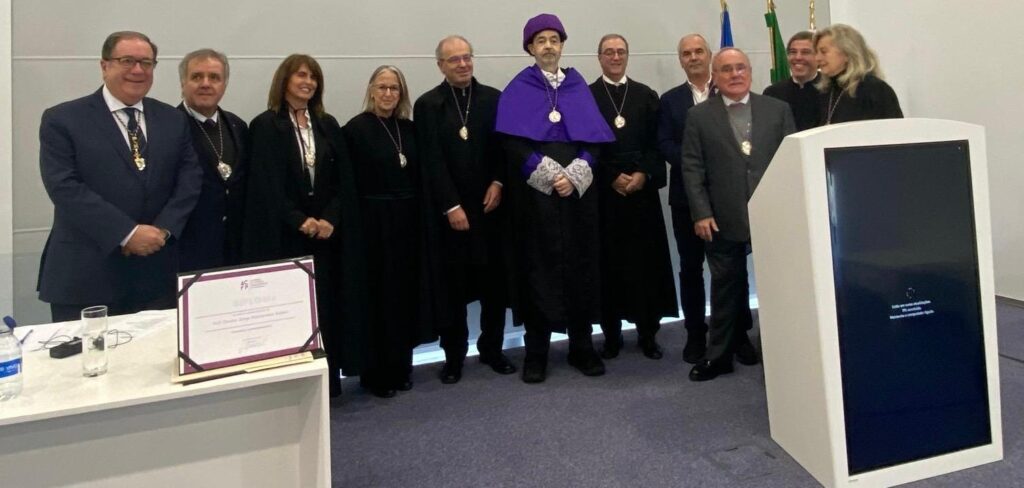
During the ceremony, Manzanares was inducted through the presentation of his inaugural lecture entitled ‘Fetal cannabinoid syndrome: neurobiological and behavioral consequences of perinatal exposure to THC’. The lecture was introduced by Fernando Jorge dos Ramos, professor at the University of Coimbra, and the formal response was delivered by Ricardo Dinis Oliveira, professor at the University of Porto, in accordance with the academic protocol established by the Academy.
Photo: Professor Jorge Manzanares, during the inauguration ceremony held in Porto on January 31.
“Being recognized as a corresponding member of the Academy of Pharmaceutical Sciences of Portugal is an honor that I deeply value”, stated Manzanares, adding, “this appointment reflects the international recognition of my scientific and academic contributions and opens new opportunities for collaboration between institutions and countries”.
Jorge Manzanares is Professor of Pharmacology and Dean of the Faculty of Pharmacy at UMH. He holds a degree in Pharmacy and a PhD in Pharmacology from the Complutense University of Madrid and was a research associate in the Department of Pharmacology and Toxicology at Michigan State University (USA). Since 2004, he has been a member of the Institute of Neurosciences, where he has developed a distinguished career in translational research.
Throughout his career, he has led numerous scientific projects and has received multiple academic distinctions. Manzanares is a Full Member of the Royal National Academy of Pharmacy of Spain, a Full Member of the Academy of Pharmacy of the Valencian Community, a Corresponding Member of the Ibero-American Academy of Pharmacy, a Corresponding Member of the Mexican Academy of Pharmaceutical Sciences, a Corresponding Member of the Mexican Academy of Medicine, and a Corresponding Member of the Mexican Academy of Psychiatry and Mental Health.
As part of the European Centre of Excellence MaX, ICN2 took part in organising a workshop of Europe’s leading forum for experts in computer architecture and high-performance computing.

.png?itok=4TuIr1sv)