.png?itok=kvnDDUue)
The Institute for Neurosciences (IN), a joint center of the Spanish National Research Council (CSIC) and Miguel Hernández University (UMH) in Elche, is once again participating in the celebration of Science and Technology Week. Throughout November, several researchers will visit secondary schools across the province of Alicante to give outreach talks about their research at the IN, aimed at high school students.

How neurons control alcohol consumption
Researcher Pablo Giménez Gómez, from the Cognition and Social Interactions laboratory, will present a talk on the brain mechanisms that regulate alcohol consumption. Using animal models, his team has identified a group of neurons in the prefrontal cortex that act as a “sensor” for blood alcohol levels. These neurons serve as a natural brake on excessive drinking: when activated, they reduce intake, and when inhibited, animals drink more. The findings help explain how the brain protects itself from intoxication and could open new avenues for addressing alcohol-related disorders.
Reward mode ON: dopamine, motivation, and resilience
Researcher Mario Aguilar Aragón, from the Mechanisms of Growth Control and Cancer laboratory, invites us to explore how the brain’s reward system works. Often referred to as the “happiness hormone,” dopamine is actually a key molecule that plays a crucial role in motivation and resilience. This talk will examine how this neuronal circuit is activated not only by achievements or tangible rewards, but also through everyday and social experiences, and how we can learn to train it to maintain well-being and the ability to face challenges.
Do we have zombies in the brain?
Researcher Violeta Durán Laforet, from the Cellular Plasticity and Neuropathology laboratory, will discuss a phenomenon as alarming as it is real: the existence of “zombie” cells in the brain. These senescent cells stop functioning properly with age or disease but do not die, and they may contribute to the progression of neurodegenerative disorders such as Alzheimer’s. The talk will explore how scientists are investigating their role in brain aging and whether it is possible to “wake up” or remove these cells to slow neuronal deterioration.
Epigenetics: controlling the genetic code that generates cellular identity
PhD student Juan Zaragoza Lillo, from the Transcriptional and Epigenetic Mechanisms of Neuronal Plasticity laboratory, will explain how epigenetics acts as a sophisticated control system over our DNA. Although all cells share the same genetic material, epigenetics determines which genes are active and which remain silent, giving rise to different cell types. Using visual examples and metaphors, the talk will reveal how this “instruction book” of DNA is organized and will present recent research showing how the loss of certain epigenetic proteins can make neurons “forget” their identity, a finding with promising implications for cell transplantation and regenerative medicine.
Molecular machinery of neuronal communication
Researcher Yolanda Giménez, from the Molecular Mechanisms in Neurosecretion laboratory, will guide us through the processes that allow neurons to communicate with each other. This communication occurs through the release of neurotransmitters, a biological process called neurosecretion, which relies on a complex molecular machinery composed of multiple components acting with precision. In recent years, her team has discovered new functions of some of these elements, revealing how their proper coordination is essential for neuronal transmission and how their dysfunction may be involved in various diseases. Understanding this mechanism not only helps explain how the brain communicates but also highlights potential therapeutic targets.
The environment shapes memory
Researcher Federico Miozzo, from the Transcriptional and Epigenetic Mechanisms of Neuronal Plasticity laboratory, will present a talk on how the environment directly influences memory and brain function. His team has shown, using animal models, that living in an enriched environment (with more social, motor, and cognitive stimuli) enhances memory, while social isolation impairs it. Analyzing neurons in the hippocampus, a key region for memory formation, they discovered that opposite environments activate or inhibit distinct gene programs related to synaptic plasticity. These findings help explain how experience shapes the brain and underscore the importance of a stimulating environment, even in adulthood, to preserve memory and prevent cognitive decline.
Switching on the brain: how the brain activates and prepares us for life
PhD student Francesco Dori, from the Development, Plasticity and Reprogramming of Sensory Circuits laboratory, invites us on a journey through the first days of brain life. At birth, the brain is still under construction: vision is blurry, walking is impossible, and hearing is limited. However, spontaneous bursts of activity already occur internally, acting as a training session to help circuits connect and later process vision, sound, and movement. The talk will explore how the brain “switches on,” how this activity spreads through its networks, and why it is essential for healthy brain development.
La entrada Science and Technology Week at the IN CSIC-UMH, Nov 2025 se publicó primero en Instituto de Neurociencias de Alicante.
Calcifying plankton quietly regulate the Earth’s thermostat by capturing and cycling carbon. However, a review published this week in Science by a team led by the ICTA-UAB finds that these organisms are oversimplified in the climate models used to predict our planet’s future.
The ICIQ and the City Council of La Canonja have renewed the collaboration agreement they have maintained since 2021, reaffirming their joint commitment to the promotion of science, education and sustainability in the municipality. This agreement provides for a subsidy for the 2025 financial year and will allow the Green, Educational and Scientific Project of La Canonja to continue to be promoted, an initiative that seeks to bring research in green chemistry closer to citizens and contribute to the educational and sustainable development of the territory. The project is developed through two main lines: Scientific activity:
Scientific activity: Support for a predoctoral researcher working in the field of green chemistry within an ICIQ research group. This line reinforces the commitment to responsible research, aimed at finding solutions to today‘s major environmental challenges.
Informative and training activity in green chemistry: Organisation of activities aimed at primary, secondary and baccalaureate students, as well as adults and the elderly, with the aim of promoting scientific vocations, stimulating critical thinking and promoting scientific literacy.
Since its launch, the project has been a success, reaching hundreds of people through workshops, talks and educational initiatives. Both the City Council and the ICIQ value the collaboration of recent years very positively.
“This agreement is an example of how collaboration between institutions can generate a real impact on society. We are very satisfied with the results achieved so far, and we remain committed to the goal of bringing science to everyone, especially the youngest,” said Emilio Palomares, director of the ICIQ
“For La Canonja it is a pride to continue working side by side with the ICIQ in a project that puts science and knowledge at the service of citizens. This collaboration, which has been going on for five years, shows that investment in education and research is also an investment in the future of our municipality. From the City Council we will continue to support initiatives that promote young talent and scientific vocations. We firmly believe that La Canonja can be an example of how collaboration between institutions, research centres and public administration can generate a positive and lasting impact on the territory“, said the mayor of La Canonja, Roc Muñoz.
This new stage of the agreement reaffirms collaboration as a key tool to promote young talent and scientific culture in the territory. A model that is committed to a society that is more prepared, critical and committed to knowledge.

La entrada La Canonja and the ICIQ renew for the fifth consecutive year the collaboration agreement se publicó primero en ICIQ.

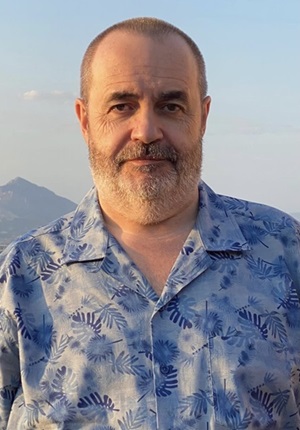
Photo: UMH Professor Jorge Manzanares, who leads the Translational Neuropsychopharmacology of Neurological and Psychiatric Diseases Group at the Institute for Neurosciences.
The genetic analysis of a blood sample could become a tool for the early diagnosis of Parkinson’s disease, according to an exploratory study led by researchers from the Institute for Neurosciences (IN), a joint center of the University Miguel Hernández (UMH) of Elche and the Spanish National Research Council (CSIC). Although not yet available for clinical use, the method was tested in newly diagnosed patients and proved effective, offering a non-invasive way to detect and monitor disease progression before major symptoms appear.
The results, published in the journal Neurotherapeutics, stem from the collaboration between scientists from the Translational Neuropsychopharmacology of Neurological and Psychiatric Diseases Group, led by UMH Professor Jorge Manzanares and the Cellular Plasticity and Neuropathology Laboratory, both at the IN; the Institute for Health and Biomedical Research of Alicante (ISABIAL), the Carlos III Health Institute, and Madrid’s Hospital 12 de Octubre.
Parkinson’s disease affects around 12 million people worldwide. It is the second most common neurodegenerative disorder and one of the leading causes of neurological disability. One of the most significant challenges in Parkinson’s research is achieving a diagnosis before severe motor symptoms emerge.
Currently, diagnosis begins with a clinical examination when visible symptoms appear. “However, tremors occur when neurological damage is already advanced and may be mistaken for other disorders”, explains Manzanares. “Until recently, the only definitive diagnosis came from post-mortem tissue analysis, but it is crucial to develop fast, minimally invasive methods that detect the disease earlier”.
The method developed by the researchers requires only a blood draw. The analysis, performed with equipment already available in many hospital laboratories, identifies genetic alterations associated with the disease in its earliest stages.
“The key lies in genetically analyzing a type of immune cells called peripheral blood mononuclear cells”, explains Professor Francisco Navarrete, first author of the article. Like all cells, these contain genetic information, but not all genes are active at all times. Some genes switch on or off depending on the body’s needs, such as during an infection or the development of a disease.
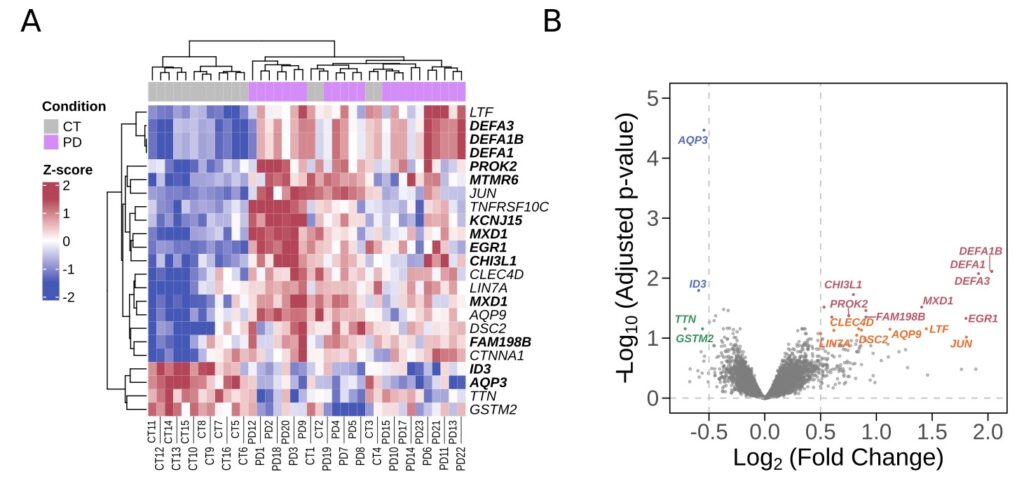
Changes in gene expression in Parkinson’s disease. A) In red, increased gene expression; in blue, decreased expression. Genes with the most significant changes are shown in bold. B) Most significant upregulated genes in red, followed by pink, blue, and green, respectively. Source: Neurotherapeutics
Through sequencing and bioinformatics, the researchers identified more than 20 genes whose activity was altered in untreated patients with Parkinson’s disease. “These changes are not seen in healthy individuals”, notes Marina Guillot, predoctoral researcher who led the gene expression analyses together with CSIC scientist José P. López-Atalaya. “This suggests that they could serve as reliable markers for diagnosis and also provide clues about the biological mechanisms underlying disease development and progression”, he adds.
In total, 22 genes showed differential expression between Parkinson’s patients and healthy volunteers. Some are involved in immune responses, supporting the hypothesis that inflammation and the immune system play a role in the disease’s development. Others are linked to molecular transport within brain tissue and iron homeostasis, processes previously associated with neurotoxicity.
Beyond gene expression, the researchers detected changes in cellular pathways associated with survival, inflammation, cell death, and the composition of immune cells. “We still do not fully understand how Parkinson’s disease emerges and progresses, and current treatments have limited effects”, says Manzanares, who hopes these analyses will help design more effective, personalized therapies in the future.
The exploratory study included 23 patients with Parkinsonism and 16 healthy controls. Despite the small sample size, the findings are consistent with other independent studies conducted in Italy and the United States over the past decade, confirming the diagnostic potential of this approach.
“Whole transcriptome analysis of peripheral blood mononuclear cells from de novo and drug-naïve Parkinson’s disease patients”. Navarrete F, Guillot-Fernández M, Martínez-Hostyn L, Navarro D, Molina J A, López-Atalaya J P and Manzanares J. Neurotherapeutics (2025) – e00762.
The project was supported by ICAR Foundation, ISABIAL, the Ministry of Education, Vocational Training and Sports, the Tatiana Pérez de Guzmán el Bueno Foundation, the Spanish State Research Agency, the Generalitat Valenciana (Prometeo Program), and the Spanish Ministry of Science, Innovation and Universities.
Source: UMH Communications Service / Institute for Neurosciences UMH-CSIC (in.comunicacion@umh.es)
La entrada Researchers at the IN UMH-CSIC move closer to an early diagnosis of Parkinson’s disease through a simple blood test se publicó primero en Instituto de Neurociencias de Alicante.

WELCOME!
The ICCUB Winter Meeting 2026 edition!
This year, the meeting will take place on February 2nd-3rd 2026. As you know, the idea of this meeting is to gather in person as many people from the ICCUB as possible, and give the opportunity to young researchers working in the research areas of our Institute (Astrophysics, Particle Physics, Cosmology, Gravitation and Nuclear Physics) to provide to a broad audience didactic and entertaining reviews of the fields in which their research is embedded. There will be also interesting talks on the status of the technological part of the institute. PhDs, postdocs and some seniors, all ICCUB members and collaborators, will be invited to give a talk on their topics of interest. The meeting will also offer an opportunity to the participants with different interests to meet and discuss their research activities with other scientists working outside their specialty, but within the broad scope of ICCUB study areas.
The workshop will be held at the Facultat de Física in the Universitat de Barcelona. The format will consist of 6 talks in the morning and 6 in the afternoon during the two days. Each talk will
last 25 minutes, and there will be programmed coffee breaks in between to foster interaction. Speakers are strongly encouraged to give their talks at a Physics graduate student level, and with a strong outreach tone, to make the talks easy to follow for ICCUB members working in very different fields.
Everybody is invited to participate in this event.
We are sure you will enjoy it!
To view this protected post, enter the password below:
The post Protected: New Horizons for H- and Γ-Convergence: From Local to Nonlocal in Fractional Form first appeared on Centre de Recerca Matemàtica.