
From over 600 applications, the BBVA Foundation has chosen 12 outstanding research projects. RETICAT will receive close to €250,000 to develop new catalysts inspired by biological enzymes.

From over 600 applications, the BBVA Foundation has chosen 12 outstanding research projects. RETICAT will receive close to €250,000 to develop new catalysts inspired by biological enzymes.
La entrada De las baterías a la salud bucodental: la electroquímica como aliada en la lucha contra las infecciones en implantes se publicó primero en IMDEA ENERGÍA.
Abstract: In this talk I’m going to present the first numerical relativity simulations of gravitational scattering between neutron stars and the first comparison of such simulations with analytical predictions as well as the black hole case. Our results probe extreme strong-field regimes up to the threshold of dynamical capture, revealing both agreement and significant tidal discrepancies with effective-one-body and post-Minkowskian predictions. In addition, I will discuss the challenges in the gravitational wave numerical extraction and detection for this type of events: these configurations allow to build numerical relativity surrogates in order to tackle the parameter estimation task. Nevertheless, degeneracies can arise when using the Weyl Scalar waves to analyse the data and only some combination of parameters might be potentially measured. Finally, I will comment on the performance of the Regge-Wheeler-Zerilli-Moncrief metric extraction technique to obtain the strain waves in such events.
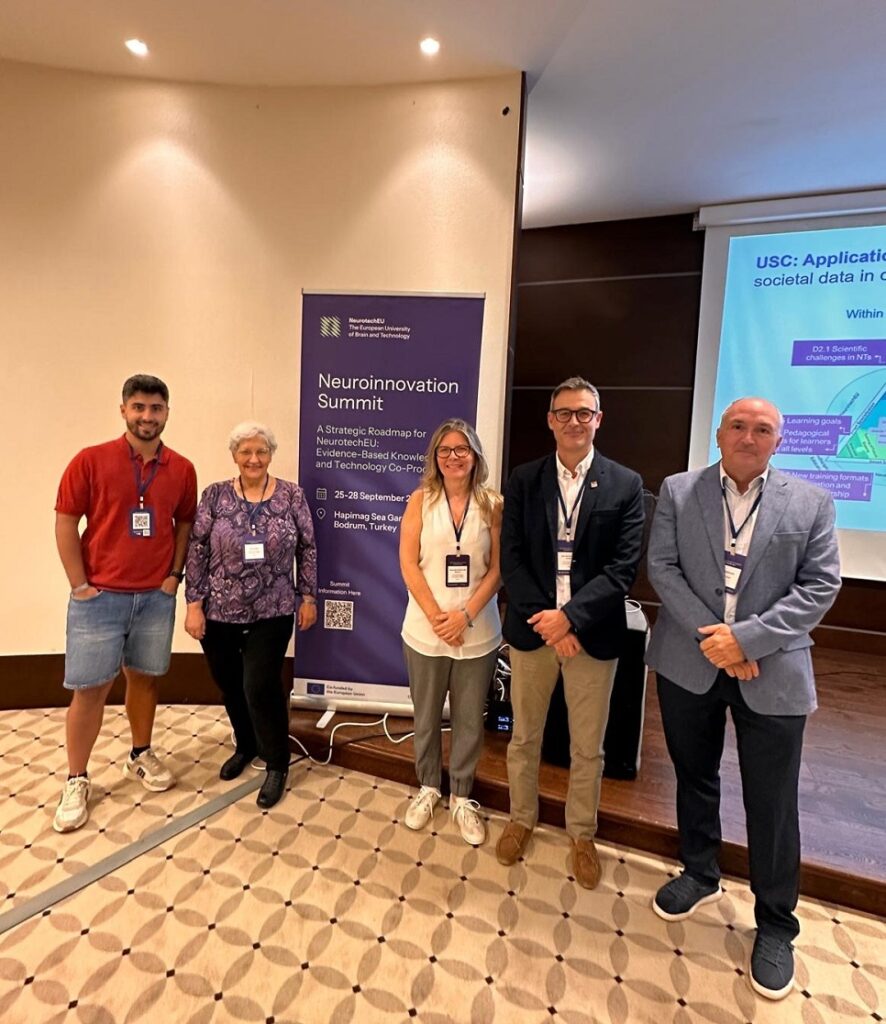
UMH delegation at the Neuroinnovation Summit 2025. From left to right: Jorge Maldonado, Juana Gallar, María del Carmen Lillo, José María Azorín, and Pablo Belmonte. Source: NeurotechEU.
One of NeurotechEU’s collective ambitions is to accelerate responsible neuroinnovation that benefits people and society across Europe. Within this framework, NeurotechEU aims to strengthen collaboration both inside and outside the alliance and to design a technology transfer strategy that transforms neurotechnological advances into high-impact applications for European society and the economy. As part of this goal, Boğaziçi Üniversitesi (BOUN, Turkey), a member of the European University of Brain and Technology – NeurotechEU, hosted the NeurotechEU Neuroinnovation Summit 2025.
Under the theme ‘A Strategic Roadmap for NeurotechEU: Evidence-Based Knowledge and Technology Co-Production’, from 25 to 28 September 2025, representatives from Miguel Hernández University of Elche (UMH) and other partner universities, as well as a range of stakeholders, met to discuss how to translate the outcomes of the Work Package ‘Common Policies and Strategy Development’ into a strategic roadmap to guide research agendas, joint educational programs, and policy dialogues in the coming years.
UMH was represented by Juana Gallar, leader of NeurotechEU at UMH and Director of the Institute for Neuroscience CSIC-UMH, accompanied by José María Azorín, Deputy Vice-Rector for Research Management; María del Carmen Lillo, Director of the UMH Translational Research Center in Physiotherapy; and Jorge Maldonado, UMH representative on the NeurotechEU Student Council and PhD student at the Institute for Neuroscience CSIC-UMH. The UMH delegation was completed by Pablo Belmonte Brissoire, CEO of Newmanbrain, a UMH spin-off company.
During the two-and-a-half-day event, participants worked on transforming outcomes into specific actions tailored to different target audiences. The summit was structured around keynote lectures, roundtables, lightning talks, and parallel working sessions. Gallar moderated two sessions and delivered the lightning talk ‘From Basic Science to the End-User: An FDA-Approved Drug & a Diagnostic Device’. Azorín presented ‘Lessons Learned from Clinical Tests of BCI Systems and Exoskeletons’. Lillo, co-author of the summit’s central document, took part in the panel discussion ‘Understanding Societal Challenges: Applications and Social Initiatives’. Meanwhile, Belmonte presented the evolution of his company as a case study in the nanosymposium ‘Translation into Industry: Challenges, Opportunities, and Success Stories’.
The Neuroinnovation Summit is one of the annual activities organized by NeurotechEU as a European Alliance committed to promoting the education and training of future professionals and researchers in the field of neurotechnology through innovative and up-to-date approaches. In addition to UMH, the NeurotechEU alliance includes seven other universities: Radboud University (Netherlands), Karolinska Institute (Sweden), University of Bonn (Germany), Boğaziçi University (Turkey), Iuliu Hațieganu University of Medicine and Pharmacy in Cluj-Napoca (Romania), University of Lille (France), and Reykjavik University (Iceland).
Source: Communication Office of NeurotechEU at UMH (jsantacreu@umh.es)
La entrada A strategic roadmap for NeurotechEU: evidence-based knowledge and technological co-production se publicó primero en Instituto de Neurociencias de Alicante.
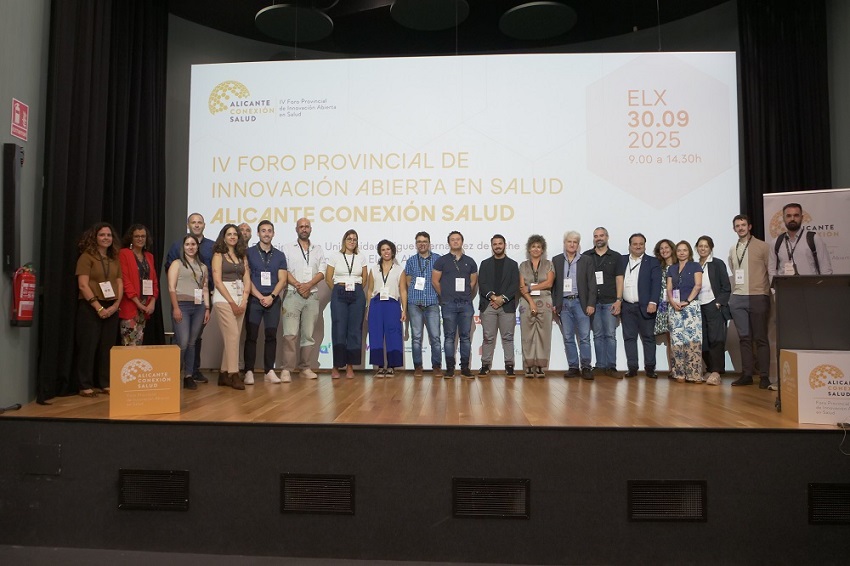
Participants at the 4th edition of Alicante Conexión Salud. Source: UMH
The 4th edition of the provincial open health innovation forum, Alicante Conexión Salud, took place on 30 September at the Valona Building of Miguel Hernández University (UMH), bringing together 85 professionals from the sector. The event has consolidated itself as a key meeting place for researchers, healthcare personnel, companies, and citizens committed to driving healthcare innovation.
The forum, attended by representatives of strategic entities from across the province, promoted new alliances in which knowledge was shared and the current challenges and opportunities of the healthcare system were analysed. The opening session featured Ángel Antonio Carbonell, Vice-Rector for Research and Knowledge Transfer at UMH, and Andrés Antón, Vice-President of BIOVAL Alicante, the BIO cluster of the Valencian Community, along with the innovation agents of the organizing entities.
“The 4th edition of Alicante Conexión Salud has reaffirmed the central role of Alicante’s ecosystem in healthcare innovation, fostering public-private collaboration, citizen involvement, and a commitment to developing high-impact solutions for the healthcare system”, said Carbonell.
This edition was organised by Fundación Fisabio, the Alicante Institute for Health and Biomedical Research (ISABIAL), BIOVAL, the science parks of UMH and the University of Alicante (UA), the Institute for Research, Development and Innovation in Health Biotechnology of Elche (IDIBE), the Scientific Unit for Business Innovation of the Institute for Neuroscience CSIC-UMH (IN.Pulse), and the Office for the Transfer of Research Results of the UA (OTRI-UA).
The event also featured participation from the three provincial technology institutes (AIJU, INESCOP, and AITEX), Alicante Futura, the Dravet Syndrome Foundation, and companies such as FutuRS, Oscillum, European Institute of Exercise and Health, and Neurovital – Institute for Advanced Rehabilitation.
Challenges and innovative solutions in healthcare
The meeting opened with a keynote on the potential of biotechnology in Alicante, setting the stage for the technical sessions. Throughout the day, key issues were addressed, such as public-private collaboration, citizen participation in R&D&I projects, and the presentation of innovative projects in strategic health areas.
Initiatives presented included Alicante innovador, conectado y competitivo, the Green Health-HUBi, the Microbiome Hub Microbionet (Fisabio), and the iDiaFOOT network (INESCOP). Representatives from patient associations and public administration also highlighted the importance of actively involving citizens in health research.
On the scientific and technological side, cutting-edge projects were showcased, including new biomaterials and smart textiles (AITEX), a human innervated skin prototype for the study of neuropathic pain (IDIBE), and an artificial intelligence platform for the early detection of Alzheimer’s disease through voice analysis (University of Alicante).
A highlight of this block was the intervention of Víctor Meseguer, co-leader of the Ocular Neurobiology group at the Institute for Neuroscience CSIC-UMH, who presented progress on a project aimed at developing a new drug for the treatment of ocular pain—a clinical challenge with significant impact on patients’ quality of life.
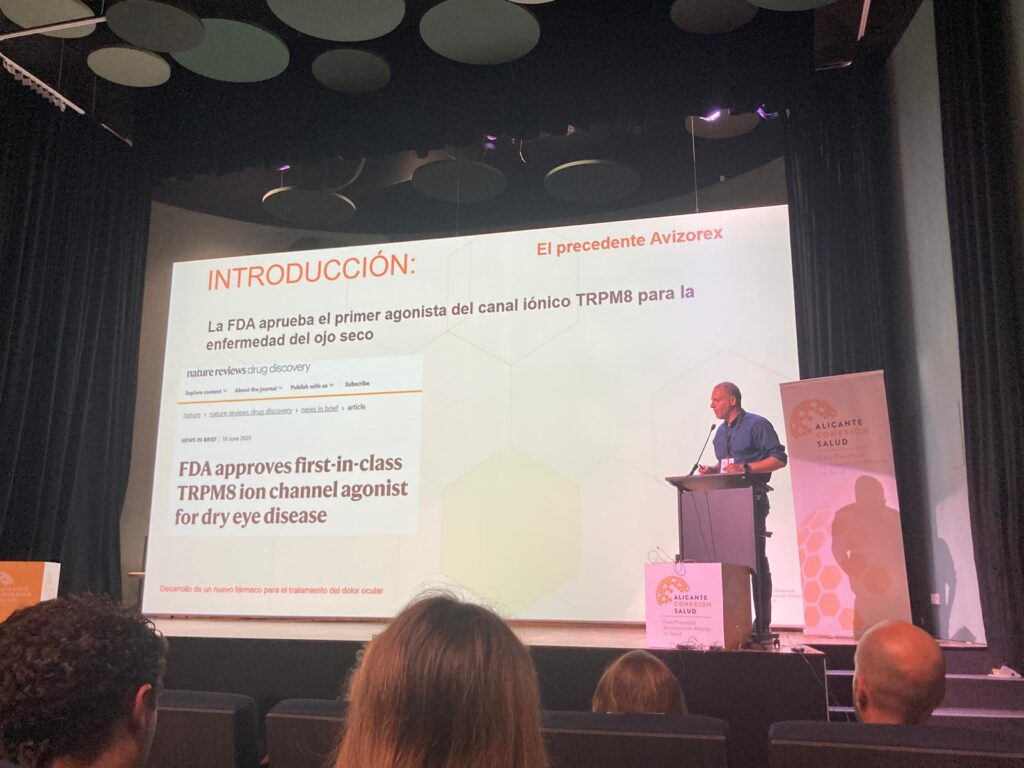
Researcher Víctor Meseguer, from the Institute for Neuroscience CSIC-UMH, presenting his project on the development of a new drug for ocular pain treatment at Alicante Conexión Salud. Source: IN CSIC-UMH.
The forum also included a session of technological pitches, where researchers and companies presented solutions for diagnostics, treatment, and rehabilitation. Proposals included CDK4 inhibitors for glioblastoma treatment, virtual reality systems for rehabilitation, 3D simulations for surgery, and other innovative clinical devices.
The day concluded with a round of bilateral meetings, facilitating direct contact between companies, researchers, and healthcare professionals, and fostering strategic alliances and new opportunities for joint development.
This initiative is co-funded by the Valencian Institute for Business Competitiveness and Innovation (IVACE +i, Generalitat Valenciana) and the European Union through the European Regional Development Fund (ERDF) Operational Programme of the Valencian Community 2021-2027 (INNTA1/2023/34).
More information in the attached program (Spanish).
Source: Valencian Ministry of Health (sec.comunicacion@gva.es) / Institute for Neurosciences CSIC-UMH (in.comunicacion@umh.es)
La entrada Alicante Conexión Salud celebrates its 4th edition and consolidates the province as a benchmark in healthcare innovation se publicó primero en Instituto de Neurociencias de Alicante.
Un equipo del Centro de Biología Molecular Severo Ochoa (CBM, CSIC-UAM), junto a la Universidad de Queensland (Australia) y la Universidad de Milán (Italia), ha identificado una nueva enzima llamada SddA, que regula la separación de las células hijas durante la división de bacterias Gram-negativas. En este grupo se encuentran bacterias, como Escherichia coli, que conviven normalmente en nuestro microbioma, pero que bajo determinadas condiciones pueden actuar como patógenos capaces de causar infecciones intestinales, urinarias o incluso cuadros graves de sepsis.
Las bacterias Gram-negativas tienen una envoltura celular compleja: dos membranas lipídicas que rodean una fina pared celular llamada peptidoglicano, compuesta por azúcares y péptidos. Esta pared celular es esencial para su supervivencia y, de hecho, su síntesis es diana de multitud de antibióticos utilizados en la actualidad.
Durante su ciclo de vida, estas bacterias crecen en longitud y se dividen, dando lugar a dos células idénticas. Para lograrlo, deben remodelar su pared celular. Durante su división la bacteria forma un septo de peptidoglicano, una pared transversal que separará a las futuras bacterias hijas. Para que la separación sea completa, el septo debe hidrolizarse por acción de enzimas amidasas, las cuales rompen los enlaces entre azúcares y péptidos. Su acción genera cadenas de peptidoglicano “desnudas”, listas para ser procesadas por enzimas hidrolíticas adicionales.
El hallazgo del equipo ha revelado que la enzima SddA modifica químicamente esas cadenas desnudas a través de su actividad deacetilasa —una reacción que altera los azúcares del peptidoglicano—, y regula la acción de las amidasas, controlando de forma precisa el proceso de división.
El equipo comprobó que SddA se concentra en la zona de división y que, cuando se produce en exceso, bloquea la separación normal de las células, formando largas cadenas de células bacterianas interconectadas.
“El descubrimiento de SddA nos revela un mecanismo de regulación desconocido hasta ahora, y nos ayuda a entender mejor cómo las bacterias coordinan la división y síntesis de su pared celular, una de las dianas más explotadas por los tratamientos antibióticos actuales” explica Manuel Pazos, investigador del CBM y uno de los autores de correspondencia del estudio.
Este avance no solo ayuda a comprender mejor la biología de bacterias que forman parte de nuestro microbioma —y que en ciertas condiciones se convierten en patógenos peligrosos—, sino que también sienta las bases para explorar nuevas dianas terapéuticas en la lucha contra las infecciones.
Hernández-Rocamora VM, Martorana AM, Belloso A, Ballesteros D, Zaccaria M, Perez AJ, et al. (2025) A novel peptidoglycan deacetylase modulates daughter cell separation in E. coli. PLoS Genet 21(9): e1011626. https://doi.org/10.1371/journal.pgen.1011626
La entrada Un hallazgo abre la puerta a frenar la división de bacterias peligrosas se publicó primero en Centro de Biología Molecular Severo Ochoa.
ICTA-UAB expresses its deepest sorrow at the death of Jane Goodall, researcher, conservationist, and a global reference in the study of primates and the defense of nature. Her legacy continues to inspire the entire scientific and environmental community.
Researchers from the Institute of Cosmos Sciences of the University of Barcelona (ICCUB) have developed a novel machine learning framework that significantly improves the ability to solve complex differential equations, especially in cases where traditional methods struggle. The work, led by Pedro Tarancón-Álvarez and Pablo Tejerina-Pérez, has been published in Communications Physics, a journal from the Nature Portfolio.
Differential equations are essential tools in physics, used to describe phenomena ranging from fluid dynamics to general relativity. However, when these equations become “stiff” (meaning they involve vastly different scales or highly sensitive parameters), they become extremely difficult to solve. This is particularly true for inverse problems, where scientists aim to deduce unknown physical laws or parameters from observed data.
To tackle this challenge, the researchers have enhanced the capabilities of Physics-Informed Neural Networks (PINNs), a type of artificial intelligence that incorporates physical laws into its learning process. Their approach combines two innovative techniques:
These methods were successfully applied to three increasingly complex systems: the flame equation, the Van der Pol oscillator, and the Einstein Field Equations in a holographic context. In the latter case, the researchers were able to recover unknown physical functions from synthetic data, a task previously considered nearly impossible.
“Recent advances in machine learning training efficiency have made PINNs increasingly popular in the past few years,” explains Pedro Tarancón-Álvarez, PhD candidate at ICCUB. “This framework offers several novel features compared to traditional numerical methods, most notably the ability to solve inverse problems.”
“Solving these inverse problems is like trying to find the solution to a problem that is missing a piece; the correct piece will have a unique solution, incorrect ones may not have a solution, or multiple ones,” adds Pablo Tejerina-Pérez, PhD candidate at ICCUB. “One could try to invent the missing piece of the problem and then see if it can be solved properly – our PINNs do the same, but in a much smarter and efficient way than us.”
The research was carried out in collaboration with Raul Jimenez (ICREA-ICCUB) and Pavlos Protopapas (Harvard University) and was supported by the Spanish Ministry of Science and Innovation and the Maria de Maeztu Excellence Program.
Tarancón-Álvarez, P., Tejerina-Pérez, P., Jimenez, R. et al. Efficient PINNs via multi-head unimodular regularization of the solutions space. Commun Phys 8, 335 (2025). https://doi.org/10.1038/s42005-025-02248-1
.png?h=30a2f3b7&itok=vVyXaGEY "Conciencia de Canal Sur dedica un reportaje al proyecto CONNECTS")

Lo que se respira en Centro Nacional de Investigaciones Oncológicas (CNIO) durante toda la jornada de la Noche Europea de los Investigadores e Investigadoras es entusiasmo. Los 110 voluntarios y voluntarias del centro conocen muy bien esa genuina alegría de plantearse preguntas, indagar para obtener respuestas y, por fin, observar boquiabiertos el resultado. Y diseñan el evento para despertar o revivir esa emoción en todo el público asistente.

Los 350 visitantes de todas las edades que han acudido este año recibieron la bienvenida del director gerente del centro, José Manuel Bernabé. En el Auditorio Margarita Salas recordó que “la ciencia sólo tiene sentido si la hacemos juntos”.
Desde allí se realizaron varias conexiones de vídeo en directo con unidades del centro para mostrar al auditorio tres fases de un experimento: las muestras conservadas a -175º C en la sala criogénica, su traslado a la sala de cultivo, donde se les aplica un compuesto para ver si es efectivo contra el cáncer, y cómo se tiñen las células en otro laboratorio para comprobar si el compuesto ha actuado o no.
Este año la sorpresa de la jornada fue la robota R2KT, similar al R2D2 de La guerra de las galaxias, y estrella de la Fundación The Pink Force. Esta fundación la lleva a visitar a niños y niñas hospitalizados y proporciona a otras organizaciones materiales e instrucciones para que construyan réplicas en miniatura y las entreguen en hospitales infantiles. El CNIO entregó recientemente dos de esos robots al Hospital Universitario La Paz.


En la zona de stands se ofrecían distintas actividades y juegos: observar cómo se ven las células y tejidos a través de distintos tipos de microscopios, aprender cómo funcionan centrifugadoras y otros aparatos básicos para la investigación, manejar pipetas, descifrar puzles para comprender las mutaciones del genoma, o extraer el ADN de un tomate. También cómo construir los robots de The Pink Force. Toda una tarde de curiosidad satisfecha y de muchas más preguntas por indagar.


La Noche Europea de los Investigadores e Investigadoras es una iniciativa de la Unión Europea que se celebra simultáneamente en 350 ciudades europeas. En Madrid está promovida por la Consejería de Ciencia, Universidades e Innovación y coordinada por la Fundación para el Conocimiento madri+d. El Proyecto está financiado por la Unión Europea dentro del Programa de Investigación e Innovación Horizonte 2020 –acciones Marie Sklodowska-Curie–.
En el CNIO, la jornada forma parte de la estrategia de divulgación del Centro a través del Decanato de Asuntos Académicos, junto con el Programa de Formación del CNIO.


Sobre The Pink Force
La Fundación The Pink Force es una entidad sin ánimo de lucro cuyo objetivo es llevar alegría e ilusión a los niños enfermos durante su estancia hospitalaria, creando momentos mágicos en sus encuentros con la robota R2-KT. Apoya a entidades que promueven iniciativas para reforzar a familiares y enfermos de diferentes patologías, en especial a los más vulnerables.
Sobre el Centro Nacional de Investigaciones Oncológicas (CNIO)
El Centro Nacional de Investigaciones Oncológicas (CNIO) es un centro público de investigación dependiente del Ministerio de Ciencia, Innovación y Universidades. Es el mayor centro de investigación en cáncer en España y uno de los más importantes en Europa. Integra a medio millar de científicos y científicas, más el personal de apoyo, que trabajan para mejorar la prevención, el diagnóstico y el tratamiento del cáncer.
La entrada El CNIO celebra la curiosidad con ciencia para ver, tocar y jugar se publicó primero en CNIO.

.png?h=bc521b01&itok=Cu51cBrk)