Author Archive

SUPERVAL partners meet in Barcelona to prepare for the project’s final phase

The SUPERVAL consortium gathered on 22 May in Barcelona for its Month 30 (M30) consortium meeting. Hosted at the offices of 2-0 LCA, partners reviewed project progress and discussed recent technical advances, coordination activities, and priorities for the coming months. 

The meeting opened with a welcome and overview of the agenda by project coordinator JR Galán-Mascarós. Technical updates began with WP1 on gas separation, presented by Santiago Capelo (Orchestra Scientific), followed by WP2 on CO₂/water photo-electrolysis, with contributions from Veronica Costantino (University of Messina), Ghazaleh Abdolhosseini (ICIQ), and Yuzhe Liu (Forschungszentrum Jülich). Josep Albero (Universitat Politècnica de València) then presented progress on WP3, focused on the photocatalytic hydrogenation of N₂ and NOx to NH₃. 

The consortium also reviewed WP4 on device integration, performance validation, and feasibility, with contributions from Santiago Capelo (Orchestra Scientific), Martí Rufí (2-0 LCA), and Laura González (Vareser). Communication, dissemination, and exploitation activities were addressed through WP5 and WP7, presented by Arnau Jordà (ICIQ) and Stefano Giancola (Orchestra Scientific), while WP6 on project management was led by Laura López and Eva Alcázar (ICIQ). 

Beyond the technical updates, partners discussed system integration strategies, risk assessment, and mitigation measures, as well as the priorities that will guide the project into its last six months to validate the SUPERVAL technology. The meeting concluded with final discussions on timelines and preparation for the next consortium gathering. 


The SUstainable Photo-ElectRochemical VALorization of flue gases – SUPERVAL project has received funding from the European Union’s Horizon Europe, Grant Agreement No. 101115456 

La entrada SUPERVAL partners meet in Barcelona to prepare for the project’s final phase se publicó primero en ICIQ.

Go to Source

The new LIGO–Virgo–KAGRA Catalog sets new records in precision gravitational astronomy

The LIGO–Virgo–KAGRA Collaboration published today a new catalog of gravitational wave events. A total of 161 events, detected between April 2024 and the end of January 2025, have been added to the collection, bringing the total number of gravitational wave signals detected to date to 390. IFAE is a member of the Virgo and LIGO collaborations.

Go to Source

Andrés Henao and Francisco Molina featured in the Supercomputing in Europe podcast on AI in Materials Science

ICN2 researchers Andrés Henao and Francisco Molina were featured in the Supercomputing in Europe podcast, where they discussed how AI and high-performance computing are transforming materials science.

Go to Source

PhD Diary: A Community Experience — Inside the MSCA-COFUND TOUCH Programme

Go to Source

A new simulation- and AI-based approach reduces the time and data needed for brain MRI scans

  • The study, published in Communications Medicine, combines magnetic resonance imaging and simulation-based artificial intelligence to speed up brain analysis while maintaining a high level of accuracy.
  • The method avoids the use of real patient data for training, reduces bias, and could facilitate the implementation of these advanced techniques in hospitals, helping to shorten waiting lists and improve diagnosis.

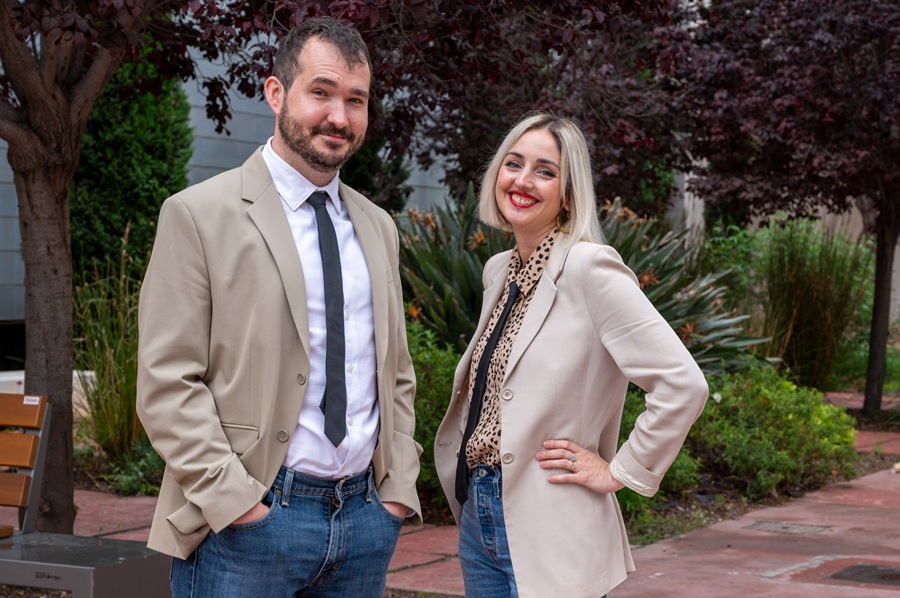
Researchers Maximilian Eggl and Silvia De Santis at the Institute for Neurosciences CSIC-UMH.

Two researchers at the Institute for Neurosciences (IN), a joint centre of the Spanish National Research Council (CSIC) and the Miguel Hernández University of Elche (UMH), have developed a new strategy based on artificial intelligence and computer simulations that makes it possible to obtain detailed brain information more quickly from MRI scans using far less data than usual. The method, published in the journal Communications Medicine, can reduce the time required for certain advanced MRI scans by up to 90% while maintaining a high level of accuracy, paving the way for more efficient and accessible neuroimaging in clinical settings.

youtube  https://youtu.be/1Gd2xR__XUw

The study proposes a shift in the way artificial intelligence is applied to neuroimaging. Instead of training models using real patient data, as is common in many current applications, the team used a model based on the physics of the diffusion process in brain tissue to generate simulations. These data are then used to train neural networks to estimate model parameters that serve as biomarkers indicating the state of the tissue using a very small number of resonance images.

“Reducing the acquisition time required makes it possible to incorporate much more advanced MRI techniques, resulting in a greater amount of clinical information available to medical staff”, explains researcher Silvia De Santis, who leads the Translational Imaging Biomarkers Laboratory at the IN CSIC-UMH.

This approach also reduces the biases associated with traditional clinical datasets. “Using simulations allows us to generate as much data as we need, without depending on patient availability and while avoiding privacy issues,” adds researcher Maximilian Eggl, who leads the AI-inspired Biomarkers of Brain Structure and Function research line at the IN CSIC-UMH.

Less scanning time, more information

The methodology relies on advanced MRI techniques such as diffusion-weighted MRI, which makes it possible to non-invasively study the movement of water in brain tissue and thereby obtain information about its microstructure. From these signals, artificial intelligence efficiently reconstructs detailed features of the brain tissue.

One of the study’s most significant findings is the drastic reduction in the number of measurements required. “We have shown that our network, trained entirely on simulations, can achieve a very high level of accuracy using only 10% of the data”, says Eggl. “This could have a direct impact in clinical settings, especially in hospitals with very long waiting lists”, adds the researcher.

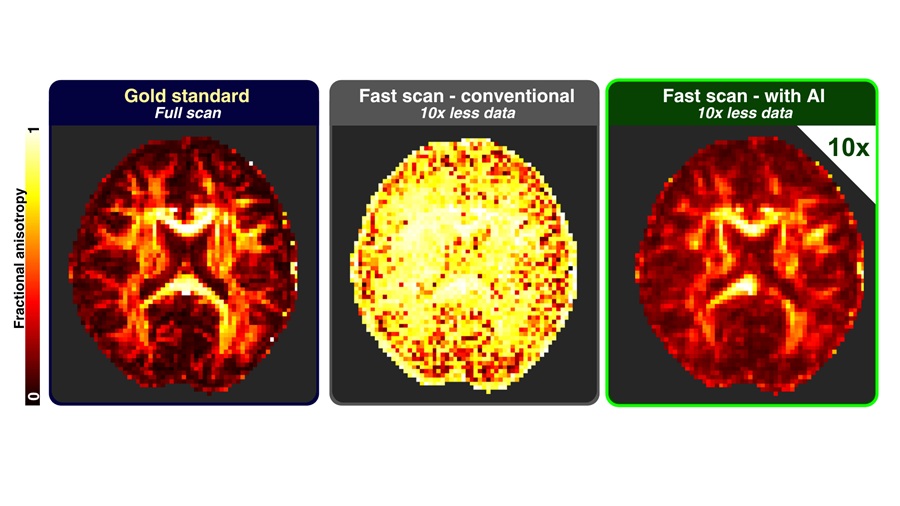
By training the AI with simulations, researchers can reconstruct brain images with high precision using only one-tenth of the data typically required in magnetic resonance imaging. The image shows a metric known as “fractional anisotropy”—an index of myelination—obtained using conventional methods and with the new approach. Source: IN CSIC-UMH.

In practice, this breakthrough could translate into a significant reduction in scan time: “Imagine going from about 40 minutes to roughly 8 to obtain the same information. This procedure would make it possible to increase the number of patients treated in the same amount of time and make the system much more efficient”, both researchers agree.

Towards early diagnosis in neurodegenerative diseases

This approach also opens up new possibilities in the study of neurodegenerative diseases such as Alzheimer’s, which present a very long preclinical phase of up to two decades, during which no visible symptoms appear. “The clinical diagnosis of degenerative diseases is still based on techniques developed more than 30 years ago, while incorporating advances generated in the laboratory remains a major challenge. This new approach would make it possible to obtain more detailed information and, in turn, improve the diagnosis of these diseases”, explains De Santis.

In addition, the system allows for the reanalysis of magnetic resonance imaging data acquired decades ago, which had previously been limited by the technologies available at the time. Thanks to this new simulation-based approach, these data can be reinterpreted to extract new relevant information about neurological diseases.

This work has been possible thanks to funding from the “laCaixa” Foundation; the Spanish State Research Agency (AEI) – Spanish Ministry of Science, Innovation and Universities; the Severo Ochoa Programme for Centres of Excellence; the grant from the Generalitat Valenciana for the recruitment of outstanding doctoral researchers (CIDEGENT 2021); and the Pasqual Maragall Researchers Programme (PMRP) of the Pasqual Maragall Foundation.

Source: Institute for Neurosciences CSIC-UMH (in.comunicacion@umh.es)

Article:

Eggl, M.F. and De Santis, S. (2026). Simulation-based inference at the theoretical limit for fast, robust microstructural MRI with minimal diffusion data. Communications Medicine, 6, 275. DOI: https://doi.org/10.1038/s43856-026-01614-6

La entrada A new simulation- and AI-based approach reduces the time and data needed for brain MRI scans se publicó primero en Instituto de Neurociencias de Alicante.

Go to Source

WINPRINT: Printing Smart Windows to Improve Energy Efficiency

This project, which brings together researchers from ICN2, spin-off company Futurechromes SL, and the Universitat Politècnica de Catalunya (UPC), focuses on designing and developing innovative, nanotechnology-based solutions to reduce energy consumption in buildings.

Go to Source

REBOOT: the trial reshaping cardiology and cementing the CNIC’s place as a driver of new clinical practice

For decades, the routine prescription of beta-blockers after myocardial infarction has been one of the cornerstones of clinical cardiology—an unquestioned recommendation embedded in international guidelines and applied daily in hospitals around the world. Today, that long-standing certainty is beginning to crack, thanks to the REBOOT clinical trial—an ambitious CNIC-led international study that is already reshaping medical practice and redefining the future of clinical guidelines.

The study was led by CNIC Scientific Director Dr. Borja Ibáñez, who combines this role with work as a cardiologist at Hospital Universitario Fundación Jiménez Díaz and a group leader in the Spanish cardiovascular research network (CIBERCV). “Until now, more than eight out of every ten patients recovering from an uncomplicated heart attack have been discharged on beta-blockers, but REBOOT is set to change the treatment of these patients worldwide,” said Dr. Ibáñez. “The results of REBOOT represent one of the most significant advances in the therapeutic strategy for acute myocardial infarction in recent decades.”

REBOOT (Treatment with Beta-Blockers after Myocardial Infarction without Reduced Ejection Fraction) enrolled 8,505 patients who had a myocardial infarction but maintained ventricular function. More than 500 researchers participated voluntarily in the study, working at 109 hospitals across Spain (74) and Italy (35). The Italian arm was coordinated by the Mario Negri Institute in Milan, under the leadership of cardiologist Roberto Latini, through a collaboration agreement with the CNIC.

Participants were randomly assigned to receive or not receive beta-blockers after hospital discharge. All other components of current standard-of-care therapy were maintained, and patients were followed for a median of nearly four years.

Although generally considered safe, beta-blockers can cause side effects such as fatigue, bradycardia (low heart rate), and sexual dysfunction.

Each year, more than 2 million people in Europe have a heart attack, including around 70,000 in Spain. Traditionally, more than 80% of these patients have been discharged on beta-blockers—a practice that the REBOOT trial results call into question.

After a myocardial infarction, patients are typically prescribed multiple medications, and this complex treatment plan can make adherence difficult, explained Dr. Ibáñez. “Beta-blockers were incorporated early into standard heart attack treatment because, at the time, they significantly reduced mortality. Their benefit was linked to reduced cardiac oxygen demand and the prevention of arrhythmias. But therapies have evolved dramatically over the past 40 years. Today, occluded coronary arteries are reopened rapidly and systematically during a heart attack, and this has drastically reduced the risk of serious complications such as arrhythmias. In this new context—where the extent of cardiac damage is smaller—the need for beta-blockers is no longer clear. While we routinely test new drugs, it is far less common to rigorously examine whether long-established treatments can be withdrawn.”

The REBOOT results, published in The New England Journal of Medicine and presented at the European Society of Cardiology Congress in Madrid in August 2025, are unequivocal: in this group of patients, long-term beta-blocker therapy does not reduce mortality or the incidence of new cardiovascular events.

Xavier Rosselló, CNIC researcher, cardiologist at Hospital Universitario Son Espases in Mallorca, and one of the leaders of both the REBOOT trial and a supporting individual patient–data meta-analysis—published simultaneously in The Lancet—explained: “Taken together, these two studies provide compelling evidence that post-infarction patients with fully preserved contractile function—an ejection fraction above 50%—do not benefit from beta-blockers, whereas those with moderate or greater dysfunction—below 50%—do.”

“It is a clear message for the medical community,” said Ibáñez. “This is not about indiscriminately withdrawing treatment, but rather about identifying which patients truly benefit and which do not.”

A collaborative effort with global impact

REBOOT is not an isolated study. Its conclusions, initially supported by the meta-analysis published simultaneously in The Lancet, were subsequently reinforced by a much larger international collaborative meta-analysis in The New England Journal of Medicine.

Presented at the American Heart Association Congress in New Orleans in November 2025, the larger meta-analysis integrated data from nearly 18,000 patients across several contemporary randomized clinical trials. The results confirm that beta-blockers do not reduce the risk of death, recurrent infarction, or heart failure after an acute myocardial infarction in patients whose cardiac contractile function is normal.


Dr. Ibáñez, principal investigator of the meta-analysis and one of its four senior investigators, explained that the study analyzed individual patient data from all contemporary trials in this setting: REBOOT (Spain and Italy), REDUCE-AMI (Sweden), BETAMI (Norway), DANBLOCK (Denmark), and CAPITAL-RCT (Japan). All included patients had survived a myocardial infarction while maintaining normal left ventricular function (left ventricular ejection fraction ≥50%), indicating preserved cardiac performance.

The message is consistent: beta-blockers are no longer necessary after myocardial infarction in patients without ventricular dysfunction.

Dr. Ibáñez emphasized, however, that “beta-blockers remain an essential therapy for other patient groups, such as those with reduced left ventricular ejection fraction (<50%) after infarction or those with other conditions such as chronic heart failure or cardiac arrhythmias.”

He also stressed that “these results do not mean that patients have been treated incorrectly until now, but rather reflect the profound improvements in heart attack management in recent years, which mean that beta-blockers are no longer required in this specific context.”

For Dr. Valentín Fuster —CNIC General Director, President of the Mount Sinai Fuster Heart Hospital, and investigator in the REBOOT trial—the value of REBOOT goes beyond the drug itself. “This trial represents exactly the kind of research the CNIC should be leading: clinical studies that address a relevant question, are designed with rigor, and ultimately change medical practice internationally.”

Dr. Fuster also highlighted the symbolic importance of the project: “It is rare for a public Spanish research center to lead a trial capable of challenging long-standing clinical recommendations. REBOOT shows that Spanish research can help set the global scientific agenda.”

Sex differences: a critical variable

One of the most relevant secondary analyses derived from REBOOT, published in the European Heart Journal, introduced sex as a crucial variable. The study showed that women with preserved cardiac function who receive beta-blockers after a heart attack have a worse prognosis than those who do not receive them.

“For years, we have treated men and women as though they respond identically to therapy,” said Dr. Rosselló. “REBOOT reminds us that evidence must be analyzed through a sex-specific lens.”

“Although women in this meta-analysis experienced more adverse events when treated with beta-blockers—something we had already observed in REBOOT,” explained Dr. Ibáñez, “this difference was not large enough to reach statistical significance. This may reflect differences in drug–sex interactions between southern and northern Europe, or other factors. In any case, it is reassuring that the potential adverse effect observed in a small subgroup of women does not appear to be consistent when all trials are analyzed together.”

Dr. Fuster noted: “We have long studied sex differences in cardiovascular disease. We already knew that disease presents differently in women and men, and this study significantly advances our understanding by showing that responses to medication are not necessarily the same. This work should help drive the much-needed sex-specific approach to cardiovascular disease.”

According to Rosselló, these findings reinforce the need for increasingly individualized therapeutic decisions: “It is not enough to know that a patient has had a heart attack; we must understand their biological and clinical profile—and now also their sex—to optimize treatment.”

Dr. Ibáñez emphasized that the CNIC is committed to studying sex differences in the patterns of cardiovascular disease and treatment responses.

From evidence to clinical guidelines

The impact of REBOOT is already being felt. CNIC-led studies have been cited as key references in the development of new European clinical practice guidelines—a decisive step in translating trial results into real-world changes in patient care.

“Changing a clinical guideline is probably one of the greatest achievements in medical research,” said Fuster. “It means the evidence is so strong that it forces us to rethink how we treat millions of patients.”

A new role for the CNIC

Beyond beta-blockers, REBOOT symbolizes a deeper transformation for the CNIC, acting as a catalyst for clinical trials that challenge dogma and redefine standards of care. A model of translational research that connects the laboratory, the hospital, and clinical guidelines.

“REBOOT represents a turning point,” concluded Rosselló, “not only in how we treat myocardial infarction, but in how we view the contribution of Spanish clinical research.”

In a healthcare landscape that increasingly demands decisions grounded in robust evidence, the REBOOT trial confirms that the cardiology of the future is already being written—and that the CNIC occupies a central place in that story.

As Dr. Fuster summarized, “This study joins other landmark trials coordinated by the CNIC—such as PESA, SECURE, and DapaTAVI—that are reshaping clinical practice worldwide.”

Today, the CNIC stands among the research centers with the greatest global influence on the diagnosis and treatment of cardiovascular disease.

Go to Source

Dr. Carla Casadevall, finalist for the 2026 Princesa de Girona Scientific Research Award

Dr. Carla Casadevall, associate researcher at ICIQ and group leader at the Universitat Rovira i Virgili, has been named one of the five finalists for the 2026 Princesa de Girona Scientific Research Award. The announcement of the winner—researcher Rafael Luque from the Instituto de Astrofísica de Andalucía—was made official this Tuesday during the central event of the Tour del talento, the Princess of Girona CongresFest. The event took place at the Víctor Villegas Auditorium and Congress Center in Murcia, presided over by H.M. the King.

In this edition, the Princesa de Girona Foundation received more than 400 nominations from all over the country. The jury responsible for deliberating and selecting the winning candidate was composed of a committee of internationally renowned experts and academics.

With this recognition, Dr. Casadevall joins a prestigious community within the organization with a major international profile. “Being a finalist is a significant milestone that validates years of effort and research in chemistry and sustainable energy. It is a recognition shared with my entire team and a future boost to continue transforming science into real and sustainable solutions”, stated Dr. Casadevall.

Specializing in sustainable energy conversion, Dr. Casadevall focuses her research on developing photocatalytic technologies inspired by photosynthesis to produce clean fuels and chemicals from solar energy.

The ultimate goal of her research at URV and ICIQ is to help close the carbon cycle through CO₂ transformation, providing real solutions for the decarbonization of the economy and boosting key sectors such as the chemical industry and environmental sustainability.

Trained at the Universitat de Girona, where she completed her Bachelor’s degree in Chemistry and a Master’s degree in Advanced Catalysis and Molecular Modeling, she has built an outstanding international career, including research stays at leading centers such as the University of Cambridge, KTH Royal Institute of Technology, and the Max Planck Institute.

Her line of research focuses on bio-inspired systems, such as polymeric microreactors and artificial membranes, capable of replicating natural processes like photosynthesis to improve the efficiency and selectivity of chemical reactions. This approach is reflected in the BIOPOLE project, which proposes a new generation of photocatalytic systems based on artificial compartmentalization to optimize key processes in the fields of energy and chemical synthesis.

Throughout her career, she has published more than 40 scientific papers and secured over 2.7 million euros in competitive funding, highlights of which include the prestigious ERC Starting Grant (2025) and the Leonardo Fellowship from the BBVA Foundation.

La entrada Dr. Carla Casadevall, finalist for the 2026 Princesa de Girona Scientific Research Award se publicó primero en ICIQ.

Go to Source

Rafael Luque, a researcher at the IAA-CSIC, is the winner of the 2026 Princess of Girona Research Award.

Rafael Luque, a researcher at the IAA-CSIC, is the winner of the 2026 Princess of Girona Research Award.

Go to Source

Ab initio Nuclear Theory: A Crash Course

Image
Ab initio Nuclear Theory: A Crash Course
Course

Ab initio Nuclear Theory: A Crash Course

Date
Place
Pere Pascual V5.07 Room and via Zoom

This intensive course will provide an introduction to modern ab initio nuclear theory, focusing on fundamental concepts and state-of-the-art computational approaches to the nuclear many-body problem. The course is designed for graduate students & postdoctoral researchers interested in computational methods, nuclear structure and quantum many-body physics.


Contents
1. Introduction to one-body, two-body, and many-body correlations
2. Pairing correlations: going beyond the Slater determinant(s)
3. Nuclear forces (and how to fake them)
4. Ab initio approaches to the nuclear many-body problem: Quantum Monte Carlo
5. Ab initio approaches to the nuclear many-body problem: No-Core Shell Model
6. Computational Lab: solving the BCS gap equations for neutrons (using Chiral EFT forces) and for cold atomic systems


Organizers / Support
This course is an initiative funded by the Catalonia Quantum Academy and organized by the Hadron and Nuclear Physics group at the ICCUB (Institut de Ciències del Cosmos, UB). For any questions, please contact: arnau.rios@ub.edu

Go to Source

Beyond the conventional nuclear superfluidity: triplet and mixed-spin superfluids across nucleonic systems, pairing at the drip-line, and more

Image
Beyond the conventional nuclear superfluidity: triplet and mixed-spin superfluids across nucleonic systems, pairing at the drip-line, and more
Seminar

Beyond the conventional nuclear superfluidity: triplet and mixed-spin superfluids across nucleonic systems, pairing at the drip-line, and more

Date
Place
Pere Pascual V5.07 Room and via Zoom

Abstract: Pairing of nucleons is a well-known property of nuclei and nucleonic matter and the mechanism driving nuclear superfluidity. While it bears a connection to the fermionic superfluidity encountered in terrestrial superconductors, various aspects of nuclear superfluidity are unique holding unanswered questions: Does the analogue of triplet superfluidity exist for neutron-proton pairs in nuclei? Can opposite parity order parameters coexist in nucleonic systems? What are the properties of the superfluid state in weakly bound states? Are these effects unique to nuclear systems? I will present new theoretical results in these directions, using a mix of phenomenological and ab initio many-body methods, and connect them to two recent precision mass measurement with TITAN at TRIUMF. Finally, in this talk I also intend to discuss other works, notably recent attempts to refine the description of microscopic three-nucleon forces.

Go to Source

Strengthening environmental stewardship practices to improve biodiversity protection worldwide

Indigenous and local communities are not secondary actors in biodiversity conservation, but decisive agents who are already protecting the natural environment worldwide.

Go to Source

Sidebar