
.png?h=d8f64029&itok=pAt9J8j6)
Abstract: After ten years of gravitational-wave observations with the LIGO–Virgo–KAGRA interferometers, nearly 200 signals from merging black hole binaries have been detected, bringing us closer to understanding how these systems form. Addressing this question involves three main stages of data analysis: searching for gravitational-wave signals in noisy data, estimating their source parameters (masses, spins, etc.), and comparing the observed distribution with predictions from different formation models. In this seminar I will present recent advancements on each of these fronts.
I will introduce the principles of gravitational-wave detection, and illustrate them with sensitivity improvements achieved by modeling additional harmonics beyond the dominant quadrupole. Next, I will describe physical heuristics that disentangle the structure of posterior distributions, enabling efficient and robust parameter estimation, with recent applications to simulation-based inference. Finally, I will show how individual observations are combined while accounting for selection effects, measurement uncertainty, and statistical significance, and I will highlight recent observational results in the context of the leading formation channels of compact binary mergers.
La entrada IMDEA Energía estrecha sus lazos con empresas y centros de investigación coreanos se publicó primero en IMDEA ENERGÍA.
• The study, published in iScience, shows that the directionality of slow waves in the cerebral cortex depends on neuronal excitability and not only on anatomy.
• The results of this work, led by the Institute for Neurosciences CSIC-UMH, could help to better understand states such as deep sleep, anesthesia, or pathologies like epilepsy.
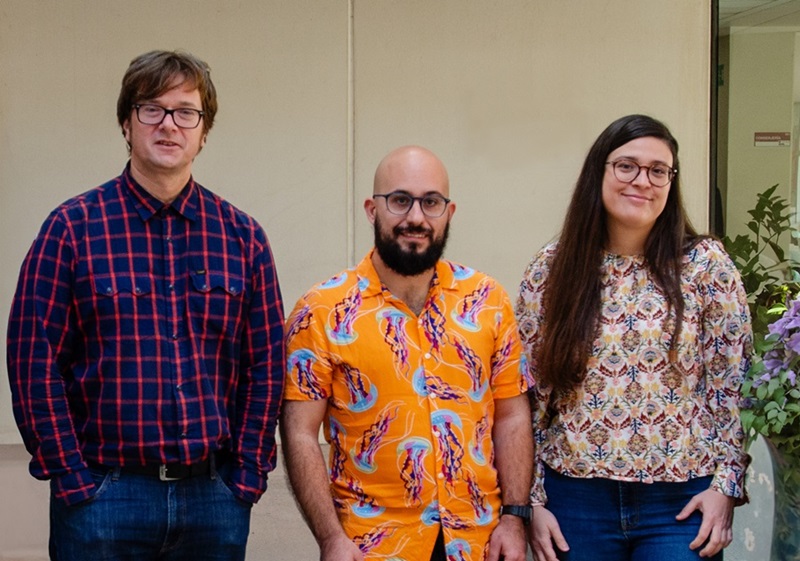
Photo: The researchers from the Institute for Neurosciences CSIC-UMH Ramón Reig, Javier Alegre Cortés, and María Sáez.
The brain never rests: even during deep sleep or under anesthesia, it maintains rhythmic electrical activity known as slow oscillations. A team from the Sensory-motor Processing by Subcortical Areas laboratory, led by Ramón Reig at the Institute for Neurosciences, a joint center of the Spanish National Research Council (CSIC) and the Miguel Hernández University (UMH) of Elche, has discovered what determines the direction of these waves. The study, published in iScience, reveals that the key lies not in anatomical structure, as previously thought, but in the degree of neuronal excitability.
The discovery was made possible thanks to an advanced computational model that combines two levels of analysis: the local activity of isolated neural networks and the global interaction between different brain areas. “Until now, most studies have worked on those two scales separately. The novelty of our approach is that we analyzed them together, which allowed us to see how local differences fade when networks are connected”, explains Reig, who co-led the study with researcher Javier Alegre Cortés.
The model showed that when several brain areas connect, differences among them tend to synchronize, following the rhythm set by the most excitable region. “It’s like what happens in a classroom: each student may have their own style, but if someone sets a trend, the others end up following”, Alegre illustrates. This concept of a neuronal ‘leader’ helps explain why, despite the diversity of properties across brain regions, slow waves ultimately propagate in a coordinated manner.
The researchers demonstrated that brain slow waves are not guided solely by anatomy, but also by the degree of excitability of specific neurons. “Our model predicted that the direction of oscillations depended on which neuronal group was most excitable at a given moment, and we confirmed it with experiments in mice”, notes Reig. When they increased excitability in the occipital lobe of anesthetized mice by applying a cocktail of drugs that made neurons more active, they observed that the wave direction reversed: instead of traveling from the front to the back of the brain, they moved the other way around.
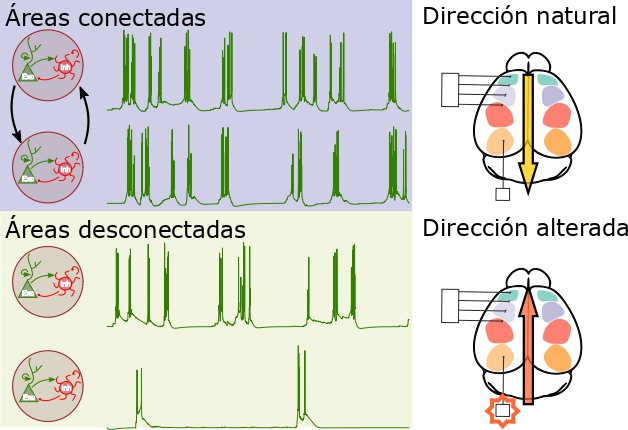
Slow brain waves propagate in a coordinated way across connected areas, guided not only by anatomy but also by neuronal excitability. Source: IN CSIC-UMH.
Under normal conditions, these oscillations play an essential role during deep sleep and anesthesia, as they help organize brain activity while at rest. However, when the mechanisms regulating them are altered, they may appear during wakefulness or transform into electrical patterns associated with epilepsy: “Understanding how excitability modulates these waves also provides clues to what happens when neuronal activity gets out of control”, the authors point out. In this study, simulations were carried out modifying the main factors that impact slow-wave activity in isolated or interconnected regions. The simulations successfully replicated different brain activity states, describing which factors are relevant at the local level and which at the global level.
Beyond the findings, this work also represents a methodological advance. The model used by the team is based on real data about the anatomy and physiology of the mammalian brain, enabling realistic simulations of how neural networks behave when connected. “Mathematical models complement experiments, making it possible to explore scenarios that are difficult to reproduce in the lab and to rigorously test hypotheses”, Alegre highlights.
“Global and local nature of cortical slow waves”. Alegre-Cortés J, Mattia M, Sáez M and Reig R. iScience. 28, 113213 (2025)
DOI https://doi.org/10.1016/j.isci.2025.113213
This work involved the collaboration of Maurizio Mattia from the National Center for Radiological Protection and Computational Physics in Rome (Italy) and was made possible thanks to funding from the Spanish State Research Agency, through the Severo Ochoa Centers of Excellence Program; the Ministry of Science, Innovation and Universities; the Miguel Hernández University through the Margarita Salas fellowship program; the Generalitat Valenciana; and Italy’s National Recovery and Resilience Plan (PNRR), funded by the European Union (NextGenerationEU).
Source: Institute for Neurosciences CSIC-UMH (in.comunicacion@umh.es)
La entrada A study by the Institute for Neurosciences CSIC-UMH reveals how the brain organizes and directs its slowest activity se publicó primero en Instituto de Neurociencias de Alicante.

La investigadora argentina Albana Gattelli acaba de ser presentada en el Centro Nacional de Investigaciones Oncológicas (CNIO) como beneficiaria de la última edición del programa Investigadores Visitantes de Fundación Occident. Gracias a este programa, Gattelli desarrollará hasta finales de octubre una colaboración con el Grupo de Interacciones Metabólicas del CNIO, encabezado por Guadalupe Sabio.
Gattelli es jefa de grupo en el Instituto de Fisiología, Biología Molecular y Neurociencia (IFIBYNE) del Consejo Nacional de Investigaciones Científicas y Técnicas (CONICET) en la Universidad de Buenos Aires (UBA), Argentina. Su trabajo se centra en estudiar los mecanismos que gobiernan la interacción entre la célula tumoral y el microambiente de la glándula mamaria.
En su colaboración con el CNIO, Gattelli explorará la forma en que las células tumorales del cáncer de mama interactúan con el tejido adiposo –tejido graso–. Concretamente, busca entender los mecanismos por los que se comunican las células del tejido adiposo, y que favorecen el desarrollo de las células tumorales Esos mecanismos podrían convertirse en una nueva área hacia la que dirigir futuros tratamientos contra el cáncer de mama, una enfermedad que supone la principal causa de muerte en mujeres a escala global.
Fundación Occident y el CNIO
El programa Investigadores Visitantes de Fundación Occident financia la estancia en el CNIO de un investigador que haya desarrollado su trabajo en un centro internacional de prestigio en los últimos cinco años. Estas visitas consolidan los lazos del grupo de investigación anfitrión con el del centro al que pertenece el investigador visitante, y permiten iniciar nuevas líneas de trabajo gracias al intercambio de ideas e intereses comunes.
La colaboración entre Fundación Occident y el CNIO se remonta a 2009. El programa ha hecho posible que el CNIO reciba la visita de David Goldgar; Rama Khokha; Mercedes Rincón; Astrid Laegreid; Maria Sibilia; Robert Benezra; Peter Petzelbauer; André Nussenzweig; Stephan A. Hahn; Patrick Sung; Chaitanya R. Divgi; Marcin Nowotny; Madalena Tarsounas; Raúl Rabadán; Wolfgang Weninger; Scott Lowe; Sonia Laín; Eva Nogales, Gonçalo Bernardes y Yardena Samuels.
Sobre el Centro Nacional de Investigaciones Oncológicas (CNIO)
El Centro Nacional de Investigaciones Oncológicas (CNIO) es un centro público de investigación dependiente del Ministerio de Ciencia, Innovación y Universidades. Es el mayor centro de investigación en cáncer en España y uno de los más importantes en Europa. Integra a medio millar de científicos y científicas, más el personal de apoyo, que trabajan para mejorar la prevención, el diagnóstico y el tratamiento del cáncer.
Sobre Fundación Occident
Desde 1998, la Fundación Occident –hasta 2024 denominada Fundación Jesús Serra– es una entidad privada sin ánimo de lucro perteneciente a GCO (Grupo Catalana Occidente) creada en memoria de Jesús Serra Santamans, reconocido empresario y mecenas, fundador del grupo asegurador. La fundación cuenta con cinco líneas de actuación que articulan la acción de la entidad: Investigación, Empresa y docencia, Acción social, Deporte y Promoción de las artes. Dentro de la línea de investigación, su labor se centra en canalizar las labores de mecenazgo que el Grupo lleva desarrollando desde hace más de un siglo, promoviendo sus propios premios de investigación que reconocen la trayectoria investigadora de jóvenes científicos españoles en los ámbitos de la alimentación y la nutrición.
Además, promueve programas en los que acercan el conocimiento de expertos científicos internacionales a grupos de investigación españoles y otras colaboraciones en pro de los avances científicos en investigación cardiovascular y oncológica.
La entrada Albana Gattelli, investigadora visitante de Fundación Occidenten el CNIO, estudia la relación entre el tejido graso y el cáncer de mama se publicó primero en CNIO.
Xavier Luri Carrascoso is now officially the new director of the Institute of Space Studies of Catalonia (IEEC). Since September 1st, Luri has taken over from the previous director, Ignasi Ribas Canudas, who led the Institute from 2017 to 2025.
Since 2023, he has been a member of the European Space Sciences Committee, an institution that provides independent scientific advice on space science to entities such as the European Commission (EC) and the European Space Agency (ESA). His scientific activity is closely tied to ESA, as it mainly focuses on the Gaia mission, an astrometric satellite built by ESA with ICCUB and IEEC participation, designed to create the largest and most precise 3D map of our galaxy by observing over a billion stars.
Luri was one of the original proponents of the Gaia mission for its approval by ESA in 2001 and was a member of its scientific advisory group, the Gaia Science Team (2001–2007). Since 2014, he has played a key role in Spain’s contribution to the project, participating in research and development related to supercomputing, data processing, software development, and the calibration of luminosity, kinematics, and galactic dynamics.
Luri also has extensive experience in innovation and knowledge transfer. During the development phase of the Gaia mission, he participated in ESA development contracts that led to a patent for a data compression system and the creation of the spin-off company DAPCOM, of which he is a founder.
In addition to his research and innovation work, Luri has shown a strong commitment to science outreach, actively working to bring space science closer to society. Throughout his career, he has participated in numerous activities such as talks, workshops, and astronomical observations, and has led successful outreach projects like co-founding the Big Van Ciencia association.
In this new phase as director of the IEEC, Xavier Luri will lead the Institute’s strategy to continue positioning it as a reference institution in scientific research, technological development and innovation, and in promoting the space sector in Catalonia. The IEEC plays a key role in the implementation of Catalonia’s NewSpace Strategy, driven by the Government of the Generalitat.
Heartfelt thanks from ICCUB
From the Institute of Cosmos Sciences of the University of Barcelona, we wish to express our deepest gratitude to Dr. Xavier Luri Carrascoso for his dedication, commitment, and leadership over the years as director of our institute.
His vision, drive, and teamwork have been fundamental in growing ICCUB and consolidating it as a national and international research leader. It has been a privilege to walk alongside him, learning from his generous and inspiring approach.
As he begins this new chapter as director of the IEEC, we wish him every success and happiness in this new challenge. We are confident he will continue to leave a lasting mark, as he has with us, and will keep contributing with passion and excellence to the world of space science.