Author Archive

Professor Sonia Garel receives the 12th Remedios Caro Almela Prize for Research in Developmental Neurobiology

  • Sonia Garel’s research has reshaped the paradigm of brain development by revealing the role of corridor cells and microglia in the formation of neuronal circuits.
  • The Remedios Caro Almela Prize recognizes, every two years, scientific excellence in developmental neurobiology and is endowed with €25,000.

The award ceremony for the 12th Remedios Caro Almela Prize for Research in Developmental Neurobiology took place today in the Assembly Hall of the Institute for Neurosciences (IN), a joint center of the Miguel Hernández University of Elche (UMH) and the Spanish National Research Council (CSIC). The Rector of UMH, Juan José Ruiz, and the Director of the Institute for Neurosciences, Juana Gallar, presented the award to Sonia Garel, Professor at the Collège de France, who leads the Brain Development and Plasticity laboratory at the Institut de Biologie de l’École Normale Supérieure in Paris (IBENS).

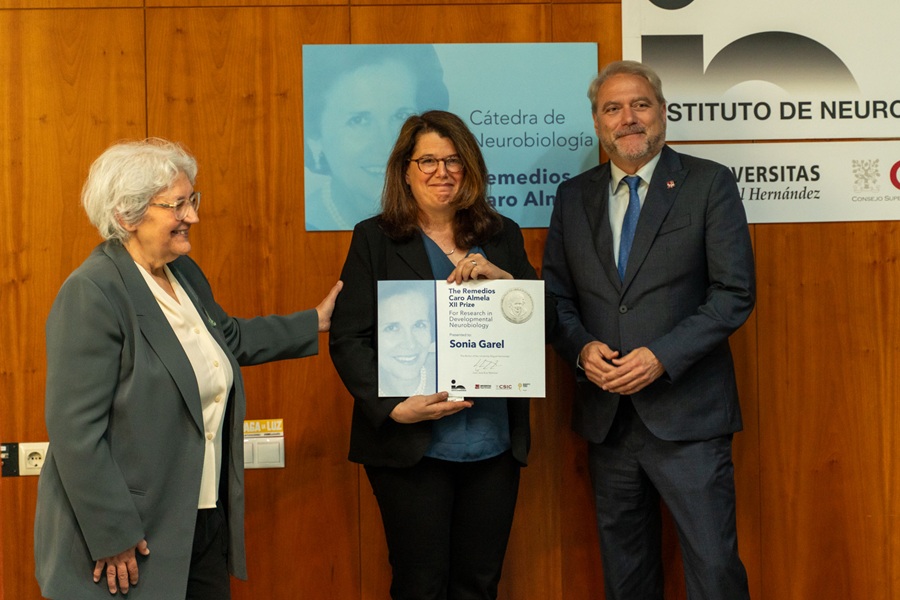
The Rector of UMH, Juan José Ruiz, and the Director of the IN UMH-CSIC, Juana Gallar, present the award to Professor Sonia Garel. Source: IN UMH-CSIC.

During the ceremony, remarks were also delivered by the Regional Director of Health of the Generalitat Valenciana in Alicante, Francisco J. Ponce Lorenzo, and the CSIC Vice President for Innovation and Knowledge Transfer, Ana Castro Morera. Following the reading of the jury’s decision, the awardee addressed the audience, emphasizing the collective nature of research: “This distinction reflects, above all, a shared effort built over years of work with students, collaborators, and colleagues. For me, research is a collective endeavor, grounded in the exchange of ideas and the joint construction of knowledge”.

A cellular choreography

Sonia Garel’s research focuses on understanding how the brain is built during development, a process that can be understood as a complex cellular choreography in which neurons, glial cells, and environmental signals interact with remarkable precision in space and time. Her work has helped transform the classical view of this process as a linear program, showing instead that it is a dynamic construction based on continuous interactions between cells, signals, and context.

Among her most influential contributions is the identification of the role of transient cell populations, such as the so-called corridor cells, which act as essential guides for axonal growth during the formation of brain circuits. These findings changed the way cortical development is understood by demonstrating that neuronal migration not only positions neurons but also actively participates in circuit organization by generating key signals at specific times and locations. Her work has also highlighted how early neuronal activity influences these processes, modulating neuronal movement, integration, and survival.

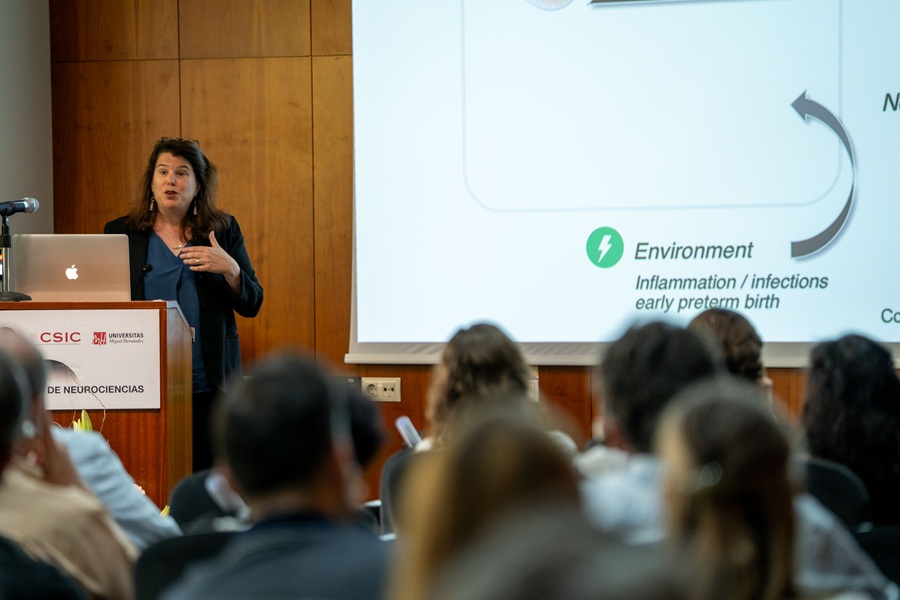
Professor Garel delivered the 12th Remedios Caro Almela Lecture, “Microglia in the early choreography of brain construction”, before the award ceremony. Source: IN UMH-CSIC.

Another central focus of her research has been the incorporation of microglia, the brain’s immune cells, into the study of neural development. Her team has shown that these cells do not act solely as sentinels, but as active participants in brain construction, regulating neuronal migration and network integration, as well as responding to external signals such as inflammation and the microbiota.

More recently, her work has revealed a protective role for microglia during brain morphogenesis, contributing to the preservation of tissue integrity under conditions of stress. Taken together, these findings provide a new framework for understanding how early interactions between cells and their environment influence brain function and vulnerability throughout life.

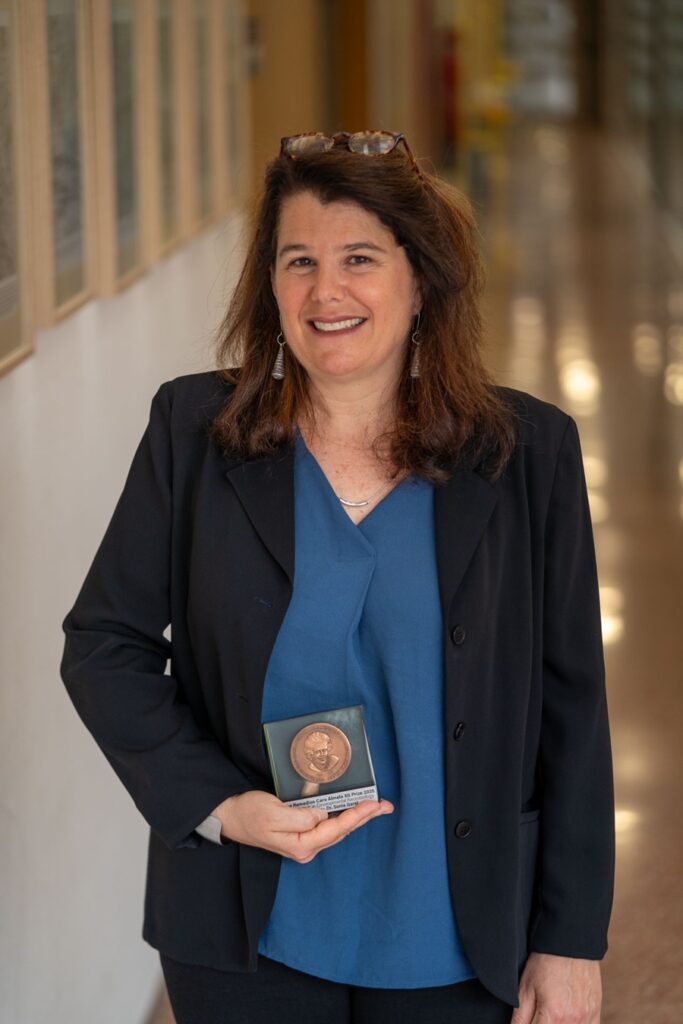
Professor Sonia Garel, awarded the 12th Remedios Caro Almela Award for Research in Developmental Neurobiology. Source: IN UMH-CSIC.

The aim of the Remedios Caro Almela Prize for Research in Developmental Neurobiology is to recognize the work of European researchers who have made particularly outstanding scientific contributions in this field and who are currently conducting cutting-edge research on the development of the nervous system. The biennial award is organized by the Institute for Neurociencias UMH-CSIC and the Miguel Hernández University of Elche, in collaboration with the Martínez-Caro family, and is endowed with €25,000.

Source: Institute for Neurociencias UMH-CSIC (in.comunicacion@umh.es)


La entrada Professor Sonia Garel receives the 12th Remedios Caro Almela Prize for Research in Developmental Neurobiology se publicó primero en Instituto de Neurociencias de Alicante.

Go to Source

Memorandum of Understanding signed between DIPC and Sejong University in South Korea

This agreement between Donostia International Physics Center (DIPC) and Sejong University establishes a strategic framework for developing fresh opportunities for joint research, and for promoting projects in emerging fields of physics, new materials and quantum technologies

Go to Source

Carolina Benedetti: Lluís Santaló Visiting Fellow 2026

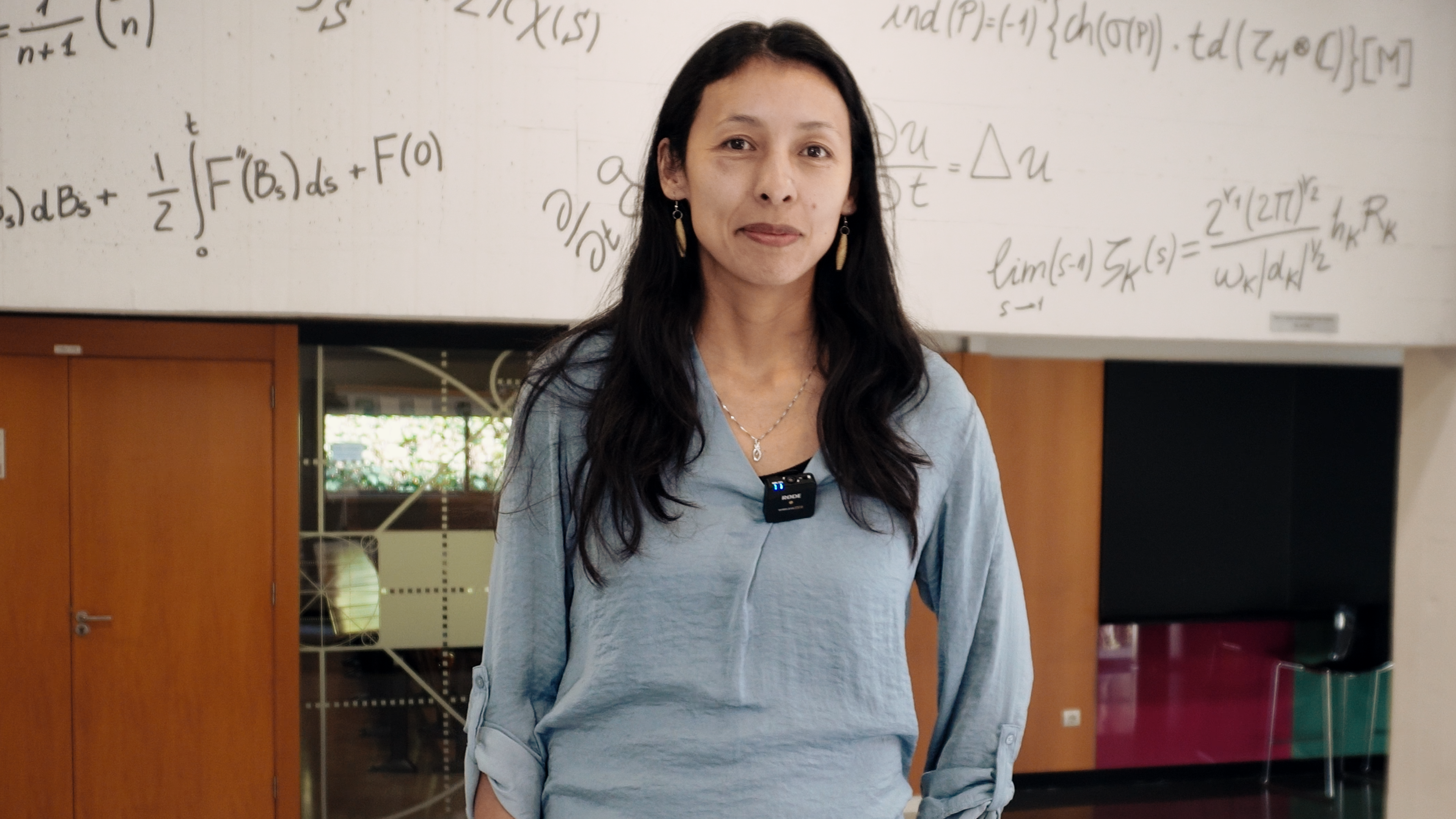
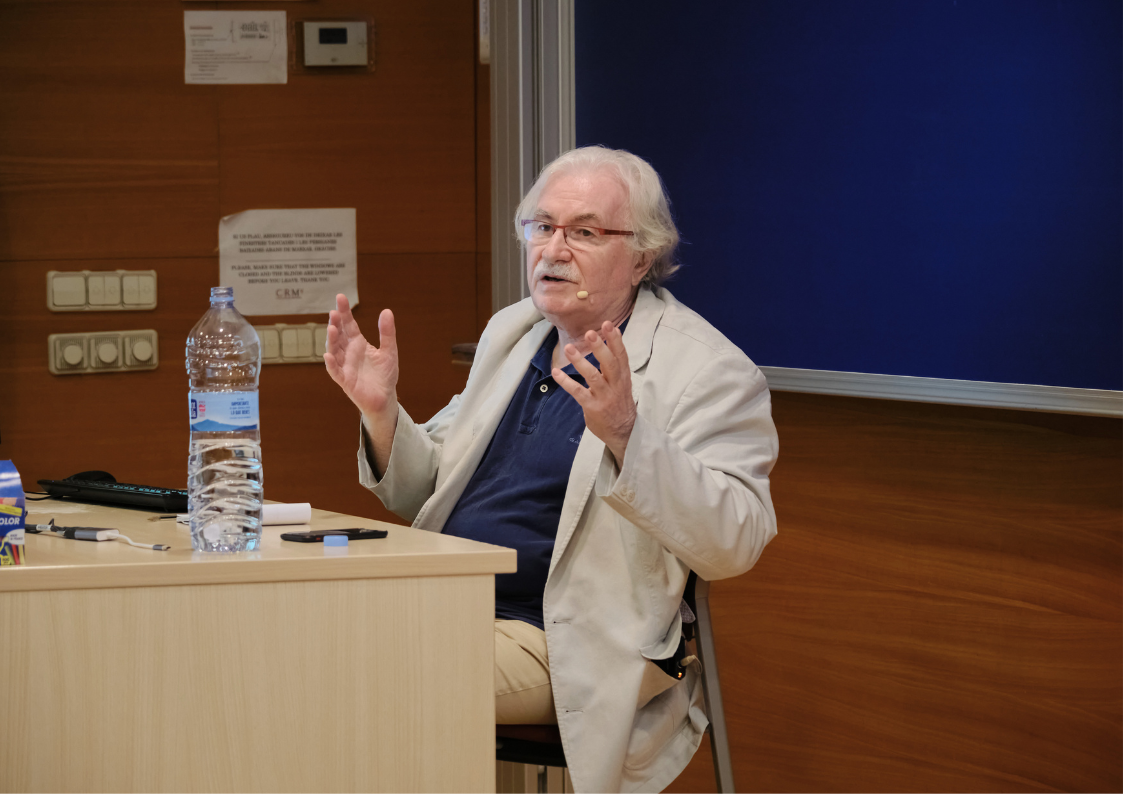
Carolina Benedetti, associate professor at the Universidad de los Andes in Bogotá, spent March at the CRM as a Lluís Santaló Fellow. A specialist in algebraic and geometric combinatorics, she is collaborating with Kolja Knauer (UB/CRM) on questions at the intersection of polytopes, permutations, and non-negativity.

Research runs on a resource that grant applications rarely mention. Funding can be estimated, and travel costs projected. Time is harder to account for: not calendar time, but the kind of accumulated, unhurried hours in which a mathematical conversation can go wrong, restart, and find its way somewhere neither person expected. A week at a conference, however stimulating, rarely produces that. You teach, you listen, you have lunch with people you have been meaning to contact for years, and the week ends before any of it has had time to settle.

In October, Carolina Benedetti came to Barcelona exactly like that. She was one of two invited lecturers at the CRM’s Research School on Combinatorial Geometries and Geometric Combinatorics, a week-long intensive course that brought together more than fifty researchers from institutions across three continents. Each morning, she gave one of her five minicourse sessions. Each afternoon, she sat through the parallel course or worked with participants in the exercise sessions that filled most of the schedule. In the evenings, she went back to the hotel and prepared the next day’s class. “Teaching my class, attending the other talks, trying to digest a little of what was happening, going back to the hotel, preparing the next day’s class, and repeat,” she says. Ideas surfaced. Names got written down. There was no room to follow anything further.
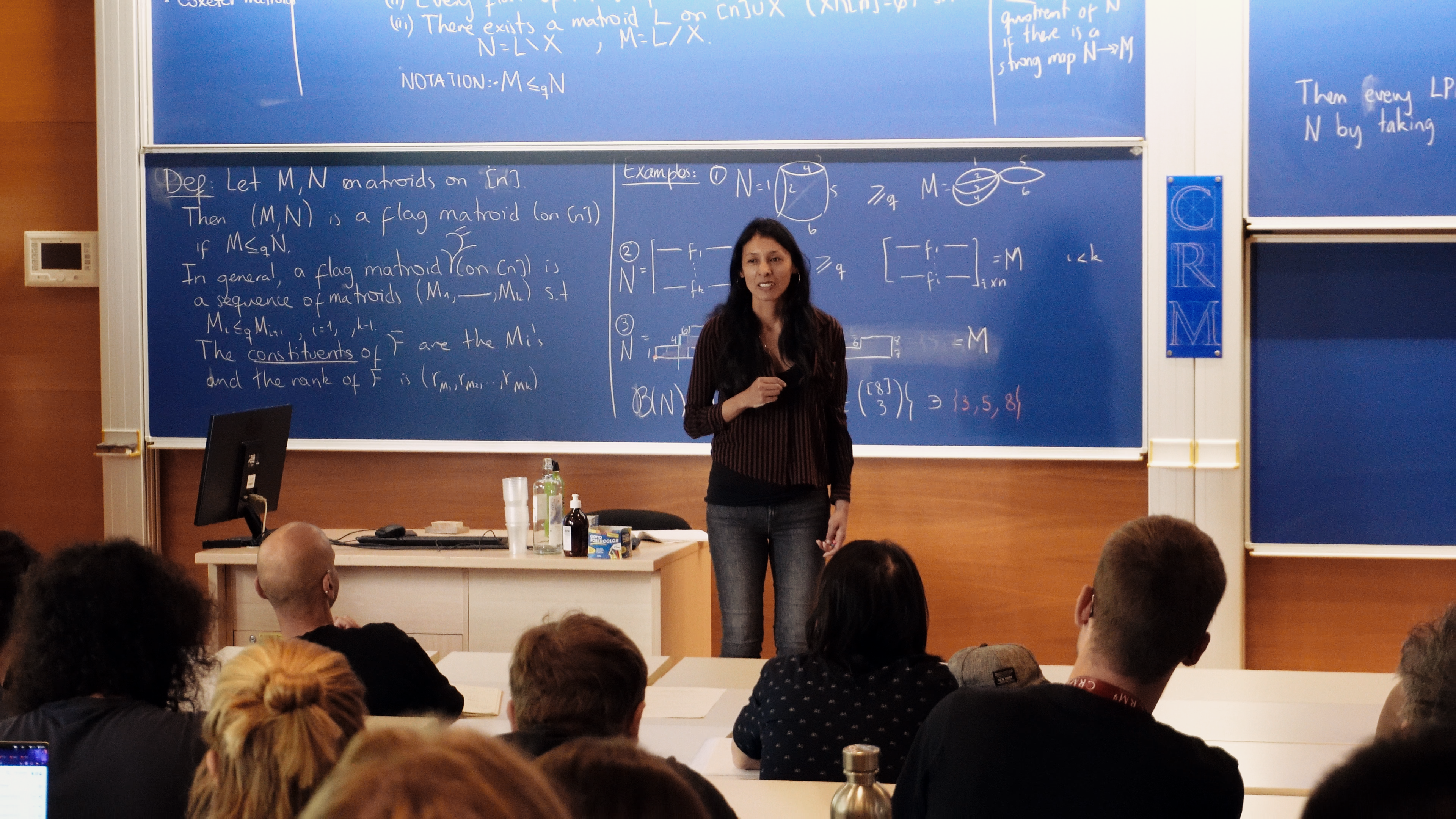
What a research stay offers is something more basic: the chance to actually be somewhere with enough time to work. Ideas that appeared during a week of intensity can, weeks later, be picked up and examined properly. Collaborations that felt promising at a conference dinner can be tested against a real problem, in a shared room, over several mornings. “The difference is really enormous,” Benedetti says. She is back in Barcelona now, this time as a Lluís Santaló Fellow at the CRM, and things, she says, are materialising.


Discrete objects, multiple angles

Benedetti works at the intersection of algebraic and geometric combinatorics. The objects that interest her are discrete: finite sets with algebraic or geometric structure, rather than continuous curves or surfaces. Permutations (the different ways to arrange a set of elements) are a recurring protagonist. So are matroids, which are abstract structures that generalise the notion of independence in linear algebra, and positroids, a specific subfamily with particularly rich geometric properties that has drawn considerable attention in recent years for its connections to non-negativity in tropical geometry.
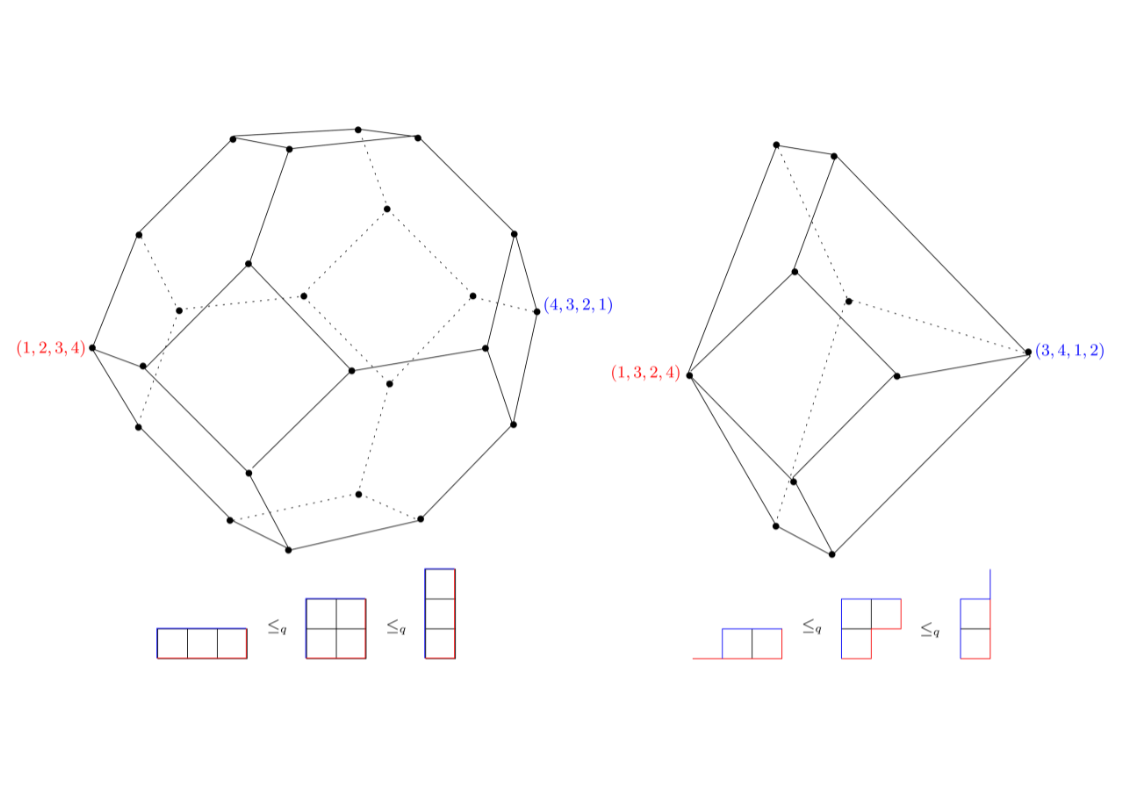
Two geometric realisations of permutation structure on four elements. Each vertex represents a permutation (labelled in red and blue), and edges connect permutations differing by a simple adjacent swap. The left figure shows the full permutohedron on 24 vertices, with dotted lines indicating an internal combinatorial decomposition. The right figure presents a constrained substructure, where only a subset of permutations is retained, yielding a reduced polytope. The diagrams below encode the associated partial order on combinatorial shapes (Young diagram–like objects), illustrating how these geometric configurations reflect an underlying order relation.

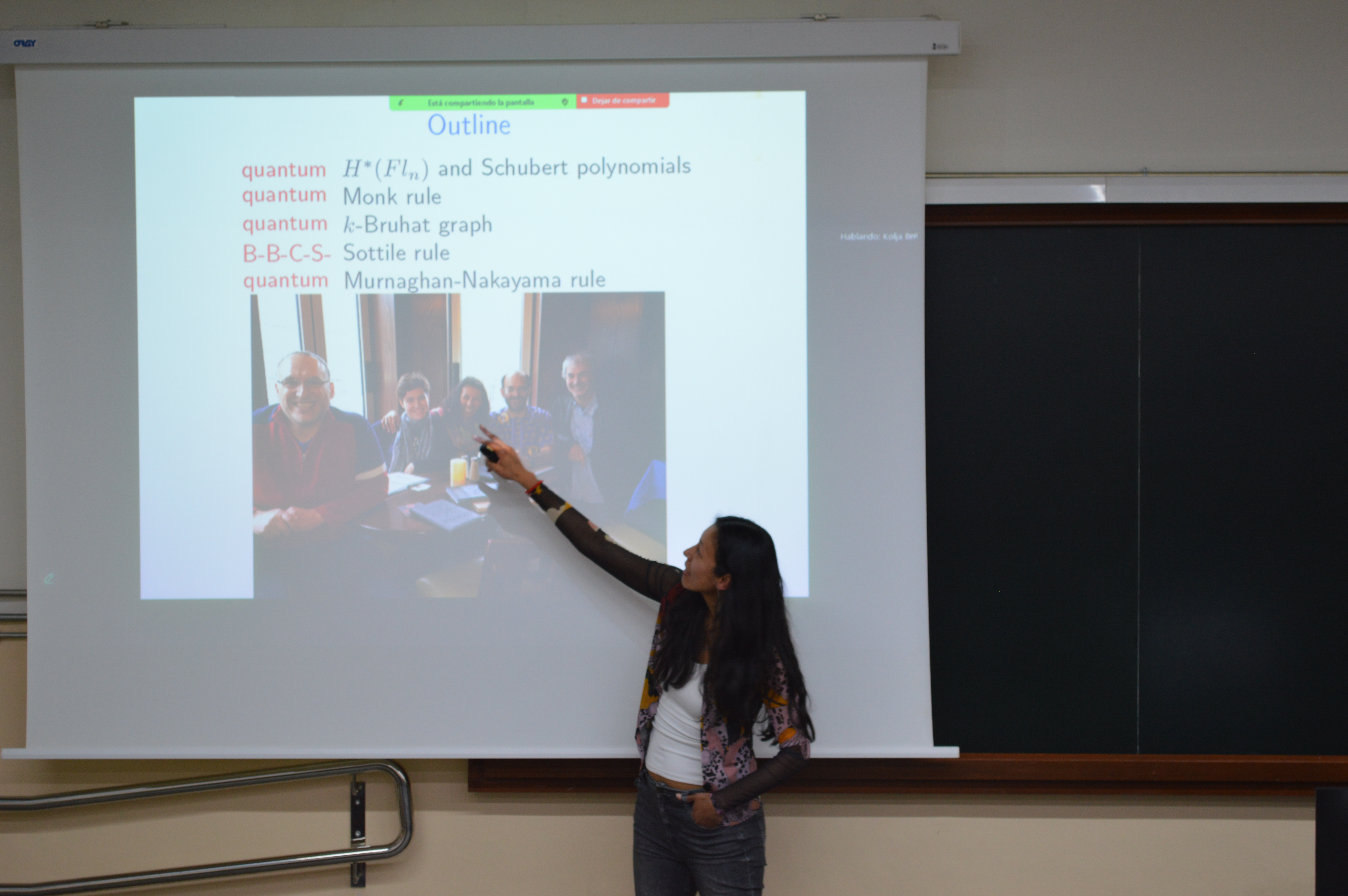
The reach of these objects is broader than it might look. In algebraic geometry, there is a classical problem of counting how many points lie at the intersection of certain spaces called Schubert varieties. The geometry involved is complicated and difficult to manipulate directly. What Benedetti’s work shows is that permutations and the operations between them can encode the answer. “With combinatorics you can respond to certain problems,” she explained at the 5 Talks in Combinatorics thematic day held at the Universitat de Barcelona on 18 March, “by forgetting that you are asking about the intersection of spaces, and simply focusing on how the underlying combinatorial objects reflect that intersection problem.” Her talk, on the combinatorics of products of quantum Schubert polynomials, drew on threads that go back to her doctoral work in Toronto and connect directly to what she is building now.
Her October minicourse at the CRM covered different territory: flags of matroids and positroids, and in particular what can be said about subdivisions of the flag polytope D_n into flags of lattice path matroids. The course introduced participants to positroids, flags of matroids, the corresponding polytopes, and the structural properties that make them interesting objects to subdivide. It ended with a set of open problems, some of them fresh from her current work. That, it turned out, was not just a rhetorical device. Several of the researchers who sat in that room in October are now working on those problems with her.

“It is not the same when you have the chance to collaborate in person, because that is where a little more of the magic actually happens.”

The current collaboration with Knauer, Deligeorgaki and Giardino grew directly from that week, though it has roots that go further back. Knauer and Benedetti first crossed paths during the pandemic, in Bogotá, in the kind of encounter that is almost impossible to engineer deliberately. He was visiting; she was there; they started talking about mathematics. What they found was that they were looking at some of the same objects from genuinely different angles. Benedetti’s approach is more combinatorial, focused on the discrete structures and their properties. Knauer’s tends toward the order-theoretic, more interested in the partially ordered sets that underlie those structures. “He has a different point of view on how I approach the discrete objects we have in common,” she says. “That was complementary.” A paper on lattice path matroids followed. Then further meetings. Then this month.

What the four of them are investigating now concerns polytopes whose vertices are permutations, objects that carry a double life: geometrically, they are polyhedra in high-dimensional space, and algebraically, they arise from vector spaces. The question pulling the group forward has to do with a notion of non-negativity in those spaces, and whether the structure of the underlying partially ordered sets can be used to understand it better than the polytopes alone allow. It is, by Benedetti’s own account, work that is still finding its shape. That is precisely what this kind of stay is for.


Mathematics is not done the same way everywhere

Benedetti did her PhD at York University in Toronto, held a postdoctoral position at Michigan State University, and has been back in Bogotá since 2023, teaching at Los Andes. Each move, she says, added something harder to name than technical breadth: a feel for which tools from which tradition fit which problem. Before Canada, she barely spoke English, a prerequisite for working internationally. Beyond language, each country had a different centre of gravity. In Canada, algebra dominated everything. “Algebra is like the queen there,” she says. The approach she encountered in Toronto bore little resemblance to what tends to go usually under the name of combinatorics, where counting and enumeration have traditionally been more central. Spain adds another angle again. One of the things a career built on moving between communities gives you, eventually, is the ability to recognise which version of a problem you are looking at.

Back in Colombia, Benedetti is one of the people behind two initiatives that have shaped how the country’s mathematical community sees itself. As founder of Círculos Matemáticos Colombia, she works to bring mathematical thinking to students and communities well outside the university circuit. And as a member of the Comunidad Colombiana de Combinatoria, a network whose growth owes a great deal to the mathematician Federico Ardila, she has been part of an effort to show that Colombian mathematicians can work at the highest level without leaving their culture at the door. “Mathematics is not done the same way everywhere,” Benedetti says, and that has something to do with idiosyncrasy, with music, with how people celebrate, with the particular texture of where you grew up.

The Lluís Santaló fellowship carries its own version of that logic. Santaló (born in Girona, 1911; died in Buenos Aires, 2001) was a Catalan mathematician who, like thousands of others, had to leave Spain when the Civil War ended and settle elsewhere. He chose Argentina, arriving in 1939, and spent the rest of his career there, first in Rosario, then in Buenos Aires, building what became one of the founding contributions to integral geometry and leaving a mark on an entire generation of Argentine mathematicians. He also cared, throughout his life, about mathematical education and about making mathematics visible beyond the university walls.

The CRM fellowship that bears his name was created specifically for researchers from Latin American institutions, to make collaboration between Latin America and Europe a little less costly than it would otherwise be. The distance is real, the expense is real, and the asymmetry of who gets to travel to whom is real. A programme that exists to push against that carries genuine weight. “To make something with lasting impact from an unfortunate situation,” Benedetti says of Santaló’s story. “That is an honour.”

She adds, without much elaboration, that there is now a new wave of mathematicians moving from the Americas towards Europe for reasons that are not entirely different from Santaló’s. The fellowship named after him has been running since 2011. It keeps finding new reasons to matter.

Watch the full interview with Carolina Benedetti Velásquez on the CRM YouTube channel.

___________________________________________________

The Lluís Santaló Visiting Fellowship call for 2027 stays is currently open. The application deadline is 30 April 2026. More information here.

Newsletter

Get the latest CRM news and activities delivered to your inbox

Subscribe now

Recent newsletters →
Carolina Benedetti: Lluís Santaló Visiting Fellow 2026

Carolina Benedetti: Lluís Santaló Visiting Fellow 2026

Carolina Benedetti, associate professor at the Universidad de los Andes in Bogotá, spent March at the CRM as a Lluís Santaló Fellow. A specialist in algebraic and geometric combinatorics, she is collaborating with Kolja Knauer (UB/CRM) on questions at the intersection…

Sant Jordi 2026 al CRM

Sant Jordi 2026 al CRM

Per celebrar Sant Jordi hem demanat a la gent del CRM que ens recomani un llibre. Un. El que tingueu al cap ara mateix. Set persones han respost, i entre les set han aconseguit cobrir quatre idiomes, almenys tres segles i cap gènere repetit….

Yves Chevallard (1946–2026)

Yves Chevallard (1946–2026)

Yves Chevallard passed away on 16 March 2026. He was 79 years old. Born in Tunis, he trained at the École normale supérieure in Paris, where he earned an agrégation de mathématiques. He went on to become a professor at Aix-Marseille Université, and it was there, over…

One Day, One Family, One Place: Poisson Geometry at CRM

One Day, One Family, One Place: Poisson Geometry at CRM

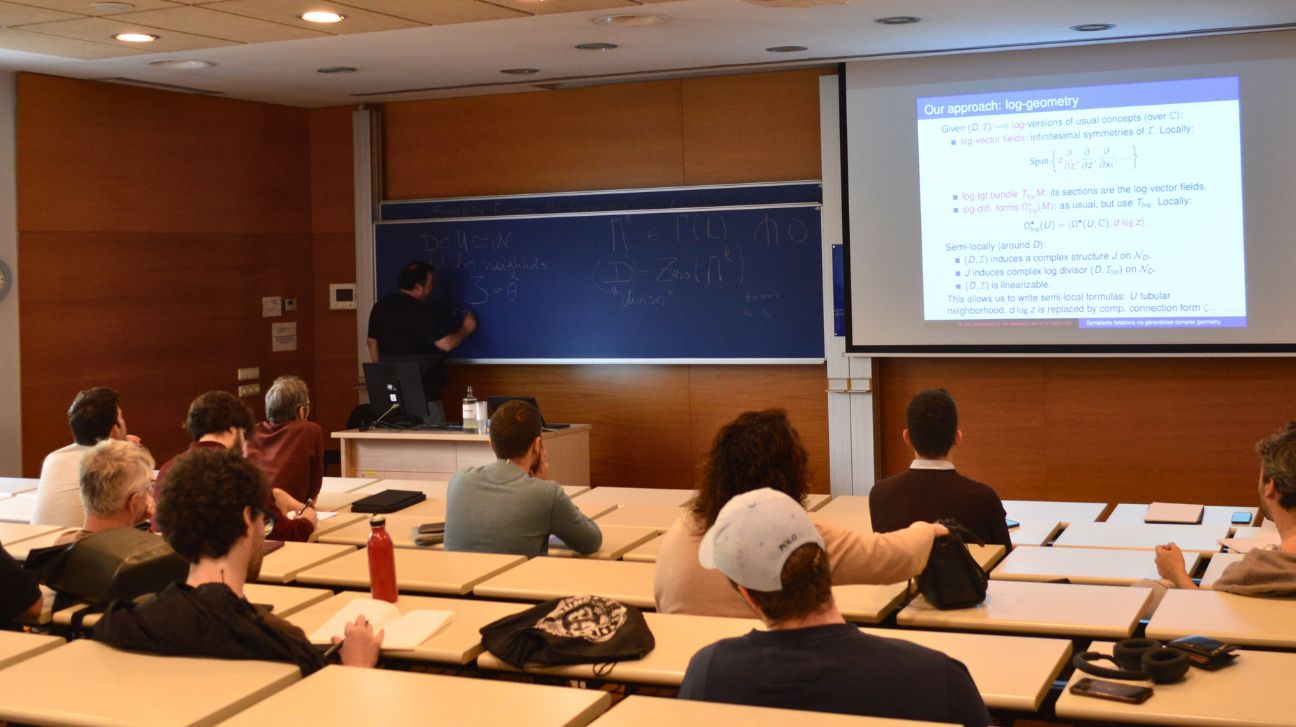
On March 23rd, 2026, the Centre de Recerca Matemàtica hosted the thematic day “Poisson Geometry and Its Relatives”, a full‑day event that brought together researchers exploring Poisson geometry and several of its neighbouring areas. The programme combined classical…

CRM Comm

Pau Varela

CRMComm@crm.cat


The post Carolina Benedetti: Lluís Santaló Visiting Fellow 2026 first appeared on Centre de Recerca Matemàtica.

Go to Source

Extractivism in Myanmar causes severe social and emotional impacts beyond environmental damage

More than half of extractive conflicts in Myanmar are associated with stress-related health problems and emotional distress, alongside livelihood loss, displacement, and environmental degradation. This is one of the main findings of a study led by researchers May Aye Thiri and Joan Martinez-Alier from ICTA-UAB.

Go to Source

Seminar by David Berenstein (U. California, Santa Barbara)

Image
seminar ICCUB
Seminar

Seminar by David Berenstein (U. California, Santa Barbara)

Date
Place
Pere Pascual V5.07 Room

Abstract: TBA

Go to Source

New Laser-Fabrication Method for On-Site Detection of Heavy Metals in Water

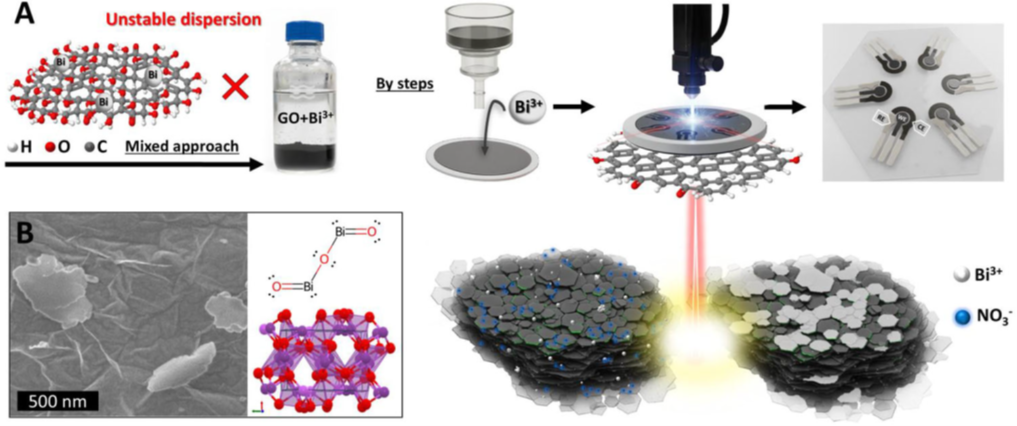
A team of ICN2 researchers has developed a laser-assisted method to produce nanosensors for fast and sensitive detection of water contaminants such as lead, cadmium, and copper.

Go to Source

Gradient Day

Go to Source

Sant Jordi 2026 al CRM

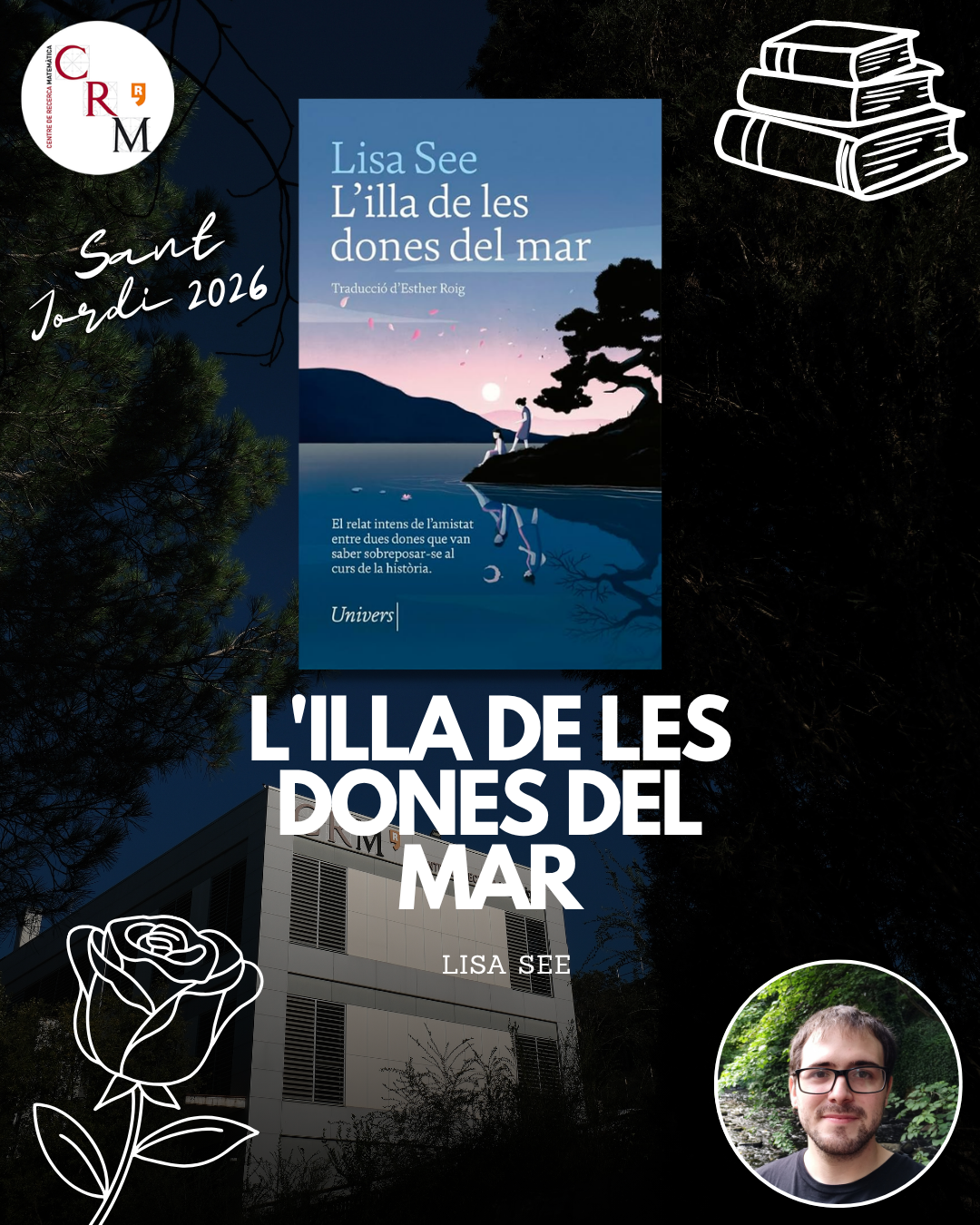
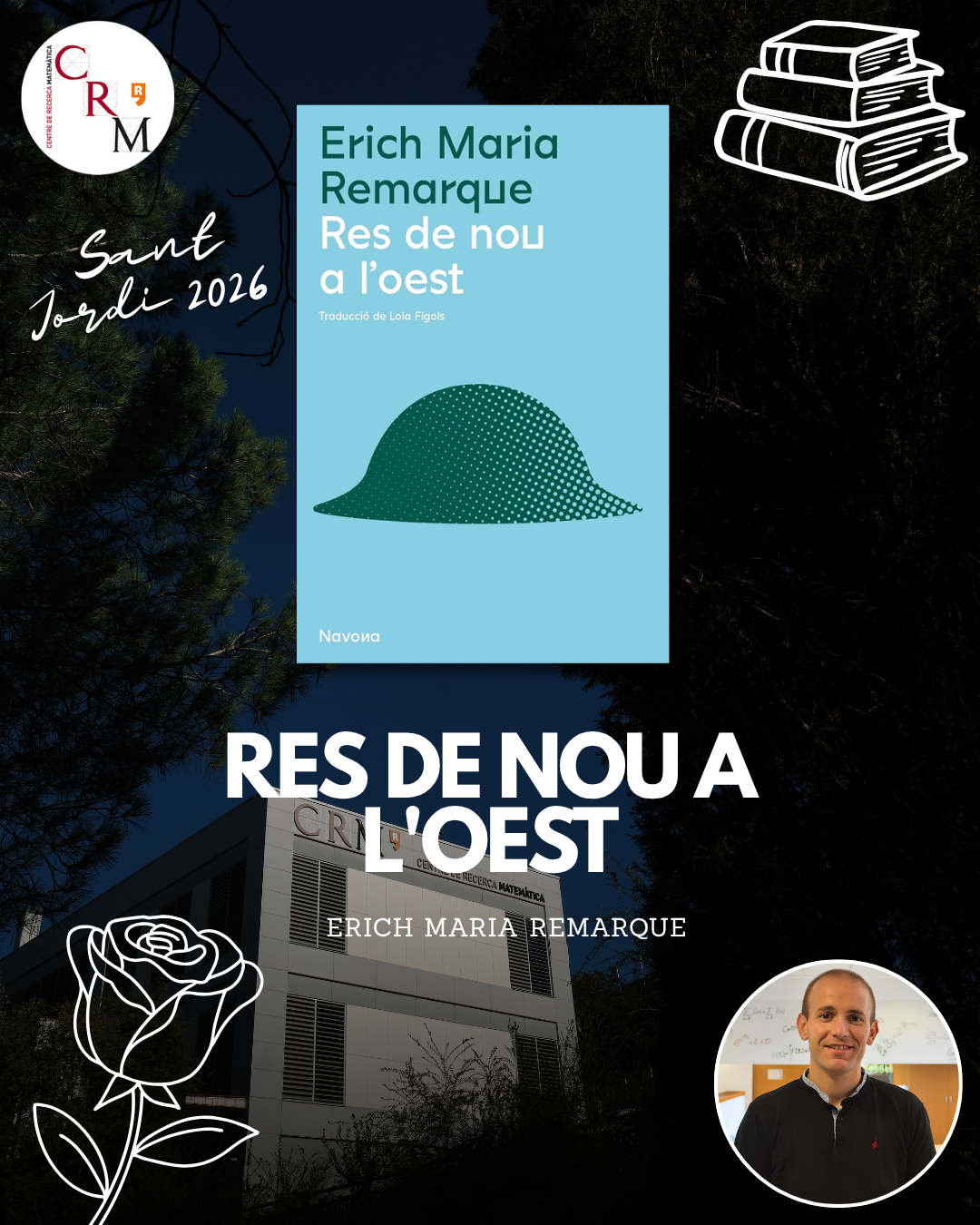
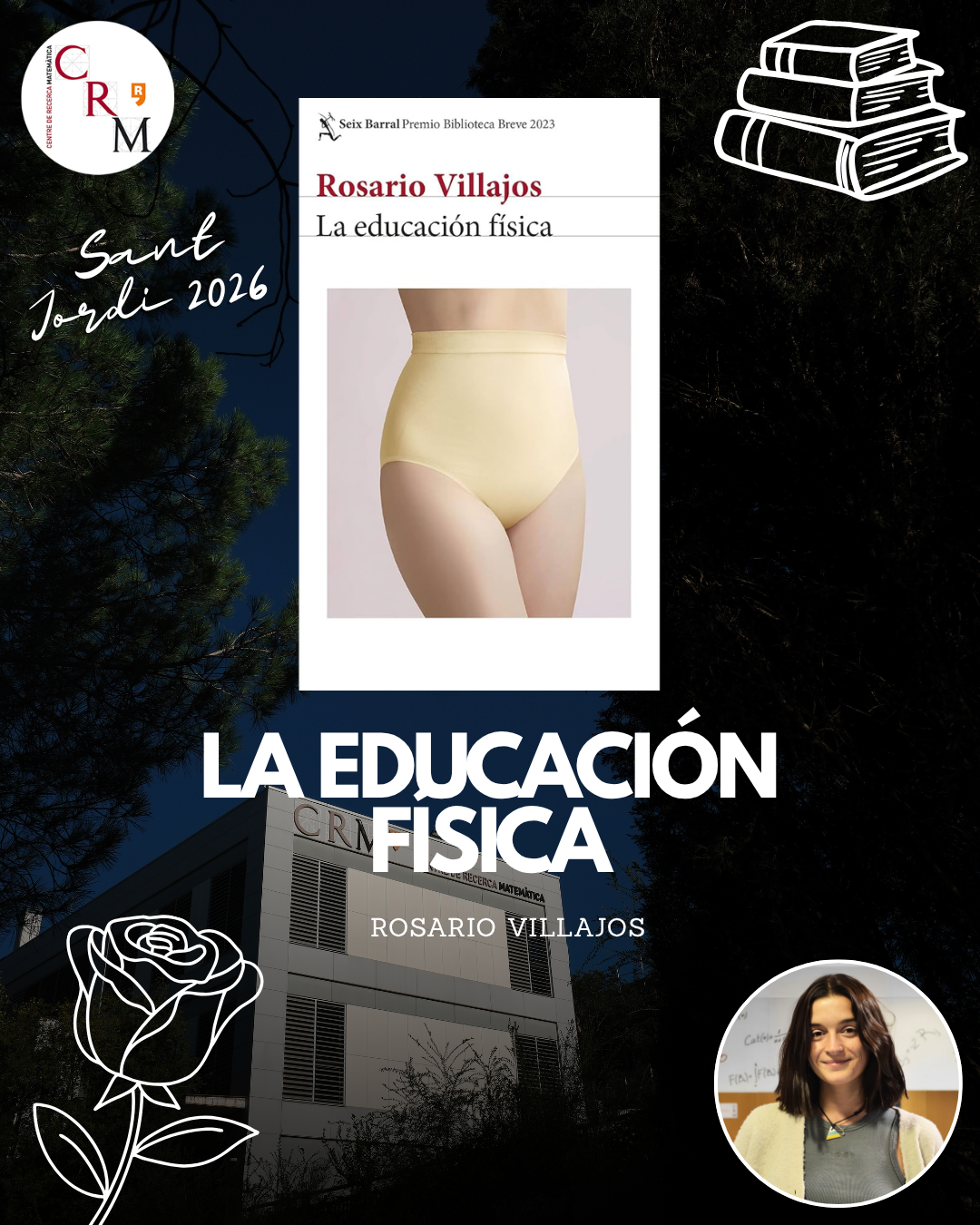
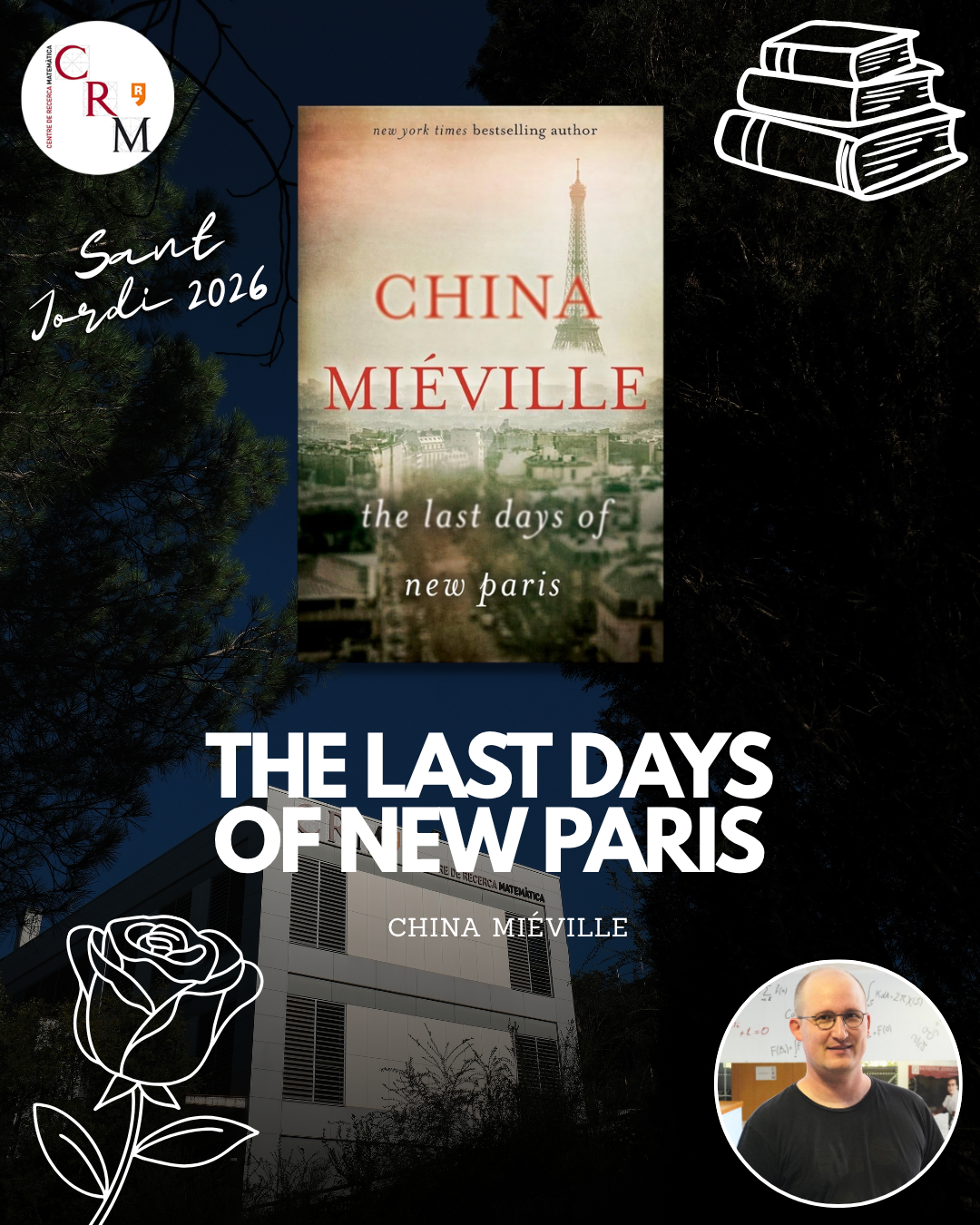
Per celebrar Sant Jordi hem demanat a la gent del CRM que ens recomani un llibre. Un. El que tingueu al cap ara mateix. Set persones han respost, i entre les set han aconseguit cobrir quatre idiomes, almenys tres segles i cap gènere repetit. Ciència-ficció, filosofia cartesiana, ficció literària, un clàssic antibèl·lic, surrealisme bèl·lic, estoïcisme i una novel·la sobre cossos de dona. Tot en una sola llista.

Tomàs Sanz proposa L’illa de les dones del mar, de Lisa See.

“L’argument central és la relació de dues amigues a l’illa de Jeju (Corea), em va agradar molt perquè a través de l’argument explica la societat matriarcal de les haenyeo i la història de Corea al segle XX.”

Tomàs Sanz proposa L’illa de les dones del mar, de Lisa See.

“L’argument central és la relació de dues amigues a l’illa de Jeju (Corea), em va agradar molt perquè a través de l’argument explica la societat matriarcal de les haenyeo i la història de Corea al segle XX.”

Dídac Gil torna als clàssics amb Res de nou a l’oest, d’Erich Maria Remarque.

“Les vivències i impressions d’un soldat que ens apropa l’absurd d’un front on la vida es desfigura fins quedar desconeguda. Lectura que hauria de ser obligatòria per tots aquells que veuen la guerra com una cosa necessària i/o inevitable.”

Amaia Vielba recomana La educación física, de Rosario Villajos.

“Explica muy bien cómo se ha utilizado nuestro propio cuerpo (el de las mujeres) en nuestra contra desde que somos pequeñas.”

Jens-Bastian Eppler proposa The Last Days of New Paris, de China Miéville.

“A wildly imaginative novel where surrealist art comes to life and joins the fight against the Nazis in an alternative, fantastical version of Paris during late World War II.”

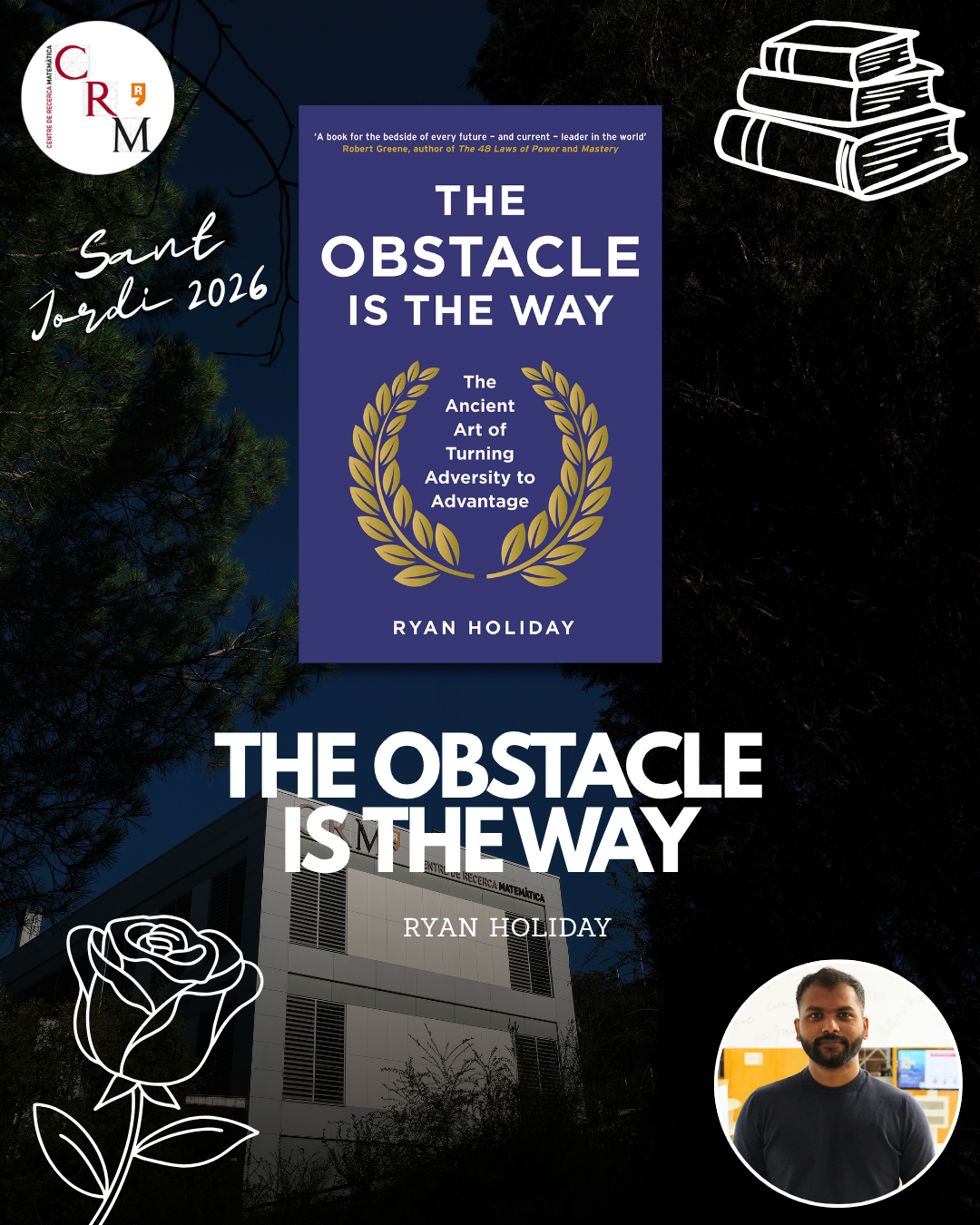
Udayraj Thorat recomana The Obstacle Is the Way, de Ryan Holiday.

“It provides a powerful Stoic reminder: ‘See things for what they are, do what you can, and endure what you must’.”

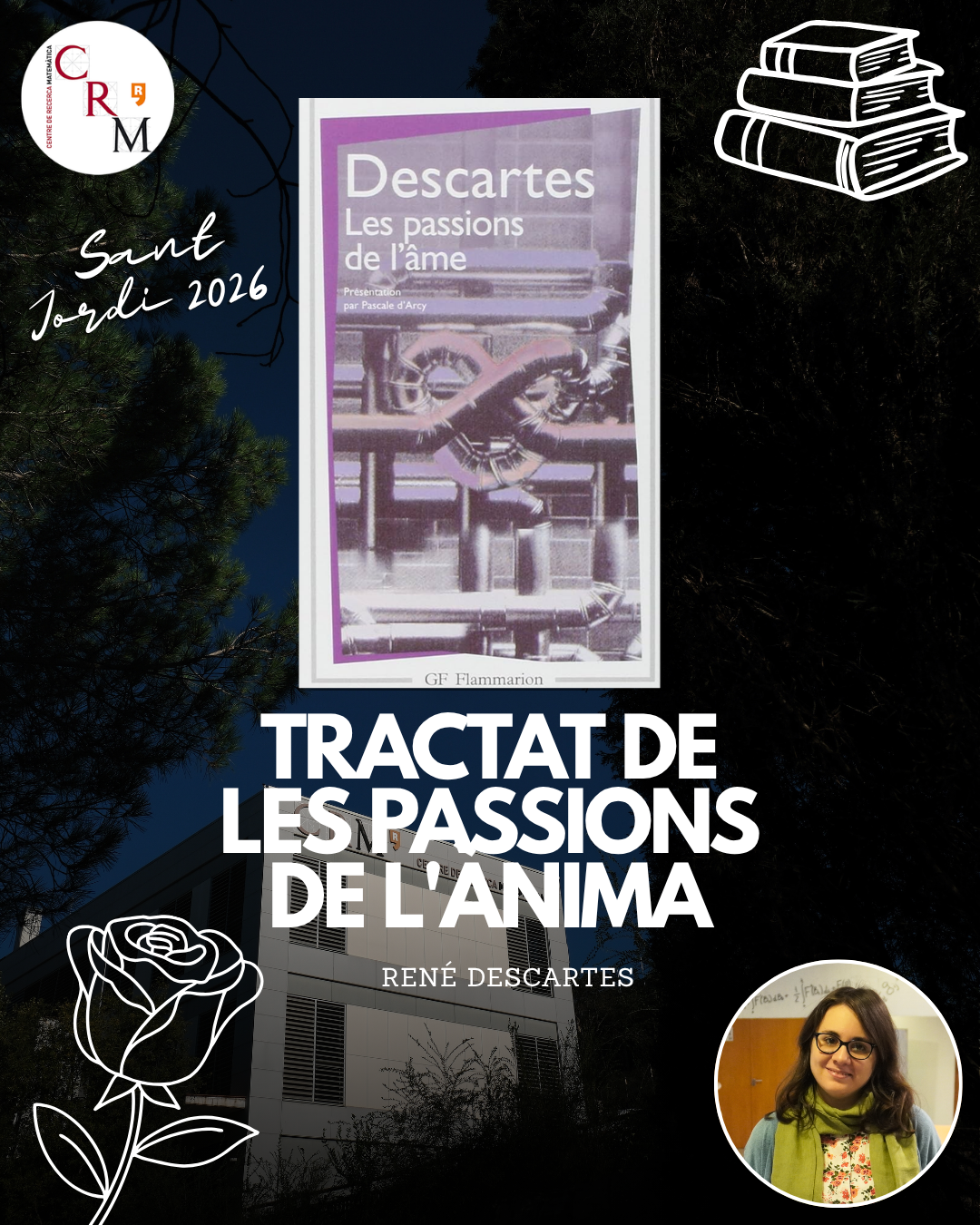
Natalia Vallina proposa el Tractat de les passions de l’ànima, de René Descartes.

“Quan un dels grans matemàtics i filòsofs del segle XVII intenta explicar les emocions humanes bàsiques (admiració, amor, odi, desig, alegria i tristesa) des d’una ment matemàtica, amb un enfocament quasi científic i fisiològic.”

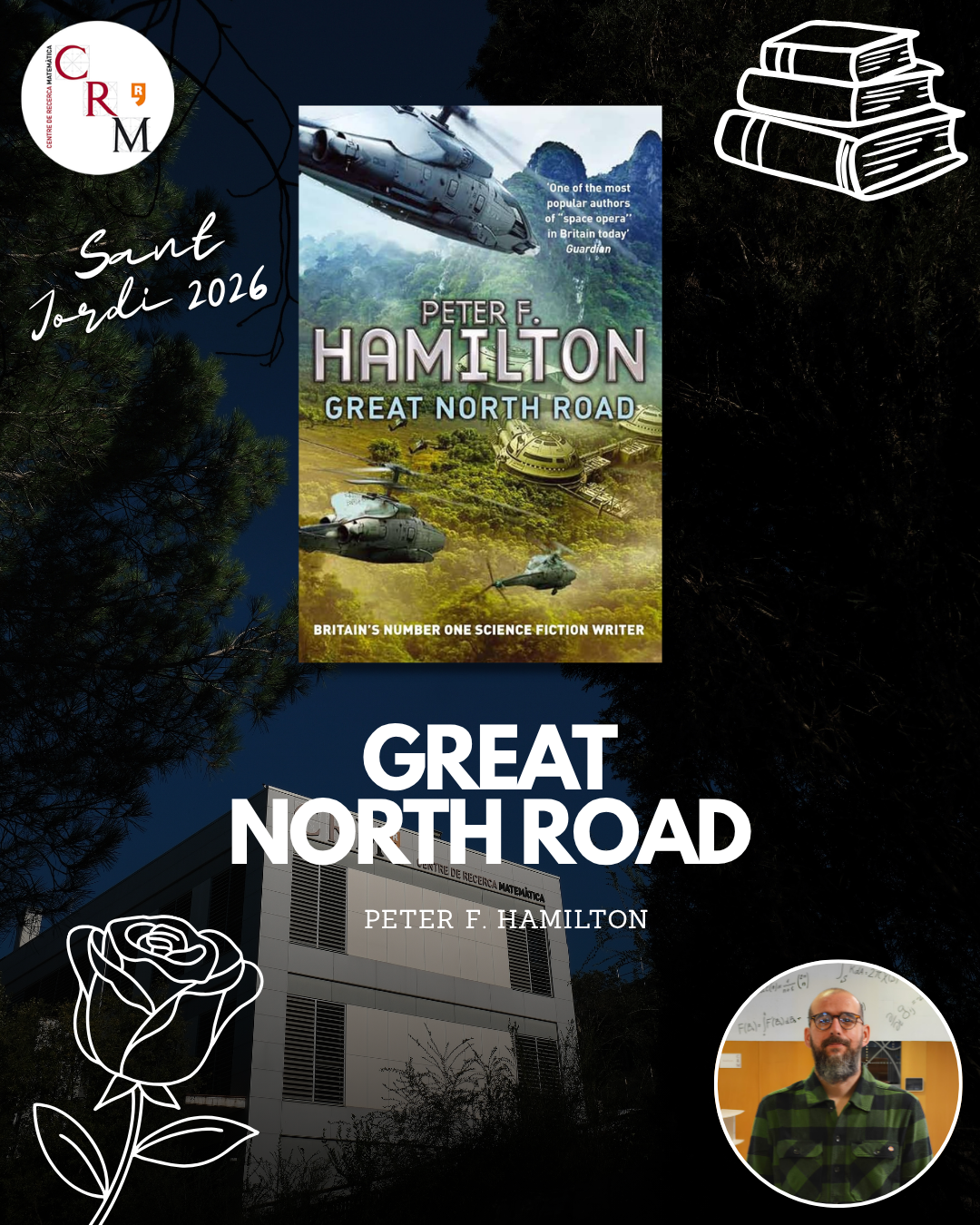
Pau Varela tanca la llista amb Great North Road, de Peter F. Hamilton.

“És d’aquelles novel·les mastodòntiques que es guanyen cada pàgina: un misteri policiac, un trencaclosques de xenobiologia i una distopia corporativa tot plegat, en un futur brut i versemblant a parts iguals.”

Sant Jordi 2026 al CRM

Sant Jordi 2026 al CRM

Per celebrar Sant Jordi hem demanat a la gent del CRM que ens recomani un llibre. Un. El que tingueu al cap ara mateix. Set persones han respost, i entre les set han aconseguit cobrir quatre idiomes, almenys tres segles i cap gènere repetit….

Yves Chevallard (1946–2026)

Yves Chevallard (1946–2026)

Yves Chevallard passed away on 16 March 2026. He was 79 years old. Born in Tunis, he trained at the École normale supérieure in Paris, where he earned an agrégation de mathématiques. He went on to become a professor at Aix-Marseille Université, and it was there, over…

One Day, One Family, One Place: Poisson Geometry at CRM

One Day, One Family, One Place: Poisson Geometry at CRM

On March 23rd, 2026, the Centre de Recerca Matemàtica hosted the thematic day “Poisson Geometry and Its Relatives”, a full‑day event that brought together researchers exploring Poisson geometry and several of its neighbouring areas. The programme combined classical…

Life After the PhD: Three Roads Forward

Life After the PhD: Three Roads Forward

On March 18, the BGSMath held its first session on careers after a PhD in mathematics, bringing together three speakers with different professional trajectories and 46 early-career researchers from nine institutions.On March 18, the Barcelona Graduate School of Math…

CRM Comm

Pau Varela

CRMComm@crm.cat


The post Sant Jordi 2026 al CRM first appeared on Centre de Recerca Matemàtica.

Go to Source

PsychoBeers “What Works and What Doesn’t in the Classroom.”

PsychoBeers
El próximo miércoles 29 de marzo, PsychoBeers tendrá una sesión dedicada a la educación bajo el título “Qué funciona y qué no en las aulas”. Las charlas comenzarán a las 20:30 h en la Sala Planta Baja. 
Seguir leyendo

Go to Source

VIII Jornadas de Investigación CIMCYC: “Ciencia al servicio de la sociedad”

jornadas ciencia al servicio de la sociedad
Los días 11 y 12 de junio el CIMCYC celebrará sus VIII Jornadas de Investigación: “Ciencia al servicio de la sociedad”, centradas en la transferencia del conocimiento.
Seguir leyendo

Go to Source

VIII Research Conference: “Science at the Service of Society”

jornadas ciencia al servicio de la sociedad
On June 11 and 12, the CIMCYC will hold its VIII Research Conference: “Science at the Service of Society,” focusing on knowledge transfer.
Seguir leyendo

Go to Source

PsychoBeers “Qué funciona y qué no en las aulas”

PsychoBeers
El próximo miércoles 29 de marzo, PsychoBeers tendrá una sesión dedicada a la educación bajo el título “Qué funciona y qué no en las aulas”. Las charlas comenzarán a las 20:30 h en la Sala Planta Baja. 
Seguir leyendo

Go to Source

Sidebar