
Author Archive
CIMCYC Talks “The Influence of Gender Stereotypes on the Neural Processing of Words and Faces”
.png?itok=bP3hSQyB "cimcyc talks francesa pescialrelli")
The Master in Cognitive and Behavioral Neuroscience invites to the CIMCYC Talks “From “Doctor” to “Nurse”: The Influence of Gender Stereotypes on the Neural Processing of Words and Faces”, with Dr. Francesca Pescialrelli, researcher at the University of Modea and Reggio Emilia.
Seguir leyendo
Arranca “Las madres de la ciencia” para promover la comunicación científica en contextos vulnerables
 (1).jpg?h=4329dafd&itok=vaFuKBy1 "Madres de la ciencia")
La Unidad de Cultura Científica y de la Innovación del Parque de las Ciencias y un amplio consorcio de instituciones científicas y educativas andaluzas, en el que participa el CIMCYC, ponen en marcha «De la investigación a la práctica: las madres de la ciencia». Se trata de un proyecto piloto que une investigación y divulgación educativa con un enfoque social e inclusivo.
Seguir leyendo
“The Mothers of Science” Project Begins to Advance Scientific Outreach in Vulnerable Communitie
The Unit of Scientific Culture and Innovation at the Science Park of Granada and a large consortium of Andalusian scientific and educational institutions, in which the CIMCYC participates, are launching “From Research to Practice: The Mothers of Science.” This is a pilot project that connects research and educational outreach with a social and inclusive focus.
Seguir leyendo
El CIMCYC y Newtral colaborarán en un proyecto sobre psicología de la desinformación y algoritmos
.png?itok=tB8sh2vg "sesgos cognitivos desinformación")
El Centro de Investigación Mente, Cerebro y Comportamiento (CIMCYC) de la Universidad de Granada (UGR) y Newtral, el medio español especialista en fact-checking, se han aliado para desarrollar una investigación periodística, fundamentada en evidencia científica, sobre los mecanismos psicológicos involucrados en la desinformación.
Seguir leyendo
The CIMCYC and Newtral Partner for a Project on Disinformation Psychology and Algorithms
El Centro de Investigación Mente, Cerebro y Comportamiento (CIMCYC) de la Universidad de Granada (UGR) y Newtral, el medio español especialista en fact-checking, se han aliado para desarrollar una investigación periodística, fundamentada en evidencia científica, sobre los mecanismos psicológicos involucrados en la desinformación.
Seguir leyendo
CIMCYC Talks “The Influence of Gender Stereotypes on the Neural Processing of Words and Faces”
El Máster en Neurociencia Cognitiva y del Comportamiento invita a la CIMCYC Talks “From “Doctor” to “Nurse”: The Influence of Gender Stereotypes on the Neural Processing of Words and Faces”, con la Dra. Francesca Pescialrelli, investigadora en la Universidad de Modea y Reggio Emilia.
Seguir leyendo
Comienza 100xCiencia.9: “Ciencia para la Sociedad, Tocando conciencias”, el encuentro anual de los centros y unidades de excelencia de SOMMa
Los próximos 13 y 14 de noviembre, CaixaForum València será el escenario de la novena edición de 100xCiencia.9, el congreso impulsado por la Alianza SOMMa (Centros de Excelencia Severo Ochoa y Unidades de Excelencia María de Maeztu) bajo el lema “Ciencia para la Sociedad, Tocando conciencias”.
El evento reunirá a investigadores de referencia, responsables institucionales, profesionales de la gestión científica y representantes de la ciudadanía para reflexionar sobre cómo la ciencia puede contribuir a afrontar los grandes retos sociales, medioambientales y económicos de nuestro tiempo.
La inauguración oficial contará con la presencia de la ministra de Ciencia, Innovación y Universidades, Diana Morant, junto a representantes institucionales de la Generalitat Valenciana, la Agencia Estatal de Investigación (AEI), el Consejo Superior de Investigaciones Científicas (CSIC) y tres universidades valencianas —Universitat de València (UV), Universitat Politècnica de València (UPV) y Universidad Miguel Hernández (UMH)
Ciencia de excelencia con impacto social
El congreso 100xCiencia.9 se consolida como un escaparate de la excelencia científica en España y del impacto social del trabajo desarrollado por los centros y unidades acreditados con el sello de Excelencia Severo Ochoa (SO) y María de Maeztu (MM).
En esta edición, cinco instituciones de investigación de referencia de la Comunidad Valenciana con acreditación SO/MM actúan como anfitrionas: el Instituto de Agroquímica y Tecnología de Alimentos (IATA-CSIC), el Instituto de Ciencia Molecular (ICMol-UV), el Instituto de Tecnología Química (ITQ-UPV/CSIC), el Instituto de Física Corpuscular (IFIC-UV/CSIC) y el Instituto de Neurociencias (IN-CSIC/UMH).
Ponencias destacadas
El programa incluye ponencias invitadas de Avelino Corma, del Instituto de Tecnología Química (ITQ, UPV-CSIC), quien ofrecerá la conferencia “Nuestra visión desde el ITQ sobre el binomio generación de conocimiento y transferencia: un recorrido histórico”, y de Pilar Goya, del Instituto de Química Médica (IQM-CSIC), con la charla “Integridad en investigación: buenas prácticas científicas”.
Además, el congreso abordará temas como la relación entre ciencia, innovación y políticas públicas, la comunicación científica y la colaboración entre investigación y sociedad, con la participación de destacados expertos nacionales.
Un encuentro abierto a la ciudadanía
Con su enfoque participativo, 100xCiencia.9 no sólo se dirige a la comunidad científica, sino también a la sociedad. El programa incluirá actividades divulgativas y debates sobre sostenibilidad, salud, energía y cambio climático, acercando la ciencia al público general y fomentando un diálogo abierto entre conocimiento y sociedad.
Sobre SOMMa
La Alianza SOMMa (Severo Ochoa y María de Maeztu) agrupa a los centros y unidades de investigación de excelencia en España, reconocidos por su liderazgo internacional, su impacto científico y su contribución a la innovación. El objetivo de SOMMa es fortalecer la ciencia de excelencia, fomentar la colaboración interdisciplinar y aumentar el impacto social del conocimiento.
Fechas: 13 y 14 de noviembre de 2025
Lugar: CaixaForum València – Edificio Àgora, Ciutat de les Arts i les Ciències
Más información: https://100xciencia2025.com/
Obituario: Antonio García-Bellido
La vida profesional de Antonio, como le conocían sus estudiantes, colaboradores y compañeros de profesión, estuvo centrada en la mosca del vinagre, un organismo que desde comienzos del siglo XX ha sido utilizado en estudios de genética. Utilizando este modelo experimental, Antonio pudo realizar numerosas conexiones entre los genes y los procesos de desarrollo que sufrimos todos los organismos multicelulares, que esencialmente implican la transición desde un estado unicelular (el “cigoto”) a una estructura muy compleja y perfectamente dimensionada formada por millones de células organizadas en tejidos y órganos.
Antonio vivió en una época científica llena de sólidos avances y transformaciones conceptuales, siendo testigo tanto de la cimentación de la Biología Molecular en los años 60 del siglo XX, como de la secuenciación de los genomas en los años que rodean al cambio de siglo y la explosión de técnicas analíticas y de imagen de gran poder descriptivo y precisión que dominan el panorama actual.
Durante estas transformaciones conceptuales, Antonio mantuvo una fijación en explicar los procesos de desarrollo en términos de las actividades de las células dirigidas por su información genética. Las etapas formativas de Antonio García-Bellido le permitieron exponerse a las escuelas de pensamiento más influyentes de su momento, empezando por la aproximación fisiológica de Vincent Wigglesworth en Cambridge, las técnicas más propias de la embriología experimental desarrolladas en Suiza por Ernst Hadorn y la genética que se realizaba en Estados Unidos por los que fueron sus colaboradores Edward Lewis y John Merrian.
Antonio fusionó estas aproximaciones en una moderna genética del desarrollo, dedicada al análisis de la contribución de los genes al desarrollo normal que alcanzó su máxima dimensión cuando el acceso a la secuenciación del ADN permitió determinar el alto grado de conservación que existe en la secuencia de los genes relevantes entre organismos tan diferentes como una mosca y un ser humano.
Antonio era una persona orgullosa de sus éxitos profesionales y a la vez carente de toda vanidad, pero es seguro que su máxima satisfacción fue poder disfrutar tanto de su legado familiar, representado por sus hijos Antonio, Juan, Diego y Elvira y sus numerosos nietos, como de su legado profesional que abarca no sólo a aquellos que tuvieron el privilegio de trabajar en su laboratorio, sino también a innumerables colegas a los que influyó de manera determinante con la fuerza de su personalidad, rigor, talento y dedicación a la tarea científica.
Jose Félix de Celis
Profesor de Investigación del CSIC en el CBM
La entrada Obituario: Antonio García-Bellido se publicó primero en Centro de Biología Molecular Severo Ochoa.
Postdoctoral positions at the University of Barcelona on Holographic Applications to Gravitational Waves
Several postdoctoral positions funded by Prof David Mateos’ Advanced ERC Grant are now open at the Institute of Cosmos Sciences at the University of Barcelona (ICCUB).
Selected candidates are expected to work with Profs David Mateos, Jorge Casalderrey-Solana and other members of the group on applications of Holography to Cosmology and Astrophysics, with a focus on Gravitational Waves.
Topics of interest include cosmological phase transitions, baryogenesis, neutron star mergers, spacetime singularities and holography with dynamical boundary gravity. Prior knowledge of holography is not required.
Faculty members at the ICCUB working on related topics include Pablo Bueno, Roberto Emparan, Bartomeu Fiol, Jaume Garriga, Cristiano Germani, Raul Jimenez, Raimon Luna, Javier Magan, Alessio Notari and Jorge Russo.
For information about research at the ICCUB visit http://icc.ub.edu
Appointments will begin in the Fall of 2026 for a period of 3 years. The deadline for applications is December 17th 2025.
The University of Barcelona is part of a group of European institutes with a centralized system of postdoctoral applications. Candidates should apply through the following website, choosing Barcelona as one of their preferred institutes:
https://academicjobsonline.
Equal Employment Opportunity Statement
The ICCUB is an equal employment opportunity employer. The ICCUB promotes a diverse and inclusive environment and welcomes applicants regardless of age, disability, gender, nationality, race, religion or sexual orientation. We strongly encourage women and underrepresented minorities in physical sciences to apply. For additional information please see the Diversity, equity and inclusion Commission.
The Institute for Neurosciences CSIC-UMH strengthens collaboration with the biotechnology industry through IN.Pulse Connect
The Institute for Neurosciences (IN), a joint center of the Spanish National Research Council (CSIC) and the Miguel Hernández University (UMH) of Elche, held today the first edition of IN.Pulse Connect, an event organized by IN.Pulse, the IN Scientific Unit for Business Innovation, with the support of the Institut Valencià de Competitivitat i Innovació (IVACE+i). The initiative aims to strengthen ties between academic research and the biotechnology business sector. The meeting was attended by the director of the UMH Scientific Park, Tonia Salinas Miralles, and the UMH Deputy for Research Management and Transfer, Javier Sáez Valero, the Head of the UMH Knowledge Transfer Service, David Úbeda González, and the Innovation Officer of the Elche and District Business Circle (CEDELCO), Rafael Hernández Stark, among other authorities.
The meeting, held in the Assembly Hall of the IN, brought together researchers from the Institute and representatives of twelve companies from the pharmaceutical, nutritional, and biomedical diagnostics sectors. Its purpose was to explore future public–private collaborations focused on technological development and the transfer of knowledge generated at the Institute. “At the IN, we want the knowledge we generate to directly contribute to improving people’s lives. IN.Pulse Connect was conceived as a space for encounter, trust, and opportunity, where science and industry can design real solutions together”, said Juana Gallar, Director of the Institute for Neurosciences, during the institutional welcome.
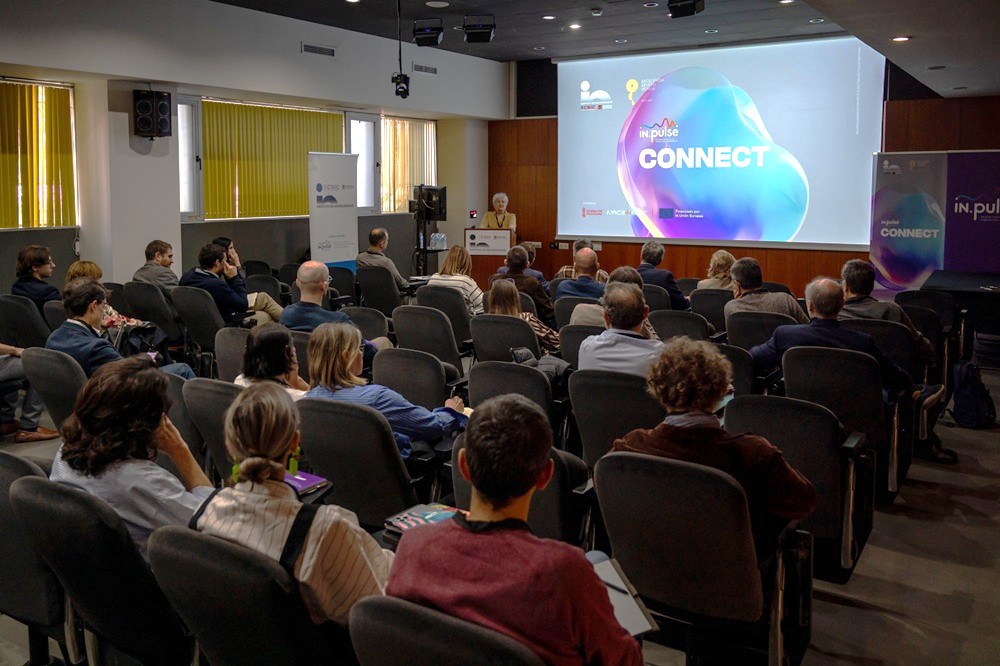
Photo: The Director of the CSIC-UMH Institute of Neurosciences, Juana Gallar, during the welcome session of the IN.Pulse Connect event. Source: IN CSIC-UMH
The event featured a keynote lecture by José María Frade, researcher at the Cajal Institute (CSIC) and founder of the biotech company Tetraneuron, titled ‘Tetraneuron: A Long Journey from Basic Science to the Clinic’. His talk served as an inspiring example of how fundamental research can turn into an innovative new therapy to fight Alzheimer’s disease.
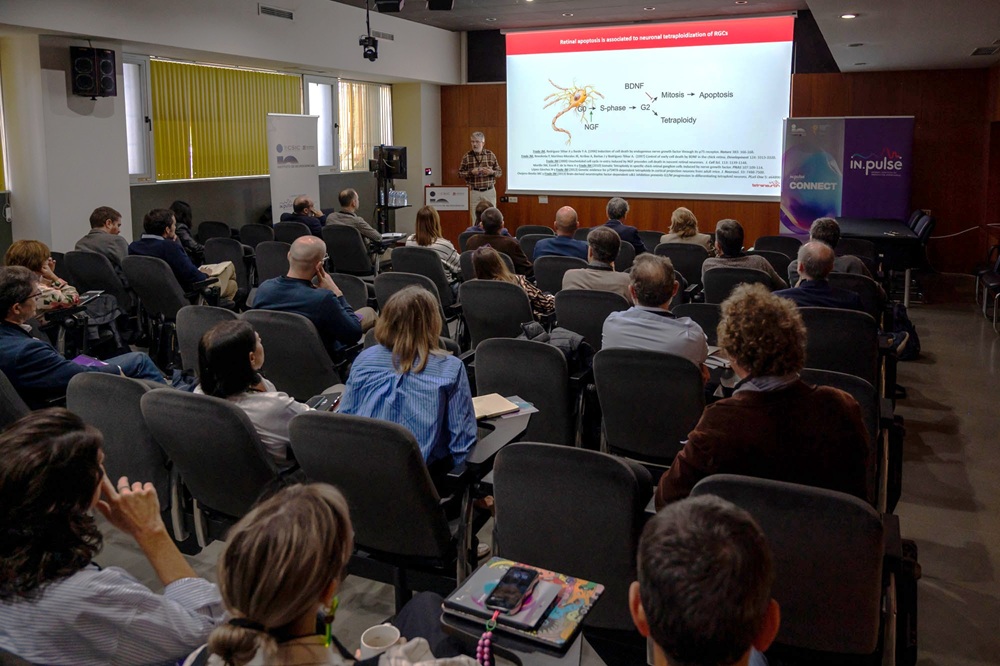
Photo: José María Frade, researcher at the Cajal Institute (CSIC) and founder of Tetraneuron, during the opening lecture. Source: CSIC-UMH
Following the keynote, IN researchers Hugo Cabedo, head of Molecular Control of Neuronal Axon Myelination laboratory; Santiago Canals, head of Plasticity Brain Networks laboratory; Inmaculada Cuchillo, senior researcher at Altered Molecular Mechanism in Alzheimer’s Disease and Dementia laboratory; Félix Leroy, head of Cognition and Social Interactions laboratory; Jose Vicente Sánchez-Mut, head of Functional Epi-Genomics of Aging and Alzheimer’s Disease laboratory; Silvia De Santis, head of Translational Imaging Biomarkers laboratory, and Remy Verhaeghe, postdoctoral researcher in the Plasticity and Remodeling of Neural Circuits laboratory, presented their research lines with transfer potential in areas such as nutraceuticals, imaging diagnostics, and new therapies. Each presentation was followed by an open discussion with company representatives, fostering the identification of common interests and potential collaboration projects.
The session concluded with an “Exploratory Coffee”, an informal networking space designed to encourage interaction and the exchange of ideas between researchers and business representatives.
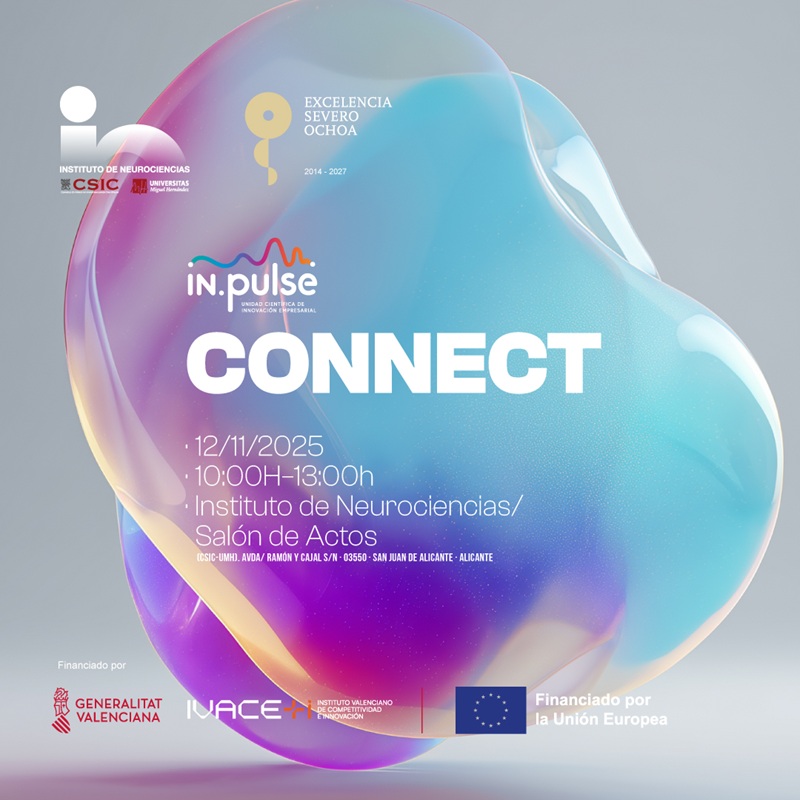 In this first edition of IN.Pulse Connect, companies from the food and pharmaceutical sectors, such as Vicky Foods and Grupo Ferrer, as well as from the healthcare sector, such as IMED Hospitales, participated. Biotechnology companies, including Aora Health, Avamed Synergy, Bioithas, Kenko Imalytics, Miramoon Pharma, Monteloeder, Oncovision, Tetraneuron, and Viva in Vitro, also took part, showing their interest in learning about the technological capabilities of the Institute of Neurosciences and exploring opportunities for joint innovation.
IN.Pulse Connect is part of the initiatives promoted by the IN Scientific Unit for Business Innovation (UCIE) with the support of IVACE+i. This Valencian Government agency fosters business competitiveness and the transfer of knowledge from research centers to the productive sector.
Source: Institute for Neurociencias CSIC-UMH (in.comunicacion@umh.es)
La entrada The Institute for Neurosciences CSIC-UMH strengthens collaboration with the biotechnology industry through IN.Pulse Connect se publicó primero en Instituto de Neurociencias de Alicante.