
Held at the University of Barcelona and the ALBA Synchrotron, the event brought X-ray diffraction specialists from across Spain together to share their expertise, discuss new challenges and explore recent advances.

Held at the University of Barcelona and the ALBA Synchrotron, the event brought X-ray diffraction specialists from across Spain together to share their expertise, discuss new challenges and explore recent advances.
The Juan de la Cierva Call 2024 has facilitated the incorporation of four postdoctoral researchers at the Institute of Chemical Research of Catalonia (ICIQ) to pursue their postdoctoral training. This initiative aims to support emerging scientists by offering them opportunities to develop their careers at leading Spanish R&D centers.
ICIQ is proud to welcome:
-Xavier Abel-Snape who joins Prof. Rubén Martin (JDC2024-053664-I)
-Raul Rojas will be at Prof. Antoni Llobet Group ( JDC2024-054773-I)
-Sergi Danés, at Prof. Julio Lloret-Fillot Group (JDC2024-055909-I)
-Estefanía Díaz will join Prof. Núria López (JDC2024-054994-I)
All researchers are set to make significant contributions to their respective fields, advancing cutting-edge projects under the mentorship of ICIQ’s research groups.
The Juan de la Cierva Grants, managed by Spain’s Ministry of Science, Innovation and Universities, aim to strengthen the careers of promising researchers while fostering excellence in R&D. By welcoming all of them, ICIQ continues to empower the next generation of scientists and drive innovation in chemistry and beyond.
These contracts are part of the grants funded by MCIU/AEI/10.13039/501100011033 and co-funded by the FSE+

La entrada ICIQ welcomes four postdoctoral researchers through Juan de la Cierva Grants se publicó primero en ICIQ.
Abstract: First-order phase transitions in the early Universe and inside neutron stars could leave observable imprints, including a stochastic gravitational wave background or characteristic waveforms in specific frequency ranges. Predicting these signals requires precise understanding of critical bubbles, often addressed using effective field theory or perturbation theory. In this talk, I will explain how the problem is tackled in the context of gauge/gravity duality, and show the explicit computation of (fully-backreacted) critical bubbles in a strongly coupled system. I will also discuss possible effective approaches to the problem, and compare the results of the different perspectives.
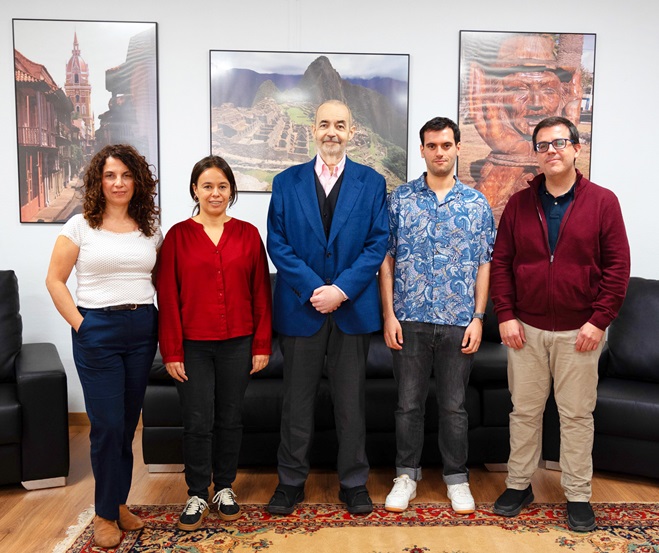
Photo: IN UMH-CSIC researchers Daniela Navarro, Mª Salud García Gutiérrez, Jorge Manzanares, Abraham Torregrosa and Francisco Navarrete. Source: IN UMH-CSIC
A new compound tested at the Miguel Hernández University of Elche (UMH) in Spain shows promising effects in reducing alcohol consumption and motivation to drink in mice, with marked sex-dependent differences in efficacy. Although MCH11 is not yet available for human use, it could pave the way for personalized treatments of alcohol use disorder.
The results, published in the scientific journal Biomedicine & Pharmacotherapy, are the outcome of four years of work by the Translational Neuropsychopharmacology of Neurological and Psychiatric Diseases Laboratory, led by Jorge Manzanares at the Institute for Neurosciences (IN), a joint center of UMH and the Spanish National Research Council (CSIC). The team is also affiliated with the Alicante Institute for Health and Biomedical Research (ISABIAL) and the Primary Care Addiction Research Network (RIAPAD).
“MCH11, a new monoacylglycerol lipase inhibitor, reduces ethanol consumption and motivation to drink in mice, with sex-dependent differences.” Torregrosa A B, García-Gutiérrez MS, Navarro D, Navarrete F and Manzanares J. Biomedicine & Pharmacotherapy (2025) 192, 118662.
Alcohol use disorder is one of the most prevalent addictions worldwide and causes approximately 2.6 million deaths annually. “However, current therapies show serious limitations”, says researcher Abraham Torregrosa, first author of the study. He explains that up to 70% of patients relapse into alcohol use within the first year of treatment.
To seek a more effective pharmacotherapy, the investigators focused on the endocannabinoid system, a signalling network linking the nervous system to the rest of the organism, and involved in the regulation of pleasure, motivation, and stress, all key processes in alcohol addiction. In people with alcohol use disorder, the system becomes imbalanced, reducing levels of molecules such as 2-arachidonoylglycerol (2-AG), which is implicated in well-being and impulse control.
The molecule studied at UMH, MCH11, acts as an inhibitor of monoacylglycerol lipase, an enzyme that degrades 2-AG. By blocking this enzyme, the amount of 2-AG available in the brain increases, reducing both the need to drink and withdrawal symptoms. “Our results show that MCH11 acts on nervous-system mechanisms that help control the drinking impulse, but without undesirable side-effects,” at least in mice and at the doses tested, explains UMH Professor Jorge Manzanares, study leader. “This finding is particularly relevant because impulsive behaviours are closely linked with the development and maintenance of alcoholism”, he adds.
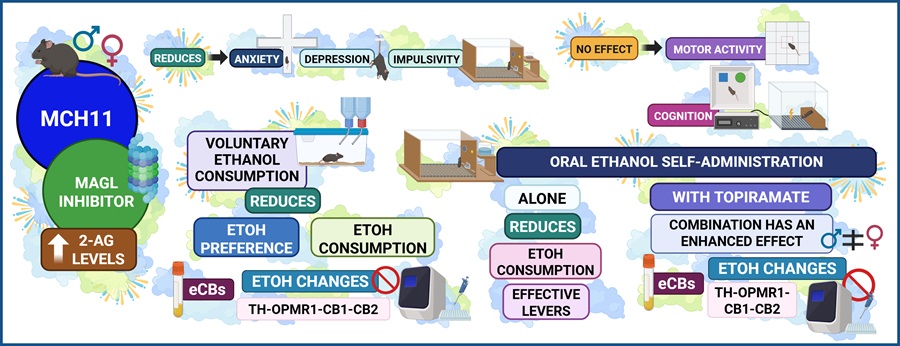
The compound MCH11 acts on the endocannabinoid system to reduce the drive to consume alcohol and the withdrawal symptoms in mice. Source: Biomedicine & Pharmacotherapy.
Treatment with MCH11 in mice was shown to be effective and selective, exhibiting anxiolytic and antidepressant properties without impairing motor or cognitive function. However, experiments revealed significant differences between sexes. “In males, the response to the treatment was effective at low and medium doses, while females required higher doses for similar effects”, explains Manzanares.
The improvement is visible not only behaviourally, but also genetically. “We know that certain genes are altered in alcohol use disorder, and we found via PCR analysis that MCH11 corrects these alterations in mice of both sexes, although females require a higher dose”, adds Torregrosa.
The team also tested a combined treatment of MCH11 with topiramate, a medication already used clinically for alcohol addiction. “We found that the combination of both compounds is the most effective,” notes Manzanares, who highlights MCH11’s potential as part of a personalized, sex-adapted combined therapy. “The results are very promising, but still preliminary; there is a long road from demonstrating drug efficacy in animal models to applying it in patients”, the UMH Professor concludes.
The research was made possible thanks to funding from the Ministry of Science, Innovation and Universities; the Spanish State Research Agency; the Severo Ochoa Program for Centers of Excellence; the RIAPAD network (Carlos III Health Institute); and ISABIAL.
Source: UMH Communications Service/ Institute for Neurosciences UMH-CSIC (in.comunicacion@umh.es)
La entrada Researchers at the Institute of Neurosciences UMH–CSIC demonstrate the effectiveness of a new treatment for alcoholism in mice se publicó primero en Instituto de Neurociencias de Alicante.
La entrada HVDC4ISLANDS impulsa la integración de energías renovables y la descarbonización de las redes eléctricas europeas se publicó primero en IMDEA ENERGÍA.
