Author Archive

Study reveals that the basic mechanisms of visual attention emerged over 500 million years ago

  • The superior colliculus, an ancestral brain structure, performs visual computations once thought to be exclusive to the cortex.
  • The study combines a novel approach using patterned optogenetics with electrophysiology, circuit mapping, and computational modelling to uncover how ancient brain circuits filter and prioritise visual information.
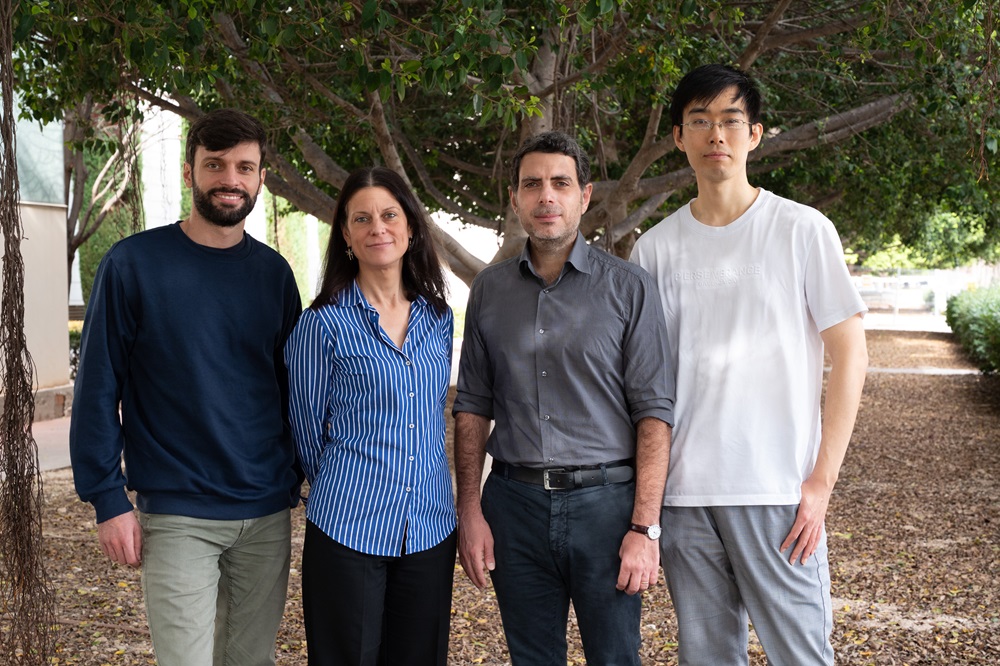
Photo: IN CSIC-UMH researchers Giovani Usseglio, Teresa Femenía, Andreas Kardamakis and Kuisong Song. Source IN CSIC-UMH.

The brain does not need its sophisticated cortex to interpret the visual world. A new study published in PLOS Biology demonstrates that a much older structure, the superior colliculus, contains the necessary circuitry to perform the fundamental computations that allow us to distinguish objects from the background and detect which stimuli are relevant in space. This work reveals that these ancestral circuits, present in the brains of all vertebrates, can generate center–surround interactions on their own: a key visual principle that enables the brain to detect contrasts, edges, and salient features in the environment.

“Recurrent circuits encode de novo visual center-surround computations in the mouse superior colliculus” Cui P, Song K, Mariatos-Metaxas D, Isla AG, Femenia T, Lazaridis I,  Meletis K,  Kumar A and Kardamakis AA. PLOS Biology 2025 23(10): e3003414.

DOI https://doi.org/10.1371/journal.pbio.3003414

“For decades it was thought that these computations were exclusive to the visual cortex, but we have shown that the superior colliculus, a much older structure in evolutionary terms, can also perform them autonomously,” explains Andreas Kardamakis, head of the Neural Circuits in Vision for Action laboratory at the Institute for Neurosciences (IN), a joint centre of the Spanish National Research Council (CSIC) and the Miguel Hernández University (UMH) of Elche, and principal investigator of the study. “This means that the ability to analyse what we see and decide what deserves our attention is not a recent invention of the human brain, but a mechanism that appeared more than half a billion years ago.”

A “radar” in the brain that prioritises what matters

The superior colliculus acts as a kind of biological radar: it receives direct input from the retina and, before information reaches the cerebral cortex, decides which stimuli in the environment are most relevant. When something moves, shines, or suddenly appears in the visual field, this structure is the first to respond and to direct the gaze towards that point.

The study combines several cutting-edge experimental techniques, including patterned optogenetics, electrophysiology, and computational modelling, to investigate how neurons are organised and communicate within the superior colliculus. By using light to activate specific retinal projections in the colliculus and record responses in mouse brain slices, the team observed that the superior colliculus can generate a suppression of the central stimulus when the surrounding area is activated, a hallmark pattern of centre–surround interactions and a mechanism backed by cell-type-specific transynaptic mapping and large-scale modelling.
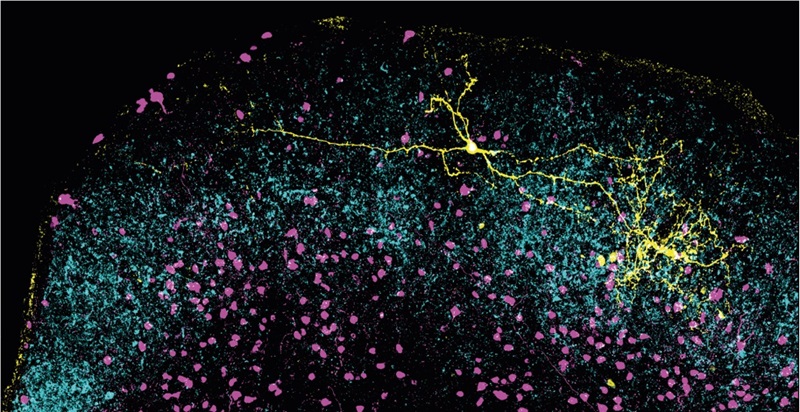
An inhibitory neuron (yellow) extends across the superior colliculus, forming a complex network that may help suppress surrounding visual signals. Retinal ganglion cell terminals are shown in cyan, and other inhibitory neurons are labeled in magenta. Confocal image by Peng Cui. Source: PLOS Biology

“We have seen that the superior colliculus not only transmits visual information but also processes and filters it actively, reducing the response to uniform stimuli and enhancing contrasts,” says Kuisong Song, co-first author of the paper. “This demonstrates that the ability to select or prioritise visual information is embedded in the oldest subcortical circuits of the brain.” The results suggest that the function of highlighting what captures our attention does not depend solely on higher cortical areas but is deeply rooted in mechanisms common to all vertebrates.

Evolutionary and cognitive implications

These findings challenge the classical view that complex visual operations are the exclusive domain of the cortex. Instead, they point to a more distributed, hierarchical organisation of the brain, where ancient structures not only relay information but also carry out essential computations for survival: detecting predators, tracking prey, or avoiding obstacles.

“Understanding how these ancestral structures contribute to visual attention also helps us understand what happens when these mechanisms fail,” Kardamakis notes. “Disorders such as attention deficit, sensory hypersensitivity, or some forms of traumatic brain injury may partly originate from imbalances between cortical communication and these fundamental circuits”.

His team is now extending these findings to in vivo models to investigate how the superior colliculus shapes visual attention and regulates distractions during goal-directed behavior. Understanding how visual distractors are transformed into behavioral responses is essential for revealing underlying pathophysiological mechanisms, particularly in an era increasingly driven by visual technology.

This study is the result of a broad international collaboration involving the Karolinska Institutet, the KTH Royal Institute of Technology (both in Sweden), and the Massachusetts Institute of Technology (MIT, USA). It also includes the participation of Teresa Femenía, researcher at the IN CSIC-UMH, who made a key contribution to the experimental development of the study.

A shared evolutionary framework for visual attention

In line with this work, Andreas Kardamakis and Giovanni Usseglio have recently published a chapter in the new volume of the Evolution of Nervous Systems series (edited by JH Kass; now appearing in Elsevier, 2025), expanding the comparative and evolutionary perspective of these subcortical visual circuits. In this chapter, the authors review how structures homologous to the superior colliculus, found in fish, amphibians, reptiles, birds, and mammals, share a common functional principle: the integration of sensory and motor information to orient attention and gaze.

The chapter highlights that this brain architecture, preserved for more than 500 million years of evolution, forms the common foundation upon which the cortex later developed higher cognitive functions. “Evolution did not replace these ancient systems; it built upon them,” says Kardamakis, and adds: “We still rely on the same basic hardware to decide where to look and what to ignore.”

This research was supported by Spain’s State Research Agency – Spanish Ministry of Science, Innovation and Universities, the Severo Ochoa Programme for Centres of Excellence, the Generalitat Valenciana through the CIDEGENT programme, the Swedish Research Council, the Swedish Brain Foundation, and the Olle Engkvist Foundation.

Source: Institute for Neurociencias CSIC-UMH (in.comunicacion@umh.es)

Chapter:

Usseglio, G. and Kardamakis, A.A. (2025). Evolution of visuomotor neural circuits. In Kass, J.H. (Ed.), Evolution of Nervous Systems – Reference Module in Neuroscience and Biobehavioral Psychology. Elsevier. DOI: https://doi.org/10.1016/B978-0-443-27380-3.00048-8

La entrada Study reveals that the basic mechanisms of visual attention emerged over 500 million years ago se publicó primero en Instituto de Neurociencias de Alicante.

Go to Source

ICTA-UAB researchers receive the PhD Extraordinary Award

Eleven researchers of the PhD programme in Environmental Science and Technology coordinated by ICTA-UAB will receive the PhD Extraordinary Award for their doctoral thesis developed during 2022-2024. The award ceremony was held on Friday, November 7th at 18h.

Go to Source

Javier Menéndez appointed corresponding member of the Royal Spanish Academy of Sciences

Image
Javier Menéndez, ICCUB
English

The Royal Spanish Academy of Sciences (RAC) has announced the election of two new members during its latest plenary session. Elena Vázquez Cendón joins as a full member of the Mathematics Section, while Javier Menéndez Sánchez has been appointed as a corresponding member of the Physics and Chemistry Section.


Javier Menéndez is a nuclear theorist and research professor at the Institute of Cosmos Sciences of the University of Barcelona (ICCUB), where he is part of the Hadronic, Nuclear and Atomic Physics group. 


Menéndez’s research focuses on nuclear theory at low energies, aiming to understand the structure of atomic nuclei from first principles. His work involves solving complex quantum many-body problems rooted in quantum chromodynamics (QCD), the fundamental theory of strong interactions. A central theme of his research is the study of exotic nuclei and their role in answering some of the most profound questions in physics.
Recently, Menéndez has expanded his research to explore quantum computing as a tool for solving the quantum many-body problem, opening new avenues for simulating nuclear systems with unprecedented precision.


The RAC’s recognition of Javier Menéndez as a corresponding member highlights his contributions to nuclear physics and his leadership in bridging theoretical models with experimental efforts worldwide. It also reflects the excellence of ICCUB researchers in advancing fundamental science and tackling the big questions about the nature of the universe.


The ICCUB warmly congratulates Javier Menéndez on this prestigious appointment.

News Type
Date
SEO Title
Javier Menéndez appointed corresponding member of the Royal Spanish Academy of Sciences

Go to Source

An international team led by the UB will study the validity of the current cosmological model

Image
 The Hubble constant describes the rate at which the universe is expanding. However, current measurements do not agree on its value, which has generated an intense scientific debate known as the “Hubble tension.”
Credits
The Hubble constant describes the rate at which the universe is expanding. However, current measurements do not agree on its value, which has generated an intense scientific debate known as the “Hubble tension.” Shutterstock
English

An international team led by researchers from the Institute of Cosmos Sciences of the University of Barcelona (ICCUB) has received a Synergy Grant from the European Research Council to resolve the Hubble tension, one of the major challenges in modern cosmology and a source of disagreement when measuring the expansion rate of the universe. The project, called RedH0T, will receive more than €12 million in funding (around €6 million allocated to the UB).

Licia Verde, ICREA researcher and Scientific Director of ICCUB, is the coordinator of RedH0T. This project’s principal investigators also include Frédéric Courbin, ICREA researcher at ICCUB and the Institute of Space Studies of Catalonia (IEEC); Julien Lesgourques, from Aachen University (Germany) and Adam Riess, from Johns Hopkins University (United States), winner of the 2011 Nobel Prize in Physics for demonstrating that the expansion of the universe is accelerating.

“RedH0T aims to address one of the challenges that cosmology has faced for years: Is the significant discrepancy between measurements of the Hubble constant (H) caused by observational errors or limitations of the current cosmological model? If the latter is true, we would be facing one of the most significant discoveries of the 21st century, with profound implications for fundamental physics,” says Licia Verde.

The researcher adds: “RedH0T is expected to improve on all current measures of H with cross-checks and internal consistency, thereby producing robust results that can guide cosmologists in revising the current paradigm.”

The project also stands out for its innovative approach, which is pioneering in cosmology. RedH0T introduces the red-teaming method, inspired by cybersecurity. “In the field of cybersecurity, ethical hackers conduct simulated, non-destructive cyberattacks to test the effectiveness of systems. In our case, we want each methodology for measuring the Hubble constant to be analysed by three different teams, which allows each method to be validated or questioned with maximum transparency and rigour, promoting scientific consensus,” says Fred Courbin.

This collaborative work will be carried out by a blue team, made up of experts who will develop the methodology; a red team, composed of specialists who will challenge assumptions and look for vulnerabilities; and a white team, with neutral figures who will oversee the process.

International institutions in pursuit of an ambitious goal

In addition to the University of Barcelona (project coordinator), Aachen University and Johns Hopkins University, the Alma Mater Studiorum – University of Bologna, The Chancellor Masters and Scholars of the University of Oxford and the University of Chicago are also participating in the project. The team from the UB’s Institute of Cosmos Sciences is completed by Raúl Jiménez-Tellado (ICREA-ICCUB) and Héctor Gil-Marín (ICCUB-IEEC).
 

Membres ICCUB del projecte RedH0T
ICCUB members of the RedH0T Project. From right to left: Héctor Gil-Marín (ICCUB-IEEC), Licia Verde (ICREA-ICCUB), Frédéric Courbin (ICREA-ICCUB-IEEC), Raúl Jiménez (ICREA-ICCUB). Crèdits: Xènia Fuentes (UB).


RedH0T and the current cosmological model

Despite the remarkable success of the standard cosmological model over the last two decades, recent observations and distance measurements using a wide range of cosmological instruments suggest cracks in this scientifically accepted paradigm. Differences have appeared in the measurements of quantities (tensions) that the current cosmological model predicts to be equal. The most prominent tension concerns the Hubble parameter, which quantifies the expansion of the universe approximately 13 billion years after the Big Bang.

The goal of solving this cosmological challenge has been recognized with a Synergy Grant, a grant from the European Research Council that supports teams of two to four researchers to tackle research projects that require deep collaboration across different disciplines. In this call, 66 research groups have been recognized and will receive €684 million in funding.

News Type
Date
SEO Title
An international team led by the UB will study the validity of the current cosmological model

Go to Source

El CIMCYC participará en el evento “Bienestar digital y menores” en el Parque de las Ciencias

Bienestar digital y menores
El Centro de Investigación Mente, Cerebro y Comportamiento (CIMCYC) estará presente en un debate fundamental sobre uno de los mayores retos sociales actuales: la relación entre el uso de las nuevas tecnologías e Internet y la salud mental infantil y juvenil.
Seguir leyendo

Go to Source

The CIMCYC will participate in the event “Digital Wellbeing and Minors” at the Science Park

Bienestar digital y menores
The Mind Brain and Behavior Research Center (CIMCYC) will participate in a fundamental debate concerning one of today’s major social challenges: the relationship between the use of new technologies and the Internet and the mental health of children and adolescents.
Seguir leyendo

Go to Source

CIMCYC Sessions: Dimensiones universales de la representación visual

cartel de la cimcyc sessions 13 11
El Centro de Investigación Mente, Cerebro y Comportamiento (CIMCYC) anuncia la vuelta de su ciclo CIMCYC Sessions para el curso académico 2025/2026. La primera sesión de la temporada de “IA, Mente y Cerebro” tendrá lugar el próximo jueves 13 de noviembre de 2025.
Seguir leyendo

Go to Source

CIMCYC Sessions: Universal Dimensions of Visual Representation

cartel de la cimcyc sessions 13 11
El Centro de Investigación Mente, Cerebro y Comportamiento (CIMCYC) anuncia la vuelta de su ciclo CIMCYC Sessions para el curso académico 2025/2026. La primera sesión de la temporada de “IA, Mente y Cerebro” tendrá lugar el próximo jueves 13 de noviembre de 2025.
Seguir leyendo

Go to Source

Identified a new key protein that controls flowering time in plants

The CBGP research group of ‘Molecular basis of plant developmental phase transition’ has unveiled a new chromatin factor called ‘INHIBITOR OF GROWTH 2 (ING2)’. The work, published in Plant Physiology, clarifies the role this protein plays in the transcriptional modulation of master genes that act as floral switches in Arabidopsis.

Go to Source

A new ERC Synergy Grant to explore the emerging field of magneto-electrocatalysis

The awarded project, entitled ‘Magnetically enhanced electrocatalysis’ – MAGNESIS, will join the efforts of Prof. J. R. Galán-Mascarós (ICIQ), Prof. Karsten Reuter (Fritz Haber Institute of the Max Planck Society, Germany), Prof. Jeppe V. Lauritsen (Aarhus University, Denmark) and Prof. David Écija (IMDEA Nanociencia, Spain). With a total budget of €12 million and a duration of six years, the project aims to understand the fundamental principles behind the synergy between magnetic fields and electrocatalytic performance, from atomic-scale model systems to full-cell devices.

In recent years, electrochemistry and electrocatalysis have become central to the transition toward sustainable industrial processes, offering the potential to replace fossil-fuel-based methods with cleaner, electricity-driven alternatives. However, these technologies still face significant performance challenges. The recent discovery that magnetic fields can enhance electrocatalytic reactions has opened a new research frontier.

“This project gives us an opportunity to define the first theoretical and experimental framework for controlling electrochemical reactions with magnetic fields, a breakthrough that could transform the way sustainable fuels and chemicals are produced in the future” says Prof. Galán-Mascarós, ICREA Research Professor and Senior Group Leader at ICIQ, coordinator of the project.

MAGNESIS aims to provide a scientific foundation for this promising approach by combining expertise in catalysis, surface science, magnetism, and theory. The project will focus on two key reactions: water oxidation and carbon dioxide reduction, both of may be sensitive to spin effects. Through the use of advanced experimental and computational tools, the team will identify the structural, electronic, and magnetic descriptors that govern these processes, thereby establishing the fundamental principles of magneto-electrochemical science and technology.

The power of surface science will allow us to probe the mechanisms of magnetoelectrocatalysis at the ultimate spatial scale,” states Prof. David Écija from IMDEA Nanociencia.

The overarching goal of the project is to validate this new phenomenon through the development of more efficient electrochemical devices that can have an impact in the energy transition, through the production of renewable fuels and chemicals.

“We aim to uncover how magnetic fields shape the chemical reactions that drive clean energy, by extending our computer models to include magnetism, we hope to unlock new ways to make electrocatalysis more efficient, enabling renewable-energy-driven chemical production, advancing materials research, and controlling reactions at the molecular level,” declares Prof. Karsten Reuter from Fritz Haber Institute of the Max Planck Society.

ICIQ’s role

MAGNESIS is the first ERC Synergy Grant of ICIQ. There, we will coordinate the electrochemical tools and operando methodologies to bring the gap between magnetic field effects on electrocatalytic surfaces at the atomic scale with the macroscopic magnetically-enhanced performance in electrochemical device.  The aim is to understand the major parameters (structural, electronic, and magnetic) which may improve the activity and selectivity of electrocatalysts, using as model reactions water oxidation and carbon dioxide reduction, paving the way for more efficient electrochemical processes powered by renewable energy.

Prof. Galán-Mascarós leads a research group devoted to the development of materials and processes for the production of renewable and sustainable fuels and chemicals. His team’s multidisciplinary expertise in both magnetism and electrocatalysis will be crucial to translate the project’s fundamental discoveries into practical electrocatalytic devices.

ERC Synergy Grants

As its name suggests, ERC Synergy Grants are built on the principle of collaboration, supporting ambitious initiatives that can only be achieved through the combined efforts of several leading research teams to push the boundaries of scientific discovery.

“The ERC synergy is a perfect match for the topic since it requires collaboration among many types of expertise, and it will be very exciting to be working with world-leading expects in surface science, computational modeling, magnetism and electrocatalysis” concludes Prof. Jeppe V. Lauritsen from Aarhus University.

In total, 712 proposals were submitted to this call. Only about one in ten proposals were selected for funding, with the successful projects receiving on average €10.3 million each. The selected projects will be carried out at universities and research centres in 26 countries across Europe and beyond.

La entrada A new ERC Synergy Grant to explore the emerging field of magneto-electrocatalysis se publicó primero en ICIQ.

Go to Source

The 50th anniversary of the Institute of Astrophysics of Andalusia, protagonist of a tenth of the National Lottery

The Council of Ministers has approved the Royal Decree that will regulate the Commission in charge of coordinating actions during the solar eclipses of August 12, 2026, August 2, 2027 and January 26, 2028. The so-called ‘Iberian trio’ of eclipses, visible almost exclusively from Spain, represents a logistical and security challenge, as well as an opportunity for research and scientific dissemination.

Go to Source

El CNIO lidera un proyecto europeo de 10 millones de euros para descifrar cómo la grasa controla la salud de nuestro cuerpo

Guadalupe Sabio / Laura M. Lombardía. CNIO

La quinta parte de la población española tiene obesidad, una enfermedad que eleva el riesgo de cáncer, enfermedades cardiovasculares o diabetes. Hasta hace poco se ha asumido que ese riesgo deriva del peso de su grasa, “pero eso no es así” afirma Guadalupe Sabio, jefa del Grupo de Interacciones Metabólicas del Centro Nacional de Investigaciones Oncológicas (CNIO). “Lo que importa no es la cantidad de grasa sino su calidad y su buen funcionamiento. La grasa es un órgano cuyas células cumplen una función, y el riesgo aparece cuando no la realizan de manera adecuada. Sin embargo, aún no sabemos cómo se comporta la grasa y cómo influye eso en otros órganos y tejidos”.

Para avanzar en ese estudio, el Consejo Europeo de Investigación (ERC, por sus siglas en inglés) acaba de conceder una ayuda ERC Synergy de 10 millones de euros al proyecto ‘Descifrando el papel del tejido adiposo en la salud y la enfermedad cardíacas: ADIPOhealth’. Se trata de una colaboración internacional de seis años de duración, coordinada por Sabio. Al grupo del CNIO le corresponden unos 3 millones de euros para descifrar cómo la grasa se comunica con el resto de nuestro organismo.

Es una convocatoria muy competitiva. De los 712 proyectos presentados, solo 66 han recibido financiación; serán desarrollados por grupos de investigación en 26 países europeos y también Estados Unidos, informa el ERC.

El tejido adiposo realiza una función clave para mantener nuestra salud

El tejido adiposo —la grasa corporal— es un órgano endocrino: sus células secretan moléculas que viajan por la sangre y regulan el metabolismo de otros órganos. Cuando la grasa funciona bien, esas señales son beneficiosas; cuando se vuelve disfuncional, pueden desencadenar enfermedades.

El proyecto investiga la influencia del tejido adiposo en el corazón, pero los resultados ampliarán el conocimiento de la función de la grasa en el organismo en general, y su papel en enfermedades como el cáncer.

La población con sobrepeso y obesidad es muy heterogénea. Entender en qué es disfuncional la grasa de cada persona indicará la probabilidad de sufrir las enfermedades asociadas, por ejemplo, quién es más susceptible de tener un infarto o de desarrollar cáncer. “Esto es importante también para los médicos, que ahora no tienen herramientas para diagnosticar la enfermedad del tejido adiposo y, en consecuencia, saber los riesgos reales a los que se enfrenta ese paciente”, afirma la investigadora.

Si la obesidad aumenta el riesgo de fallo cardíaco, también pueden hacerlo los tratamientos antitumorales. De hecho, un 60% de los casos de abandono de tratamientos de cáncer se deben a problemas cardíacos. Comprender cómo las células de grasa controlan el corazón permitiría adaptar los tratamientos antitumorales en las personas con sobrepeso y obesidad.

El primer objetivo del proyecto ADIPOhealth es identificar cambios que se producen en la grasa disfuncional y cómo estos cambios son capaces de alterar la comunicación de las células de grasa, o adipocitos, con el corazón. Para ello buscarán biomarcadores: sustancias que secreta el adipocito cuando es disfuncional. Como estas sustancias van por la sangre, podrán ser utilizadas como dianas terapéuticas y tratamientos muy accesible.

Personas delgadas con grasa disfuncional

Los biomarcadores permitirán detectar qué grasa está sana y qué grasa no, para así diferenciar cuáles de las personas con sobrepeso u obesidad tienen mayor riesgo cardiovascular, “porque sus adipocitos funcionan mal, y cuáles mantienen bajo ese riesgo, porque sus adipocitos funcionan bien”, explica Sabio.

“También hay personas delgadas con adipocitos disfuncionales sin saberlo”, declara la especialista en metabolismo, y añade: “si tu adipocito no es capaz de almacenar grasa, esa grasa se va al hígado. Eres una persona delgada, pero con mayor riesgo de tener hígado graso y, por tanto, cáncer hepático”.

 
Para determinar los biomarcadores que indiquen cuál es el riesgo real de cada persona, el equipo de Sabio en el CNIO estudiará en modelos animales y muestras humanas por qué y en qué medida es disfuncional el adipocito, y qué sustancias secreta cuando no funciona bien. El grupo de Jesper Olsen, de la Universidad de Copenhague (Dinamarca), aportará el análisis de proteínas de las diferentes muestras.

Objetivo último: fármacos en nanocápsulas

Dale Abel, de la Universidad de California en Los Angeles (EE. UU.), comprobará junto a Sabio cuáles de esas sustancias detectadas por sus colegas afectan a las células del corazón, cuáles a otros tejidos y cuáles sirven como biomarcadores. “En el tejido adiposo no tenemos ningún marcador que nos diga: tu tejido adiposo está mal”, afirma Sabio.

Los biomarcadores seleccionados se contrastarán en muestras humanas. Los resultados definirán las moléculas clave sobre las que actuar para evitar los efectos perniciosos del mal funcionamiento de los adipocitos.

En una última fase, el grupo de Sabio intentará desarrollar un fármaco dirigido a esas moléculas diana, y después Mauro Giacca, del King’s College de Londres (Reino Unido), diseñará nanopartículas que puedan administrarse y llegar directamente hasta el corazón.

Sobre las ayudas ERC-Synergy

Las ayudas ERC-Synergy –o Synergy Grants –financian a entre dos y cuatro grupos de diferentes disciplinas y países, para que, juntos y aportando diferentes habilidades y recursos, aborden problemas ambiciosos que no podrían ser afrontados individualmente. Esta financiación forma parte del Programa de Investigación e Innovación de la Unión Europea Horizonte Europa.

Sobre el Centro Nacional de Investigaciones Oncológicas (CNIO)

El Centro Nacional de Investigaciones Oncológicas (CNIO) es un centro público de investigación dependiente del Ministerio de Ciencia, Innovación y Universidades. Es el mayor centro de investigación en cáncer en España y uno de los más importantes en Europa. Integra a medio millar de científicos y científicas, más el personal de apoyo, que trabajan para mejorar la prevención, el diagnóstico y el tratamiento del cáncer.

Sobre el Consejo Europeo de Investigación (ERC)

El ERC, creado por la Unión Europea en 2007, es la principal organización europea de financiación de la investigación de excelencia. Ofrece cuatro programas de ayudas: Starting Grants, Consolidator Grants, Advanced Grants y Synergy Grants. Un programa adicional Proof of Concept ayuda a los beneficiarios a salvar la brecha entre una investigación pionera y las primeras fases de su comercialización.

La entrada El CNIO lidera un proyecto europeo de 10 millones de euros para descifrar cómo la grasa controla la salud de nuestro cuerpo se publicó primero en CNIO.

Go to Source

Sidebar